AI can generate code in seconds. But can it help an enterprise modernise thousands of applications, accelerate testing, migrate complex integrations and deliver measurable business outcomes, without compromising quality, security or governance?
That is the real challenge facing technology leaders today.
Many organisations have introduced coding assistants, copilots and generative AI tools. Individual tasks may be completed faster, yet software delivery cycles remain slow, technical debt continues to grow and promising pilots struggle to reach production.
The problem is not a lack of AI tools. It is the absence of a connected delivery model that brings people, AI agents, reusable assets, governance and enterprise engineering together.
Prolifics is addressing this challenge through two closely connected ideas: the 10x engineering team and the AI Software Factory.
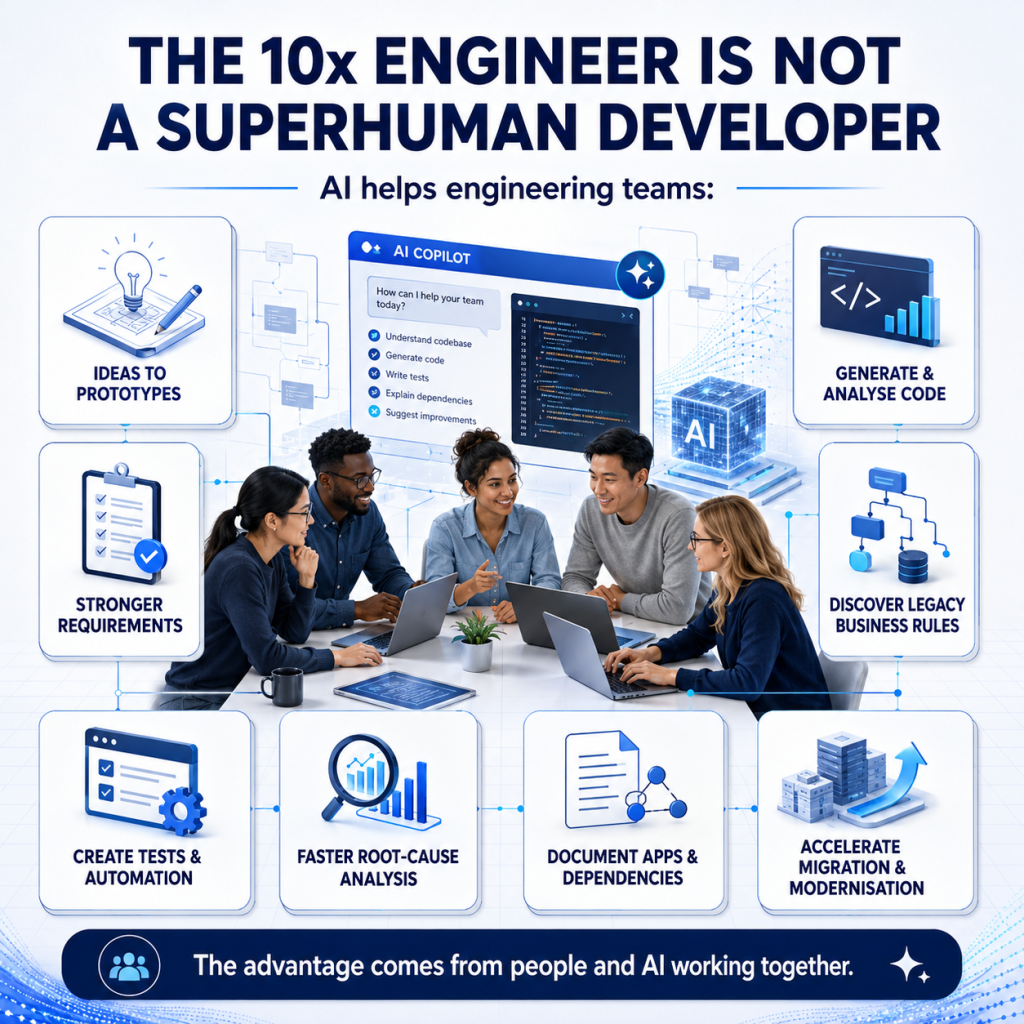
The 10x Engineer Is Not a Superhuman Developer
The term “10x engineer” is often misunderstood. It does not mean one developer should replace ten people or that AI should produce software without human supervision.
At Prolifics, the 10x engineer represents an AI-enabled professional who can achieve significantly more because intelligent tools support the entire engineering lifecycle.
AI can help teams:
Transform early ideas into working prototypes
Enrich requirements and identify missing acceptance criteria
Generate and analyse code
Discover business rules in legacy applications
Create test scenarios, test data and automation assets
Analyse defects and recommend likely root causes
Document applications and technical dependencies
Accelerate migration and modernisation activities
Engineers continue to own architecture, quality, security and delivery decisions. AI handles repeatable analysis and generation, while people provide context, judgement and accountability.
This combination creates more than personal productivity. It changes the speed at which an entire team can move from concept to production.
From AI-Assisted Coding to AI-Enabled Engineering
Prolifics has been applying this model within its own engineering environment.
During its June 2026 Innovation Spotlight, Prolifics demonstrated how a nine-person team built 22 production applications in two months. The estimated equivalent effort using traditional delivery methods was 13.5 person-years, compressed into eight weeks, with just $660 spent on AI tooling.
The reported return on that tooling investment was 225x.
The improvement did not come from generating more code without control. The team changed the delivery process itself.
Instead of spending weeks creating detailed specification documents, engineers used AI to develop working prototypes within days. Stakeholders could interact with something tangible, provide feedback and confirm the design before full production development began.
For every solution, the team also created a test harness covering navigation, calculations, user-interface behaviour and reconciliation rules. As the software evolved, every change was checked against those controls.
AI accelerated creation. Engineers verified, approved and owned the result.
This is the foundation of a 10x engineering team: faster learning, earlier feedback and greater delivery capacity, supported by structured quality controls.
The AI Software Factory: Turning Speed into Scale
Improving an individual engineer’s productivity is valuable. Creating a repeatable way to deliver that productivity across teams, applications and transformation programmes is far more powerful.
The Prolifics AI Software Factory brings together specialist AI agents, reusable accelerators, delivery frameworks, enterprise guardrails and experienced engineers.
Rather than treating every project as a new experiment, the factory applies repeatable patterns to areas such as:
Application and legacy modernisation
Integration and API migration
Data-platform transformation
AI-enabled software testing
Business-rule and policy discovery
Requirements and documentation generation
Enterprise AI readiness and governance
A specialist agent might catalogue an application estate, analyse dependencies, generate a target-platform artefact or produce a test case. Human experts then manage complex exceptions, architecture decisions, validation and approval.
Resolved edge cases can be incorporated back into the factory, enabling the model to improve from one sprint or migration wave to the next.
What an AI Software Factory Can Deliver
The impact becomes particularly clear in complex migration programmes.
For a global logistics provider moving integrations from BizTalk and Seeburger to MuleSoft, Prolifics developed an AI-powered migration factory. The solution catalogued existing integrations and generated target-ready artefacts, while experienced engineers reviewed complex cases and quality.
A process that previously completed approximately one customer migration every one to two weeks progressed to 20 customer migrations in one day.
For a Fortune 500 healthcare distributor migrating hundreds of undocumented MuleSoft integrations to IBM webMethods, an AI-assisted factory automated approximately 70% of the migration process, covering assessment, code generation, deployment and validation.
For a membership-based wholesale retailer, Prolifics modernised more than 2,600 complex Talend ETL jobs into optimised PySpark scripts. The approach delivered migration speeds of up to 75% faster, while maintaining consistent outputs and avoiding operational disruption.
These examples demonstrate an important shift: AI is no longer limited to helping someone write code faster. It can help industrialise large-scale transformation.
Quality Must Accelerate with Engineering
Generating software more quickly creates a corresponding need for faster, more intelligent assurance.
Prolifics applies AI throughout the software testing lifecycle—from analysing requirements and identifying coverage risks to generating test scenarios, creating privacy-safe synthetic data, prioritising regression tests and supporting defect analysis.
Its AI Quality Engineering Factory is designed to help organisations scale these capabilities across applications and programmes while maintaining human oversight, traceability and enterprise controls.
The principle is simple: AI can recommend, generate and execute, but people remain accountable for quality strategy and release decisions.
Governance Cannot Be Added at the End
An AI Software Factory depends on trusted data, secure platforms and a clear operating model. Without these foundations, organisations risk creating disconnected tools, duplicated effort, uncontrolled cloud spending and shadow AI.
Prolifics helps enterprises establish that foundation through readiness assessments and its Data & AI Centre of Excellence approach. This includes governance guardrails, use-case scoring, platform direction, role definitions, reusable assets and lifecycle processes.
The objective is not to slow innovation. It is to give successful ideas a secure route from pilot to production.
Meet Prolifics at Ai4 2026
The next stage of enterprise AI will not be defined by who launches the most experiments. It will be defined by who can turn AI into a repeatable, governed and measurable delivery capability.
At Ai4 2026, Prolifics will demonstrate how 10x engineering teams, intelligent agents and AI Software Factories can help enterprises modernise technology, strengthen quality and move from isolated pilots to production-scale impact.
Snowflake helped Whatnot transform rapidly growing marketplace data into accessible, trusted business insights. By combining scalable data infrastructure, decentralized ownership, conversational analytics, and intelligent monitoring, Whatnot enabled employees to make faster decisions without placing every data request on a centralized technical team.
Whatnot used Snowflake to build a scalable data foundation that supports rapid business growth, real-time customer experiences, and company-wide analytics. The organization expanded access to trusted data while maintaining visibility into platform performance, governance, and cost.
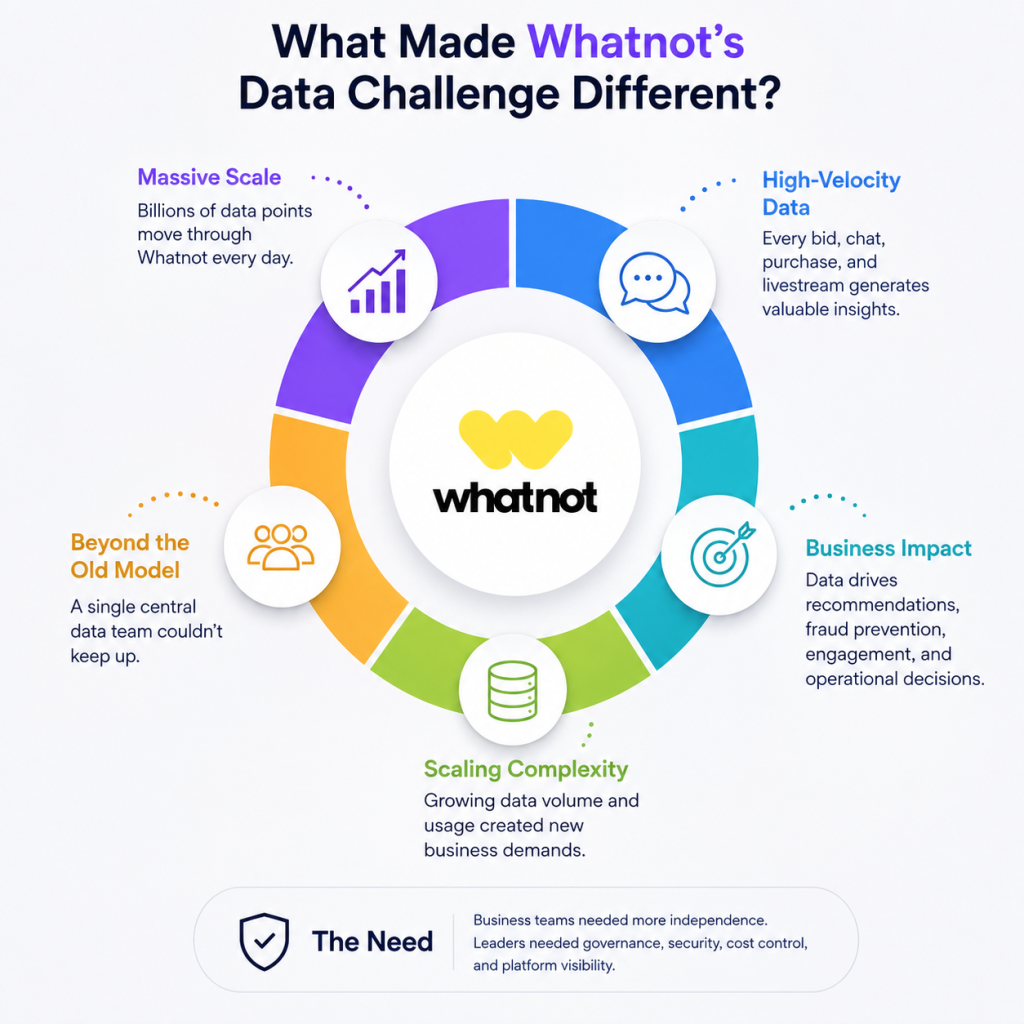
What Made Whatnot’s Data Challenge Different?
Whatnot is a live shopping marketplace that connects buyers and sellers through livestreamed auctions and interactive shopping experiences.
Every auction bid, purchase, chat message, livestream, and customer interaction produces valuable information. That data supports more than historical reporting. It influences recommendations, seller performance, fraud prevention, customer engagement, and operational decisions.
As Whatnot expanded, the volume and complexity of its data grew. Snowflake reported that billions of data points now move through Whatnot’s environment every day. This created a business need for data that could remain accessible, reliable, and actionable even as usage increased.
A traditional model in which one central data team handles every request would not scale effectively. Business teams needed greater independence, while technology leaders still needed governance, cost control, security, and platform visibility.
How Did Snowflake Support Whatnot’s Growth?
Whatnot initially managed data through a centralized team. As the company grew, this structure created bottlenecks and increased the time required to answer business questions.
The company responded by adopting a more modular operating model. Individual teams received the ability to manage dedicated Snowflake warehouses and data pipelines based on their specific business requirements.
This decentralized approach helped business units move faster. Teams could explore information, develop use cases, and respond to changing priorities without waiting for every request to pass through one central queue.
However, decentralization also introduced new responsibilities. More users, workloads, warehouses, and pipelines meant that Whatnot needed stronger visibility across its data environment.
The company therefore balanced team independence with shared controls for:
Data access and security.
Platform performance.
Usage and cost management.
Data ownership.
Monitoring and incident response.
Consistent business definitions.
The broader lesson is that scalable infrastructure alone is not enough. Organizations must combine technology with an operating model that establishes clear accountability for how data is created, governed, and used.
How Did Conversational Analytics Expand Data Access?
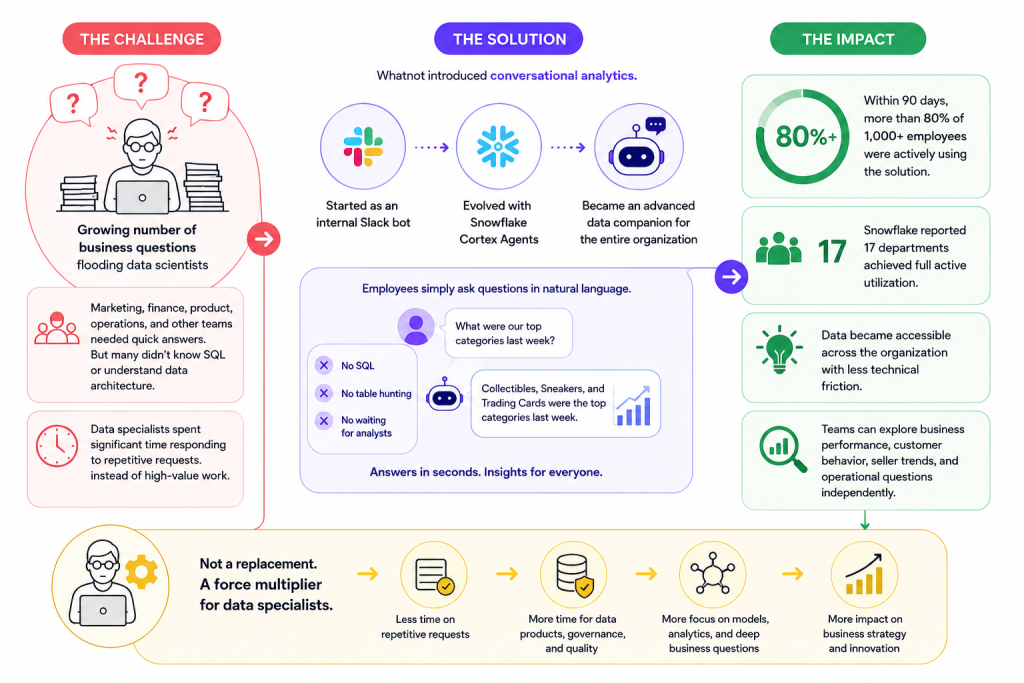
One of Whatnot’s biggest challenges was the growing number of business questions directed to data scientists.
Marketing, finance, product, operations, and other departments needed quick answers, but many employees did not know SQL or understand the underlying data architecture. Data specialists consequently spent significant time responding to individual requests.
Whatnot addressed this challenge by introducing conversational analytics.
Its approach evolved from an internal Slack bot into a more advanced data companion powered by Snowflake Cortex Agents. Employees could ask business questions using natural language rather than locating tables, writing queries, or waiting for an analyst.
Within 90 days of launching the agentic analytics solution, more than 80% of Whatnot’s 1,000-plus employees were actively using it. Snowflake also reported that 17 departments achieved full active utilization.
This shift made data more accessible across the organization. Teams could investigate business performance, customer behavior, seller trends, and operational questions with less technical friction.
Conversational analytics did not eliminate the need for data specialists. Instead, it allowed those specialists to spend less time handling repetitive requests and more time improving data products, governance, models, and strategic analysis.
Why Is Governance Essential for AI-Powered Analytics?
Making data easier to access does not automatically make every answer reliable.
As conversational analytics expands, unclear definitions, incomplete models, inconsistent ownership, and weak access controls can become more visible. An AI assistant can retrieve information quickly, but the quality of its response still depends on the data, context, and governance behind it.
Whatnot introduced guidance designed to help its AI systems communicate findings responsibly. Its agents separate factual observations from business interpretations, avoid claiming causation based only on correlation, and use appropriately cautious language where the available evidence is not conclusive.
This is an important consideration for any enterprise implementing AI-powered analytics.
A trusted conversational analytics environment requires:
Governed and well-understood data.
Consistent business definitions.
Role-based access controls.
Clear data ownership.
Transparent analytical reasoning.
Responsible AI guidance.
Continuous quality monitoring.
Snowflake has similarly emphasized that trusted enterprise AI requires connected and governed infrastructure, security designed for autonomous systems, and performance that can support high-volume AI workloads.
How Did Whatnot Improve Platform Visibility?
Expanding access to data also increased the number of workloads operating across Whatnot’s Snowflake environment.
Without sufficient visibility, decentralized environments can create unexpected costs, performance issues, delayed pipelines, and operational risk. Technology teams therefore need to understand how warehouses, queries, pipelines, and users affect the wider platform.
Whatnot worked with Snowflake to improve the speed and accessibility of platform monitoring. Snowflake Trail and its event-table capabilities helped make telemetry available more quickly, while AI-assisted workflows simplified the creation of alerts for performance anomalies and cost changes.
This represents a broader shift in data operations.
Monitoring should not be limited to confirming whether a technical job completed. Organizations need visibility into whether data remains current, whether workloads are performing efficiently, whether costs are changing unexpectedly, and which business processes could be affected by an incident.
When monitoring is connected to business context, teams can respond more effectively and prioritize issues based on their actual operational impact.
What Can Enterprises Learn from Whatnot?
Whatnot’s experience provides several useful lessons for organizations building modern data and AI environments.
Build for business decisions
Data platforms should be designed around the decisions they need to support. Collecting more information provides limited value unless employees can use it to improve customer experiences, operations, revenue, or risk management.
Balance decentralization with governance
Giving teams greater control can accelerate innovation, but independence must operate within clear security, quality, ownership, and cost-management standards.
Make trusted data easier to access
Self-service analytics reduces dependence on centralized data teams. Conversational interfaces can extend that access further by allowing employees to ask questions using familiar business language.
Establish shared business meaning
AI assistants and analytics tools require consistent definitions. Terms such as active customer, revenue, seller performance, and conversion must have a shared meaning across departments.
Treat observability as a business capability
Monitoring should connect technical events to customer, financial, and operational outcomes. This allows teams to focus on the issues that matter most to the organization.
Prepare data before scaling AI
Enterprise AI depends on trusted, governed, and accessible information. Organizations that strengthen their data foundations are better positioned to move AI initiatives from experimentation into production.
How Can Prolifics Help Organizations Modernize with Snowflake?
The Whatnot story demonstrates what becomes possible when scalable data infrastructure is combined with governance, accessibility, and intelligent operations.
Prolifics helps organizations design, migrate, modernize, and manage Snowflake environments that support analytics and enterprise AI. The focus is not simply moving data into a cloud platform. It is creating a trusted foundation that connects data investments to measurable business outcomes.
Our Snowflake capabilities can help organizations:
Assess current data environments and modernization priorities.
Migrate legacy data platforms and workloads.
Build scalable data engineering pipelines.
Establish governance and security controls.
Enable governed self-service analytics.
Improve data quality and platform observability.
Prepare enterprise data for AI and machine learning.
Optimize Snowflake performance and operating costs.
Prolifics combines Snowflake capabilities with industry knowledge, data engineering, integration, governance, and AI expertise to help organizations reduce complexity and accelerate time to insight.
Turning Data Growth into Business Value
Rapid data growth does not automatically create better decisions. Organizations need a scalable platform, trusted information, clear ownership, and accessible analytical tools.
Whatnot’s Snowflake journey shows how these capabilities can work together. Decentralized infrastructure helped teams move faster. Conversational analytics expanded access to insight. Governance established boundaries for responsible use. Intelligent monitoring improved visibility across an increasingly complex environment.
The result is a data environment designed not only to manage growth, but also to turn that growth into business value.
As enterprises prepare for AI-powered operations, the same principle will apply. The organizations that create trusted, governed, and accessible data foundations will be best positioned to transform enterprise information into confident decisions and scalable AI outcomes.
Take the Next Step
Build a trusted, scalable, and AI-ready data foundation with Prolifics and Snowflake.
Frequently Asked Questions
How did Snowflake help Whatnot manage rapid growth?
Snowflake provided a scalable data foundation that allowed Whatnot to support growing workloads, decentralize data ownership, expand analytics access, and improve visibility into platform performance and costs.
What are Snowflake Cortex Agents?
Snowflake Cortex Agents help users interact with enterprise data through conversational interfaces. They can interpret natural-language questions, identify relevant data, and support governed analytical workflows.
Why is data governance important for conversational analytics?
Conversational analytics can expand data access significantly. Governance helps ensure that users receive information based on consistent definitions, appropriate permissions, reliable data, and responsible analytical practices.
What is the main lesson from Whatnot’s data journey?
The main lesson is that technology, governance, and organizational adoption must advance together. A scalable platform creates capacity, but trusted data and accessible analytics turn that capacity into measurable business value.
A manufacturer invested in advanced analytics, yet teams still waited days for reliable insights. Its data remained fragmented; models struggled in production, and leaders questioned returns. Startups face the same pressure, only with fewer resources and less room for error.
AI and machine learning innovation helps organizations turn connected data into predictions, decisions, and automated actions. Artificial intelligence defines the broader capability, while machine learning supplies the adaptive models that learn from patterns and improve performance over time.
Why Are Enterprises Prioritizing AI and Machine Learning Now?
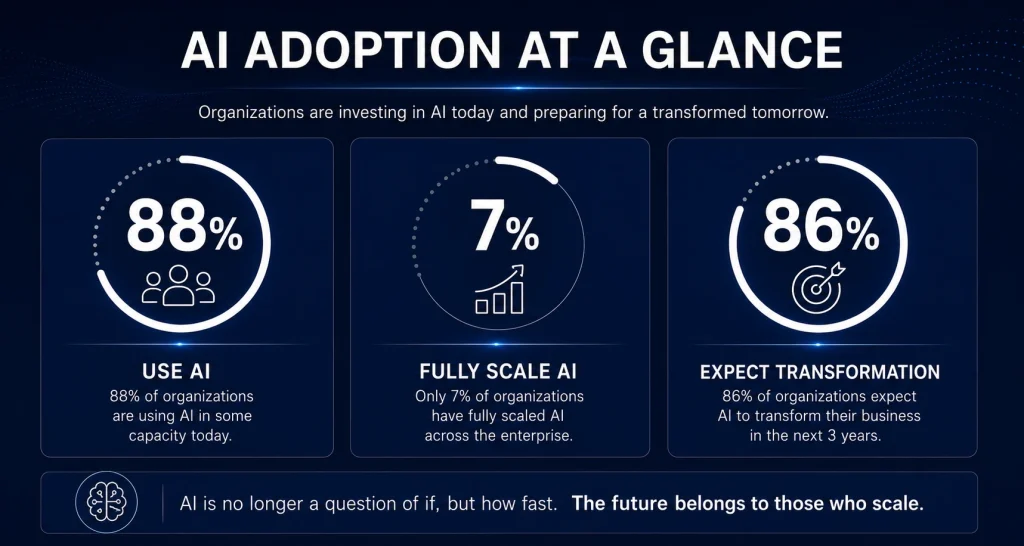
Enterprise interest has moved beyond experimentation, but execution still creates a wide gap between adoption and value. McKinsey reported that 88 percent of surveyed organizations used AI in at least one business function during 2025. However, only 7 percent had fully scaled AI across their organizations.
That gap shows why buying an AI platform does not create an operating capability. Companies need integrated data, valuable use cases, governance, MLOps, security, adoption, and executive ownership.
The World Economic Forum found that 86 percent of surveyed employers expect AI and information processing technologies to transform their businesses by 2030.
Prolifics helps enterprises connect trusted data, machine learning, automation, and scalable AI engineering to move high-value use cases from strategy into production securely at scale.
What Are the Core Principles of AI and Machine Learning?
Artificial intelligence enables systems to perform tasks that normally require human intelligence. Machine learning gives those systems a method for learning patterns from data. Enterprise success depends on aligning both technologies with defined outcomes, quality information, and responsible operational controls.
These four principles guide effective enterprise AI and ML programmers:
Business outcomes should define every model, workflow, and investment decision.
Trusted data creates reliable predictions, automation, and measurable enterprise value.
Continuous learning keeps models accurate as enterprise operating conditions change.
Strong governance protects privacy, security, fairness, compliance, and stakeholder confidence.
AI vs Machine Learning: What’s the Difference?
Artificial intelligence represents the broader discipline of creating systems that perform intelligent tasks. Machine learning forms a specialized branch of AI that learns relationships from data instead of following only fixed instructions.
Business Lens
Artificial Intelligence
Machine Learning
Primary purpose
Simulates intelligent behaviour and supports autonomous actions.
Learn patterns and produce predictions from data.
Typical capabilities
Reasoning, language, vision, planning, and decision support.
Classification, forecasting, clustering, recommendations, and anomaly detection.
Enterprise example
A service assistant coordinates requests across business systems.
A prediction model identifies customers likely to leave.
Success measure
Task quality, business impact, safety, and user trust.
Accuracy, precision, recall, drift, latency, and business value.
Companies combine models, rules, automation, integration, and human oversight into intelligent operating solutions.
How Do AI and ML Complement Each Other in Enterprise Environments?
Enterprise environments require more accurate models. AI coordinates reasoning, interactions, and actions across processes, while machine learning supplies predictions based on operational evidence. Their integration creates systems that understand context, anticipate outcomes, and support consistent execution.
The combined approach strengthens enterprise performance in several practical ways:
Machine learning detects patterns that artificial intelligence converts into actions.
AI workflows apply model predictions across connected enterprise business processes.
Feedback loops improve model performance and operational decision quality continuously.
Human oversight guides exceptions, ethics, accountability, and responsible strategic judgement.
The benefits of combining AI and machine learning become strongest when organizations connect models directly to workflows. A churn prediction creates limited value inside a dashboard. It creates measurable value when a customer platform automatically recommends the next appropriate retention action.
How Does Machine Learning Power Artificial Intelligence?
Machine learning powers artificial intelligence by transforming data into adaptive decision models. Instead of programming every possible response, teams train algorithms to recognize relationships, estimate outcomes, and improve through evaluation.
Prolifics support this process through data engineering, predictive AI, real-time analytics, machine learning, MLOps, natural language processing, governance, and enterprise integration.
These capabilities explain how machine learning powers artificial intelligence:
Supervised learning predicts outcomes using accurately labeled historical business data.
Unsupervised learning reveals hidden segments, relationships, and unusual behavioral patterns.
Reinforcement learning improves actions through feedback, rewards, and repeated evaluation.
MLOps manages deployment, monitoring, retraining, governance, and model lifecycle controls.
Machine learning enables adaptation, but data quality determines its value. Incomplete, biased, delayed, or inconsistent data produces unreliable outcomes.
How Have AI and Machine Learning Evolved?
AI first relied heavily on programmed rules and expert systems. Greater computing power, cloud platforms, connected data, improved algorithms, and modern engineering practices gradually expanded its practical business value.
Five developments shaped today’s enterprise AI landscape:
Rule-based systems automated decisions within narrow, predictable enterprise operating conditions.
Statistical learning introduced scalable forecasting, classification, and behavioral pattern recognition.
Cloud computing expanded affordable storage, processing, experimentation, and model deployment.
Deep learning improved language, vision, audio, and complex prediction capabilities.
MLOps connected model development with secure, repeatable enterprise production operations.
Leaders now judge AI through margins, resilience, customer outcomes, productivity, and speed to market.
How Can Organizations Turn Data into Intelligent Business Decisions?
AI and ML create value when organizations connect reliable data to actionable decisions.
Enterprise Data Collection, Integration, and Preparation
Strong data foundations help models learn from complete business context:
Integrate structured and unstructured data securely across trusted enterprise platforms.
Standardize data definitions, formats, ownership, quality checks, and access controls.
Prepare reusable datasets that support training, testing, and operational inference.
Identification of Trends, Risks, and Growth Opportunities
Machine learning helps teams detect signals that traditional reporting may miss:
Detect changing customer behaviors before they affect retention or revenue.
Identify operational anomalies that indicate emerging cost or service risks.
Reveal underserved segments, demand patterns, and profitable growth opportunities early.
Application of Predictive Analytics for Strategic Planning
Predictive analytics helps leaders evaluate likely outcomes before committing resources:
Forecast future demand using historical performance, seasonality, and external indicators.
Model financial scenarios to test investment assumptions and downside exposure.
Estimate customer, asset, and operational outcomes accurately for proactive planning.
Faster, Data-Informed, and More Accurate Decisions
Intelligent decision systems bring timely evidence directly into operational workflows:
Deliver relevant predictions within the applications employees already use daily.
Automate routine decisions while routing complex exceptions toward human specialists.
Measure outcomes continuously and refine models using current performance feedback.
Where Do Enterprises Apply AI and Machine Learning?
Enterprise applications work best when they address a defined decision, process, or customer needs. The best AI and machine learning tools for business depend on data maturity, architecture, security requirements, operating scale, and expected outcomes.
Companies commonly apply AI and ML across these high-value areas:
Personalization improves recommendations, engagement, service relevance, and long-term customer retention.
Fraud models detect suspicious behavior and priorities of investigations more accurately.
Predictive maintenance identifies equipment risks before failures interrupt production schedules.
Healthcare, finance, and retail teams improve specialized daily operational decisions.
AIOps and intelligent testing improve software reliability and delivery speed.
Tool selection should follow use-case design, not market excitement. The right architecture connects data, modelling, orchestration, observability, integration, and governance without unnecessary complexity.
How Do AI and ML Drive Automation, Efficiency, and Innovation?
Automation removes repetitive effort, reduces errors, and accelerates processes. AI extends that value by interpreting information, predicting outcomes, and supporting complex decisions.
Organizations can use AI-enabled automation to achieve several outcomes:
Automate repetitive business processes involving documents, requests, checks, and approvals.
Improve employee productivity through intelligent recommendations, summaries, and decision support.
Optimize enterprise resources by forecasting workloads, capacity, demand, and constraints.
Accelerate product innovation through rapid testing and deeper customer insight.
Create intelligent services, pricing models, and new digital revenue opportunities.
Successful automation keeps people involved where judgement, empathy, accountability, or regulatory interpretation of matters.
How Should Businesses Implement AI and ML in Their Strategy?
Organizations often ask how to implement AI and ML in your business strategy without creating disconnected pilots. The answer starts with business value, then connects data, technology, governance, people, and operating processes around that objective.
The following sequence supports practical, scalable implementation:
Define measurable business problems clearly before selecting platforms or algorithms.
Assess data quality, availability, ownership, security, and technical integration requirements.
Priorities use cases using business value, feasibility, risk, and readiness.
Build small production-focused releases with clear technical performance success measures.
Establish MLOps, governance, monitoring, retraining, and responsible human oversight processes.
Scale proven capabilities through reusable architecture, skills, and operating standards.
Executive sponsorship should connect investment with accountability. Cross-functional teams should unite domain, data, engineering, security, compliance, product, and operational expertise.
What Is the Future of AI and Machine Learning Innovation in 2026?
The future of AI and machine learning innovation in 2026 will center on connected enterprise systems that combine predictive intelligence, automation, real-time data, domain knowledge, and governed human oversight.
Five priorities will shape the next stage of enterprise adoption:
Intelligent systems will coordinate decisions across applications, teams, and workflows.
Human and AI collaboration will strengthen judgement, speed, and consistency.
Reusable platforms will scale trusted AI capabilities across organizational functions.
Workforce programmed will develop data literacy, oversight, and applied skills.
Sustainable strategies will balance innovation, cost, governance, and measurable value.
The strongest organizations will treat AI as an operating capability, modernize data foundations, reuse engineering standards, monitor outcomes, and redesign work.
How Can Prolifics Help Enterprises Scale AI and Machine Learning?
Prolifics help organizations move from fragmented data and isolated experiments toward governed, production-ready AI. Its capabilities span strategy, data engineering, predictive AI, real-time analytics, machine learning, MLOps, natural language processing, automation, integration, governance, implementation, and managed services.
This approach connects reliable foundations, valuable use cases, production models, business workflows, and continuous optimization, reducing the gap between experimentation and measurable impact.
Conclusion
Artificial intelligence and machine learning create the greatest value around real business decisions. AI provides the framework for intelligent action, while machine learning converts data into predictions that improve through experience.
Trusted data, clear outcomes, responsible governance, and scalable engineering help teams move beyond pilots, improve operations, strengthen customer experiences, and build competitive advantage through AI and machine learning integration for business innovation.
Generative AI introduced organizations to intelligent assistants that could summarize content, answer questions, and generate code. Today, enterprises are entering the next phase of AI adoption with agentic AI, autonomous AI systems capable of reasoning, planning, making decisions, and executing business processes across multiple applications with minimal human intervention.
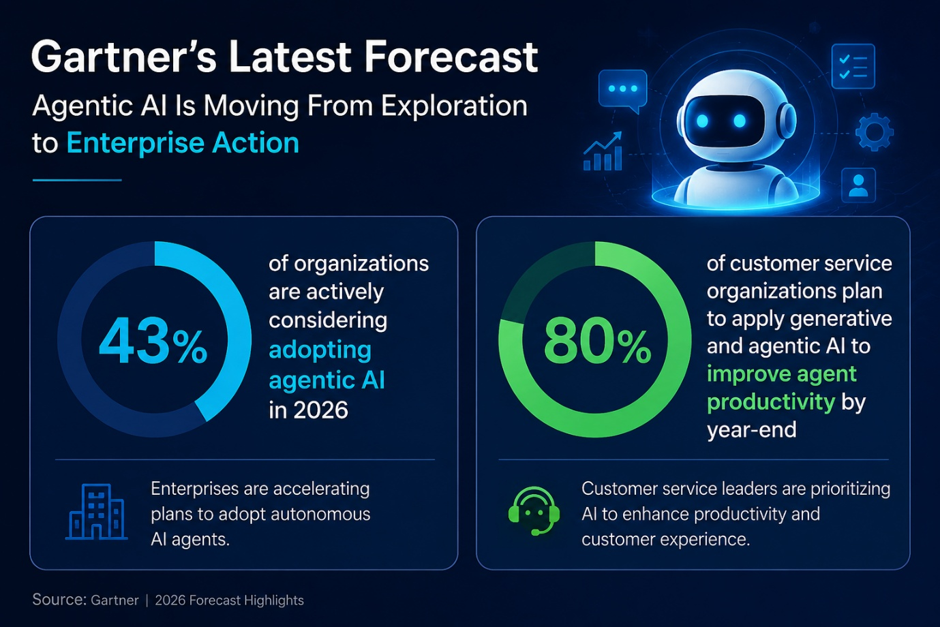
Gartner’s latest forecast provides additional context: 43% of organizations are actively considering adopting agentic AI in 2026, while 80% of customer service organizations plan to apply generative and agentic AI to improve agent productivity by year-end. IDC projects that 40% of roles in Global 2000 companies will involve direct engagement with AI agents by the end of 2026 – a figure that underscores just how deeply these systems are penetrating enterprise workflows. While the opportunity is enormous, so are the risks.
Unlike traditional AI models that simply generate recommendations, AI agents can access enterprise systems, invoke APIs, execute workflows, trigger financial transactions, update customer records, or initiate infrastructure changes. Without proper governance, these capabilities can introduce operational, security, compliance, and reputational risks.
The question enterprise leaders are asking is no longer:
“Can we build AI agents?”
It is:
“How do we govern autonomous AI agents safely at enterprise scale?”
The answer lies in combining governance, security, runtime guardrails, and human oversight into every stage of the AI lifecycle.
Why Traditional AI Governance Is No Longer Enough
Most enterprise AI governance programs were designed for predictive analytics or generative AI models where humans remained in control of every important decision.
Agentic AI fundamentally changes that model.
Modern AI agents can:
Plan multi-step workflows
Access enterprise applications
Use business tools and APIs
Collaborate with other AI agents
Make contextual decisions
Learn from previous interactions
This increased autonomy creates entirely new governance challenges.
Organizations must answer questions such as:
What systems can an AI agent access?
Which actions can it execute autonomously?
When should human approval be required?
How are AI decisions monitored?
How are AI actions audited?
How do we prevent unauthorized or unsafe behavior?
Industry leaders increasingly advocate adaptive, risk-based governance that classifies AI agents by risk level and applies controls appropriate to their business impact rather than relying on one-size-fits-all policies.
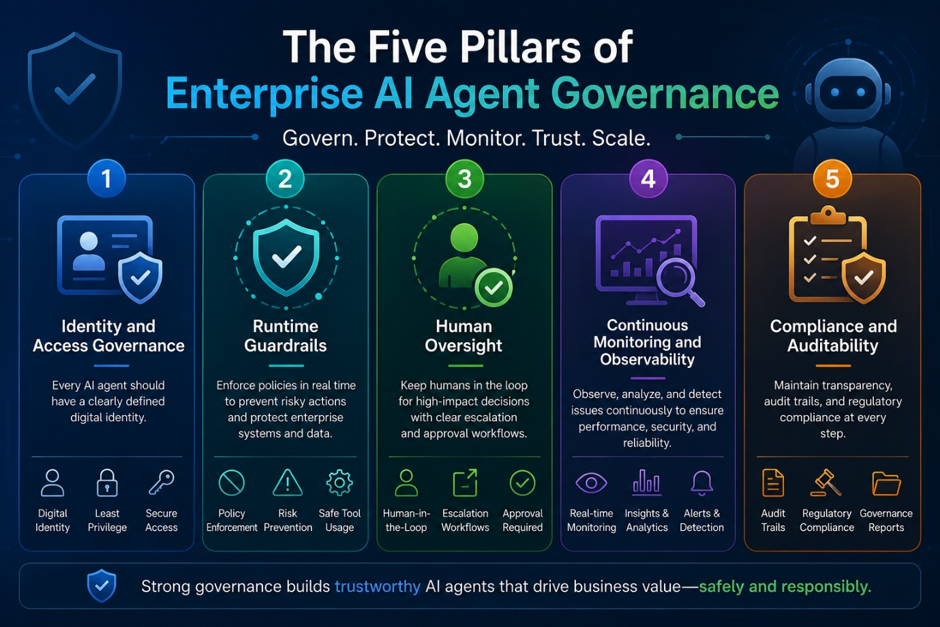
The Five Pillars of Enterprise AI Agent Governance
1. Identity and Access Governance
Every AI agent should have a clearly defined digital identity.
Organizations should apply Zero Trust principles by ensuring agents receive only the minimum permissions necessary to complete their assigned tasks.
Key practices include:
Role-based access control
Least privilege access
Time-limited credentials
API authorization
Secure secrets management
Multi-system identity federation
AI agents should never inherit unrestricted access simply because a user possesses elevated permissions.
2. Runtime Guardrails
Static governance policies alone are insufficient.
Because AI agents make decisions dynamically, governance must also occur during execution.
Runtime guardrails monitor AI behavior in real time and enforce predefined policies before actions are executed.
Examples include:
Blocking access to restricted systems
Preventing sensitive data exposure
Validating tool usage
Limiting transaction values
Detecting prompt injection attacks
Restricting high-risk workflows
Industry experts increasingly describe governance as something that must be enforced by the platform itself rather than relying on documentation or manual reviews.
3. Human Oversight
Autonomy should never eliminate accountability.
High-impact business decisions require humans to remain part of the decision process.
Examples include:
Financial approvals
Contract execution
Healthcare recommendations
Regulatory submissions
Security policy changes
Customer-impacting decisions
Organizations should establish escalation thresholds where AI agents pause and request human approval before proceeding.
This “human-in-the-loop” approach balances automation with responsible governance.
4. Continuous Monitoring and Observability
Enterprise AI cannot be trusted if organizations cannot observe its behavior.
Modern AI observability includes:
Decision logs
Agent reasoning traces
Tool invocation history
API activity
Data lineage
Security alerts
Performance metrics
Drift detection
Complete observability allows organizations to investigate incidents, satisfy compliance requirements, and continuously improve AI performance.
Security leaders increasingly view observability as a foundational capability for safe agentic AI deployments.
5. Compliance and Auditability
Enterprise AI deployments must align with evolving regulatory expectations.
Organizations should maintain:
Complete audit trails
Policy enforcement records
Model version history
Risk assessments
Human approval logs
Data access records
Governance reports
Frameworks such as the NIST AI Risk Management Framework, ISO/IEC 42001, and emerging industry guidance provide useful foundations, but enterprises must translate these governance objectives into enforceable runtime controls for agentic systems.
Common AI Agent Security Risks
As AI agents gain broader enterprise access, security risks expand significantly.
Some of the most common threats include:
Prompt Injection
Malicious prompts manipulate agent behavior, causing unintended actions or disclosure of sensitive information.
Excessive Permissions
Overprivileged agents may access applications or data beyond their intended scope.
Data Leakage
Sensitive enterprise information may be unintentionally exposed through agent interactions.
Unauthorized Tool Usage
Agents may invoke APIs or business applications without appropriate authorization.
Shadow AI
Employees deploying unapproved AI agents create governance blind spots similar to Shadow IT.
Agent-to-Agent Risks
Multiple autonomous agents interacting without coordination may amplify errors or create cascading operational failures.
Mitigating these risks requires layered security, runtime controls, and continuous monitoring rather than relying solely on policy documents.
A Practical AI Agent Compliance Framework
Organizations can accelerate responsible AI adoption by implementing a structured governance model.
Discover
Identify AI agents, data sources, integrations, and business processes.
Classify
Assess risk based on business impact, autonomy level, regulatory exposure, and data sensitivity.
Govern
Define policies covering identity, permissions, security, compliance, and acceptable behaviors.
Control
Deploy runtime guardrails that enforce policies during execution.
Monitor
Continuously observe agent activities, security events, and business outcomes.
Improve
Use operational insights to refine policies, strengthen controls, and optimize performance over time.
This adaptive governance approach enables innovation while maintaining enterprise trust and accountability.
How Prolifics Helps Enterprises Build Responsible Agentic AI
At Prolifics, we help organizations move beyond AI experimentation to enterprise-scale deployment with governance built into every stage of the AI lifecycle.
Our Enterprise AI capabilities include:
AI readiness assessments
Agent architecture and design
Governance strategy development
AI security and risk assessments
Enterprise guardrail implementation
Responsible AI frameworks
Microsoft Azure AI and Copilot integration
IBM watsonx and enterprise AI solutions
AI observability and monitoring
Compliance and audit enablement
By combining deep AI expertise with cloud engineering, integration, and security capabilities, Prolifics enables organizations to deploy trustworthy AI agents that accelerate business outcomes without compromising governance or compliance.
The Future of Trustworthy Agentic AI
Enterprise AI is rapidly evolving from assistants that recommend actions to autonomous agents capable of executing complex workflows.
Organizations that succeed will not necessarily be those with the most sophisticated AI models.
They will be the ones with the strongest governance foundations.
Trustworthy AI requires more than accurate models. It requires continuous oversight, adaptive governance, secure identities, runtime guardrails, transparent decision-making, and human accountability.
By embedding governance into every layer of the AI ecosystem, enterprises can confidently move from AI pilots to production-scale autonomous operations while maintaining the trust of customers, regulators, employees, and stakeholders.
As organizations embrace the next generation of Agentic AI, governance is no longer a compliance exercise, it is a strategic business capability that enables innovation at scale.
Take Your Agentic AI Strategy from Pilot to Production at Ai4 2026
Ready to scale Agentic AI without compromising security, governance or human accountability?
Meet Prolifics at Ai4 2026 and discover how to design, govern and operationalise autonomous AI agents for secure, responsible and measurable enterprise impact. Connect with our AI leaders to explore practical strategies for runtime guardrails, human oversight, AI observability, compliance and production-scale deployment.
Move beyond AI experimentation and build trusted Agentic AI that delivers business value at scale.
AI Is No Longer the Future. It Is the New Competitive Advantage.
Nearly every enterprise has invested in artificial intelligence. Organizations have experimented with generative AI, deployed Microsoft Copilot licenses, built automation pilots, and explored machine learning initiatives. Yet for many businesses, the expected return on these investments remains elusive.
The challenge is not access to AI technology. It is transforming isolated AI experiments into scalable business capabilities that deliver measurable outcomes.
This is where the combined strengths of Microsoft and Prolifics make a difference.
As a Microsoft Solutions Partner, Prolifics helps enterprises move beyond experimentation by combining Microsoft Azure, Azure AI Foundry, Microsoft Copilot Studio, Power Platform, Azure OpenAI Service, and enterprise engineering expertise to accelerate modernization, improve productivity, and create sustainable business value.
Rather than implementing technology for technology’s sake, Prolifics helps organizations build AI-powered business operations that are secure, governed, scalable, and aligned with measurable business objectives.
From AI Experiments to Enterprise Transformation
Many organizations share a similar AI journey.
They have:
Deployed Microsoft Copilot for productivity.
Built isolated automation workflows.
Tested generative AI use cases.
Created proofs of concept.
Modernized portions of their application landscape.
While these initiatives demonstrate AI’s potential, they rarely create enterprise-wide transformation.
The next stage requires connecting people, business processes, enterprise data, and intelligent automation into a unified operating model.
Using Microsoft Copilot Studio, Azure AI Foundry, Power Automate, and Microsoft Azure, Prolifics helps organizations design and deploy intelligent agentic systems that automate workflows, assist employees with real-time insights, and continuously improve operational performance.
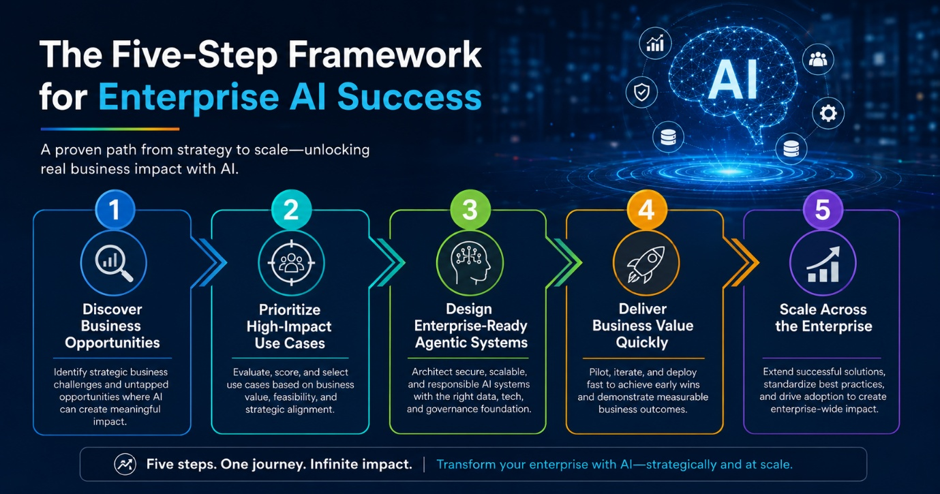
The Five-Step Framework for Enterprise AI Success
Successful AI adoption is not about deploying more models. It begins with understanding where AI can create measurable business impact.
Prolifics follows a structured transformation framework that enables organizations to scale AI confidently.
1. Discover Business Opportunities
Every engagement begins by identifying business personas, workflows, operational bottlenecks, and decision points.
Rather than asking “Where can we use AI?”, organizations answer a more valuable question:
2. Prioritize High-Impact Use Cases
Not every workflow deserves automation.
Prolifics identifies the highest-value opportunities based on operational complexity, business impact, implementation effort, and expected ROI.
This allows organizations to focus investments where AI can deliver results fastest.
3. Design Enterprise-Ready Agentic Systems
Using Microsoft Copilot Studio, Azure AI Foundry, and Power Automate, Prolifics designs governed AI systems that combine:
AI agents
Enterprise workflows
Secure enterprise data
Business rules
Human decision-making
Microsoft cloud services
The result is an intelligent operational platform rather than disconnected automation tools.
4. Deliver Business Value Quickly
Instead of large, high-risk transformation programs, Prolifics delivers incremental implementations that prove business value in weeks.
Organizations can validate outcomes, improve adoption, and reduce implementation risk before expanding AI across additional departments.
5. Scale Across the Enterprise
Once proven, successful AI implementations become reusable assets that can be expanded across business functions, locations, and enterprise systems.
This incremental approach enables organizations to build sustainable AI capabilities while maintaining governance and operational control.
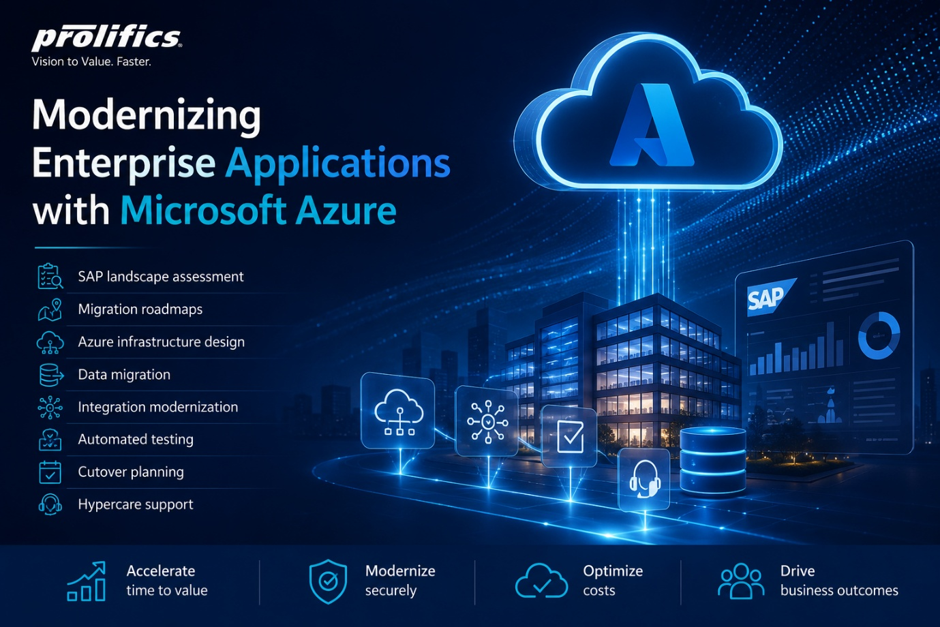
Modernizing Enterprise Applications with Microsoft Azure
AI transformation cannot succeed on outdated infrastructure.
Legacy ERP systems, aging applications, and fragmented integrations often limit an organization’s ability to adopt intelligent automation.
Prolifics helps enterprises modernize these environments using Microsoft Azure as the foundation for future innovation.
For SAP customers approaching ECC end-of-maintenance, Prolifics provides structured migration services to SAP S/4HANA on Azure through Greenfield, Brownfield, and Bluefield migration strategies.
The approach includes:
SAP landscape assessment
Migration roadmaps
Azure infrastructure design
Data migration
Integration modernization
Automated testing
Cutover planning
Hypercare support
With experience spanning 150+ SAP customers, 55+ SAP HANA migrations, 75+ end-to-end implementations, and 400+ SAP-certified consultants, Prolifics helps organizations modernize ERP environments while minimizing business disruption.
Unlocking Hidden Business Knowledge with AI
One of the biggest modernization challenges is understanding legacy applications.
Business rules are often buried inside custom code, stored procedures, APIs, and decades-old applications. Documentation is outdated, and institutional knowledge resides with only a handful of experienced developers.
Prolifics addresses this challenge with its AI-powered Systems Intelligence solution.
Powered by the Prolifics Code Profiler and Transformer (PCPT) and Azure OpenAI Services, the solution automatically discovers and visualizes:
Business rules
Decision logic
Policy enforcement
Runtime dependencies
Business entities
Impact analysis
Instead of manually reverse-engineering applications, organizations gain a searchable knowledge graph that enables business and technical teams to understand system behavior through natural language queries.
This significantly reduces modernization risk while accelerating cloud migration, application transformation, and compliance initiatives.
Why Enterprises Choose Prolifics
Technology alone does not deliver transformation.
Successful AI initiatives require deep engineering expertise, industry experience, governance, and a proven delivery methodology.
Organizations partner with Prolifics because of its ability to combine:
Microsoft AI and Azure expertise
Enterprise application modernization
SAP transformation services
AI-powered software engineering
Business process automation
Data modernization
Secure AI governance
Production-ready delivery models
Every engagement is designed to help customers retain ownership of their AI solutions while accelerating time to value through incremental, measurable outcomes.
Build an AI-Ready Enterprise with Prolifics and Microsoft
The future belongs to organizations that successfully connect AI, enterprise data, business applications, and intelligent automation into a unified operating model.
Whether your organization is modernizing SAP on Azure, deploying Microsoft Copilot Studio, building agentic AI solutions, modernizing legacy applications, or discovering hidden business logic through AI, Prolifics provides the strategy, engineering expertise, and Microsoft technologies needed to accelerate transformation.
Ready to Turn AI into Business Value?
Start with a strategic assessment from Prolifics to identify your highest-impact AI opportunities, build a practical modernization roadmap, and accelerate enterprise transformation with Microsoft Azure and AI technologies.
Because the goal isn’t simply adopting AI. It’s creating measurable business outcomes that drive innovation, productivity, and long-term competitive advantage.
Frequently Asked Questions (FAQs)
1. How can Microsoft Copilot Studio help accelerate enterprise AI adoption?
Microsoft Copilot Studio enables organizations to build custom AI agents that automate business processes, assist employees, and integrate with enterprise systems. When combined with Azure AI Foundry and Power Automate, businesses can create intelligent, secure, and scalable workflows that improve productivity and decision-making. Prolifics helps organizations design, implement, and govern these AI solutions to ensure measurable business outcomes.
2. Why should organizations choose Microsoft Azure for AI and application modernization?
Microsoft Azure provides a secure, scalable, and enterprise-ready cloud platform that supports AI, analytics, automation, and application modernization. Its integrated services, including Azure OpenAI Service, Azure AI Foundry, Power Platform, and Azure Kubernetes Service, enable organizations to modernize legacy applications, deploy AI solutions faster, and build a future-ready digital foundation.
3. How does Prolifics help organizations move beyond AI pilots?
Prolifics follows a structured transformation approach that begins with identifying high-value business opportunities, designing enterprise-ready AI solutions, and delivering measurable outcomes through incremental implementation. By combining deep engineering expertise with Microsoft’s AI technologies, Prolifics helps organizations transform isolated AI experiments into scalable business capabilities that deliver long-term value.
4. Can Prolifics help modernize SAP and legacy applications on Microsoft Azure?
Yes. Prolifics specializes in enterprise modernization, including SAP ECC to SAP S/4HANA migrations on Microsoft Azure, legacy application modernization, cloud migration, API integration, and AI-powered code analysis. The company’s proven frameworks help reduce migration risk, improve operational efficiency, and accelerate digital transformation while minimizing business disruption.
5. What industries can benefit from Prolifics and Microsoft AI solutions?
Prolifics delivers Microsoft-powered AI and cloud transformation solutions across a wide range of industries, including manufacturing, financial services, healthcare, life sciences, retail, consumer products, energy, and the public sector. Whether the objective is automating workflows, modernizing applications, improving customer experiences, or enabling AI-driven decision-making, Prolifics tailors each solution to meet industry-specific business challenges.
Multi-agent AI orchestration is the architecture and coordination layer that enables multiple AI agents to work together toward a shared enterprise objective. Rather than relying on a single large language model (LLM), orchestration manages task distribution, communication, memory, governance, and decision-making across specialized agents to improve accuracy, scalability, and business outcomes.
As enterprises move from AI pilots to production, multi-agent AI orchestration is becoming a foundational capability for building reliable, autonomous systems that integrate with enterprise applications, adhere to governance policies, and execute complex business workflows.
Quick answer
Multi-agent AI orchestration is the process of coordinating multiple specialized AI agents to collaborate on complex business tasks. An orchestration layer manages planning, task routing, agent communication, memory, security, and monitoring, enabling enterprises to build scalable, governed AI systems that outperform isolated AI assistants for multi-step workflows.
What is multi-agent AI orchestration?
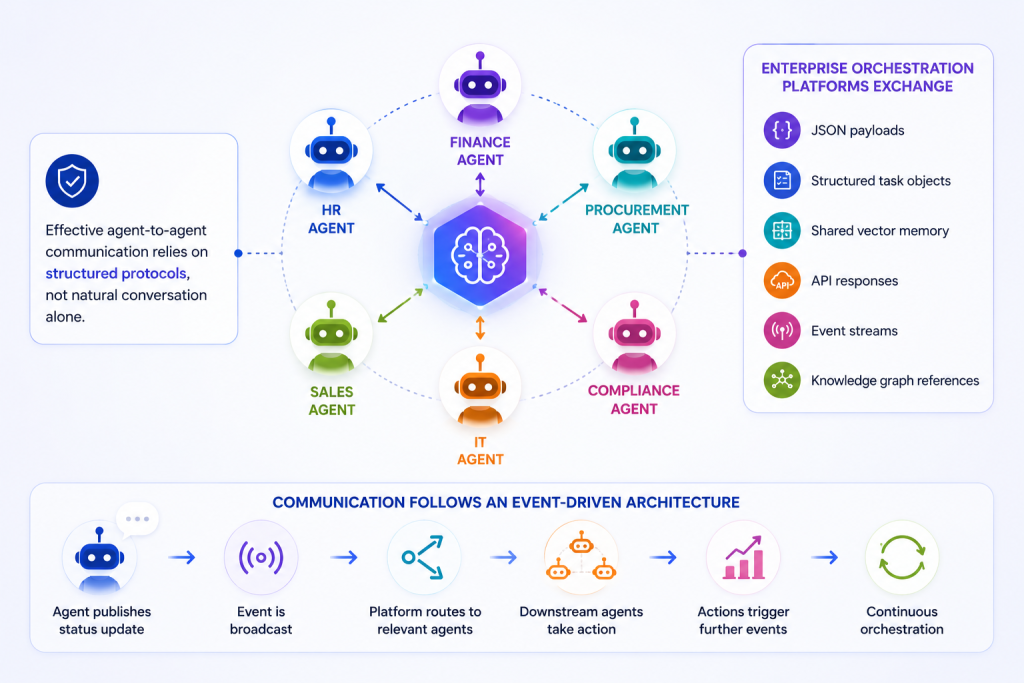
Multi-agent AI orchestration is the coordinated management of multiple AI agents that each perform specialized functions while working toward a common business objective.
Unlike a single AI assistant that attempts to complete every task, an orchestrated system assigns responsibilities to different agents based on expertise.
For example:
Planner Agent creates an execution strategy.
Research Agent gathers information.
Integration Agent retrieves enterprise data.
Compliance Agent validates policy requirements.
Execution Agent performs approved actions.
Monitoring Agent observes outcomes and triggers improvements.
The orchestration platform determines:
Which agent should execute each task.
When agents should collaborate.
How information is shared.
How conflicts are resolved.
When human approval is required.
This creates an AI agent network for enterprise environments that is modular, resilient, and easier to govern than monolithic AI systems.
Definition
Multi-agent AI orchestration is the architecture, policies, and runtime coordination that allow multiple autonomous AI agents to communicate, share context, delegate work, and execute enterprise workflows securely while maintaining governance, auditability, and human oversight.
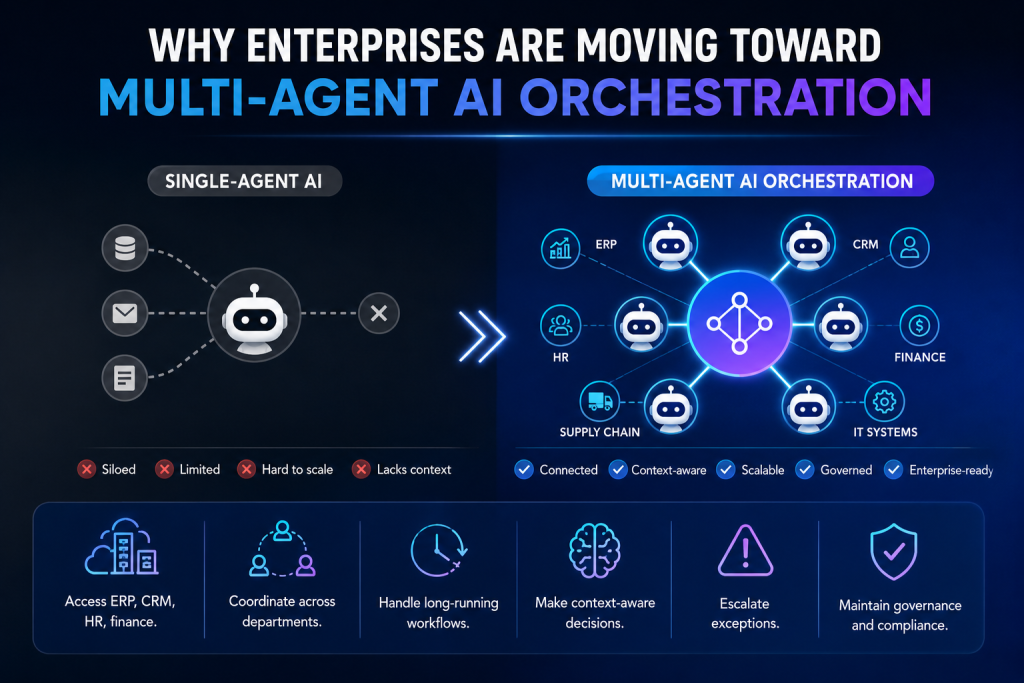
Why are enterprises moving toward multi-agent AI orchestration?
Single-agent AI works well for isolated tasks but struggles with enterprise operations involving multiple systems, business rules, approvals, and data sources.
Modern enterprises require AI systems that can:
Access ERP, CRM, HR, and finance platforms.
Coordinate across departments.
Handle long-running workflows.
Make context-aware decisions.
Escalate exceptions.
Maintain governance and compliance.
According to Gartner, organizations are rapidly evolving from AI assistants toward autonomous business agents capable of coordinating business processes. IBM similarly identifies orchestration as a key capability for enterprise-scale generative AI because governance becomes increasingly difficult as AI complexity grows.
For enterprises pursuing digital transformation, LLM orchestration becomes the layer that connects AI with existing applications rather than replacing enterprise systems.
How does multi-agent AI orchestration work?
A typical orchestration architecture contains several coordinated layers.
1. User Request
A user submits a request such as:
Generate a commercial insurance quote.
2. Planning Agent
The planner determines:
Required tasks
Dependencies
Required enterprise systems
Required approvals
3. Specialized Agent Workflow Tasks move through a sequence of purpose-built agents.
Each agent contributes a specialized decision while the orchestration engine maintains the overall workflow.
Which enterprise use cases benefit most from multi-agent AI orchestration?
Several industries are already well suited for coordinated AI systems.
Financial Services
Multiple agents collaborate to:
Verify customer identity.
Assess credit risk.
Detect fraud.
Generate loan documentation.
Route approvals.
This reduces manual effort while maintaining regulatory controls.
Healthcare
Agents can coordinate to:
Summarize patient records.
Retrieve clinical guidelines.
Check insurance eligibility.
Recommend treatment pathways.
Schedule follow-up appointments.
Human clinicians remain responsible for final decisions.
Retail
Retail organizations can orchestrate agents for:
Inventory optimization.
Demand forecasting.
Dynamic pricing.
Supplier coordination.
Customer service.
These coordinated workflows improve operational efficiency across the supply chain.
Insurance
Claims processing benefits from specialized agents handling:
Document extraction.
Fraud detection.
Policy verification.
Damage estimation.
Settlement recommendations.
Rather than replacing adjusters, AI accelerates administrative tasks while maintaining oversight.
How can enterprises design a scalable multi-agent AI system?
A successful implementation requires more than connecting several LLMs. Enterprises need an architecture that balances autonomy with governance.
Recommended design principles
Define business outcomes before selecting AI models.
Assign each agent a single, specialized responsibility.
Use an orchestration layer to coordinate workflows and resolve dependencies.
Integrate agents with enterprise systems through secure APIs.
Implement shared memory and contextual retrieval to maintain continuity across tasks.
Apply governance controls, including authentication, authorization, and audit logging.
Introduce human approval for high-risk decisions.
Continuously monitor agent performance, latency, costs, and business outcomes.
Test workflows under production-scale conditions before broad deployment.
Refine orchestration logic based on operational feedback and evolving business requirements.
This approach supports long-term scalability while reducing operational risk.
What challenges should enterprises address before deploying autonomous AI systems?
Moving from pilots to production introduces several architectural and operational challenges.
Common considerations include:
Hallucination management.
Identity and access control.
Data privacy.
Cross-agent consistency.
Model version management.
Cost optimization.
Regulatory compliance.
Observability.
Human oversight.
Integration with legacy applications.
A centralized orchestration platform provides visibility and governance across all participating agents, making enterprise AI systems easier to manage and audit.
What does the future of AI workflow orchestration look like?
Industry analysts expect enterprise AI to evolve from isolated assistants toward autonomous AI systems that coordinate business processes across departments.
Future orchestration platforms will increasingly include:
Dynamic agent discovery.
Self-optimizing workflows.
Multi-model routing.
Cross-enterprise collaboration.
Event-driven automation.
Policy-aware reasoning.
Real-time business optimization.
Rather than replacing enterprise software, these capabilities will augment existing investments in ERP, CRM, cloud, and integration platforms.
Conclusion
Multi-agent AI orchestration is emerging as the operating model for enterprise AI, enabling specialized agents to collaborate securely across business processes rather than functioning as isolated assistants. By coordinating task execution, enforcing governance, and integrating with enterprise systems, orchestration improves scalability, reliability, and operational efficiency.
As organizations transition from AI experimentation to production, the focus should shift from individual models to well-designed orchestration architectures that support long-term business outcomes. Prolifics helps enterprises design, integrate, and operationalize governed multi-agent AI systems that align with existing cloud, data, and application ecosystems.
Frequently Asked Questions
What is multi-agent AI orchestration?
Multi-agent AI orchestration coordinates multiple specialized AI agents through a centralized orchestration layer that manages planning, communication, task delegation, governance, and execution. It enables enterprises to automate complex workflows more reliably than a single AI assistant.
How is multi-agent orchestration different from using one large language model?
A single LLM attempts to solve every problem itself, while multi-agent orchestration distributes work among specialized agents with distinct responsibilities. This improves scalability, governance, resilience, and accuracy for enterprise workflows.
Why do enterprises need AI workflow orchestration?
Enterprise processes span multiple systems, approvals, and business rules. AI workflow orchestration coordinates these activities, integrates with existing applications, maintains governance, and ensures AI actions align with organizational policies and compliance requirements.
Which industries benefit most from multi-agent AI systems?
Financial services, healthcare, retail, insurance, manufacturing, and public sector organizations benefit significantly because they rely on complex workflows involving multiple stakeholders, regulatory requirements, and enterprise applications.
What should enterprises evaluate before implementing multi-agent AI orchestration?
Organizations should evaluate governance, security, integration architecture, data quality, human oversight, monitoring, scalability, and business outcomes before deploying production-grade multi-agent AI systems. A phased approach helps validate performance while reducing operational risk.
Enterprise AI initiatives often stall because critical data remains trapped across disconnected systems. AI models cannot produce reliable outcomes when information arrives late, lacks context, or comes from untrusted sources. Point-to-point connections create brittle dependencies as applications multiply. Integration teams spend more time fixing interfaces than supporting innovation. Business leaders face rising costs while AI pilots struggle to reach production.
Prolifics addresses these challenges with IBM webMethods Hybrid Integration. Together, they help enterprises build a governed, reusable, and scalable API-led integration foundation that connects legacy applications, cloud platforms, enterprise data, and AI services. This approach gives AI systems secure access to trusted business capabilities while reducing integration complexity.
Why Enterprise AI Depends on Integration
Enterprise AI needs more than models and computing power. It requires timely access to accurate data, applications, and business processes. Without a strong integration layer, teams repeatedly build custom connections, slow delivery, and create inconsistent controls.
The following capabilities create a dependable foundation for enterprise AI integration:
AI models need timely, trusted data from connected enterprise systems.
Reusable APIs reduce duplication and accelerate secure AI application delivery.
Governed integrations help teams control access, quality, and operational risk.
A connected architecture also improves traceability. Teams can identify where data originated, how systems transformed it, and which AI service used it. That visibility supports responsible deployment in regulated and business-critical workflows.
What Is API-Led Integration?
API-led integration is an architectural approach that exposes data, applications, and business processes through reusable, governed APIs. Instead of creating a separate connection for every system pair, teams build standardized interfaces that multiple applications, channels, partners, and AI services can securely reuse.
IBM defines API integration as using APIs to expose flows and connect enterprise applications, systems, and workflows. API-led strategies treat APIs as managed business assets.
This separation lets enterprises modernize gradually while maintaining consistent access for AI, analytics, and digital channels.
API-Led Integration vs. Point-to-Point Integration
The following comparison highlights the architectural differences:
Area
API-Led Integration
Point-to-Point Integration
Architecture
Uses reusable, standardized service layers.
Creates dedicated connections between individual systems.
Scalability
Supports new consumers without rebuilding integrations.
Adds complexity with every new connection.
Maintenance
Centralizes changes through governed interfaces.
Requires updates across dependent connections.
Security
Applies consistent access and traffic policies.
Often creates uneven controls across interfaces.
Visibility
Centralizes monitoring, discovery, and lifecycle management.
Spreads monitoring across tools and scripts.
AI readiness
Provides controlled access to business capabilities.
Delivers inconsistent data access and context.
Point-to-point integration may solve needs, but API-led integration scales better for modernization and AI adoption.
How APIs Connect Enterprise Data and AI
APIs give AI applications controlled access to data and business functions. They connect models with ERP, CRM, mainframe, supply chain, and analytics platforms.
Reusable services prevent teams from rebuilding connectivity for every AI use case.
Prolifics designs these services around business domains, security, and performance requirements. This model moves enterprises from isolated pilots toward governed production AI.
Top Integration Challenges Limiting AI Adoption
Many AI programs encounter integration barriers before reaching production. These issues affect security, data quality, scalability, and trust.
The following challenges commonly prevent enterprises from scaling AI successfully:
Disconnected systems prevent AI models from accessing complete, current, trusted business data.
Legacy interfaces cannot support modern real-time AI application requirements at enterprise scale.
Enterprises need standardized connectivity, controlled reuse, and clear ownership.
How IBM webMethods Enables API-Led Integration
IBM webMethods Hybrid Integration provides a unified iPaaS that connects APIs, applications, events, data, messaging, B2B transactions, and EDI processes. IBM designed the platform to address disconnected systems, vendor sprawl, data silos, limited observability, and growing integration complexity.
For enterprise AI, webMethods connects AI applications with operational systems across cloud and on-premises environments. Teams can expose approved functions, support events, and monitor integrations.
The platform includes application integration, API management, event connectivity, B2B integration, managed file transfer, runtime management, and monitoring. Its hybrid control plane governs distributed APIs, events, messaging, and integrations.
webMethods also supports real-time processing and event-driven integrations. AI applications can respond to inventory changes, service incidents, payments, customer activity, and supply chain events without waiting for scheduled transfers.
How Prolifics Builds AI-Ready Integration Architectures
Technology alone does not create an AI-ready enterprise. Organizations also need architecture, governance, and delivery practices aligned with business outcomes.
Prolifics assess existing integrations, identifies modernization priorities, and designs practical target architectures. As an IBM Platinum Business Partner, it combines IBM expertise with integration, data, AI, automation, cloud, and modernization experience.
A Prolifics engagement can include the following activities:
Assess current integrations, dependencies, risks, costs, and modernization priorities clearly.
Define reusable APIs aligned with business domains and outcomes consistently.
Connect hybrid applications through secure, scalable integration patterns across environments.
Establish governance standards for development, deployment, monitoring, reuse, and retirement.
Modernize incrementally without disrupting critical business operations or customer services.
Create operating models supporting continuous optimization and sustained platform adoption.
In one published case study, Prolifics reported 500-plus global integrations, 40 percent faster deployments, and 35 percent lower infrastructure costs. Results vary by organization.
Connecting Legacy, Cloud, and AI Systems
Legacy Systems
Legacy platforms often contain valuable business rules, history, and operational data. API-led integration exposes selected functions securely, allowing AI applications to use those capabilities without requiring immediate replacement.
Cloud Platforms
Cloud applications improve speed and scalability, but independent adoption can create new silos. A hybrid platform connects SaaS, cloud services, data platforms, and on-premises systems through consistent integration patterns.
AI Systems
AI systems need contextual data and permission to perform approved actions. Prolifics designs APIs that provide relevant access while meeting security, latency, audit, and reliability requirements.
API Security, Governance, and Compliance
API security and governance include the policies, controls, and lifecycle practices that protect APIs and guide consistent usage.
The following controls support secure and responsible AI adoption:
Enforce identity, authentication, authorization, encryption, and traffic protection policies consistently.
Track API ownership, versions, dependencies, usage, and operational performance continuously.
Maintain complete audit trails supporting regulatory reviews and incident investigations.
Prolifics incorporates governance throughout architecture, implementation, testing, deployment, and operations. Teams define access rights, data boundaries, activity logging, exception handling, and ownership before exposing services to AI applications.
Shared catalogs and lifecycle standards limit API sprawl, support reuse, and guide version management.
Enterprise AI Use Cases and Business Benefits
An API-led foundation supports customer service, predictive maintenance, fraud detection, supply chain optimization, document processing, and workflow automation. Each use case needs secure access to accurate data and approved actions.
Business value comes from reuse, speed, control, and reliability. Teams launch AI services faster without rebuilding connectivity, while governance and observability reduce risk.
A Forrester Consulting Total Economic Impact study commissioned by IBM reported a potential 176 percent return on investment for a composite organization deploying webMethods. The study offers an evaluation framework based on interviewed customers, not a guaranteed result for every enterprise.
Organizations can pursue benefits across several areas:
Accelerate AI delivery through reusable, production-ready enterprise integration services securely.
Improve decisions using timely, contextual, trusted, and governed enterprise information.
Reduce maintenance costs by replacing duplicated connections with governed reusable APIs.
Strengthen compliance through centralized policies, continuous monitoring, and complete auditability controls.
Support innovation without forcing immediate replacement of valuable legacy technology investments.
Improve resilience through observable, manageable, and scalable enterprise integration operations.
A Practical Roadmap for Getting Started
Building an AI-ready integration environment requires a structured and business-focused approach. The following roadmap helps enterprises move from initial planning to scalable implementation while reducing operational and technical risks.
Step 1: Define Business Outcomes
Select one or two AI use cases with clear operational value. Identify users, decisions, processes, and measurable outcomes.
Step 2: Assess the Integration Landscape
Document applications, interfaces, data sources, dependencies, owners, controls, and recurring failures. Identify systems that contain reusable business capabilities.
Step 3: Prioritize Reusable APIs
Define APIs around stable business domains, such as customers, orders, products, payments, assets, or claims. Prioritize services that support several use cases.
Step 4: Establish Security and Governance
Define identity, authorization, data protection, logging, lifecycle, and approval requirements. Assign ownership for every API and integration asset.
Step 5: Build a Controlled Pilot
Connect one AI use case to selected enterprise services. Test performance, reliability, data quality, security, observability, and user outcomes.
Step 6: Measure and Scale
Compare results with the business case. Reuse proven APIs, improve operating processes, and expand to additional workflows and AI services.
Conclusion
Enterprise AI succeeds when models can access trusted data, business context, and operational capabilities safely. API-led integration creates that foundation through reusable, governed services.
IBM webMethods Hybrid Integration connects applications, APIs, events, data, messaging, and B2B processes across hybrid environments. Prolifics adds strategy, architecture, implementation expertise, governance, and modernization experience.
Together, they build a secure foundation for scalable enterprise AI adoption.
Frequently Asked Questions
What is API-led integration in enterprise AI?
API-led integration exposes enterprise data and processes through reusable, governed APIs. AI systems can then retrieve information and invoke approved functions securely.
How does IBM webMethods support AI-led integration?
IBM webMethods connects applications, APIs, events, data, messaging, and B2B processes through a unified hybrid platform. It supports monitoring, API management, event processing, and governance.
What is the difference between API-led and point-to-point integration?
API-led integration creates reusable service layers for many consumers. Point-to-point integration creates a dedicated connection between two systems, increasing complexity as the environment grows.
Can API-led integration connect legacy systems to AI platforms?
Yes. APIs can expose selected legacy data and functions without immediate replacement. Integration platforms can transform formats, apply policies, route requests, and connect legacy services with cloud AI.
What is MCP, and how does it relate to webMethods?
The Model Context Protocol, or MCP, standardizes how AI applications and agents interact with external tools and data sources. IBM webMethods supports exposing integrations as MCP tools, helping agents discover and invoke approved enterprise capabilities consistently.
How do I choose an integration partner for IBM webMethods?
Choose a partner with proven webMethods expertise, hybrid architecture experience, API security knowledge, modernization methods, governance capabilities, and measurable client outcomes. The partner should align platform decisions with business goals and support long-term adoption.
Artificial intelligence has transformed software development. AI coding assistants can generate functions, explain code, and automate repetitive programming tasks within seconds. Yet many enterprises are discovering that faster code generation alone does not guarantee faster software delivery.
Large organizations still struggle with legacy applications, compliance requirements, security reviews, testing bottlenecks, documentation gaps, and complex approval workflows. These challenges exist across the entire Software Development Lifecycle (SDLC), not just during coding.
This is where IBM Bob is redefining enterprise software engineering.
Following our introductory overview of IBM Bob, it is time to explore what makes the platform different in real-world enterprise environments and why organizations are beginning to view AI as a complete delivery partner rather than simply a coding assistant.
From AI Coding Assistant to AI SDLC Partner
Many AI tools focus on helping individual developers write code faster. IBM Bob takes a broader approach by orchestrating AI across planning, design, development, testing, deployment, modernization, and operations. Rather than replacing developers, Bob acts as an intelligent development partner that coordinates specialized AI agents while keeping humans in control through configurable approval checkpoints.
This enterprise-first design makes IBM Bob particularly valuable for organizations managing:
Large legacy application portfolios
Multi-team software delivery
Regulatory and compliance requirements
Complex modernization initiatives
Mission-critical enterprise applications
Instead of optimizing isolated coding tasks, IBM Bob aims to improve software delivery outcomes across the complete development lifecycle.
Why Enterprises Need More Than Code Generation
Generating code has become relatively easy.
Managing enterprise software remains difficult.
Development teams spend significant time understanding existing applications, reviewing documentation, validating security policies, coordinating releases, reviewing pull requests, and maintaining governance.
IBM Bob addresses these challenges through several enterprise capabilities:
Intelligent planning before implementation
Automated code reviews
AI-assisted modernization
Documentation generation
Security policy enforcement
Workflow orchestration
End-to-end auditability
The result is an AI platform that supports both developers and engineering leaders.
Intelligent Planning Before Writing Code
One of IBM Bob’s most distinctive capabilities is its planning-first approach.
Instead of immediately generating code from prompts, Bob can analyze an entire codebase, understand project context, create an implementation strategy, and wait for developer approval before making changes.
This structured workflow helps organizations:
Reduce implementation errors
Improve architectural consistency
Minimize unnecessary code generation
Increase developer confidence
Support better collaboration between teams
For enterprise software, thoughtful planning often creates more value than simply generating code faster.
AI Agents Working Across the SDLC
IBM Bob introduces an agentic approach where specialized AI agents perform different responsibilities throughout software delivery.
These agents can support activities such as:
Code analysis
Refactoring
Test generation
Documentation
Code reviews
Legacy modernization
Pipeline automation
Rather than relying on one general-purpose assistant, IBM Bob assigns specialized AI capabilities to specific development tasks, helping teams scale AI adoption across multiple projects simultaneously.
Built for Enterprise Governance
Enterprise AI adoption depends as much on governance as productivity.
IBM Bob includes built-in capabilities designed for regulated industries and large enterprises, including:
Prompt normalization
Sensitive data scanning
Policy enforcement
Human approval workflows
Traceable audit logs
Self-documenting AI processes
Every AI-assisted action can be reviewed and tracked, helping organizations meet security, compliance, and governance requirements without sacrificing developer productivity.
Accelerating Legacy Modernization
Legacy modernization remains one of the biggest technology priorities for global enterprises.
IBM Bob assists modernization initiatives by helping developers understand existing applications, generate documentation, refactor code, modernize legacy languages, and coordinate migration activities across multiple repositories.
IBM has demonstrated examples where modernization tasks that traditionally required weeks of engineering effort were completed significantly faster through AI-assisted orchestration.
For organizations managing decades of accumulated technical debt, this capability could substantially reduce modernization timelines.
What Industry Experts Are Saying
Industry reactions suggest IBM Bob occupies a different position from mainstream AI coding assistants.
Several analysts believe its strength lies in enterprise software delivery rather than individual developer experimentation. Experts note that IBM Bob speaks the language of CIOs, compliance leaders, and modernization teams by emphasizing governance, workflow orchestration, and enterprise integration.
Community reviews also highlight improvements in planning workflows, structured reviews, and enterprise-focused capabilities, although some developers continue comparing Bob with consumer-focused coding assistants such as Claude Code and Cursor.
This balance of innovation and constructive feedback reflects the growing maturity of enterprise AI development platforms.
Why This Matters for Digital Transformation
Enterprise AI success is no longer measured by how quickly code is generated.
Organizations increasingly evaluate AI based on business outcomes such as:
Faster application delivery
Reduced modernization costs
Higher software quality
Improved developer productivity
Stronger governance
Better compliance
Lower operational risk
IBM Bob aligns closely with these priorities by extending AI beyond coding into enterprise software delivery.
As organizations continue modernizing applications, integrating AI into engineering processes, and adopting agentic development models, platforms like IBM Bob represent the next evolution of enterprise software engineering.
How Prolifics Helps Enterprises Unlock IBM AI Innovation
Technology alone does not deliver transformation. Organizations need the right strategy, governance framework, modernization roadmap, and implementation expertise to maximize AI investments.
As a trusted IBM Platinum Business Partner with decades of experience delivering enterprise transformation, Prolifics helps organizations accelerate AI adoption while reducing implementation risk. Our IBM practice combines deep expertise across application modernization, integration, automation, data platforms, cloud transformation, and AI engineering to help enterprises realize measurable business value.
Whether you are modernizing legacy applications, implementing AI-powered software delivery, adopting agentic development practices, or integrating IBM technologies into complex enterprise environments, Prolifics provides the consulting expertise, accelerators, and delivery capabilities needed to achieve successful outcomes.
Ready to modernize software delivery with enterprise AI?
Connect with Prolifics to discover how IBM AI solutions can help your organization accelerate innovation, improve software quality, and transform the entire software development lifecycle.
Frequently Asked Questions
1. What is IBM Bob?
IBM Bob is an AI-powered Software Development Lifecycle (SDLC) partner that assists developers throughout planning, coding, testing, modernization, deployment, and operations using specialized AI agents.
2. How is IBM Bob different from traditional AI coding assistants?
Unlike traditional coding assistants that primarily generate code, IBM Bob focuses on the complete software delivery lifecycle by combining planning, governance, security, workflow orchestration, documentation, and modernization capabilities.
3. Which organizations benefit most from IBM Bob?
IBM Bob is designed for enterprises managing complex software environments, legacy systems, regulated industries, large engineering teams, and modernization initiatives requiring governance and compliance.
4. Does IBM Bob support legacy application modernization?
Yes. IBM Bob helps analyze legacy codebases, generate documentation, refactor applications, automate modernization tasks, and support migration initiatives across enterprise environments.
5. How can Prolifics help organizations adopt IBM Bob?
Prolifics partners with enterprises to design AI adoption strategies, modernize applications, integrate IBM technologies, establish AI governance, and accelerate successful enterprise-wide software transformation using IBM’s AI portfolio.
AI in logistics helps enterprises optimize delivery routes, reduce transportation costs, improve service reliability, and make faster operational decisions using real-time data, predictive analytics, automation, and machine learning. For logistics-heavy industries such as retail, healthcare, finance, insurance, and the public sector, AI turns fragmented supply chain data into practical decisions that improve speed, cost control, and resilience.
Quick answer: AI in logistics uses machine learning, predictive analytics, automation, and real-time data to improve route planning, fleet utilization, shipment visibility, cost control, and decision-making. It helps enterprises reduce manual planning, avoid delays, respond to disruption faster, and build more resilient, data-driven logistics operations.
What is AI in logistics?
AI in logistics is the use of artificial intelligence, machine learning, predictive analytics, automation, optimization models, and real-time data to improve how goods, vehicles, inventory, people, and decisions move across a supply chain. It helps logistics teams predict demand, plan routes, manage disruptions, reduce costs, improve service levels, and make faster operational decisions.
At an enterprise level, AI in logistics is not just a route optimization tool. It is part of a broader digital transformation strategy that connects transportation management systems, warehouse management systems, ERP platforms, order management systems, IoT data, customer data, and external signals such as weather, traffic, fuel prices, and supplier performance.
IBM explains that AI supports supply chain planning, management, and optimization by processing large volumes of data, predicting trends, performing complex tasks in real time, and improving data-driven decision-making. IBM also notes that AI can optimize routes, streamline workflows, improve procurement, reduce shortages, automate processes, cut fuel consumption, and lower operational costs.
For CTOs, IT directors, and digital transformation leaders, the real value is not only in automation. The bigger value comes from system integration, cloud migration, enterprise automation, data modernization, and intelligent decision-making across the logistics network.
How does AI in logistics optimize routes?
AI in logistics optimizes routes by analyzing live and historical data to recommend the most efficient path for each shipment, vehicle, driver, delivery window, and service commitment. Unlike static route planning, AI can adjust routes as conditions change.
Traditional route planning often depends on fixed rules, manual dispatching, spreadsheet-based planning, or historical driver knowledge. Those methods can work in predictable environments, but they struggle when traffic changes, weather disrupts movement, customer delivery windows shift, or inventory availability changes across locations.
AI-powered route optimization uses data from GPS systems, fleet telematics, traffic feeds, warehouse systems, order platforms, IoT devices, and logistics providers. It can evaluate multiple variables at once, including distance, time, fuel usage, driver availability, load capacity, delivery priority, service-level agreements, and cost-to-serve.
This matters because logistics decisions are rarely one-dimensional. The shortest route is not always the lowest-cost route. A slightly longer route may reduce missed delivery windows, avoid congestion, improve fleet utilization, or protect temperature-sensitive goods in healthcare and retail supply chains.
IBM notes that route optimization tools can use data from IoT devices, logistics providers, and supplier networks to optimize logistics networks, reduce fuel consumption, and improve supply chain workflows.
For enterprises, the goal is not just faster routing. The goal is better routing decisions that balance cost, reliability, customer experience, compliance, sustainability, and operational risk.
How does AI in logistics reduce operating costs?
AI in logistics reduces operating costs by improving route efficiency, lowering fuel consumption, reducing manual work, improving asset utilization, preventing delays, and helping teams make better inventory and transportation decisions.
Logistics cost is often hidden across multiple systems and teams. Transportation, warehousing, labor, inventory carrying cost, customer service, returns, penalties, and expedited shipping may all sit in different reporting structures. AI helps connect these signals so leaders can see where cost leakage is happening and act faster.
McKinsey reported that companies successfully implementing AI-enabled supply chain management have improved logistics costs by 15%, inventory levels by 35%, and service levels by 65% compared with slower-moving competitors. McKinsey also identifies demand forecasting, end-to-end transparency, integrated business planning, dynamic planning optimization, and automation of physical flows as key AI-enabled supply chain capabilities.
In practical terms, AI can reduce logistics costs by:
Reducing unnecessary miles through smarter routing.
Improving vehicle and driver utilization.
Forecasting demand to avoid last-minute shipping.
Reducing stockouts and overstock through better inventory planning.
Identifying bottlenecks in warehouses, carrier networks, and delivery flows.
Automating repetitive planning, tracking, and exception-management tasks.
Improving supplier and carrier performance visibility.
For enterprise IT teams, cost reduction depends on data quality and integration. AI cannot optimize what it cannot see. Transportation, warehouse, ERP, customer, finance, and partner data need to be connected through modern integration architecture, APIs, cloud platforms, and reliable governance.
Why does AI in logistics improve enterprise decision-making?
AI in logistics improves enterprise decision-making by turning fragmented operational data into timely, explainable, and action-ready insights. It helps leaders move from reactive decision-making to predictive and prescriptive decision-making.
Most logistics teams already have data. The problem is that the data is often scattered across legacy systems, spreadsheets, carrier portals, warehouse tools, ERP platforms, customer service systems, and external data sources. This makes it difficult to answer basic questions quickly: Which shipment is at risk? Which route is most profitable? Which warehouse should fulfill this order? Which carrier is underperforming? Which customer commitments may be missed?
AI helps solve this by analyzing large datasets, identifying patterns, predicting outcomes, and recommending actions. For example, an AI model may detect that a specific delivery region has higher late-delivery risk when volume crosses a threshold, weather changes, and a certain carrier is assigned. Instead of waiting for the issue to appear in a weekly report, the system can flag the risk early and recommend a reroute, inventory shift, carrier change, or customer communication.
IBM states that AI agents in supply chain management can combine real-time data from enterprise systems, sensors, IoT devices, machine learning, predictive analytics, optimization, and reasoning models to evaluate tradeoffs and recommend or run actions. IBM also notes that these agents can help decisions happen closer to the point of impact, improving speed and consistency.
For decision-makers, this is where AI becomes more than automation. It becomes an enterprise intelligence layer across logistics, finance, operations, customer experience, compliance, and supply chain risk.
Which logistics processes should enterprises prioritize first?
Enterprises should prioritize AI use cases where logistics decisions are frequent, data-heavy, cost-sensitive, and measurable. The best starting points are route optimization, demand forecasting, shipment visibility, warehouse planning, carrier performance, exception management, and cost-to-serve analysis.
A practical AI logistics roadmap should start with business value, not technology excitement. Gartner found that only 29% of supply chain organizations had developed at least three of five competitive characteristics needed for future readiness. Gartner identified AI achievement capability and trade-policy navigation as future drivers of supply chain influence, while highlighting agility, resilience, regionalization, integrated ecosystems, and integrated enterprise strategy as important competitive characteristics.
A structured implementation process can help enterprises move faster without creating fragmented AI pilots.
Identify the highest-cost logistics problem. Start with measurable pain points such as delivery delays, high fuel cost, poor route utilization, manual dispatching, stockouts, excess inventory, or rising expedited freight.
Map the data sources. Review ERP, TMS, WMS, CRM, carrier, telematics, IoT, weather, traffic, finance, and customer service data.
Fix data quality and integration gaps. AI requires clean, connected, governed data. Poor master data, duplicate records, missing location data, or disconnected platforms will weaken results.
Choose one focused AI use case. Start with a use case such as route optimization, demand forecasting, shipment risk prediction, or carrier performance scoring.
Define success metrics. Measure cost per delivery, on-time delivery, fleet utilization, planning time, fuel consumption, inventory turns, customer satisfaction, and exception resolution time.
Run a controlled pilot. Test AI recommendations against current planning methods in a specific region, business unit, product category, or customer segment.
Integrate into daily workflows. AI should fit into dispatch, planning, warehouse, finance, and customer service workflows rather than becoming another disconnected dashboard.
Scale with governance. Expand once the business case is proven, with human oversight, explainability, security controls, and continuous model monitoring.
This approach helps enterprises avoid isolated AI experiments and build a scalable foundation for IT modernization, enterprise automation, cloud migration, and system integration.
How does AI in logistics compare with legacy route planning?
AI in logistics is more adaptive, data-driven, and scalable than legacy route planning because it can evaluate real-time conditions, predict risk, and recommend better decisions across complex logistics networks.
Legacy route planning is often built around static rules. It may consider distance, location, and delivery sequence, but it usually cannot process large volumes of real-time signals or adjust dynamically across multiple constraints. AI-enabled logistics planning can analyze live traffic, weather, driver availability, delivery windows, vehicle capacity, inventory position, customer priority, and cost impact at the same time.
Area
Legacy logistics planning
AI-enabled logistics planning
Route planning
Static routes and manual adjustments
Dynamic route optimization using real-time data
Decision speed
Slower, often dependent on planners
Faster recommendations and automated alerts
Data usage
Limited historical and operational data
Historical, real-time, external, and predictive data
Cost visibility
Often fragmented across systems
Better cost-to-serve and performance visibility
Disruption response
Reactive after delays occur
Predictive alerts and scenario-based recommendations
Scalability
Harder to scale across regions and networks
Easier to scale with cloud, APIs, and integrated platforms
Human role
Manual planning and exception handling
Oversight, validation, strategy, and exception management
Business impact
Efficiency depends heavily on people and static rules
Efficiency improves through continuous learning and optimization
The point is not to remove experienced logistics teams from the process. The point is to give them better intelligence, faster recommendations, and stronger control. AI should augment human expertise, especially in regulated, high-risk, or customer-sensitive environments such as healthcare, insurance, finance, public sector logistics, and retail distribution.
What is a real-world AI logistics use case for enterprise buyers?
A strong enterprise use case is healthcare distribution, where AI can optimize routes, inventory, and delivery decisions for medical products moving across hospitals, pharmacies, clinics, labs, and regional distribution centers.
Healthcare logistics is complex because delivery reliability directly affects patient care, compliance, and operating cost. Products may have strict temperature requirements, expiration dates, service-level commitments, and regional demand variability. A delay is not just an inconvenience. It can create stockouts, emergency replenishment, compliance exposure, and higher shipping costs.
In this scenario, AI can analyze demand patterns, inventory availability, delivery windows, route performance, traffic, carrier reliability, and temperature-sensitive handling requirements. It can recommend which distribution center should fulfill an order, which route should be used, which shipments are at risk, and when inventory should be repositioned before demand spikes.
For example, a healthcare distributor serving hospitals and outpatient clinics could use AI to predict demand for critical supplies by region, optimize daily delivery routes, flag high-risk shipments, reduce emergency freight, and improve inventory placement. The business value would come from fewer stockouts, better service levels, lower transportation cost, reduced manual planning, and improved resilience.
This same model applies to retail store replenishment, insurance field operations, public sector emergency supply movement, and finance-related secure document or device logistics. The technology changes by industry, but the pattern is consistent: connect the data, predict the risk, optimize the decision, automate the workflow, and keep humans in control of exceptions.
What should CTOs and IT directors consider before implementing AI in logistics?
CTOs and IT directors should consider data readiness, integration architecture, security, governance, cloud scalability, workflow adoption, and measurable business value before implementing AI in logistics.
AI logistics success depends heavily on the quality of the enterprise technology foundation. If transportation data lives in one system, warehouse data in another, customer data in another, and finance data in spreadsheets, AI will struggle to produce reliable recommendations. This is why AI in logistics often requires data modernization, cloud migration, API-led integration, enterprise automation, and stronger governance.
Key considerations include:
Data quality: Are location, order, inventory, shipment, carrier, and customer records accurate and standardized?
System integration: Can ERP, TMS, WMS, CRM, telematics, and partner systems exchange data reliably?
Cloud readiness: Can the architecture support real-time processing, model deployment, and scaling?
Security and compliance: Are customer, shipment, operational, and partner data protected?
Explainability: Can planners understand why the AI recommended a route, carrier, or inventory action?
Human oversight: Which decisions can be automated, and which require approval?
Measurement: Which KPIs will prove value after deployment?
For enterprise buyers, the safest path is to begin with a high-value use case, validate results, then scale into adjacent workflows. AI in logistics works best when it is embedded into operations, not treated as a standalone experiment.
Conclusion
AI is helping logistics enterprises reduce costs, improve delivery performance, and make faster decisions. By starting with a focused use case and building the right data and technology foundation, organizations can scale AI across their logistics operations with confidence. Prolifics helps enterprises move from fragmented processes to smarter, connected, and more resilient logistics.
FAQ
How can AI improve logistics route optimization?
AI analyzes traffic, weather, delivery windows, vehicle capacity, driver availability, and customer priorities to recommend faster and more cost-effective routes. It also helps logistics teams respond quickly to delays and disruptions.
What data is needed to use AI in logistics?
AI typically uses shipment, order, location, fleet, inventory, warehouse, carrier, traffic, weather, and customer data. This information should be clean, connected, governed, and accessible across enterprise systems.
How does AI reduce transportation and logistics costs?
AI lowers costs by reducing empty miles, improving fleet utilization, forecasting demand, preventing stockouts, optimizing routes, and automating planning tasks. It can also identify inefficiencies across carriers, warehouses, and delivery operations.
Is AI in logistics useful for regulated industries?
Yes. With strong security, governance, explainability, and human oversight, AI can support regulated industries. It can improve critical supply deliveries in healthcare and enable secure, traceable logistics in finance, insurance, and the public sector.
What AI logistics use case should enterprises start with?
Enterprises should start with a measurable, high-cost challenge such as route optimization, delay prediction, or demand forecasting. A focused pilot helps prove value before scaling. Prolifics helps build the data, integration, cloud, and AI foundations needed for smarter, more efficient logistics.
Salesforce CRM has evolved beyond organizing customer data, managing opportunities, and tracking service cases. Businesses now need CRM systems that understand context, recommend next steps, and help teams act faster across sales, service, marketing, and commerce.
Agentforce AI agents support this shift by connecting Salesforce data, workflows, permissions, and enterprise integrations to drive intelligent action.
For Prolifics, Agentforce implementation goes beyond enabling a Salesforce feature. Prolifics helps enterprises build the right foundation through Salesforce expertise, data readiness, integration, governance, and workflow design, turning Salesforce from a system of record into a system of intelligent action.
Why Traditional CRM AI Is No Longer Enough
Traditional CRM AI helped teams predict outcomes, score leads, recommend content, and automate simple tasks. These capabilities still matter, but they often stop short of real execution. A sales rep may see a lead score, but still need to research the account, draft the follow-up, update the opportunity, and trigger the next workflow manually.
Many organizations now face a bigger challenge. Their CRM contains valuable customer data, but users still spend too much time interpreting insights and moving information between tools. Older CRM AI often assists the user, while agentic AI in CRM helps move work forward.
These limitations show why enterprises need a stronger CRM AI approach.
Predictive scores rarely trigger complete business actions automatically.
Chatbots often lack full customer context.
Manual follow-ups slow down revenue teams.
Disconnected data weakens customer decision-making.
Workflow handoffs remain inconsistent across departments.
What Is Agentforce in Salesforce?
Agentforce is Salesforce’s AI agent platform for building, deploying, and managing AI agents inside the Salesforce ecosystem. Salesforce explains that agents need data, reasoning, and actions to complete work, and Agentforce agents can use workflows, automation, and APIs to perform tasks across business systems.
Agentforce supports enterprise CRM teams in several important ways.
Agents work inside Salesforce CRM environments.
Customer data grounds every relevant interaction.
Workflows help agents complete business tasks.
APIs connect agents with external systems.
Why AI Agents Are Changing Salesforce CRM
AI agents in Salesforce CRM change the user experience from reactive to proactive. Instead of waiting for users to search records, review dashboards, or interpret reports, agents can help surface insights and recommend actions in the flow of work.
For sales teams, this means faster account research, better opportunity prioritization, and more relevant follow-ups. For service teams, it means quicker case understanding, better knowledge recommendations, and stronger customer resolution. Marketing teams can use agentic capabilities to improve segmentation, campaign execution, and customer journey personalization. Commerce teams can support more contextual buying experiences, while operations teams can reduce repetitive CRM administration.
The real value comes from connecting insight with action. When agents understand customer history, access trusted data, and follow approved workflows, Salesforce becomes more than a platform for storing information. It becomes a platform that helps teams act with greater speed, consistency, and confidence.
The Salesforce AI Agent Architecture Stack
Successful Salesforce Agentforce implementation depends on the architecture behind the agents. Enterprises cannot scale AI agents safely by adding a chatbot on top of disconnected CRM data. They need a layered architecture that supports trusted data, workflow execution, integration, security, and monitoring.
1. Customer Data Layer
The customer data layer forms the foundation for every Agentforce use case. It includes Salesforce account records, contact details, opportunity history, service cases, marketing engagement, commerce behavior, and external customer records.
Agents need reliable customer data to answer questions, recommend actions, and support business workflows. If CRM data contains duplicates, outdated records, missing fields, or inconsistent ownership, agents may produce weak recommendations. Strong data quality gives agents better context and helps teams trust the output.
2. Data Cloud and Context Layer
The context layer helps unify customer information across systems. Salesforce Data Cloud can support unified profiles, segmentation, real-time data access, and customer context management. This layer matters because agents need more than isolated CRM fields. They need the right data at the right time.
When businesses connect customer profiles, engagement history, service interactions, and operational data, Agentforce agents can support more relevant responses. This context also helps agents personalize actions without losing alignment with business rules.
3. Agentforce Agent Layer
The Agentforce agent layer includes agent roles, topics, instructions, prompts, reasoning patterns, and business objectives. Salesforce’s Agent Builder supports low-code and pro-code development, including tools for data sources, jobs to be done, actions, and performance monitoring.
This layer defines what each agent should do. For example, a sales agent may focus on lead qualification, opportunity follow-up, and account research. A service agent may focus on case triage, knowledge recommendations, and resolution support. Clear agent design prevents overlap and improves consistency.
4. Actions and Workflow Layer
The actions and workflow layer turns AI guidance into business execution. Salesforce notes that Agentforce can use existing tools such as Flows, prompts, Apex, and MuleSoft APIs to configure agents and connect them with business processes.
This layer may include Salesforce Flow, Apex, approvals, ticket creation, email drafting, lead routing, task updates, and service workflows. It helps agents take approved actions instead of only generating suggestions. Businesses should define which actions agents can complete independently and which actions require human approval.
5. Integration Layer
The integration layer connects Salesforce with enterprise systems. This may include ERP platforms, marketing automation tools, customer service platforms, data warehouses, legacy applications, middleware, and external APIs.
Agentforce becomes more valuable when agents can access and act across connected systems. For example, a service agent may need order status from ERP, warranty details from a legacy system, and case history from Service Cloud. Strong integration improves accuracy and reduces manual switching between platforms.
6. Security and Trust Layer
The security and trust layer protects customer data and business workflows. It includes user permissions, role-based access, identity controls, data privacy rules, secure prompt design, and Salesforce Trust Layer considerations. Salesforce states that its Trust Layer focuses on secure generative AI use, including agreements with LLM providers that support zero data retention commitments.
This layer helps ensure agents only access the data and actions their assigned roles allow. Enterprises should apply least-privilege access, secure actions, and strong approval controls for sensitive workflows.
7. Governance and Monitoring Layer
The governance and monitoring layer helps teams manage agent behavior over time. It includes audit logs, performance tracking, testing, approval workflows, policy enforcement, output quality checks, and human oversight.
Salesforce emphasizes that secure Agentforce implementation requires precision in real-world workflows, including least privilege, secure actions, real-time monitoring, and testing.
This layer becomes critical as adoption grows. Businesses need continuous monitoring to understand how agents perform, where they fail, and how teams should refine instructions, workflows, and controls.
Why Agentforce Raises the Stakes for Salesforce Teams
Agentforce is not just another CRM chatbot. It can act inside the Salesforce environment, use customer data, trigger workflows, and interact with connected systems. That capability creates real business value, but it also increases responsibility.
When agents only answer simple questions, the risk stays limited. When agents help qualify leads, update records, create service tasks, draft emails, or trigger approvals, organizations must control how those actions happen. Poor data quality, weak permissions, unclear workflows, or limited oversight can create operational risk.
Salesforce teams should treat Agentforce for enterprise as a strategic platform initiative, not a quick AI add-on. Business, IT, security, compliance, and operations teams need shared ownership before adoption scales.
These priorities help reduce risk while improving business value.
Agents need clear business rules before execution.
Sensitive customer data requires strict access control.
Human approval protects high-risk operational workflows.
Continuous testing improves agent accuracy and reliability.
Governance must scale with every new agent.
What Businesses Should Prioritize Before Scaling Agentforce
Enterprises should prepare Salesforce before they expand Salesforce AI agent adoption. Agentforce can create strong outcomes, but only when the CRM environment has the right data, governance, integration, and workflow discipline.
The best starting point is a focused use case. Businesses should avoid launching agents across every department at once. Instead, they should identify high-value workflows with measurable outcomes and manageable risk. Lead qualification, account research, service case support, and internal sales assistance often make strong starting points.
Teams should also review permissions, data quality, automation logic, and integration readiness. An agent should not expose sensitive data, bypass approvals, or act on incomplete customer records. Strong preparation helps organizations scale faster with fewer issues.
Businesses should address these priorities before a broad Agentforce rollout.
Clean Salesforce data before launching production agents.
Define use cases with measurable business outcomes.
Start with low-risk, high-value workflows first.
Strengthen governance across data and automation.
Connect CRM with enterprise business systems.
Apply role-based access across every agent.
Add approvals for sensitive business actions.
Monitor agent behavior and output quality.
Create reusable agent design patterns.
Align sales, service, IT, and compliance.
High-Value Agentforce Use Cases in Salesforce CRM
The strongest AI-powered sales automation Salesforce use cases start with workflows that slow teams down today. Agentforce can help employees reduce manual research, improve customer context, and move work forward with more consistency.
These use cases can create value across Salesforce teams.
Qualify leads using account and engagement signals.
Route opportunities based on territory and priority.
Summarize account history before customer meetings.
Recommend follow-ups for active sales opportunities.
Support service teams with case resolution guidance.
Suggest knowledge articles for recurring customer issues.
Assist renewals with customer usage and risk signals.
Personalize campaigns using CRM and engagement data.
Guide onboarding teams through customer success tasks.
How Prolifics Helps Implement Agentforce in Salesforce CRM
A successful Salesforce Agentforce implementation requires more than selecting an AI tool. It requires Salesforce expertise, enterprise architecture, integration experience, data readiness, security design, and adoption planning. Prolifics brings these capabilities together to help organizations move from AI ambition to practical CRM outcomes.
Prolifics positions its Salesforce practice around end-to-end implementation and consulting services that help enterprises modernize sales, service, marketing, and field operations. The company also highlights its Salesforce CRM consulting, AI innovation, and enterprise integration capabilities as part of building scalable, insight-driven CRM ecosystems.
For Agentforce, Prolifics helps organizations identify the right use cases, assess Salesforce data readiness, design agent workflows, and connect agents with enterprise systems. This approach matters because agents only perform well when they work from trusted data and approved business processes.
Prolifics supports Agentforce implementation through the following:
CRM data cleanup and preparation for AI readiness
Salesforce Flow and automation design for agent-driven workflows
Integration with ERP, service platforms, and enterprise systems
Role-based access control and approval workflow configuration
Continuous testing, monitoring, and optimization after deployment
The Business Impact of AI Agents in Salesforce CRM
The business value of Agentforce comes from better execution. When agents connect customer data, reasoning, and approved actions, teams can reduce manual work and respond faster across the customer lifecycle.
Agentforce can help Salesforce teams move from insight to action with less friction. It can also improve CRM consistency because agents guide users through approved steps and workflows. Over time, this can support better productivity, stronger customer experiences, and more scalable revenue operations.
Strong Agentforce adoption can create these measurable improvements.
Sales teams follow up faster with better context.
Service teams resolve cases with stronger guidance.
Marketing teams personalize outreach using trusted customer data.
Employees spend less time on repetitive CRM tasks.
Leaders gain better consistency across customer operations.
Conclusion: The Future of Salesforce CRM Is Agentic
The future of Salesforce CRM is moving toward intelligent action. Businesses no longer need CRM systems that only store customer data and display reports. They need platforms that help teams understand context, recommend next steps, and execute approved workflows.
Agentforce AI agents represent this shift. However, the value will not come from agents alone. It will come from clean data, connected systems, secure access, strong governance, and carefully designed workflows.
For enterprises, the next step is clear. Treat agentic AI in CRM as a business transformation initiative, not a standalone technology project. With the right strategy and implementation partner, Agentforce can help Salesforce become a smarter, faster, and more trusted engine for customer growth.