Discover how Prolifics helped a leading North American forestry enterprise transform manual maintenance operations into an intelligent, AI-powered workflow using Microsoft Copilot Studio, Azure OpenAI, and Agentic AI, reducing inspection review time from hours to minutes while unlocking CAD $1.5M in annual business value.
The Challenge
Manual inspections, fragmented communication, and inconsistent decision-making often slow maintenance operations. For this leading forestry enterprise, growing inspection volumes and geographically distributed operations made traditional maintenance processes increasingly difficult to scale. Supervisors spent hours reviewing inspection reports, interpreting free-text comments, searching equipment manuals, and coordinating maintenance activities, resulting in slower response times and missed opportunities for optimization.
Key Business Challenges
Manual review of equipment inspection reports
Slow transition from inspection to corrective action
Inconsistent maintenance decisions across teams
Heavy reliance on experienced supervisors
Manual work order and parts identification
Limited access to technical knowledge during maintenance
Lack of structured maintenance data for predictive analytics
The Solution
Prolifics designed and implemented an Agentic AI-powered Maintenance Agent built on Microsoft Azure technologies that automatically transforms inspection data into actionable maintenance intelligence.
The intelligent agent reviews inspection records in real time, interprets operator comments using AI, retrieves relevant information from equipment manuals, recommends corrective actions, classifies issue severity, and automatically notifies the appropriate stakeholders, dramatically accelerating maintenance workflows.
Microsoft Technologies Used
Microsoft Copilot Studio
Azure OpenAI
Azure AI Foundry
Azure AI Search
Microsoft Forms
Dataverse
Power Automate
Azure Blob Storage
Business Impact
Within weeks of deployment, the Agentic AI Maintenance solution transformed reactive maintenance into an intelligent, automated process.
Results at a Glance
Inspection review time reduced from 5–7 hours to just minutes
6,000 hours of equipment downtime eliminated annually
Approximately CAD $1.5 million in total annual operational value created
Why This Matters
Agentic AI is redefining enterprise maintenance by combining intelligent automation with real-time decision support.
With AI embedded directly into maintenance workflows, organizations can:
Improve equipment uptime
Reduce manual effort
Accelerate maintenance response
Standardize operational decisions
Build a foundation for predictive maintenance
Enable future autonomous operations
Future Vision
This implementation is only the beginning.
The organization is expanding its Agentic AI ecosystem with specialized intelligent agents for:
Predictive Maintenance
Automated Work Order Creation
Parts Identification
Detection of High-Risk Equipment Issues
Guided Repair Instructions
Together, these AI agents will enable a shift from reactive maintenance to predictive, intelligent, and eventually autonomous maintenance operations.
Why Prolifics
Prolifics combines deep industry expertise with proven AI implementation capabilities to help enterprises accelerate digital transformation.
For this engagement, Prolifics provided:
AI Strategy & Use Case Discovery
Agentic AI Solution Architecture
Microsoft Copilot Studio Development
Azure OpenAI Integration
Azure AI Search Implementation
Workflow Automation with Power Automate
Business Process Analysis
Enterprise AI Roadmap Planning
Download the Complete Case Study
Learn how Prolifics helped a leading forestry enterprise transform maintenance operations with Agentic AI and Microsoft technologies while delivering measurable operational improvements and significant business value.
Across industries, organizations have invested heavily in generative AI, copilots, intelligent automation, and agentic AI. Teams are experimenting with coding assistants, AI-powered testing, intelligent document processing, and customer service agents. Yet despite the excitement, many executives continue to ask the same question:
“Where is the business value?”
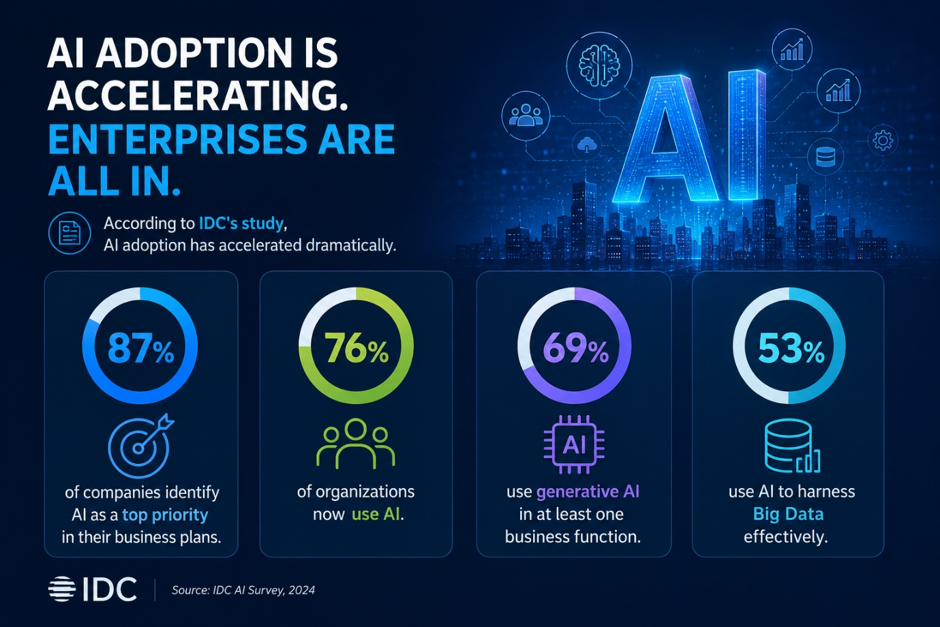
According to IDC’s study, AI adoption has accelerated dramatically, with 87% of companies identifying AI as a top priority in their business plans. The study also reveals that 76% of organizations now use AI, 69% use generative AI in at least one business function, and 53% use AI to harness Big Data effectively.
The problem isn’t AI. The problem is that most organisations are optimising individual tasks rather than transforming entire business systems.
At Prolifics, we believe enterprise AI success requires more than deploying new tools. It requires a structured operating model that combines people, intelligent automation, and business transformation.
That’s why we’ve developed a proven three-pillar approach that helps organizations close the AI productivity gap and transform isolated experiments into enterprise-wide outcomes.
The AI Productivity Gap
Many organizations begin their AI journey with enthusiasm.
Developers receive AI coding assistants.
Business teams experiment with ChatGPT.
Customer service launches a chatbot.
Marketing creates AI-generated content.
Operations explore automation.
Each initiative delivers incremental improvements.
Yet months later, executive dashboards still show:
Software delivery cycles remain slow.
Technical debt continues to grow.
Data isn’t AI-ready.
Business processes remain fragmented.
Operational costs continue to increase.
Productivity gains are difficult to measure.
Why?
Because isolated AI tools don’t create enterprise productivity.
It is created by connected systems, repeatable delivery models, and organizational transformation.
Why AI Experiments Fail to Scale
The biggest misconception about AI is that buying technology automatically creates business value.
In reality, most organizations struggle because they lack three critical elements:
1. AI-enabled people
Employees have access to AI tools but lack structured ways of working.
2. Industrialized delivery
Projects remain manual, inconsistent, and dependent on individual expertise.
3. Business transformation
AI is layered onto existing processes instead of redesigning how work gets done.
Closing the productivity gap requires all three.
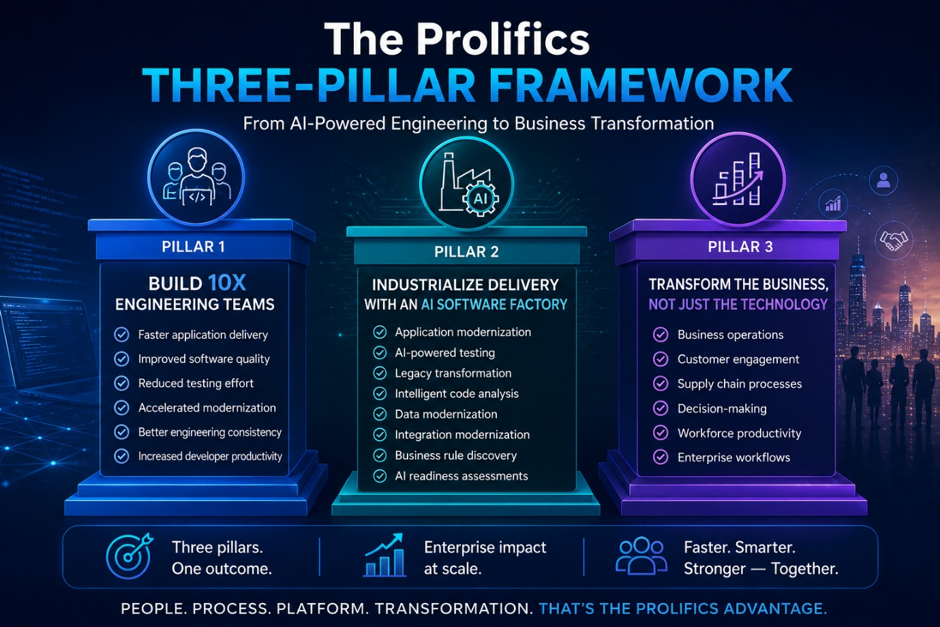
The Prolifics Three-Pillar Framework
At Prolifics, enterprise AI transformation is built on three interconnected pillars that reinforce one another.
Pillar 1: Build 10x Engineering Teams
The future is not about replacing developers.
It is about creating engineers who can accomplish significantly more by combining their expertise with AI.
Our AI-enabled engineering approach empowers teams across the software development lifecycle by integrating intelligent assistants into requirements analysis, architecture, coding, testing, documentation, quality assurance, and modernization.
Rather than automating isolated coding tasks, we create AI-assisted engineering workflows that increase velocity while improving quality.
Benefits include:
Faster application delivery
Improved software quality
Reduced testing effort
Accelerated modernization
Better engineering consistency
Increased developer productivity
Organizations adopting this model move beyond AI-assisted coding to AI-enabled software engineering.
Pillar 2: Industrialize Delivery with an AI Software Factory
Individual productivity improvements are valuable.
Repeatable enterprise delivery is transformational.
The Prolifics AI Software Factory combines reusable accelerators, proven delivery frameworks, automation assets, governance, and AI-powered workflows to consistently deliver outcomes at scale.
Instead of reinventing every engagement, organizations leverage repeatable AI patterns for:
Application modernization
AI-powered testing
Legacy transformation
Intelligent code analysis
Data modernization
Integration modernization
Business rule discovery
AI readiness assessments
This factory-based approach enables organizations to reduce delivery risk while accelerating implementation.
Our repeatable solution model focuses on outcomes that matter most to enterprise leaders:
Increase software delivery speed and quality
Reduce technology costs and technical debt
Accelerate data readiness for AI
Improve operational efficiency
Grow revenue through AI-enabled customer experiences
Rather than isolated projects, enterprises gain a scalable operating model that can be replicated across business units.
Pillar 3: Transform the Business, Not Just the Technology
Organizations achieve the highest ROI when AI becomes embedded into how decisions are made, processes operate, and employees collaborate.
This means reimagining:
Business operations
Customer engagement
Supply chain processes
Decision-making
Workforce productivity
Enterprise workflows
AI becomes an intelligent layer across the organization rather than another disconnected technology investment.
This transformation-first mindset enables organizations to move from experimentation to sustainable competitive advantage.
What Enterprise AI Success Looks Like
When these three pillars work together, organizations begin seeing measurable improvements across the enterprise.
Engineering teams deliver software faster.
Testing becomes intelligent and highly automated.
Legacy modernization accelerates through AI-powered analysis.
Data platforms become AI-ready.
Business rules become discoverable and reusable.
Operations become more predictive.
Customer experiences become more personalized.
Instead of isolated productivity gains, organizations experience enterprise-wide transformation.
The Shift from Automation to Intelligence
The first wave of digital transformation focused on automation.
The next wave focuses on intelligence.
Modern enterprises are moving beyond traditional robotic process automation toward AI-powered agents capable of reasoning, learning, and supporting complex business decisions.
This evolution enables organizations to:
Modernize legacy applications faster
Improve engineering efficiency
Accelerate AI adoption
Enhance decision-making
Reduce operational complexity
Unlock new revenue opportunities
The organizations that embrace this shift today will define tomorrow’s competitive landscape.
Turning AI Investments into Business Outcomes
Enterprise leaders are under increasing pressure to demonstrate measurable returns from AI investments.
Success is no longer measured by the number of AI pilots launched.
It is measured by business outcomes such as:
Faster software delivery
Lower operational costs
Higher engineering productivity
Improved customer experiences
Better business agility
Increased revenue growth
The organizations that achieve these outcomes recognize that AI is not a technology initiative.
It is a business transformation strategy.
Why Prolifics
For more than four decades, Prolifics has helped global enterprises modernize technology, accelerate innovation, and solve complex business challenges.
Today, we combine deep engineering expertise with AI-powered delivery, industry accelerators, and repeatable transformation frameworks to help organizations move confidently from experimentation to enterprise-scale adoption.
Our proven approach combines:
AI-enabled engineering teams
AI Software Factory delivery
Application modernization expertise
AI-powered quality engineering
Data modernization and AI readiness
Intelligent automation
Business transformation consulting
The result is faster implementation, lower risk, measurable productivity improvements, and long-term business value.
The Future Belongs to AI-Native Enterprises
The AI race is no longer about who adopts AI first.
It is about who scales it successfully.
Organizations that connect people, repeatable delivery, and business transformation will create sustainable competitive advantage while others remain trapped in endless experimentation.
The productivity gap is real.
But it is also solvable.
The future belongs to enterprises that transform how they build software, modernize technology, empower employees, and deliver value at scale.
With the right strategy, the right operating model, and the right partner, AI moves beyond experimentation and becomes a measurable business advantage.
Ready to Close the AI Productivity Gap?
Whether you’re modernizing legacy applications, building an AI Software Factory, enabling 10x engineering teams, or transforming enterprise operations with AI, Prolifics can help you accelerate your journey from pilot projects to enterprise-wide impact.
Talk to a Prolifics AI expert today and discover how to turn AI investments into measurable business outcomes.
FAQ’s
What is the enterprise AI productivity gap?
The enterprise AI productivity gap is the disconnect between AI experimentation and measurable business outcomes. Many organizations adopt AI tools but fail to achieve enterprise-wide value because AI is not integrated into business processes and operating models.
Why do enterprise AI initiatives fail to deliver business value?
Enterprise AI initiatives often fail because organizations focus on individual AI tools instead of enabling people, standardizing delivery, and transforming business processes. A scalable AI strategy requires all three.
How can organizations close the enterprise AI productivity gap?
Organizations can close the enterprise AI productivity gap by combining AI-enabled engineering teams, an AI Software Factory for repeatable delivery, and business transformation that embeds AI into operations and decision-making.
What is an AI Software Factory?
An AI Software Factory is a standardized delivery model that combines AI-powered workflows, reusable assets, governance, and automation to accelerate software delivery, improve quality, and reduce implementation risk.
How does enterprise AI improve business outcomes?
Enterprise AI improves business outcomes by increasing engineering productivity, modernizing legacy systems, reducing operational costs, accelerating AI adoption, and enabling data-driven decision-making across the organization.
AI in sales helps organizations increase pipeline without increasing headcount by automating repetitive tasks, improving lead quality, prioritizing opportunities, accelerating sales cycles, and enabling sales teams to spend more time engaging buyers. Rather than replacing sales professionals, AI augments decision-making with predictive insights, workflow automation, and real-time recommendations that improve conversion rates and revenue productivity.
Quick answer:
AI in sales enables organizations to generate more qualified opportunities without expanding sales teams. By combining predictive analytics, generative AI, automation, CRM intelligence, and workflow orchestration, businesses can improve prospecting, qualification, forecasting, proposal creation, and customer engagement while reducing manual effort. The result is higher pipeline velocity, better seller productivity, and improved revenue efficiency.
What Is AI in Sales?
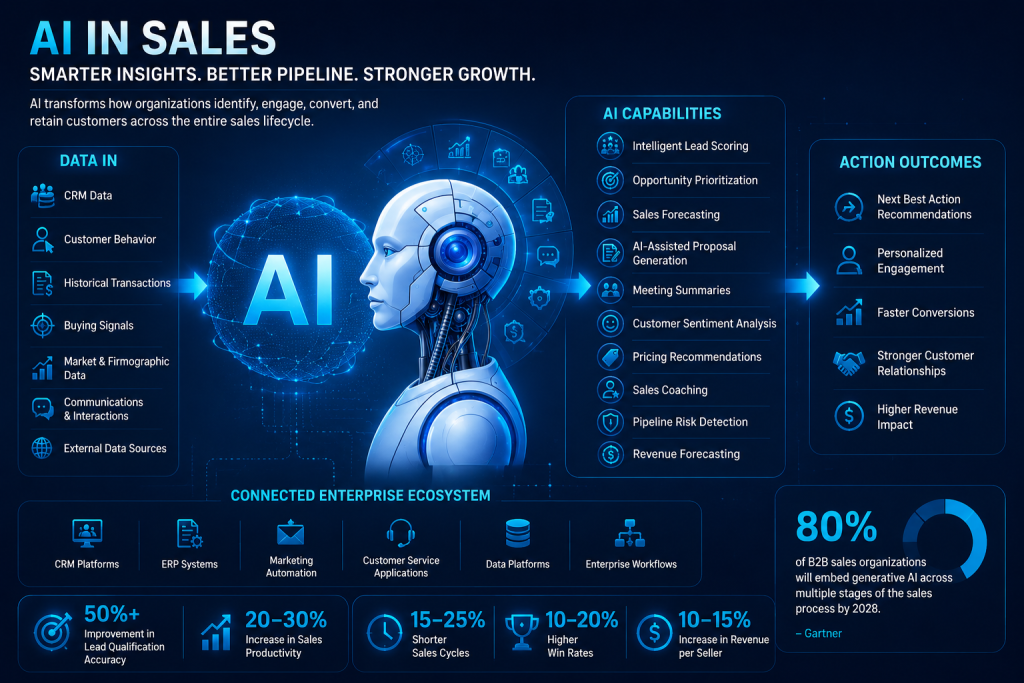
AI in sales is the use of artificial intelligence, machine learning, predictive analytics, generative AI, and intelligent automation to improve how organizations identify, engage, convert, and retain customers. Rather than simply automating administrative work, modern AI analyzes customer behavior, historical transactions, CRM data, buying signals, and external market information to recommend the next best action throughout the sales lifecycle.
Enterprise AI platforms now support:
Intelligent lead scoring
Sales forecasting
Opportunity prioritization
AI-assisted proposal generation
Meeting summaries
Customer sentiment analysis
Pricing recommendations
Sales coaching
Pipeline risk detection
Revenue forecasting
For enterprise organizations, AI becomes even more valuable when integrated with CRM platforms, ERP systems, marketing automation, customer service applications, data platforms, and enterprise workflows. This connected approach allows sellers to work with complete customer context instead of fragmented information.
According to Gartner, by 2028, business-to-business sales organizations are expected to increasingly embed generative AI across multiple stages of the sales process, fundamentally changing seller productivity and buyer engagement.
Why Are Enterprises Using AI to Increase Pipeline Instead of Hiring More Salespeople?
Organizations are adopting AI because revenue growth increasingly depends on improving seller productivity rather than expanding teams. Hiring additional sales representatives increases costs, onboarding time, and management complexity. AI enables existing teams to achieve higher output using the same resources.
Research from McKinsey estimates that generative AI could unlock hundreds of billions of dollars in annual value across sales and marketing by improving customer interactions, content creation, and commercial operations.
Several factors are driving enterprise adoption:
Rising customer acquisition costs
Longer B2B buying cycles
More stakeholders involved in purchasing decisions
Larger volumes of customer data
Increasing pressure to improve forecast accuracy
Growing demand for personalized customer experiences
AI addresses these challenges by automating repetitive work while improving decision quality.
Examples include:
Prioritizing accounts most likely to convert
Identifying buying intent signals
Automatically generating personalized outreach
Summarizing customer meetings
Drafting proposals
Recommending cross-sell opportunities
Predicting stalled deals before they impact revenue
Instead of replacing experienced sales professionals, AI removes low-value administrative work, allowing sellers to spend more time building relationships and closing business.
How Does AI Increase Sales Pipeline Without Increasing Headcount?
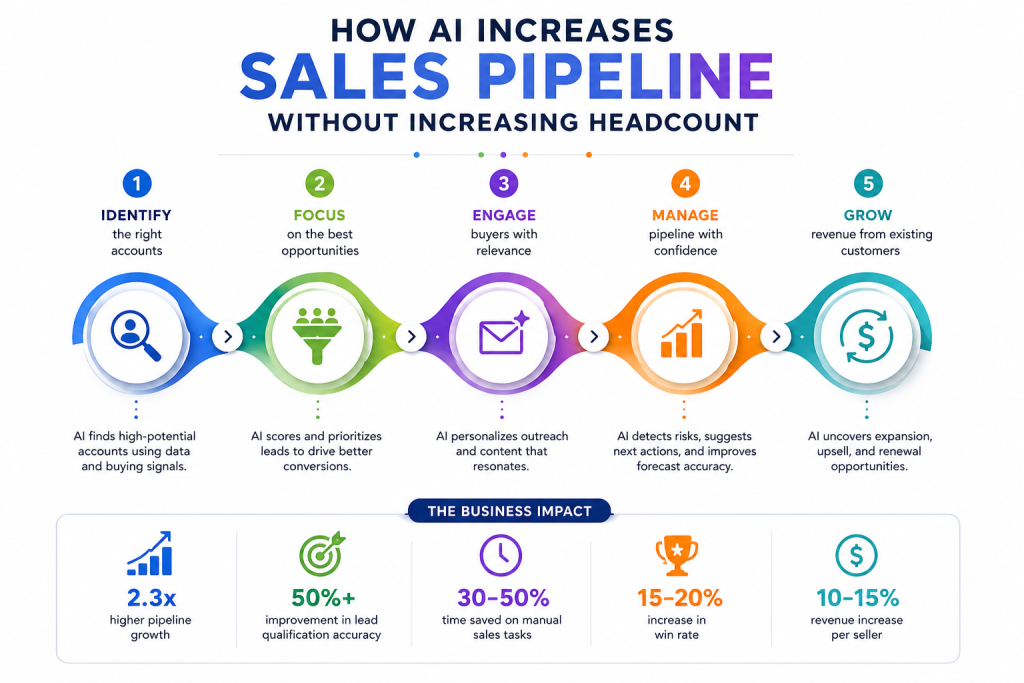
AI increases pipeline by improving efficiency across every stage of the revenue lifecycle.
Instead of relying on additional personnel, organizations improve how existing sellers spend their time.
Prospect Identification
AI continuously analyzes market signals, firmographic data, customer behavior, website activity, and historical conversions to identify high-potential prospects.
Instead of manually searching for leads, sellers receive prioritized account recommendations.
Lead Qualification
Machine learning models score incoming leads using historical win patterns, engagement data, buying intent, company attributes, and sales interactions.
This allows sales teams to focus on opportunities with the highest probability of success.
Personalized Engagement
Generative AI creates personalized emails, meeting preparation notes, account research, presentations, and proposal drafts tailored to each buyer.
This significantly reduces preparation time while improving relevance.
Opportunity Management
AI monitors pipeline health and identifies:
Deals losing momentum
Missing stakeholders
Competitive risks
Next-best actions
Forecast changes
Sales managers gain greater visibility into pipeline quality without manually reviewing every opportunity.
Revenue Expansion
AI identifies:
Cross-sell opportunities
Upsell recommendations
Renewal risks
Customer expansion potential
Instead of only generating new opportunities, AI helps maximize existing customer value.
Which Sales Activities Deliver the Highest ROI with AI?
Not every sales activity delivers the same return on AI investment. Organizations typically see the greatest impact when repetitive work and large volumes of data slow decision-making.
Traditional Sales Process
AI-Enabled Sales Process
Business Impact
Manual lead qualification
Predictive lead scoring
Higher conversion rates
Generic outreach
Personalized AI-generated messaging
Better engagement
Spreadsheet forecasting
Predictive forecasting
Improved forecast accuracy
Manual meeting notes
AI meeting summaries
More selling time
Static proposals
AI-assisted proposal generation
Faster sales cycles
Reactive pipeline reviews
Pipeline risk prediction
Higher win rates
Manual account research
AI account intelligence
Better sales preparation
Organizations often begin with sales assistants before expanding into predictive forecasting, conversational AI, pricing optimization, and autonomous workflow orchestration.
How Can Enterprises Implement AI in Sales Successfully?
Successful AI adoption requires more than deploying a chatbot or adding generative AI to CRM software. Organisations need a structured approach to transformation that aligns people, data, technology, and governance.
1. Assess sales process maturity
Identify repetitive activities, workflow bottlenecks, data quality issues, and manual reporting tasks.
2. Build a trusted data foundation
Improve CRM data quality, customer records, product information, pricing data, and interaction history.
3. Prioritize high-value AI use cases
Focus on measurable outcomes such as:
Lead qualification
Proposal generation
Sales forecasting
Customer insights
Pipeline management
4. Integrate enterprise systems
Connect AI with CRM, ERP, marketing automation, customer support, analytics, and collaboration platforms.
5. Establish governance
Define security, access controls, human oversight, compliance requirements, and model monitoring.
6. Measure business outcomes
Track metrics including:
Pipeline growth
Win rate
Sales cycle duration
Revenue per seller
Forecast accuracy
Customer acquisition cost
Organizations that treat AI as a business transformation initiative rather than a technology project achieve stronger long-term results.
How Is AI Transforming Sales Across Enterprise Industries?
Enterprise AI adoption varies by industry, but the objective remains consistent: improve revenue productivity while delivering better customer experiences.
Healthcare
Healthcare organizations use AI to identify provider engagement opportunities, personalize communications, improve account planning, and support complex sales involving multiple stakeholders.
Financial Services
Banks and insurance providers apply AI for relationship management, customer segmentation, wealth advisory recommendations, opportunity scoring, and regulatory-compliant communications.
Retail
Retail organizations use AI to improve merchandising recommendations, account management, demand forecasting, supplier engagement, and omnichannel customer experiences.
Insurance
Insurance providers leverage AI for broker relationship management, policy recommendations, customer retention, claims insights, and personalized renewal strategies.
Public Sector
Government agencies increasingly use AI-assisted knowledge management, citizen engagement, intelligent document processing, and workflow automation to improve service delivery while managing constrained resources.
What Does a Real-World Enterprise AI Sales Use Case Look Like?
A global healthcare organization managing multiple product portfolios struggled with fragmented customer information spread across CRM systems, marketing platforms, and regional databases. Sales representatives spent significant time researching accounts, preparing proposals, and manually updating customer records.
By implementing an AI-enabled customer intelligence platform integrated with CRM, marketing automation, and analytics systems, the organization created a unified view of each customer. AI prioritized high-value opportunities, generated account summaries, recommended next-best actions, and automated proposal creation.
The results included:
Faster account research
Improved opportunity prioritization
Higher seller productivity
More consistent customer engagement
Better forecast visibility
This type of transformation reflects how enterprise organizations combine AI, integration, automation, and trusted data to improve commercial performance rather than simply adding standalone AI tools.
Which Technologies Power Modern AI Sales Platforms?
Modern enterprise sales AI combines several technologies rather than relying on a single model.
Common capabilities include:
Generative AI
Predictive analytics
Machine learning
Natural language processing
Customer data platforms
Intelligent automation
Agentic AI
Enterprise search
Knowledge graphs
CRM intelligence
Data integration
API-based system connectivity
Cloud-native analytics
These technologies become significantly more valuable when connected across enterprise applications instead of operating independently.
Conclusion
AI in sales enables enterprises to grow their pipeline by improving how existing teams work rather than simply expanding headcount. Organizations that combine trusted data, intelligent automation, predictive analytics, and integrated enterprise systems create more productive sales operations, better customer experiences, and stronger revenue performance. The greatest value comes from treating AI as part of a broader digital transformation strategy, not as a standalone tool. At Prolifics, we help enterprises design and implement AI-powered sales solutions that integrate with existing business systems to deliver measurable commercial outcomes.
Frequently Asked Questions
How can AI increase the sales pipeline without hiring additional sales representatives?
AI increases pipeline by automating repetitive sales tasks, improving lead qualification, identifying buying signals, generating personalized outreach, and recommending next-best actions. This allows sales teams to spend more time engaging prospects and closing deals rather than handling administrative work.
What is the best enterprise AI use case for B2B sales organizations?
Lead scoring, opportunity prioritization, sales forecasting, proposal generation, account intelligence, and pipeline risk detection deliver the highest business value by improving seller productivity and increasing conversion rates.
Does AI replace enterprise sales teams?
No. AI augments sales professionals by handling repetitive tasks and providing actionable insights, allowing sellers to focus on relationship building, negotiations, and closing complex deals.
What data is required to implement AI in sales?
Organizations need high-quality CRM data, customer interaction history, marketing engagement data, product and pricing information, transaction records, and integrated enterprise systems to ensure accurate AI recommendations.
How should enterprises measure AI sales success?
Track metrics such as pipeline growth, conversion rates, forecast accuracy, sales cycle length, revenue per seller, customer acquisition cost, and overall seller productivity to measure AI’s business impact.
Enterprise AI has moved beyond experimentation. Most organizations now see AI as a way to improve productivity, customer experience, decision-making, and operational efficiency. However, many AI initiatives still fail to move from pilot to production because the architecture is not ready to support scale. The real challenge is no longer just choosing the right model or tool. It is building a secure, governed, integrated, and cost-efficient foundation that allows AI to work reliably across departments, systems, and workflows.
At Prolifics, we help enterprises turn AI from isolated experiments into scalable business capabilities. Our approach focuses on the architecture behind AI, including data readiness, system integration, governance, security, quality validation, observability, and cloud performance. By connecting AI strategy with the right enterprise architecture, Prolifics enables organizations to build trusted AI systems that deliver measurable business value and support long-term transformation.
What Is Enterprise AI Architecture?
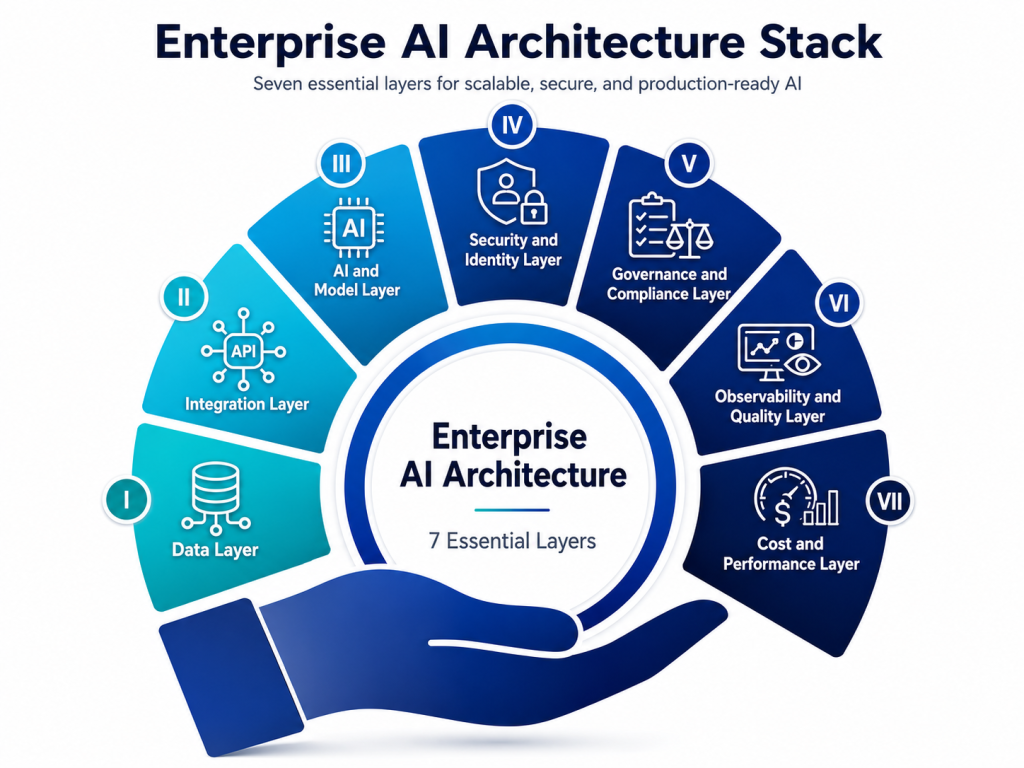
Enterprise AI architecture is the layered technical and operational foundation that enables organizations to deploy, govern, scale, and sustain AI systems across enterprise workflows. It connects seven critical layers data readiness, system integration, AI and model selection, security and identity, governance and compliance, observability and quality, and cost and performance and determines whether AI scales beyond pilots into production-grade enterprise capability.
The CTO’s Core Challenge: Building the Right AI Foundation
The CTO now plays a central role in enterprise AI success. Business teams may identify use cases, and data science teams may build models, but the CTO must ensure that AI fits into the broader enterprise technology landscape. This responsibility includes platform decisions, architecture readiness, integration design, security standards, governance models, and operational resilience.
For CTOs, the real challenge involves building an enterprise AI architecture framework for CIOs, business leaders, and technology teams. This framework must help the organization decide which use cases deserve investment, which platforms should support AI delivery, and which governance controls should guide production deployment.
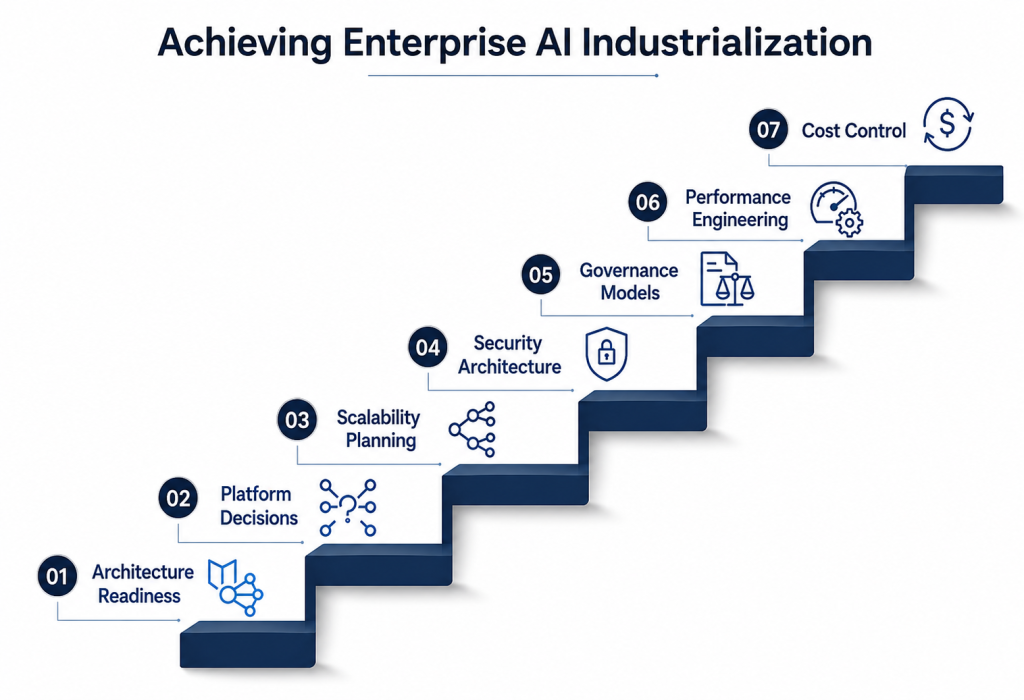
CTOs should evaluate AI readiness across several connected areas.
Architecture readiness determines whether AI moves beyond isolated departmental experiments.
Platform decisions shape flexibility, vendor risk, and long-term scalability choices.
Scalability planning prevents performance issues during wider enterprise adoption phases.
Security architecture protects data across users, prompts, and tools consistently.
Governance models define ownership, approvals, policies, and audit responsibilities clearly.
Performance engineering keeps AI responsive under real production workloads daily.
Cost control aligns model usage with measurable business value outcomes.
This approach helps CTOs move from experimentation to industrialization. It also creates a practical path for how to build a scalable AI architecture for enterprise environments.
The Enterprise AI Architecture Stack
A scalable AI architecture works as a connected stack. Each layer supports the next. If one layer remains weak, the entire system becomes harder to govern, secure, monitor, and scale. This is why enterprise AI architecture best practices 2026 must focus on the full operating model, not only model selection.
I. Data Layer
The data layer forms the foundation of enterprise AI. Models need high-quality, available, governed, and well-contextualized data to produce useful outputs. If data lives in silos, lacks ownership, or carries inconsistent definitions, AI systems will struggle to deliver reliable results.
A strong data layer includes data quality controls, metadata management, lineage, master data practices, and governance policies. It also includes access rules that define which users, systems, and models can use specific datasets. When organizations strengthen the data foundation first, AI systems gain better context and produce more dependable outcomes.
II. Integration Layer
Enterprise AI must connect with real business systems. This includes ERP, CRM, legacy platforms, cloud applications, data warehouses, workflow tools, and customer-facing systems. Without integration, AI can answer questions but cannot support meaningful business execution.
The integration layer uses APIs, event-driven architecture, middleware, connectors, and automation platforms to connect AI with enterprise workflows. This layer matters because business value often comes from action, not only insight. AI must retrieve information, update records, trigger approvals, recommend next steps, and support employees inside their existing processes.
III. AI and Model Layer
The AI and model layer includes large language models, generative AI tools, retrieval-augmented generation, custom machine learning models, AI agents, orchestration frameworks, and prompt management. This layer needs flexibility because enterprise needs will continue to evolve.
Some use cases may need a public LLM. Others may require a private model, a domain-specific model, or a retrieval-based system grounded in approved enterprise knowledge. The architecture must allow teams to choose the right model for the right use case while maintaining consistent controls around quality, security, and cost.
IV. Security and Identity Layer
Security cannot come after AI deployment. AI systems interact with sensitive data, user prompts, enterprise applications, and sometimes external tools. Organizations need strong identity and access management from the beginning.
This layer includes role-based access control, permission boundaries, authentication, encryption, data masking, and secure prompt handling. It also requires clear policies for tool access. If an AI agent can retrieve data, open tickets, update records, or trigger workflows, the organization must define exactly what it can and cannot do.
V. Governance and Compliance Layer
AI governance gives leaders control over how AI systems behave, who owns decisions, and how risks get managed. Governance also supports responsible AI, compliance readiness, and auditability.
This layer includes policy enforcement, approval workflows, model documentation, risk classification, human review, and exception handling. It also helps organizations prove that AI systems follow business rules, regulatory requirements, and ethical standards. For regulated industries, governance becomes essential before AI can support production workflows.
VI. Observability and Quality Layer
AI systems behave differently from traditional software. They can produce inconsistent outputs, hallucinate, miss context, or respond differently when prompts change. This makes observability and quality engineering critical.
This layer includes monitoring, testing, output validation, hallucination checks, bias checks, performance tracking, drift detection, and user feedback loops. It helps teams understand how AI behaves in production and whether outputs remain accurate, relevant, and safe. Continuous validation builds trust and reduces operational risk.
VII. Cost and Performance Layer
AI can create new cost pressures through cloud infrastructure, model usage, token consumption, storage, integration traffic, and monitoring tools. Without cost visibility, AI programs can become expensive before they become valuable.
The cost and performance layer includes FinOps, usage tracking, latency management, infrastructure optimization, capacity planning, and model selection controls. This layer helps leaders connect AI spending with business outcomes. It also helps technical teams improve speed, reliability, and scalability across production workloads.
Why Agentic AI Raises the Stakes
Agentic AI changes the enterprise risk profile. Traditional generative AI often responds to a question or creates content. Agentic AI can take action. It can use tools, interact with systems, trigger workflows, complete tasks, and make decisions within defined boundaries.
This shift raises the importance of architecture. If an AI agent connects with enterprise systems, it needs strict access control, clear instructions, business policy awareness, and real-time monitoring. Otherwise, a small error can move from a wrong answer to a wrong action.
Organizations need these controls before deploying agentic AI.
Guardrails keep agents within approved actions and business policies safely.
Human review protects high-risk decisions before automation executes them fully.
Tool controls limit access across systems, data, and workflows securely.
Audit logs show what agents did, when, and why clearly.
Failure handling stops flawed actions before they create operational disruption.
Continuous monitoring detects drift, misuse, and unexpected behavior patterns early.
This is especially important for organizations exploring how to design AI systems that scale across departments. As AI moves into finance, sales, service, operations, HR, and supply chain, the number of connected workflows increases. Architecture must manage that complexity without slowing innovation.
What CTOs Should Prioritize Before Scaling AI
CTOs do not need to solve every AI challenge at once. They need a structured roadmap that strengthens the foundation while moving high-value use cases into production. The goal should focus on scalable patterns, not isolated wins.
These priorities help CTOs prepare enterprise AI for scale.
Modernize data foundations before expanding AI into critical enterprise operations.
Connect core systems through APIs and integration platforms for AI workflows.
Build governance early so teams scale with consistent controls confidently.
Secure AI access with clear identity and permission models enterprise-wide.
Validate AI outputs continuously across quality and risk dimensions measurable.
Control infrastructure and model costs through FinOps discipline and visibility.
Design reusable patterns that support cross-department AI adoption at enterprise scale.
Move high-value use cases into production with measurable outcomes quickly.
These priorities create a practical roadmap for moving beyond experimentation. They also help leaders avoid scattered AI adoption, where each department builds its own tools, rules, and data flows. A reusable architecture helps the business scale faster while maintaining control.
The Business Impact of Getting AI Architecture Right
Strong AI architecture creates business value because it turns AI from a set of tools into an enterprise capability. When architecture connects data, systems, security, governance, and workflows, AI becomes easier to trust and easier to use.
Organizations can expect several business outcomes from stronger AI architecture.
Faster decisions emerge when teams trust accessible enterprise data consistently.
Better customer experiences improve engagement, service, and personalization across channels.
Improved productivity frees employees from repetitive manual work every day.
Smarter automation connects insights with real business execution at scale.
Lower operational risk comes from governance and continuous validation practices.
Reliable AI outcomes build confidence across leadership and users alike.
Faster production movement turns pilots into repeatable enterprise capabilities successfully.
The value also compounds over time. Once the architecture supports one production use case, teams can reuse patterns for other use cases. A customer service AI assistant can share architecture patterns with sales enablement, knowledge management, compliance review, or IT support. This reuse lowers delivery effort and improves consistency.
Strong architecture also helps leaders make better investment decisions. Instead of funding disconnected experiments, they can prioritize use cases that align with business value, technical readiness, and operational feasibility. This improves the return on AI investment and reduces wasted effort.
Conclusion: Enterprise AI Success Depends on Architecture
Enterprise AI success does not come from models alone. Models matter, but they cannot create sustained value without the right architecture around them. Organizations need clean data, connected systems, secure access, strong governance, continuous validation, and cost-aware infrastructure.
This is why enterprise AI has become an architecture problem. The next stage of AI adoption will reward companies that build scalable foundations, not companies that only run more pilots. CTOs and technology leaders must now create the operating model that turns AI from experimentation into enterprise capability.
A secure, scalable, governed, and connected architecture gives AI the structure it needs to support real business outcomes. It helps organizations move faster, reduce risk, improve trust, and scale innovation across departments. In the long run, the enterprises that solve the architecture problem will capture the greatest value from AI.
AI-powered operational decisions help organizations automate routine business decisions by combining data, analytics, business rules, and artificial intelligence. Despite significant investments in digital transformation, many enterprises still rely on spreadsheets, emails, manual reviews, and disconnected systems to make operational decisions, creating delays, inconsistencies, and missed opportunities.
Organizations that implement AI-powered operational decisions can improve speed, accuracy, and scalability while allowing employees to focus on higher-value work. By embedding intelligence directly into workflows, businesses can move from reactive decision making to proactive, data-driven operations.
What Are AI-Powered Operational Decisions?
AI-powered operational decisions use artificial intelligence, automation, and real-time data to support or automate routine business decisions. While many organizations still depend on manual processes due to legacy systems, fragmented data, and governance concerns, AI can help improve decision speed, consistency, compliance, and operational efficiency across healthcare, finance, insurance, retail, and public sector environments.
AI-powered operational decisions are business decisions made or supported by artificial intelligence within day-to-day operations. These decisions typically involve repetitive, high-volume activities such as approving transactions, prioritizing customer requests, routing service tickets, forecasting inventory, processing claims, or managing workflows.
AI-powered operational decisions are the use of artificial intelligence, machine learning, predictive analytics, and business rules to evaluate data and recommend or execute actions within operational processes. Unlike strategic decisions made by executives, operational decisions occur continuously across business functions and directly impact efficiency, customer experience, and business outcomes.
Many enterprises have invested heavily in digital transformation initiatives, cloud migration programs, enterprise automation, and system integration projects. However, the actual decision-making process often remains dependent on human intervention. Employees spend valuable time gathering information from multiple systems, validating data, and determining the next best action.
According to IBM research, organizations increasingly recognize that AI delivers the greatest value when embedded directly into business processes rather than deployed as standalone technology. This shift is driving interest in operational decision intelligence and AI-driven automation.
Why Are Operational Decisions Still Manual in Most Organizations?
Operational decisions remain manual because many organizations have modernized technology without fully modernizing how decisions are made.
Legacy applications, siloed data sources, fragmented workflows, and inconsistent business rules create significant barriers to automation. Even organizations with advanced analytics platforms often struggle to operationalize insights at scale.
Several factors contribute to manual decision making:
Data exists across multiple systems without unified visibility.
Business rules are undocumented or inconsistently applied.
Compliance requirements require oversight and auditability.
Legacy systems lack modern integration capabilities.
Employees rely on institutional knowledge rather than standardized processes.
A healthcare provider, for example, may have patient information spread across electronic health records, scheduling systems, insurance databases, and billing applications. Staff often manually review information from multiple sources before making decisions regarding authorizations, scheduling, or patient prioritization.
Similarly, insurance organizations frequently depend on manual reviews for claims processing, fraud detection, and policy administration, despite having access to large volumes of structured and unstructured data.
Research from Gartner suggests that organizations continue to face challenges moving from descriptive analytics to automated decision execution. Many enterprises generate insights but still rely on human intervention to determine actions.
The result is slower response times, inconsistent outcomes, increased operational costs, and limited scalability.
How Does AI Improve Operational Decision Making?
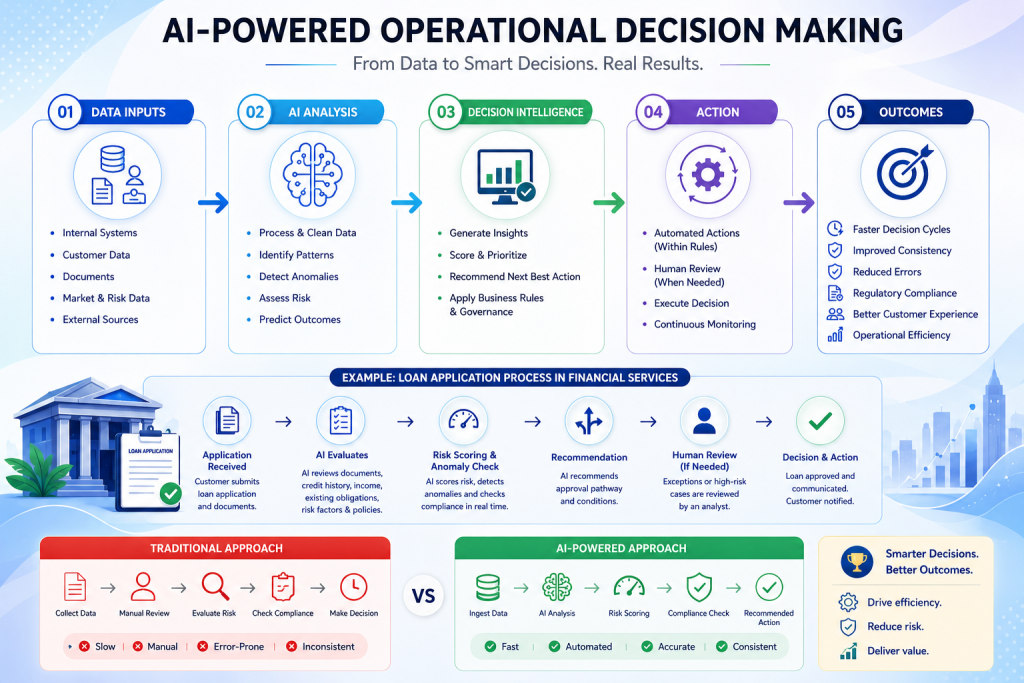
AI improves operational decision making by analyzing large volumes of data, identifying patterns, generating recommendations, and automating routine actions within predefined business rules.
Instead of requiring employees to manually gather and evaluate information, AI systems can continuously assess operational conditions and recommend the next best action in real time.
The benefits include:
Faster decision cycles
Improved consistency
Reduced human error
Enhanced regulatory compliance
Better customer experiences
Increased operational efficiency
For example, a financial services organization processing loan applications may traditionally require analysts to review documentation, credit history, risk factors, and compliance requirements manually. AI can evaluate these factors instantly, identify anomalies, score risk, and recommend approval pathways while maintaining governance controls.
A retail organization can use AI-driven forecasting models to analyze historical sales, inventory levels, market conditions, and seasonal demand. This enables automated inventory replenishment decisions that reduce stockouts and excess inventory.
Modern AI platforms can also combine machine learning with enterprise automation technologies, workflow orchestration, and business process management systems. This creates a connected decision-making ecosystem where insights automatically trigger actions.
According to McKinsey, organizations that successfully deploy AI across business operations can achieve significant productivity improvements while accelerating decision velocity and operational performance.
Which Operational Decisions Deliver the Fastest AI ROI?
The highest-return opportunities are operational decisions that occur frequently, follow predictable patterns, and involve significant manual effort.
Organizations often achieve measurable results by focusing on decisions that directly impact revenue, cost reduction, customer experience, or risk management.
Common high-value use cases include:
Industry
Operational Decision
Potential Benefit
Healthcare
Prior authorization routing
Faster patient care
Insurance
Claims triage
Reduced processing time
Banking
Loan prequalification
Improved customer experience
Retail
Inventory replenishment
Lower carrying costs
Public Sector
Citizen service routing
Faster service delivery
Manufacturing
Maintenance scheduling
Reduced downtime
Consider a nationwide healthcare distributor that uses AI to forecast product demand. By analyzing purchasing patterns and market trends, the organization can make more accurate inventory decisions, reducing inventory carrying costs while improving product availability.
Similarly, insurance providers can automate claims classification and fraud detection processes, enabling adjusters to focus on complex cases rather than routine assessments.
The most successful AI initiatives often begin with targeted operational decisions before expanding into broader enterprise automation programs.
How Can Organizations Move From Manual Decisions to AI-Assisted Decisions?
Organizations should adopt a phased approach that combines data modernization, governance, process optimization, and AI deployment.
Successful transformation requires more than implementing new technology. It requires establishing trust, transparency, and operational readiness.
6 Steps to Implement AI-Powered Operational Decisions
Organizations that follow this approach can reduce risk while building confidence in AI-generated recommendations.
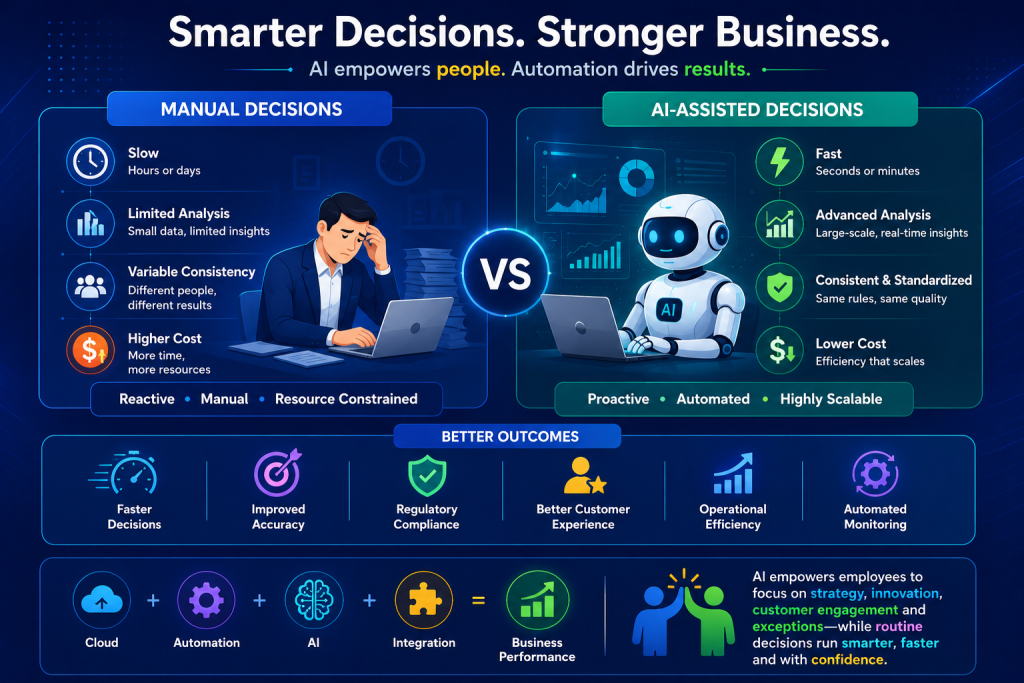
What Is the Difference Between Manual and AI-Assisted Decision Making?
The difference between manual and AI-assisted decision making lies in speed, scalability, consistency, and the ability to act on data in real time.
Capability
Manual Decisions
AI-Assisted Decisions
Speed
Hours or days
Seconds or minutes
Data Analysis
Limited
Large-scale, real-time
Consistency
Variable
Standardized
Scalability
Resource constrained
Highly scalable
Compliance Tracking
Manual audits
Automated monitoring
Customer Experience
Delayed responses
Faster service
Decision Accuracy
Human dependent
Data-driven insights
Operational Cost
Higher
Lower over time
AI-assisted decision making does not eliminate human oversight. Instead, it enables employees to focus on exceptions, strategy, customer engagement, and innovation while routine decisions are handled more efficiently.
This approach aligns with broader digital transformation initiatives that seek to combine enterprise automation, cloud migration, AI, and system integration to improve business performance.
Conclusion
AI-powered operational decisions help organizations move beyond manual processes and unlock greater speed, consistency, and business value. While many enterprises have modernized applications and infrastructure, operational decision making often remains dependent on human effort, disconnected systems, and fragmented data.
By combining AI, enterprise automation, digital transformation, cloud migration, and system integration, organizations can create more intelligent operations that scale efficiently and respond faster to changing business conditions. Prolifics helps organizations design and implement AI-driven operational decision solutions that align technology investments with measurable business outcomes.
Sources: IBM Institute for Business Value, Gartner Research on Decision Intelligence, McKinsey Global Institute AI Research.
How can AI improve operational decision making in enterprises?
AI improves operational decision making by analyzing data, identifying patterns, and generating recommendations or automated actions. This helps organizations reduce delays, improve consistency, lower operational costs, and make faster decisions across business processes.
What operational processes should organizations automate first?
Organizations should prioritize high-volume, repetitive decisions such as claims processing, inventory management, customer service routing, loan prequalification, scheduling, and workflow approvals because they often deliver the fastest return on investment.
Is AI replacing operational decision makers?
No. Most enterprise AI initiatives focus on augmenting decision makers rather than replacing them. AI handles data analysis and routine evaluations while employees retain oversight, governance, exception handling, and strategic responsibility.
What challenges prevent organizations from automating operational decisions?
Common challenges include legacy systems, fragmented data, inconsistent business rules, regulatory requirements, integration complexity, and limited trust in AI-generated recommendations. Addressing these challenges requires both technology modernization and governance.
How do organizations measure success from AI-powered operational decisions?
Organizations typically measure success through decision speed, operational efficiency, cost reduction, customer satisfaction, compliance improvements, productivity gains, and business outcomes such as revenue growth or reduced risk exposure.
Prolifics has been helping clients navigate digital transformation for nearly 50 years, through mainframe to client-server, on-premise to cloud, waterfall to agile. Multiple waves of technology change, and each time the same essential challenge: working out what the shift actually means for how software gets built and delivered.
The AI wave is something different.
Previous shifts changed the tools engineers used. This one is changing what an engineer is and what software itself looks like. The skills that defined seniority a few years ago are being redistributed. Design decisions that once took weeks of experienced hands can happen in hours. Solutions that would have required large teams and long timelines are being assembled in days. Software is being fundamentally reimagined: how it’s conceived, how it’s built, and what it’s capable of. The organizations that grasp this early and act on it, not just study it, will move at a pace that becomes very hard for others to match.
What sets this moment apart for us is that we’re not observing this shift from the outside. We’re living it. Prolifics has been transforming our own engineering workflows, building our own AI-powered tools, and accumulating hard-won experience in what works and what doesn’t. When we talk to clients about AI transformation, we speak from inside the journey.
Every few months, we run an Innovation Spotlight: a session where engineering teams share what they’ve actually built, using live demos rather than slides. The June 2026 session gave us the clearest view yet of how far that transformation has come, and what it looks like when it’s working. The numbers surprised even us.
Here’s what we showed.
$6 Million in Impact. Five AI-Powered Assets. Eight Weeks of Work.
Before the demos started, we shared some context on where the investments have landed.
Over the past few months, Prolifics’ AI initiatives have generated approximately $6 million in business impact across customer wins and delivery efficiencies. We’ve produced five AI-powered engineering assets that are already running in live client engagements. And the lessons from building those assets, including the hard ones, have shaped how we now approach every new project.
Those are the headline numbers. The demos showed how we got there.
22 Applications. 2 Months. $660 in AI Tooling.
The first demo came from our internal automation team, led by Ravi Thalluri, and the numbers they opened with set the tone for the entire session.
In two months, a nine-person team built 22 production applications. When they measured what that would have cost using traditional methods, they calculated 13.5 person-years of equivalent effort, delivered in eight weeks. Total AI tooling spend across the entire project: $660.
The productivity gains came from a disciplined shift in how software gets built.
Traditional delivery cycles are slow at the back end , requirements get written, code gets built, and the rework happens after shipping, when it’s most expensive. Ravi’s team inverted this. Instead of writing specification documents, they use AI to build a working prototype in days, put it in front of stakeholders immediately, and get feedback on something tangible. Rework happens at the design stage. Code generation only begins once the prototype is approved.
One example from the session illustrated the impact. The team took a flat financial reporting table, rows of numbers, sorted alphabetically, that you had to interpret manually, and transformed it into a visual management dashboard: KPI cards, drill-down detail by business entity, and a live revenue forecast that overlays pipeline data to show where the business lands at different conversion rates. Time from idea to prototype: two days. Time from approved prototype to production: seven days.
When questions came in about governance, specifically, whether generating code ten times faster means you need ten times as many senior engineers to review it, Ravi’s answer was instructive. For every utility built, the team creates a test harness alongside the prototype. The harness encodes non-negotiables: how the UI renders, how calculations work, how screens navigate, how totals reconcile. Every change to the prototype runs against the harness. That same harness ships to production.
The team of nine, most with around a year of experience, are producing output that competes with senior engineers because AI is handling the design heavy lifting. But accountability stays with the team. The AI generates; humans verify, own, and ship.
The return on the AI tooling investment: 225x.
One Customer in Two Weeks → Twenty Customers in a Day
The second strand of demos shifted to what this looks like when applied to client work at scale – and how purpose-built AI factories change the economics of complex migrations.
Rajeev Sharma presented the work his team built for a large global logistics provider migrating from legacy integration platforms (BizTalk and Seeburger) to MuleSoft. This is the kind of project that’s traditionally expensive and slow, dozens of customers, hundreds of integration flows, significant manual effort at every step.
The team built a purpose-specific migration factory using Prolifics’ Agentic Assembly Framework (AAF). The process: ingest the client’s existing integrations, generate a structured catalog using AI and custom scripts (data formats, flow direction, protocol, complexity), then spin up agents that produce MuleSoft-ready canonical files, DataWeave transformation files, and push the artifacts directly to the client’s GitHub. The demo showed this running live, selecting a customer, triggering the migration, watching the agent work in real time, and downloading the generated artifacts.
Before the factory: one customer migration took one to two weeks. After: twenty customer migrations in a single day.
And the asset doesn’t expire at the end of this engagement. The same framework, tuned for BizTalk today, can be adapted for Seeburger, Lobster, or WebMethods tomorrow. Each engagement makes the factory more capable.
From Jira Ticket to Coded Test Stub – Without Leaving the Platform
The testing side of the software delivery lifecycle has its own version of this problem: the gap between a vague ticket and a testable, automated requirement burns significant team time.
Our team demonstrated work built for a major financial services client using Quality Fusion, Prolifics’ test automation platform. The client was onboarding multiple acquired entities, user stories were incomplete, and the engineering team was losing time bridging the gap manually.
The solution: two AI-driven capabilities embedded directly into Quality Fusion.
Starting from a sparse one-liner Jira story, the platform generates a fully enriched version, business value, acceptance criteria, edge cases, grounded in existing project knowledge and linked artefacts. From there, one click produces BDD scenarios in Gherkin format. Another generates functional test cases. A third produces Java code stubs that the automation team can build from directly. Everything syncs back to Jira.
The full chain, vague ticket to testable, coded test stub, in one tool, with no manual handoffs.
The Architecture That Makes It All Composable
Running through every demo in the session was a structural point worth making explicit: the Agentic Assembly Framework.
Every time an AI capability is built as a standalone tool, it risks becoming a silo, hard to share, impossible to combine with the next project’s agents. AAF is Prolifics’ answer to that. It’s a framework for building AI agents and tools in a standardised way so that they can be composed, recomposed, and reused across different software factories and business applications.
The University of Lancashire migration demo made this concrete. The platform ingested the university’s existing integration code, extracted domain concepts, business logic, and use cases, and generated data mappings between systems, including bridge mappings for moving from an on-premise system to SaaS. The test generation capabilities shown in the Quality Fusion demo ran inside the same interface, because they’re built on the same framework.
The reference implementation, a working e-commerce application, showed the architectural shift this enables. Instead of a separate API endpoint for every piece of business logic, the backend becomes a single endpoint backed by a dynamic agent that routes to the right tool based on context. Configure a tool, expose it through AAF, and the agent orchestrates everything.
Alongside AAF, we’ve built an AI Workbench: a management layer for the toolkits running in any given environment. At runtime, you can see what agents and tools are active, what’s being called, and what each interaction costs in tokens. That last point is one of the disciplines that makes agentic systems viable at scale, controlling token burn so that the economics work as you grow.
Finding Where Agents Belong – Before You Build Anything
Not every process should be automated. Not every workflow is a good fit for agentic AI. Knowing which is which is often where organizations get stuck.
Salem Hadim presented Prolifics’ approach to Agentic Business Transformation, a structured consulting engagement designed to answer exactly that question before a line of code gets written.
The process runs in structured workshops. Current workflows get mapped, every persona and task gets documented, and each use case gets scored on two dimensions: the value that automation would generate, and how well the process actually fits an agentic model. Processes that are deterministic, standardised, and data-complete score well. Everything else gets deprioritized – or ruled out entirely.
Prolifics ran this process internally, across HR, resource management, and sales operations. The scoring identified which processes to build first and sized the potential return before any investment was committed.
For the HR onboarding process, the numbers were clear: more than 1,500 hours saved from a 2,000-hour total, a reduction of over 70%. Factoring in implementation and running costs, the projected ROI landed at 56%. The sales process scored higher.
Those projections are now being built. Abhishek Mishra demoed the first steps of the HR onboarding toolkit live: scanning new joinee records, drafting personalised welcome emails via agent, and surfacing document status from the onboarding portal in real time, with plain-language queries answered on the spot. Three steps live. Thirty to forty more are in development.
What This Means for Organizations Undergoing Their Own AI Transformation
The question we hear most from clients is some version of: “Where do we actually start?”
The June session gave a practical answer, not through theory, but through working examples at every layer of the software delivery lifecycle.
For engineering teams, the shift is about changing how work gets structured: using AI for design heavy lifting, generating from approved prototypes, and testing with harnesses rather than hoping. For delivery at scale, it’s about building purpose-specific factories, not applying off-the-shelf AI to generic problems, but building agents tuned to the specific transformation you’re running. And for business operations, it’s about scoring before building, and understanding where agents genuinely reduce effort versus where they add complexity.
Across all of it, the human accountability stays. The AI amplifies; engineers direct, review, and own the outcome.
The results from June, $6 million in impact, 225x ROI on tooling, twenty migrations a day, 70% reduction in operational hours, aren’t projections. They’re what’s already running.
Interested in what an AI-powered software factory or agentic business transformation could look like for your organization?
FAQ’s
How much ROI can AI tooling deliver for software engineering teams?
Prolifics achieved a 225x return on AI tooling investment – delivering 13.5 person-years of engineering output in 8 weeks at a total AI tooling cost of $660.
What is the Agentic Assembly Framework (AAF)?
AAF is Prolifics’ proprietary framework for building composable AI agents that can be reused across software factories and business applications – enabling structured, scalable agentic delivery.
How does AI reduce software delivery timelines?
By using AI to generate working prototypes in 2 days, validate with stakeholders before writing code, and ship to production in 7 days – replacing traditional slow requirement-to-rework cycles.
How long does a MuleSoft migration take with AI automation?
With Prolifics’ AI-powered migration factory, 20 customer migrations are completed in a single day – compared to 1–2 weeks per customer using traditional methods.
What is Agentic Business Transformation?
It’s a structured consulting process by Prolifics that maps and scores business workflows on automation value and AI-fit before any code is written – identifying ROI-positive use cases first.
Artificial intelligence is reshaping how organizations plan, sell, forecast, and grow revenue. Sales leaders now face growing pressure to speed up deal cycles, improve forecast accuracy, and deliver personalized customer experiences while controlling costs.
Through AI sales lifecycle optimization, enterprises can make faster, data-driven decisions across the buyer journey.
At Prolifics, we help organizations modernize sales operations with automation, analytics, machine learning, and intelligent decision support. By embedding AI across the sales lifecycle, businesses can accelerate growth, improve productivity, and build a more predictable revenue engine.
What is AI Sales Lifecycle Optimization?
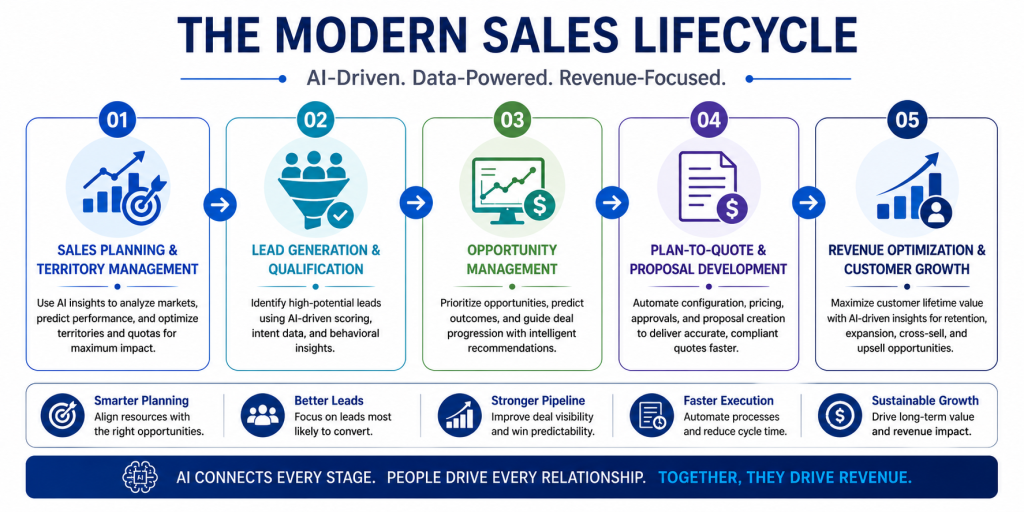
AI sales lifecycle optimization is the use of artificial intelligence, including machine learning, predictive analytics, and agentic AI to automate and improve every stage of B2B revenue generation: from sales planning and lead qualification to plan-to-quote automation, CPQ, pricing, and post-sale revenue growth.
Understanding the Sales Lifecycle from Planning to Revenue
The modern sales lifecycle encompasses every activity that influences revenue generation, from strategic planning and lead acquisition to quoting, deal closure, customer retention, and expansion. Each stage contributes directly to business performance and customer satisfaction.
AI enhances visibility, automation, and decision-making across this lifecycle. Instead of managing isolated activities, organizations can create connected, data-driven sales ecosystems that continuously improve performance and outcomes.
The following are key stages of the modern sales lifecycle:
Sales Planning & Territory Management.
Lead Generation & Qualification.
Opportunity Management.
Plan-to-Quote & Proposal Development.
Revenue Optimization & Customer Growth.
When organizations integrate AI across these stages, they gain the ability to anticipate customer needs, identify opportunities earlier, and respond more effectively to market changes.
AI in Sales Planning, Forecasting, and Territory Optimization
AI-Powered Sales Planning
Effective sales planning requires a deep understanding of customer behavior, historical performance, competitive dynamics, and market trends. AI analyzes vast amounts of structured and unstructured data to identify patterns that human teams may overlook.
Machine learning models can evaluate previous sales outcomes, customer purchasing trends, seasonal fluctuations, and economic indicators to generate more accurate planning recommendations. Sales leaders can use these insights to set realistic targets, allocate resources efficiently, and prioritize strategic accounts.
These capabilities deliver several advantages:
Forecast future demand using historical and real-time intelligence.
Allocate resources efficiently across high-value markets and accounts.
Improve strategic planning through actionable predictive business insights.
AI-Driven Revenue Forecasting
Revenue forecasting remains one of the most challenging responsibilities for sales leadership. Traditional forecasting often depends on subjective assessments and outdated spreadsheets, resulting in inconsistent projections.
AI improves forecasting accuracy by continuously analyzing pipeline activity, customer engagement signals, opportunity progression, and historical conversion patterns. The system identifies risks and opportunities in real time, helping leaders make informed decisions before issues affect revenue performance.
Organizations gain significant value through:
Improve forecast accuracy using continuously updated predictive models.
Detect revenue risks before impacting quarterly business performance.
Provide executives with greater pipeline visibility and confidence.
AI-Based Territory Optimization
Sales territory management directly influences productivity and revenue generation. Uneven territory assignments often create workload imbalances and missed opportunities.
AI evaluates geographic data, market potential, customer density, buying patterns, and seller capacity to optimize territory structures. Organizations can align resources more effectively and ensure sales representatives focus on the highest-value opportunities.
Key advantages include:
Balance territories based on opportunity potential and workload.
Expand market coverage through intelligent territory assignment strategies.
Increase productivity by reducing inefficient account management activities.
Smarter Lead Generation and Opportunity Prioritization
Traditional lead qualification processes often depend on manual scoring systems and subjective judgment. While these methods can provide value, they frequently miss emerging opportunities and consume significant sales resources.
AI changes this approach by evaluating thousands of behavioral and demographic signals simultaneously. It identifies prospects most likely to convert and continuously updates lead scores based on real-time activity.
Traditional vs AI-Powered Lead Management
Traditional lead management often depends on manual scoring, broad targeting, and static qualification rules. AI-powered lead management uses predictive insights and real-time behavior to prioritize better opportunities.
Traditional Approach
AI-Powered Approach
Manual lead scoring
Predictive lead scoring
Broad prospect targeting
Precision audience targeting
Reactive sales engagement
Proactive opportunity identification
Static qualification criteria
Dynamic behavioral analysis
Limited scalability
Scalable real-time prioritization
AI-powered lead management helps organizations focus resources on opportunities with the highest probability of success. By combining predictive analytics, intent data, and behavioral insights, sales teams improve conversion rates while reducing time spent on low-value prospects.
This capability becomes especially important for organizations seeking how to implement AI in B2B sales process to increase win rates, as better lead qualification directly influences pipeline quality and revenue outcomes.
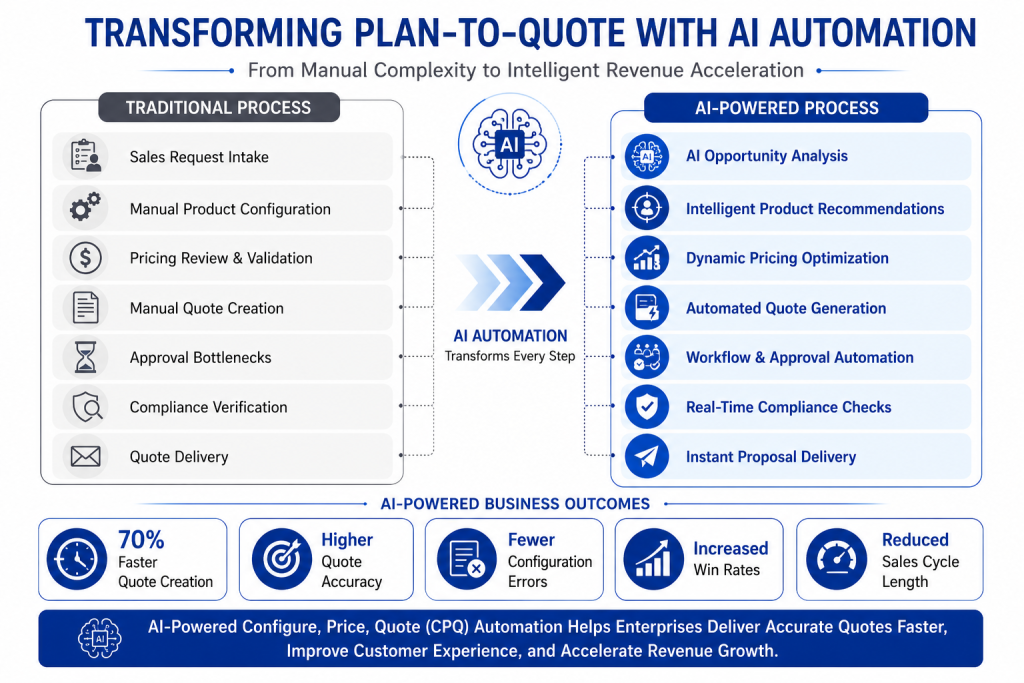
Transforming Plan-to-Quote with AI Automation
For many enterprises, the plan-to-quote process represents one of the most complex and time-consuming stages of the sales lifecycle. Multiple stakeholders, pricing rules, approval workflows, product configurations, and compliance requirements often create bottlenecks that delay deal progression.
AI plan-to-quote automation simplifies and accelerates these activities by automating repetitive tasks and improving decision-making throughout the quoting process.
One of the most impactful capabilities involves AI-powered configure price quote automation for enterprise sales. Intelligent CPQ systems help sales teams configure products accurately, recommend complementary solutions, and generate compliant pricing structures based on customer requirements.
AI also improves quote generation by analyzing historical deals, customer preferences, and business rules. Instead of manually creating proposals, sales representatives can generate accurate, customized quotes within minutes.
Additional AI capabilities include:
Automated product and solution recommendations.
Intelligent quote generation based on customer requirements.
Approval workflow automation and escalation management.
Compliance validation and pricing governance enforcement.
Real-time error detection during quote creation.
These improvements deliver measurable business outcomes:
Accelerate quote delivery for improved customer responsiveness.
Reduce manual effort across complex enterprise sales processes.
Improve quote accuracy through automated validation and controls.
Enhance customer experience with faster proposal turnaround times.
Organizations seeking to reduce sales cycle length with AI automation for enterprise deals often achieve significant improvements through AI-enabled quoting and approval processes. Faster quote generation enables buyers to make decisions sooner while helping sellers maintain momentum throughout the sales journey.
AI-Powered Pricing, Proposals, and Sales Engagement
AI-Powered Pricing
Pricing decisions have a direct impact on revenue, profitability, and competitiveness. Many organizations still rely on static pricing models that fail to account for changing market conditions.
AI analyzes customer behavior, competitor activity, historical transactions, and market trends to recommend optimal pricing strategies. Dynamic pricing models help organizations maximize margins while maintaining competitiveness.
These systems can identify pricing opportunities that increase profitability without negatively affecting win rates. Sales teams gain confidence knowing recommendations are backed by real-time market intelligence.
AI-Generated Proposals
Proposal creation often consumes valuable selling time. AI helps automate this process by generating personalized proposals that align with customer requirements and organizational standards.
Modern AI systems can:
Create tailored proposal content automatically.
Recommend relevant case studies and references.
Maintain consistent messaging across sales teams.
Reduce administrative effort during proposal development.
This approach improves efficiency while ensuring every proposal reflects organizational expertise and value propositions.
Intelligent Sales Engagement
AI also enhances how sales teams interact with prospects and customers. Intelligent engagement platforms analyze conversations, emails, meetings, and customer behavior to recommend next-best actions.
Examples include:
Personalized outreach recommendations.
Automated follow-up suggestions.
Conversation intelligence and coaching insights.
Opportunity progression guidance.
These capabilities help sellers engage more effectively while improving customer experiences throughout the buying journey.
The result is stronger pipeline performance, improved conversion rates, higher seller productivity, and more consistent revenue generation.
Revenue Optimization Beyond the Sale
Revenue growth does not end when a contract is signed. Long-term business success depends on customer retention, expansion opportunities, and maximizing lifetime value.
AI enables organizations to move beyond transactional selling and focus on sustained customer growth.
Customer Retention Analytics
Retaining existing customers often costs less than acquiring new ones. AI analyzes customer engagement patterns, support interactions, usage trends, and satisfaction metrics to identify retention risks before they become serious problems.
Organizations can proactively address concerns and strengthen customer relationships through targeted interventions.
Churn Prediction
Machine learning models detect early indicators of customer attrition by analyzing behavioral changes and engagement patterns.
Sales and customer success teams can take preventive action when AI identifies customers at risk of leaving. This proactive approach improves retention and protects recurring revenue streams.
Cross-Sell and Upsell Recommendations
AI identifies opportunities to expand customer relationships through additional products and services. By evaluating customer needs, purchase history, and behavioral data, organizations can deliver highly relevant recommendations.
This increases revenue while providing customers with solutions that support their business goals.
Customer Lifetime Value Optimization
AI helps organizations understand which customers generate the greatest long-term value. These insights support smarter investment decisions and more effective account management strategies.
By prioritizing high-value relationships, businesses can maximize profitability and improve overall revenue performance.
AI Quote-to-Cash Automation
An increasingly important component of revenue operations involves AI quote-to-cash automation benefits for revenue operations teams. Quote-to-cash processes connect sales, finance, billing, and customer management activities into a unified workflow.
AI streamlines invoicing, payment processing, contract management, and revenue recognition activities while reducing errors and delays.
Organizations benefit through:
Increased recurring revenue through proactive customer growth strategies.
Improved satisfaction from personalized customer engagement initiatives.
Stronger predictability across revenue planning and forecasting activities.
Building an Intelligent Revenue Engine with Agentic AI
The next evolution of enterprise sales involves autonomous and semi-autonomous AI agents that actively support revenue generation. Organizations increasingly explore agentic AI in sales pipeline management and revenue forecasting to improve operational efficiency and decision-making.
Unlike traditional automation, agentic AI systems can analyze situations, recommend actions, execute tasks, and continuously learn from outcomes. These intelligent agents support sales teams by monitoring opportunities, updating forecasts, identifying risks, and recommending interventions.
For example, an AI agent might detect declining engagement within a strategic account, recommend outreach actions, suggest relevant solutions, and notify stakeholders before the opportunity becomes at risk.
As adoption accelerates, agentic AI will play a critical role in helping enterprises scale sales operations while maintaining personalized customer experiences.
Organizations implementing AI revenue optimization strategies for B2B sales teams 2026 increasingly view agentic AI as a competitive differentiator capable of driving measurable business value.
Conclusion: Building an AI-Driven Revenue Engine
AI sales lifecycle optimization helps organizations improve planning, forecasting, quoting, engagement, and revenue growth through data-driven decision-making. Technologies such as AI plan-to-quote automation, intelligent forecasting, and AI-powered configure price quote automation for enterprise sales help accelerate sales cycles, improve accuracy, and enhance customer experiences.
At Prolifics, we help businesses implement scalable AI solutions, including agentic AI in sales pipeline management and revenue forecasting, to drive smarter revenue operations. By combining automation, analytics, and industry expertise, we help organizations reduce sales cycle length with AI automation for enterprise deals, increase win rates, and achieve sustainable growth.
From Code Generation to Complete Software Delivery
Artificial Intelligence is redefining how enterprises build, modernize, and maintain software. While early AI coding assistants focused primarily on code suggestions and developer productivity, the next evolution is here: AI coding agents that actively participate across the entire software development lifecycle (SDLC).
IBM’s latest innovation, IBM Bob, represents this shift. Introduced at IBM Think 2026, Bob is more than a coding assistant, it is an AI development partner designed to support planning, coding, testing, deployment, modernization, and governance within enterprise environments. Unlike traditional AI coding tools that focus on isolated tasks, Bob aims to orchestrate the entire software delivery process while maintaining enterprise-grade security and compliance controls.
As organizations accelerate digital transformation initiatives, tools like IBM Bob are becoming essential for overcoming legacy system complexity, talent shortages, rising development costs, and growing pressure to deliver software faster.
What is IBM Bob?
IBM Bob is an enterprise AI coding agent by IBM, introduced at IBM Think 2026. It automates the full software development lifecycle from requirements gathering and code generation to testing, deployment, and legacy modernization using generative AI, agentic workflows, and multi-model orchestration (IBM Granite, Anthropic Claude, Mistral) with enterprise-grade security and governance controls.
Unlike conventional code assistants that recommend snippets of code, Bob operates across the full SDLC. It can assist architects during application design, help developers generate and refactor code, support testing and quality assurance processes, and contribute to modernization initiatives involving legacy applications.
IBM positions Bob as an AI-first development partner capable of helping enterprises address the realities of modern IT landscapes, including hybrid cloud environments, compliance requirements, security mandates, and technical debt.
Key Capabilities of IBM Bob
1. Full Software Development Lifecycle Support
One of Bob’s most significant differentiators is its ability to support every stage of software development.
Instead of acting as a standalone coding tool, Bob helps organizations manage:
Planning and requirements analysis
Architecture and design
Code generation and optimization
Testing and validation
Deployment automation
Application modernization
Ongoing maintenance and governance
This end-to-end approach enables development teams to maintain continuity throughout the software lifecycle while reducing handoff delays and operational silos.
2. Multi-Model Intelligence
Bob leverages a multi-model orchestration strategy that automatically routes tasks to the most suitable AI model based on complexity, performance requirements, and cost considerations. IBM reports that the platform can utilize models such as IBM Granite, Anthropic Claude, and Mistral, enabling organizations to benefit from specialized capabilities without manually selecting models.
This intelligent routing improves efficiency while ensuring optimal outcomes for different development tasks.
3. Enterprise Security and Governance
Security remains one of the biggest concerns surrounding AI-generated code.
IBM Bob addresses this challenge by incorporating:
Prompt normalization
Sensitive data scanning
Policy enforcement
Auditability and traceability
Human review checkpoints
These controls help organizations reduce risks associated with AI-generated software while supporting regulatory and compliance requirements.
4. Application Modernization
Many enterprises continue to rely on legacy applications that are costly to maintain and difficult to modernize.
Bob helps accelerate modernization initiatives by assisting with:
Legacy code analysis
Refactoring
Code transformation
Documentation generation
Modern architecture adoption
This capability is particularly valuable for organizations operating large-scale Java, COBOL, and mainframe environments.
IBM Bob vs. Traditional AI Coding Assistants
How does IBM Bob compare to tools like GitHub Copilot or Amazon Q Developer?
Feature
IBM Bob
GitHub Copilot
Amazon Q Dev
Full SDLC Coverage
Yes
Partial
Partial
Multi-Model Routing
Yes (Granite, Claude, Mistral)
No
No
Enterprise Governance
Built-in
Limited
Limited
Legacy Modernization
Yes (COBOL, Java)
No
Partial
Agentic Workflows
Yes
No
Partial
Security & Auditability
Enterprise-grade
Basic
Moderate
Business Benefits of IBM Bob for Enterprise Organizations
The emergence of AI coding agents is not simply about faster coding, it is about transforming software delivery economics.
Organizations adopting AI-driven development tools are pursuing several key outcomes:
Faster Time-to-Market
By automating repetitive development activities and reducing manual effort, teams can accelerate project delivery and respond more quickly to changing business requirements.
Increased Developer Productivity
IBM reports that internal teams using Bob achieved significant productivity improvements across complex development workflows, allowing engineers to focus on higher-value activities rather than routine coding tasks.
Improved Software Quality
Integrated testing, governance, and review processes help identify defects earlier in the development cycle, reducing costly rework and production issues.
Reduced Modernization Costs
AI-assisted modernization accelerates the migration of legacy applications, helping organizations unlock innovation while lowering maintenance expenses.
Enterprise Use Cases: Who Benefits from IBM Bob?
Financial Services
Banks and insurers running COBOL-based mainframe environments can use IBM Bob to analyze and transform legacy code, migrate to cloud-native architectures, and meet SOX and PCI-DSS compliance mandates — with full auditability.
Healthcare & Life Sciences
Healthcare organizations can accelerate HIPAA-compliant application development. IBM Bob’s security scanning and policy enforcement reduce data exposure risk in AI-generated code.
Telecommunications
Telcos operating large-scale Java and legacy service platforms can refactor aging infrastructure, automate documentation generation, and adopt modern microservices architectures without disrupting operations.
Why Enterprise Organizations Need a Strategic Partner
While AI coding agents offer tremendous potential, successful adoption requires more than deploying a new tool.
Organizations must address:
AI governance frameworks
Security and compliance requirements
Integration with existing DevOps pipelines
Cloud and hybrid infrastructure alignment
Legacy modernization strategies
Workforce enablement and change management
Without the right implementation approach, organizations risk creating disconnected AI initiatives that fail to deliver measurable business value.
How Prolifics Helps Organizations Maximize IBM Bob
As a long-standing IBM partner with deep expertise across application modernization, AI, cloud, DevOps, integration, and managed services, Prolifics helps enterprises unlock the full potential of IBM technologies.
Prolifics can help organizations:
Assess AI readiness across development environments
Define enterprise AI governance strategies
Integrate IBM Bob into existing SDLC workflows
Accelerate application modernization initiatives
Implement DevSecOps best practices
Optimize hybrid cloud development environments
Enable developer adoption through training and change management
By combining IBM Bob’s advanced AI capabilities with Prolifics’ proven consulting and implementation expertise, organizations can modernize software delivery, improve developer productivity, reduce operational costs, and accelerate digital transformation outcomes.
As AI coding agents continue to evolve, the future of software engineering will belong to organizations that successfully combine intelligent automation with strategic execution. IBM Bob provides the technology foundation, while Prolifics delivers the expertise needed to turn that foundation into measurable business value.
Future of AI Coding Agents: 2026–2027 Outlook
The AI coding agent landscape is evolving rapidly. Key trends shaping the next 18 months:
Autonomous agentic development: AI agents that plan, execute, and iterate on full features with minimal human input
Multi-agent collaboration: Multiple specialized AI agents working in parallel across SDLC stages
AI-native DevOps pipelines: CI/CD systems where AI agents are first-class participants
Expanded multi-model ecosystems: Broader routing across open-source and proprietary models based on task economics
Organizations that build governance foundations and developer trust today will be best positioned to capture value from these advances
FAQs
How is IBM Bob different from traditional AI coding assistants?
Traditional coding assistants primarily generate code suggestions, while IBM Bob acts as an AI development partner that coordinates activities across the full SDLC and includes governance, security, and modernization capabilities.
Can IBM Bob help with legacy application modernization?
Yes. IBM Bob is designed to assist with code analysis, refactoring, transformation, and modernization of legacy applications, including enterprise-scale environments.
What security features does IBM Bob provide?
IBM Bob includes prompt normalization, sensitive data scanning, policy enforcement, auditability, and human review checkpoints to support secure enterprise AI adoption.
How can Prolifics help organizations adopt IBM Bob?
Prolifics helps organizations implement IBM Bob through AI strategy consulting, governance frameworks, application modernization services, DevOps integration, cloud transformation, and enterprise-scale deployment support
Enterprise automation is evolving rapidly. For years, Robotic Process Automation (RPA) has helped organizations streamline repetitive tasks, reduce operational costs, and improve efficiency. But as businesses face increasingly dynamic workflows, unstructured data, and the need for real-time decision-making, a new paradigm is emerging: agentic AI.
The discussion around Agentic AI vs. RPA is no longer about replacing one technology with another. Instead, it is about understanding how intelligent, autonomous systems can complement and elevate traditional automation strategies. Modern enterprises are now moving from task automation to decision automation, and agentic AI is at the center of this transformation.
What is RPA?
Robotic Process Automation (RPA) is a technology that uses software bots to automate repetitive, rules-based tasks. These bots mimic human interactions with digital systems, such as logging into applications, copying data, generating reports, or processing transactions.
According to Forrester’s 2026 Enterprise Automation Study, nearly 45% of enterprise automation budgets are now quietly diverted from building new capabilities to maintaining existing, fragile RPA bot ecosystems. That number is the clearest signal that the first era of enterprise automation has hit its ceiling. It’s also the reason a growing number of Fortune 500 enterprises are shelving their RPA rollouts, not because automation failed, but because a fundamentally more capable approach has arrived.
RPA works best in environments where:
Processes are highly structured
Rules rarely change
Inputs are predictable
Workflows are repetitive
Organizations across finance, healthcare, retail, and manufacturing have successfully adopted RPA for tasks such as invoice processing, claims management, employee onboarding, and customer data entry. According to industry reports, RPA implementations often deliver significant ROI by reducing manual workloads and improving operational accuracy.
However, RPA has limitations. Traditional bots struggle when workflows become unpredictable or when systems require contextual understanding and decision-making.
What is Agentic AI?
Agentic AI refers to autonomous AI systems capable of perceiving, reasoning, planning, and taking action toward a specific objective. Unlike RPA bots that strictly follow predefined scripts, Agentic AI agents can dynamically adapt to changing conditions and determine the best path to achieve outcomes.
Powered by technologies such as Large Language Models (LLMs), machine learning, and orchestration frameworks, Agentic AI can:
Interpret unstructured information
Make context-aware decisions
Learn from interactions
Coordinate across systems
Execute complex workflows autonomously
The fundamental shift from RPA to agentic AI is not just technological it is strategic. RPA answers the question “How do we do this faster?” while Agentic AI answers “How do we decide what to do next?” This distinction matters enormously for enterprise leaders mapping their automation roadmap. According to Gartner, by 2027, over 50% of enterprises that deployed RPA standalone will begin layering agentic AI on top to handle exception management, contextual decisions, and dynamic process orchestration tasks that traditional bots simply cannot perform.
For organizations working with Prolifics, this transition is already underway, with hybrid automation architectures replacing legacy bot farms and unlocking a new class of intelligent, self-correcting enterprise workflows.
Where RPA Still Excels
Despite the rise of Agentic AI, RPA remains highly valuable. Businesses should not assume that traditional automation is obsolete.
RPA continues to excel in:
High-volume transactional processes
Legacy system integration
Data migration
Compliance-heavy operations
Standardized workflows
For example, banking institutions use RPA for KYC verification, payroll automation, and reconciliation tasks because these processes are stable and highly structured.
RPA also offers predictability. Since bots follow predefined rules, organizations can maintain strong control over execution and compliance.
Where Agentic AI Creates Greater Value
Agentic AI shines in environments where complexity, variability, and decision-making are essential.
Some high-impact use cases include:
Intelligent customer support
Supply chain optimization
Predictive IT operations
Autonomous incident management
Dynamic workflow orchestration
Personalized healthcare recommendations
Agentic AI can analyze vast amounts of information, adapt to changing scenarios, and continuously improve its responses. This makes it ideal for modern enterprises dealing with massive data volumes and rapidly changing business conditions.
For example, in IT operations, AI agents can proactively identify anomalies, diagnose issues, and initiate corrective actions before users even notice a disruption. This shifts enterprises from reactive support models to proactive operational intelligence.
The Hybrid Future: Agentic AI + RPA
The future of enterprise automation is not RPA versus Agentic AI—it is RPA plus Agentic AI.
Industry leaders increasingly recognize that combining deterministic RPA execution with intelligent AI reasoning creates the most effective automation strategy.
In this hybrid model:
Agentic AI handles interpretation, planning, and decision-making
RPA executes repetitive backend actions reliably
For example:
An AI agent receives a customer request via email
It interprets the request contextually
It determines the required workflow
RPA bots execute the required transactions across enterprise systems
The AI agent validates completion and communicates with the customer
This combination enables enterprises to automate not just tasks, but entire business processes end-to-end.
Challenges Enterprises Must Address
While Agentic AI offers enormous promise, organizations must approach adoption strategically.
Key challenges include:
Data quality and governance
Security and compliance concerns
AI hallucinations and trust issues
Integration complexity
Ethical and regulatory considerations
Experts also warn against “agent washing,” where vendors simply rebrand traditional automation tools as Agentic AI without true autonomous capabilities.
Organizations must focus on building strong AI governance frameworks, secure infrastructure, and transparent orchestration models to scale Agentic AI responsibly.
Conclusion
Enterprise automation is entering a new era. RPA laid the foundation for operational efficiency, but Agentic AI is expanding automation into intelligent decision-making and autonomous execution.
Rather than replacing RPA entirely, Agentic AI enhances it by bringing adaptability, reasoning, and contextual understanding into enterprise workflows. Businesses that successfully combine RPA’s reliability with Agentic AI’s intelligence will gain a significant competitive advantage in operational efficiency, customer experience, and innovation.
As enterprises navigate this transformation, partnering with experienced technology experts becomes essential. Prolifics helps organizations accelerate intelligent automation journeys by combining AI, automation, cloud, and integration expertise to build scalable, future-ready enterprise solutions. From RPA modernization to Agentic AI implementation, Prolifics enables businesses to unlock the full potential of next-generation automation.
FAQs
1. What is the main difference between Agentic AI and RPA?
RPA automates repetitive, rule-based tasks using predefined workflows, while Agentic AI uses reasoning and autonomy to achieve broader business goals dynamically.
2. Can Agentic AI replace RPA completely?
Not entirely. RPA remains highly effective for structured, repetitive processes. Most enterprises will benefit from a hybrid approach that combines both technologies.
3. Which industries benefit most from Agentic AI?
Industries such as healthcare, finance, retail, logistics, telecommunications, and IT operations can significantly benefit from Agentic AI due to their complex and dynamic workflows.
4. Is Agentic AI secure for enterprise use?
Yes, but organizations must implement strong governance, security controls, and monitoring frameworks to ensure responsible AI adoption and compliance.
5. How can businesses start adopting Agentic AI?
Businesses should begin by identifying high-value workflows that require decision-making and adaptability. Partnering with experienced automation providers like Prolifics can help accelerate implementation and reduce risk.
Event-driven architecture is an integration approach that enables organizations to capture, process, and act on business events in real time. By connecting applications, data, AI systems, and operational workflows through event streams, enterprises can improve decision-making, accelerate automation, and modernize legacy systems without disrupting critical operations.
Organizations adopting event-driven architecture gain real-time visibility across business processes, support AI-powered decision-making, and create scalable digital ecosystems that respond instantly to changing conditions.
Quick answer:
Event-Driven Architecture (EDA) is a software architecture pattern where systems communicate through real-time events rather than direct point-to-point integrations. It enables enterprises to process data as it is generated, support intelligent automation, improve customer experiences, modernize legacy applications, and provide AI systems with continuously updated operational data.
What Is Event-Driven Architecture?
Event-driven architecture is an architectural approach that allows systems, applications, and services to communicate through events. An event represents a significant business occurrence, such as a customer placing an order, a payment being processed, a medical record being updated, or a shipment changing status.
Unlike traditional integration models, where applications communicate directly with one another, Event-Driven Architecture introduces a decoupled approach. Systems publish events to a streaming platform, and interested applications subscribe to those events independently.
Event-driven architecture is a software design pattern that enables applications to react to business events in real time through asynchronous communication mechanisms. This approach reduces system dependencies, improves scalability, and enables organizations to process large volumes of operational data as it occurs.
Modern event streaming platforms such as Confluent, built on Apache Kafka, provide enterprise-grade capabilities including stream processing, data governance, schema management, hybrid deployment support, and AI-ready data pipelines. Combined with IBM’s integration, hybrid cloud, automation, and AI capabilities, organizations can create a foundation for real-time enterprise operations.
Why Is Event-Driven Architecture Important for Enterprise AI?
Enterprise AI depends on fresh, contextual, and continuously updated data. Event-Driven Architecture provides the real-time data foundation required to support intelligent automation and AI-driven decision-making.
Many organizations still operate with batch-based systems that process information hours after events occur. This delay creates challenges for fraud detection, predictive analytics, customer engagement, and operational monitoring.
According to IBM, enterprise AI initiatives require trusted, governed, and timely data to generate reliable business outcomes. Event streaming enables organizations to continuously ingest and distribute operational data across AI models, analytics platforms, and automation systems.
As a result, AI systems can move beyond delayed insights and act on live business context. Event-Driven Architecture helps enterprises make faster decisions, improve automation, and respond to risks and opportunities as they happen. Organizations that can continuously turn data into action will be better positioned to innovate, scale AI initiatives, and compete in an increasingly digital economy.
How Does Event-Driven Architecture Support Digital Transformation?
Event-Driven Architecture supports digital transformation by connecting legacy systems, cloud platforms, AI applications, and enterprise data sources through a common real-time integration framework.
Many organizations face challenges caused by:
Legacy applications
Siloed data systems
Batch processing dependencies
Complex point-to-point integrations
Cloud migration complexity
Disconnected customer experiences
Traditional integration models often become difficult to scale as organizations add new applications and services.
Event-driven systems provide a more flexible approach. Applications publish events once and allow multiple consumers to access them simultaneously. This reduces integration complexity while improving agility.
IBM and Confluent enable organizations to establish a smart data platform that supports both data at rest and data in motion. This allows enterprises to connect operational systems, analytics platforms, AI models, and automation tools within a unified architecture.
For digital transformation leaders, this means faster modernization initiatives, improved operational visibility, and reduced dependence on rigid legacy integration patterns.
Which Industries Benefit Most from Event-Driven Architecture?
Industries with high transaction volumes, complex operational environments, and strict compliance requirements often realize the greatest value from Event-Driven Architecture.
Financial Services
Banks use event streaming to monitor transactions in real time, identify fraud, improve compliance monitoring, and modernize core banking systems. Real-time transaction monitoring enables organizations to detect anomalies within milliseconds rather than hours.
Healthcare
Healthcare organizations use event-driven systems to connect patient records, improve care coordination, enable real-time clinical insights, and support AI-assisted diagnostics. Real-time patient event streaming helps improve operational efficiency and patient outcomes.
Retail and E-Commerce
Retailers use event streaming for inventory management, personalized recommendations, and omnichannel customer experiences. Real-time inventory visibility helps reduce stockouts while improving customer satisfaction.
Manufacturing and Supply Chain
Manufacturers leverage IoT event streaming, predictive maintenance, and real-time logistics monitoring to improve operational efficiency and strengthen supply chain resilience.
How Can Organizations Implement Event-Driven Architecture Successfully?
Successful Event-Driven Architecture initiatives require a structured approach that balances technology, governance, scalability, and business objectives.
6-Step Event-Driven Transformation Checklist
Organizations that align business and IT stakeholders early in the process often achieve faster adoption and stronger business outcomes. Shared KPIs, governance visibility, and continuous modernization planning are critical success factors.
What Is the Difference Between Traditional Integration and Event-Driven Architecture?
Capability
Traditional Integration
Event-Driven Architecture
Data Processing
Batch-based
Real-time
System Coupling
Tight coupling
Loose coupling
Scalability
Limited
Highly scalable
AI Readiness
Delayed data availability
Continuous data streams
Customer Experience
Reactive
Responsive and personalized
Modernization Support
Complex migrations
Incremental modernization
Operational Visibility
Delayed insights
Live visibility
Automation
Limited responsiveness
Event-triggered automation
This shift from batch processing to real-time event processing is one of the key drivers behind enterprise modernization and AI adoption strategies.
Why Do Enterprises Need a Strategic Partner for Event-Driven Transformation?
Technology alone does not guarantee transformation success.
Organizations frequently struggle with architecture modernization, governance requirements, cloud migration challenges, integration complexity, data silos, and skills shortages.
As a strategic IBM partner, Prolifics helps enterprises design, implement, modernize, and scale event-driven ecosystems using IBM and Confluent technologies. Capabilities include:
Event-driven architecture consulting
Enterprise integration modernization
Hybrid cloud transformation
AI and data integration
Mainframe modernization
Managed services and optimization
By combining deep expertise in system integration, cloud migration, enterprise automation, and AI readiness, Prolifics helps organizations accelerate transformation while reducing risk.
FAQ
What is Event-Driven Architecture in simple terms?
Event-Driven Architecture is a design approach where systems communicate using real-time events. Instead of applications directly calling each other, they publish and subscribe to event streams, enabling faster processing, better scalability, and real-time business responses.
How does Event-Driven Architecture improve AI performance?
Event-Driven Architecture provides AI systems with continuously updated operational data. This improves model accuracy, enables real-time decision-making, and supports intelligent automation by ensuring AI applications operate on current business information.
Is Event-Driven Architecture suitable for legacy systems?
Yes. Event-driven architecture allows organizations to modernize legacy systems incrementally. Existing applications can publish events without requiring complete replacement, reducing risk and preserving previous technology investments.
What technologies are commonly used for Event-Driven Architecture?
Apache Kafka is one of the most widely adopted event streaming technologies. Enterprise platforms such as Confluent build on Kafka and provide governance, security, hybrid deployment, and large-scale operational capabilities.