A global manufacturer and a fast-growing startup face the same problem: both connected systems through APIs, yet their AI pilots struggle to act reliably across workflows. The architecture supports applications well, but intelligent agents now demand more context and control.
Prolifics helps enterprises connect data, AI, machine learning, APIs, governance, and operations so teams can move from isolated pilots to secure, scalable business outcomes faster.
The shift is already happening
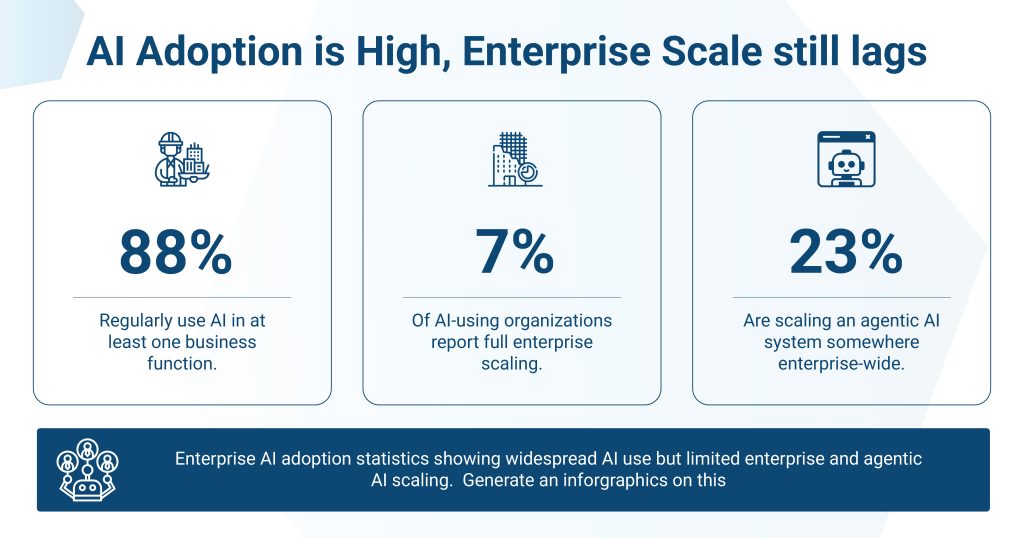
Enterprise AI adoption no longer sits at the edge of technology strategy. McKinsey’s 2025 global survey found that 88% of respondents reported regular AI use in at least one business function. Among organizations using AI, only 7% reported organization-wide deployment and integration. The same study found that 23% were scaling an agentic AI system somewhere in the enterprise. That gap between adoption and scale explains why architecture now matters so much.
Teams can launch copilots, chatbots, retrieval applications, and machine learning models quickly. Scaling them across business processes proves harder because AI must access trusted data, choose appropriate tools, respect permissions, retain useful context, and produce observable outcomes. An API catalogue alone cannot solve every part of that problem.
What does API-first vs AI-first architecture actually mean?
API-first vs AI-first architecture is not a choice between APIs and artificial intelligence. API-first architecture treats APIs as productized contracts that expose reusable capabilities before teams build consuming applications. It improves integration, consistency, interoperability, and development speed.
AI-first enterprise architecture keeps those strengths but adds an intelligence layer. Models and agents can interpret intent, retrieve relevant context, select approved tools, invoke business capabilities, and adapt their next action based on results.
The architectural question therefore changes. API-first teams ask which service an application should call. AI-first teams must also ask which model or agent should handle a goal, what context it can use, which actions it can take, and how the organization will govern the outcome.
Modern agent architectures combine orchestrators, models, APIs, semantic indexes, tool interfaces, and security controls. OpenAPI still matters, while agents also need safe capability discovery. Microsoft’s current agent architecture guidance similarly identifies OpenAPI-based APIs, semantic indexes, orchestration, models, tool access, and responsible AI controls as important architectural components.
Why API-first is not enough for AI
The question of why API-first is not enough for AI starts with determinism. Traditional applications usually know which endpoint they need, what parameters they will send, and what response structure they expect. AI agents interpret natural language goals and may decide which tool, data source, or action sequence best fits the request.
That flexibility creates value and new responsibilities. An agent may retrieve customer context before calling a CRM API, compare data sources before recommending an action, or request human approval before changing a financial record. It may also need to explain which information influenced its response.
APIs therefore become part of a broader AI execution environment. Enterprises need policy enforcement, agent identity, contextual retrieval, model access controls, observability, evaluation, cost management, and auditability alongside standard API management. Enterprise platforms increasingly treat identity, access control, security, compliance, and operational oversight as core requirements for agent governance.
What enterprise architecture for AI agents requires
Effective enterprise architecture for AI agents connects intelligence with existing enterprise capabilities without weakening control. The architecture should separate responsibilities, so teams can change models, tools, or data sources without rebuilding entire workflows.
At the interaction layer, users and systems submit goals through applications, workflow triggers, or conversational channels. An orchestration layer coordinates models, agents, retrieval services, and deterministic business logic. Tool and API layers expose approved actions, while data services provide governed access to structured and unstructured information.
Security must span every layer. Enterprises should assign identities to agents, enforce least-privilege access, apply policy checks before sensitive actions, and maintain traceable logs. High-impact workflows should also include clear approval paths instead of unrestricted autonomous execution.
Observability must go beyond uptime. Teams should track latency, model selection, retrieval quality, tool calls, failures, policy violations, user feedback, and task outcomes. These signals help architects distinguish impressive demonstrations from systems that create dependable business value.
How to transition from API-first to AI-first architecture
Teams asking how to transition from API-first to AI-first architecture should avoid a wholesale rebuild. A stronger approach extends existing API, cloud, data, security, and integration investments with AI-ready capabilities.
1. Start with workflows, not models
Choose workflows where AI can improve decisions, reduce manual coordination, or accelerate knowledge work. Define the outcome, acceptable risk, required systems, and measurable success criteria before selecting a model. This keeps pilots tied to operational priorities.
2. Map APIs, data, and decision points
Document which systems hold authoritative data, which APIs expose business actions, and where people make decisions. Identify undocumented endpoints, inconsistent authentication, duplicate services, poor data quality, or missing ownership. This map becomes the foundation for safe agent access.
3. Add a governed AI access layer
Create controlled access to approved models and AI services rather than allowing every team to integrate providers independently. Centralized access can support routing, policy enforcement, usage tracking, cost controls, safety filters, and provider flexibility. Modern AI gateways increasingly provide centralized traffic, security, model access, and usage controls for enterprise AI workloads.
4. Introduce retrieval and enterprise context
AI needs current, relevant, permission-aware information. Retrieval-augmented generation can ground responses in enterprise content, while semantic search can help agents find information beyond exact keyword matches. Architects should preserve source permissions and data classification throughout retrieval.
5. Design human control around risk
Low-risk tasks may run automatically, while financial changes, customer commitments, regulated decisions, or destructive actions may require human confirmation. Architecture should encode these boundaries explicitly rather than depending on prompt instructions alone.
6. Measure outcomes before expanding autonomy
Evaluate whether the system completes tasks accurately, safely, quickly, and economically. Test tool selection, retrieval quality, failure recovery, security behaviors, and business outcomes. Expand autonomy only when evidence supports dependable performance.
AI-ready API design for enterprises
AI-ready API design for enterprises starts with the same fundamentals that made API-first successful: clear contracts, versioning, reliability, security, and discoverability. The difference lies in designing APIs for machine reasoning as well as application integration.
Use descriptive operation names and precise schemas so agents can understand each capability. Define required parameters clearly, return structured errors, and avoid ambiguous field meanings. Where appropriate, make write operations idempotent so retries do not create duplicate transactions.
Authentication should support fine-grained scopes and workload identities. Rate limits, quotas, and policy controls should protect systems when autonomous processes increase call volume. APIs should also expose enough metadata for approved tools to become discoverable without revealing capabilities an agent cannot use.
Emerging protocols such as Model Context Protocol can complement established APIs by helping AI systems discover tools and context through standard interfaces. They do not remove the need for API management, lifecycle controls, security, monitoring, or ownership.
An enterprise architecture roadmap for AI adoption
A practical enterprise architecture roadmap for AI adoption should move through controlled stages instead of chasing organization-wide autonomy immediately.
Foundation
Standardize identity, API governance, data access, model access, security policies, logging, and approved development patterns. Clarify ownership across architecture, security, data, integration, and business teams.
Prove
Select a small number of high-value workflows. Connect agents to trusted data and limited tools, then measure quality, risk, cost, and user impact. Keep approval steps around sensitive actions.
Scale
Turn successful patterns into reusable platform capabilities. Provide shared orchestration, retrieval, model gateways, evaluation frameworks, API discovery, agent registries, and observability so teams do not rebuild identical controls. Current enterprise agent platforms increasingly centralize these capabilities to support secure production scaling.
Optimise
Compare models and workflows against business outcomes, not novelty. Improve latency, cost, accuracy, resilience, and user experience continuously. Retire duplicate agents and tools when they add complexity without measurable value.
This roadmap turns disconnected AI experiments into a scalable architectural capability.
How Prolifics helps enterprises move from pilots to production
Prolifics supports organizations across AI consulting, agentic AI, custom machine learning, data modernization, MLOps, automation, governance, and managed AI services. Its public Data and AI portfolio focus on moving organizations from pilots towards enterprise adoption while connecting AI initiatives to measurable business outcomes.
For enterprises with mature API estates, the opportunity often starts with assessment rather than replacement. Prolifics can help teams evaluate the current data and integration landscape, identify AI-ready services, establish governance requirements, prioritise business use cases, and connect architecture decisions with operational value.
AI-first transformation requires coordinated changes across APIs, data, security, cloud, operating models, and application delivery.
Conclusion: The next evolution builds on API-first, not against it
API-first architecture gave enterprises a disciplined way to expose reusable business capabilities. AI-first architecture takes the next step by making those capabilities understandable and usable by intelligent systems operating across dynamic workflows.
The goal is not to let agents call everything. The goal is to give the right agents access to the right context and tools, under the right policies, with measurable outcomes.
Enterprises that make this transition deliberately can preserve existing API investments while creating a safer foundation for agentic workflows, intelligent automation, and future AI services. Those that treat AI as another application layer may continue producing pilots without solving enterprise-scale execution.
Frequently asked questions
What is AI-first enterprise architecture?
AI-first enterprise architecture designs enterprise systems so AI models and agents can access trusted context, use approved tools, follow governance controls, and contribute to business workflows. It extends existing application, API, data, cloud, and security architecture rather than replacing them.
Is API-first architecture becoming obsolete?
No. API-first remains a critical foundation because AI agents need secure, reliable interfaces to enterprise systems. AI-first architecture builds on API-first principles by adding orchestration, context, model management, agent identity, evaluation, and policy controls.
What makes an API AI-ready?
An AI-ready API has a clear machine-readable contract, precise schemas, predictable errors, strong authentication, scoped permissions, reliable versioning, and useful metadata. It should support safe tool use without exposing unnecessary business capabilities.
Where should an enterprise begin its AI-first transition?
Start with one valuable workflow, map the required data and APIs, define risk boundaries, connect approved AI services, and measure outcomes. Use the successful pattern to create reusable enterprise standards before expanding autonomy.