Real-Time AI uses event-driven architecture to process live data, apply AI models, and support decisions as business events occur. By connecting event streaming, real-time analytics, and low-latency inference, enterprises can detect changes and respond without waiting for scheduled data processing. With the right architecture, selected workloads can achieve millisecond-level processing and decision latency.
Real-Time AI combines continuous data streams, event-driven architecture, and AI inference to support immediate, context-aware decisions. Instead of analyzing historical data alone, it processes events as they happen. This enables enterprises to detect fraud, identify operational risks, personalize customer experiences, and automate time-sensitive actions with reduced decision latency.
What Is Real-Time AI and How Does Event-Driven Architecture Support It?
Real-Time AI is an approach to artificial intelligence in which systems analyze continuously arriving data and generate predictions, recommendations, or actions within a defined time window. It integrates event streaming, stream processing, AI inference, and business rules to support operational decisions while information remains relevant. Its defining characteristic is not simply processing speed but the ability to act on current information.
Traditional enterprise analytics often relies on scheduled data movement and processing. Data is collected from multiple systems, transformed, stored, and analyzed before decisions are made. This remains valuable for historical reporting, forecasting, and strategic planning.
However, certain business situations require decisions before the next processing cycle.
A bank may need to evaluate a transaction before authorization. A retailer may need to update inventory availability immediately after a purchase. A healthcare organization may need to identify a critical change in patient-monitoring data.
Event-driven architecture supports these requirements by enabling applications to publish and respond to changes as they occur.
According to IBM’s explanation of event-driven architecture, the architectural model is built around the publication, capture, processing, and storage of events.
Its three foundational components include:
- Event producers: Applications, devices, databases, and services that generate events.
- Event brokers: Infrastructure that distributes events to the appropriate systems.
- Event consumers: Applications and processing services that interpret events and initiate actions.
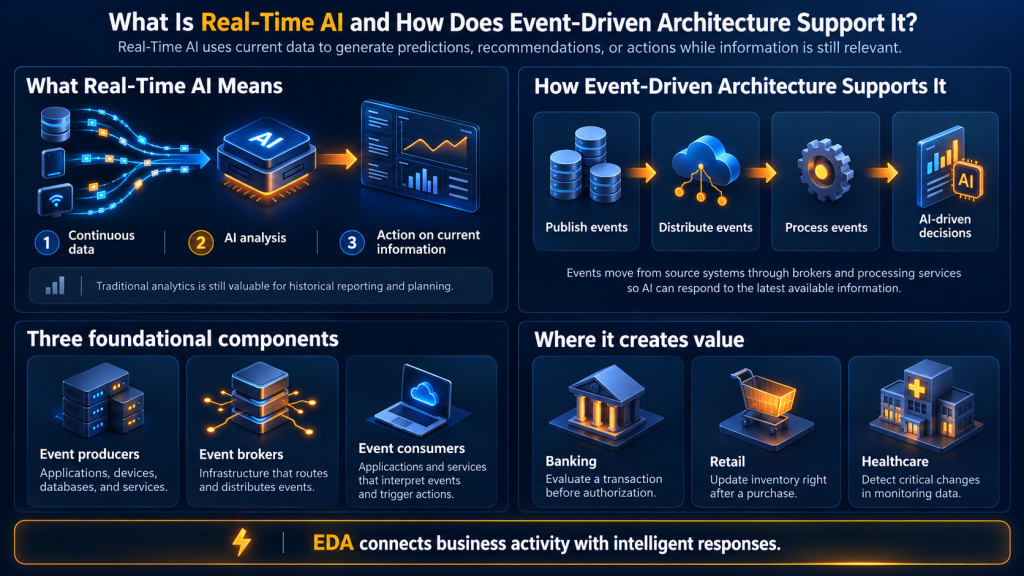
AI extends this model by analyzing events, identifying patterns, and supporting decisions based on the latest available information.
The result is an architecture that connects business activity with intelligent responses.
Why Does Real-Time AI Matter for Enterprise Decision-Making?
Real-Time AI matters because the value of business information often depends on how quickly an organization can act on it.
A fraud warning generated after a payment has been completed may have less preventive value than one generated during authorization. Similarly, identifying equipment failure after production has stopped offers fewer opportunities for preventive intervention.
For enterprise leaders, the objective is to reduce the time between detecting a relevant event and taking an appropriate action.
Real-time intelligence supports this objective across several operational priorities.
- Faster risk identification: Detect suspicious transactions, abnormal activities, and emerging operational issues.
- Improved customer experiences: Respond to customer interactions using current behavioral and transactional information.
- Intelligent automation: Initiate appropriate workflows without unnecessary manual intervention.
- Operational resilience: Identify system changes and trigger responses before issues escalate.
- Better decision context: Combine recent events with historical data and business policies.
The value of AI also depends on measurable outcomes.
In an IBM article on AI and real-time event processing, IBM cites a 2023 Institute for Business Value survey of 2,500 global executives. The research reported an average AI project ROI of 5.9%, compared with 13% among best-in-class companies.
These figures reflect broader AI initiatives rather than the specific ROI of event-driven architecture. They nevertheless reinforce the importance of connecting AI investment with measurable business outcomes.
For organizations modernizing enterprise technology, the focus should therefore extend beyond model performance to include decision speed, operational effectiveness, and business impact.
How Does Event-Driven Architecture Enable Millisecond AI Decisions?
Event-driven architecture enables low-latency AI decisions by moving relevant information through an integrated processing environment as events occur.
Instead of requiring applications to repeatedly request updates, event producers publish information that interested systems can consume.
This reduces unnecessary polling and allows processing services to respond independently.
A typical Real-Time AI architecture includes five connected capabilities.
1. Event generation and data ingestion
Business applications, APIs, databases, connected devices, and operational platforms generate events. These can include payment requests, customer interactions, inventory updates, or equipment readings.
2. Event streaming and distribution
An event streaming platform receives and distributes events to downstream processing services. Technologies such as Apache Kafka support durable event storage, partitioned processing, and continuous event consumption.
3. Real-time data processing
Stream processing engines filter, transform, aggregate, and correlate incoming events. This prepares the information required for accurate analysis and AI inference.
4. AI inference and decision logic
AI models evaluate relevant information to produce predictions or classifications. Business rules then determine whether a recommendation, automated action, or human review is appropriate.
5. Action and operational monitoring
The decision is delivered to the relevant business application, workflow, or operational system. Monitoring captures latency, decision outcomes, errors, and model performance.
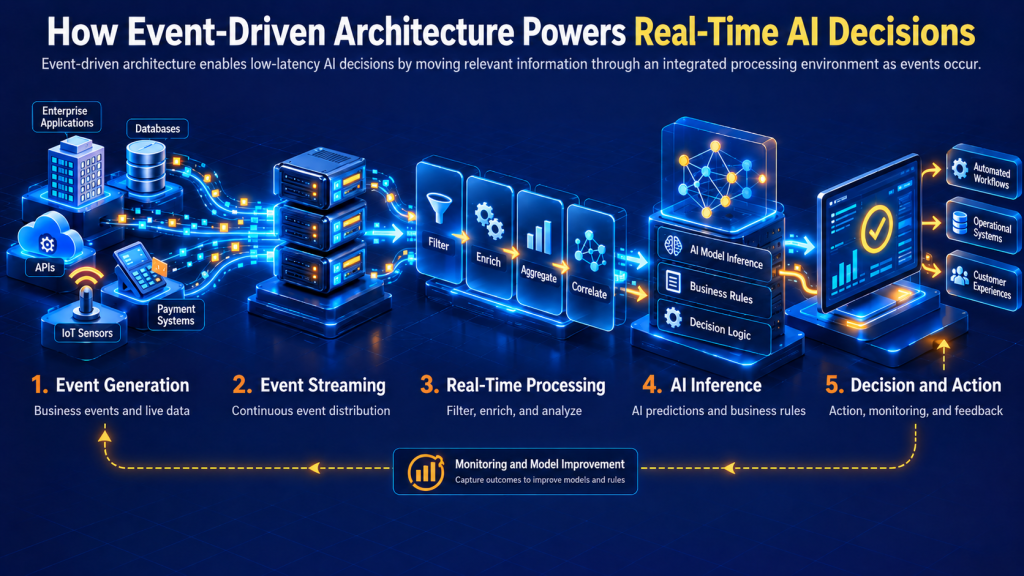
The Apache Kafka documentation describes event streaming as capturing, storing, processing, and routing events continuously.
However, millisecond performance is not automatic. Network delays, model complexity, data retrieval, processing queues, and downstream dependencies all contribute to total response time.
Enterprises must therefore evaluate the complete decision path rather than measuring event delivery speed alone.
Which Technologies Support Real-Time AI Architecture?
Real-Time AI requires coordinated technologies for collecting, processing, analyzing, and acting on continuous data streams.
No single platform delivers the entire architecture. The appropriate technology stack depends on existing enterprise systems, required performance, deployment environments, and governance standards.
Several technology categories play important roles.
- Event streaming platforms: Apache Kafka and managed streaming services enable continuous distribution and consumption of event data.
- Stream processing engines: Apache Flink and comparable technologies support stateful processing, aggregation, and event correlation.
- AI inference services: Deployed machine learning models evaluate incoming information and generate predictions or classifications.
- Data integration technologies: APIs, connectors, and change data capture mechanisms connect operational databases and enterprise applications.
- Workflow automation platforms: Decision engines and orchestration services translate model outputs into business actions.
- Cloud and infrastructure services: Scalable computing, networking, storage, and monitoring support workload performance and reliability.
A critical architectural consideration is how these technologies interact.
The Role of Prolifics Data Engineering
Prolifics helps enterprises build scalable data foundations that support real-time analytics and AI-driven decision-making. Through modern data engineering, streaming data pipelines, and enterprise integration, Prolifics enables organizations to connect diverse data sources, improve data accessibility, and process information continuously. These capabilities help businesses establish reliable data flows for intelligent automation, operational insights, and faster decision-making.
Learn more: Data Engineering: Build AI-Ready Foundations | Prolifics
For example, a stream processing engine may enrich a transaction event with recent account activity before passing it to a fraud detection model. The prediction then informs a decision service that applies predefined authorization rules.
Each capability must be designed around the same decision requirements.
Apache Kafka documents the foundations of event streaming, while AWS guidance on event-driven AI describes how events can coordinate loosely coupled AI services.
For enterprise IT leaders, platform selection should prioritize interoperability, latency requirements, operational resilience, and long-term maintainability rather than individual technology features.
How Can Enterprises Implement Real-Time AI Step by Step?
Implementing Real-Time AI requires a structured approach that connects business priorities, architecture design, AI capabilities, and operational governance.
A phased implementation reduces complexity and helps organizations validate business value before expanding into additional use cases.
A practical six-step implementation roadmap
Step 1. Identify time-sensitive business decisions
Start with a decision where latency has a measurable business impact. Examples include fraud detection, real-time inventory allocation, or equipment anomaly detection.
Define the required response time and expected business outcome.
Step 2. Assess existing systems and data sources
Identify which applications generate relevant events and determine whether the required information is available in real time.
Evaluate data accessibility, quality, integration dependencies, and current processing limitations.
Step 3. Establish an event-driven data foundation
Introduce event ingestion, routing, and processing capabilities that support reliable information exchange.
Define event schemas, access controls, retention policies, and recovery mechanisms.
Step 4. Integrate AI models into operational workflows
Deploy appropriate models and connect inference services with relevant event streams.
Use contextual data and business rules to determine how model outputs influence decisions.
Step 5. Validate latency, accuracy, and resilience
Test the complete workflow under realistic conditions, including peak event volumes and infrastructure failures.
Measure decision latency, model performance, throughput, and processing reliability.
Step 6. Scale with governance and continuous monitoring
Expand successful use cases while maintaining visibility into data quality, security, model drift, operational costs, and decision outcomes.
Establish ownership for platform operations and AI governance.
For enterprise modernization programs, Real-Time AI adoption should complement existing cloud migration, data modernization, and system integration initiatives.
A carefully selected pilot can demonstrate value while establishing reusable capabilities for subsequent applications.
Which Industries Benefit Most from Real-Time AI?
Real-Time AI is particularly relevant to industries where transactions, customer interactions, and operational conditions change continuously.
The strongest use cases involve decisions that must be made within a defined time window to protect revenue, reduce risk, or maintain service quality.
Financial services and insurance
Financial institutions can evaluate transaction activity, account behavior, and risk signals as events occur.
AI models can identify unusual patterns and support decisions such as additional verification, transaction review, or fraud investigation.
Insurance organizations can apply similar capabilities to claims-event monitoring, suspicious activity detection, and operational workflow prioritization.
Healthcare and pharmaceuticals
Healthcare organizations can analyze patient-monitoring events, equipment information, and operational signals to identify conditions requiring attention.
For example, a monitoring system could detect an abnormal pattern in incoming device readings and prioritize an alert for clinical evaluation.
Such systems require validated models, reliable data, appropriate oversight, and clinical governance. Real-time detection supports professionals rather than replacing clinical judgment.
Retail and consumer products
Retailers can respond to inventory changes, customer interactions, and transaction events using current information.
Potential applications include inventory synchronization, order exception detection, demand monitoring, and context-aware product recommendations.
Manufacturing and logistics
Industrial organizations can analyze telemetry, production signals, and supply chain events to identify equipment anomalies or operational disruptions.
Early detection can support maintenance decisions, production adjustments, and improved resource coordination.
Government and public sector
Public sector organizations can apply event-driven processing to service monitoring, infrastructure operations, and authorized workflow automation.
These implementations require strong controls over sensitive information, transparency, accountability, and system reliability.
Across industries, the primary benefit is the ability to connect timely information with decisions that influence business operations.
What Does Real-Time AI Look Like in a Financial Services Use Case?
Consider a financial institution processing digital transactions across mobile banking, payment platforms, and merchant channels.
Each transaction generates an event containing relevant information, such as transaction amount, time, payment channel, and account identifiers.
An event-driven fraud detection workflow could operate as follows:
- A payment request generates a transaction event.
- An event streaming service delivers the information to the risk processing system.
- Stream processing combines the transaction with recent account activity and available risk indicators.
- An AI model evaluates the enriched information and produces a fraud risk score.
- A decision service applies authorization policies and determines whether to approve, challenge, or escalate the transaction.
- The outcome is recorded for monitoring, investigation, and future model evaluation.
This illustrative architecture demonstrates how event streaming and AI inference can support time-sensitive risk decisions.
The architecture must also satisfy operational and regulatory requirements.
A low-latency prediction provides limited value if account data is outdated, the decision logic is unreliable, or downstream services cannot complete the required action.
Performance targets must therefore cover the full authorization workflow.
For example, an organization might establish an internal target of 100 milliseconds for its fraud scoring service, while measuring the broader payment authorization process separately. This is an illustrative engineering target, not a universal industry benchmark.
The expected business outcomes include faster risk assessment, more consistent decision execution, and improved visibility into suspicious activity.
Actual improvements must be established through production testing and outcome measurements.
What Challenges Must Enterprises Address Before Scaling Real-Time AI?
Scaling Real-Time AI introduces challenges that extend beyond deploying AI models or event streaming infrastructure.
Enterprise systems must process information consistently while supporting performance, security, governance, and operational reliability.
Five areas require particular attention.
Data quality and consistency
AI predictions depend on reliable information. Missing events, inconsistent schemas, duplicate messages, and stale contextual data can affect decision quality.
Event validation and data governance must be incorporated into the architecture.
Latency and infrastructure performance
Each stage introduces processing time, including event ingestion, feature retrieval, model inference, network communication, and downstream execution.
Organizations should measure end-to-end latency at realistic transaction volumes, including high-percentile performance.
Reliability and event handling
Distributed environments must address retries, duplicate processing, event ordering, and consumer failures.
Appropriate recovery processes and idempotent operations help prevent incorrect or repeated actions.
Security and compliance
Sensitive business and customer information requires strong authentication, authorization, encryption, auditability, and retention controls.
Automated decisions may also require explainability and human oversight depending on their impact.
Model monitoring and operational governance
AI performance can change as business behavior and data patterns evolve.
Organizations need continuous model evaluation, drift monitoring, controlled deployment, and clear escalation mechanisms.
AWS guidance on publish-subscribe architecture highlights both the scalability benefits of asynchronous communication and considerations involving eventual consistency and delivery guarantees.
The enterprise objective is not simply faster processing. It is dependable decision-making within clearly defined operational boundaries.
How Should Enterprises Measure the Success of Real-Time AI?
Real-Time AI initiatives should be evaluated using technical performance and measurable business outcomes.
Model accuracy alone does not establish whether an architecture delivers operational value.
A successful implementation should demonstrate that relevant information reaches the decision process quickly, decisions remain dependable, and resulting actions improve business performance.
Key performance indicators include:
- End-to-end decision latency: Time from event occurrence or receipt to an actionable decision.
- Processing throughput: Number of events processed successfully within a defined interval.
- Decision accuracy: Quality of model predictions against validated outcomes.
- System availability: Ability to maintain required processing services and response capabilities.
- Event processing reliability: Successful handling of events, retries, failures, and recovery.
- Business impact: Changes in fraud losses, operational costs, customer response times, or other use-case-specific outcomes.
Latency should be evaluated using percentiles rather than averages alone. For example, p95 and p99 measurements help reveal slower responses that average processing times may conceal.
Business measures should also reflect the consequences of incorrect decisions.
In fraud detection, a lower decision time must be considered alongside detection performance and false-positive rates. In healthcare monitoring, alert timeliness must be evaluated alongside clinical relevance and patient safety.
A balanced measurement framework connects technical performance with real operational results.
For CTOs and enterprise technology leaders, this creates a clearer basis for determining which applications justify further investment.
Frequently Asked Questions
What is real-time AI in enterprise applications?
Real-Time AI processes live information and applies AI models to support immediate decisions. Enterprises use it for applications such as fraud detection, operational monitoring, intelligent automation, and customer interaction analysis.
How does event-driven architecture improve AI performance?
Event-driven architecture delivers relevant changes to processing services as they occur, reducing dependence on scheduled data updates. It supports timely AI inference, but total performance also depends on model complexity, data access, and infrastructure latency.
Can real-time AI make decisions in milliseconds?
Yes, selected Real-Time AI workloads can achieve millisecond-level decision latency with optimized infrastructure and models. Actual response times depend on event ingestion, processing, inference, network performance, and downstream application requirements.
Which platform is best for enterprise real-time AI?
There is no universal best platform. Enterprises should evaluate technologies such as Apache Kafka and Apache Flink alongside AI inference services, based on integration requirements, processing volume, latency objectives, security, and operational capabilities.
How can businesses start implementing real-time AI?
Businesses should begin with a measurable, time-sensitive use case, assess data availability, and establish an event-driven processing foundation. A controlled pilot can validate model performance, decision latency, reliability, and business value before broader deployment.
How Can Enterprises Move Forward with Real-Time AI?
Real-Time AI connects event-driven architecture, continuous data processing, and intelligent decision-making to help enterprises respond when information matters most. Successful implementation depends on reliable integration, well-governed AI models, measurable latency, and resilient operations. By starting with high-value use cases, organizations can build scalable capabilities that support faster and more informed business decisions. Prolifics helps enterprises modernize their data, integration, and AI foundations to turn real-time intelligence into measurable business value.