AI can generate code in seconds. But can it help an enterprise modernise thousands of applications, accelerate testing, migrate complex integrations and deliver measurable business outcomes, without compromising quality, security or governance?
That is the real challenge facing technology leaders today.
Many organisations have introduced coding assistants, copilots and generative AI tools. Individual tasks may be completed faster, yet software delivery cycles remain slow, technical debt continues to grow and promising pilots struggle to reach production.
The problem is not a lack of AI tools. It is the absence of a connected delivery model that brings people, AI agents, reusable assets, governance and enterprise engineering together.
Prolifics is addressing this challenge through two closely connected ideas: the 10x engineering team and the AI Software Factory.
The 10x Engineer Is Not a Superhuman Developer
The term “10x engineer” is often misunderstood. It does not mean one developer should replace ten people or that AI should produce software without human supervision.
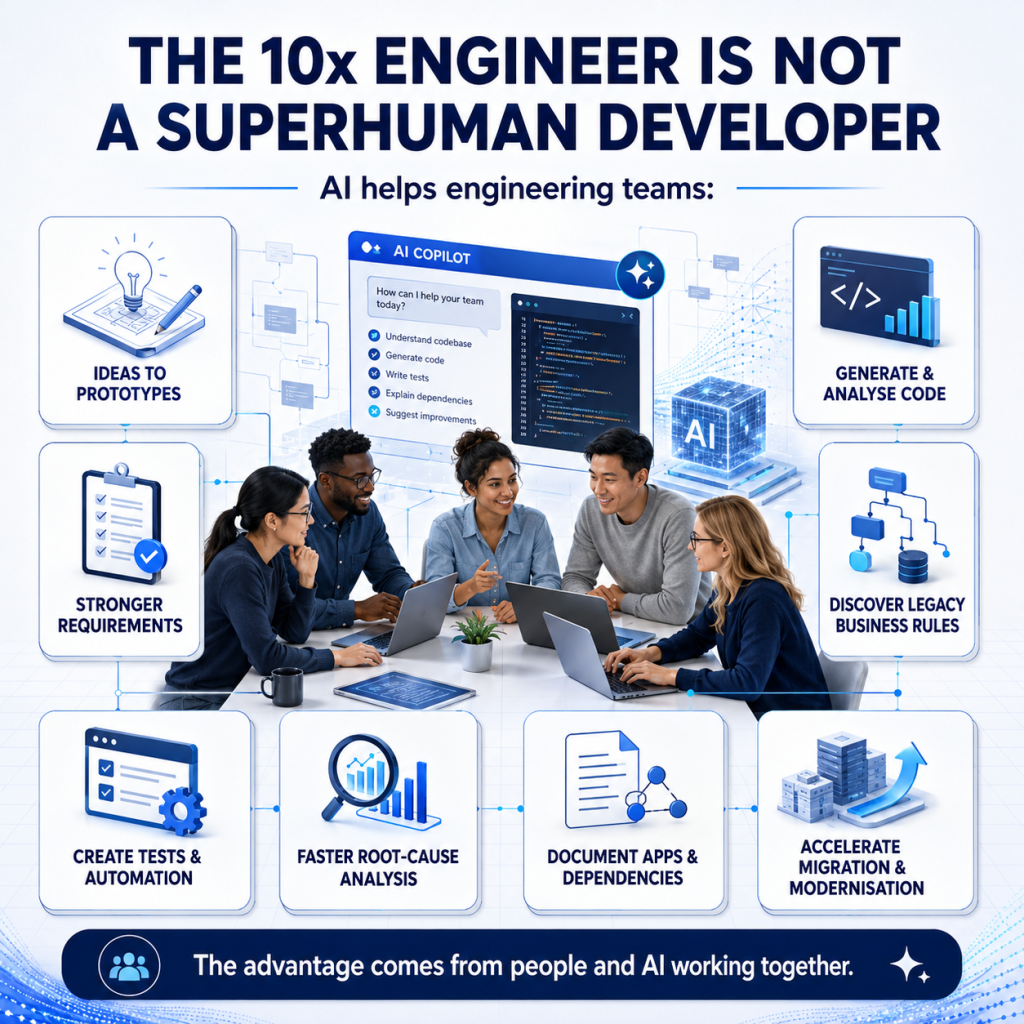
At Prolifics, the 10x engineer represents an AI-enabled professional who can achieve significantly more because intelligent tools support the entire engineering lifecycle.
AI can help teams:
- Transform early ideas into working prototypes
- Enrich requirements and identify missing acceptance criteria
- Generate and analyse code
- Discover business rules in legacy applications
- Create test scenarios, test data and automation assets
- Analyse defects and recommend likely root causes
- Document applications and technical dependencies
- Accelerate migration and modernisation activities
Engineers continue to own architecture, quality, security and delivery decisions. AI handles repeatable analysis and generation, while people provide context, judgement and accountability.
This combination creates more than personal productivity. It changes the speed at which an entire team can move from concept to production.
From AI-Assisted Coding to AI-Enabled Engineering
Prolifics has been applying this model within its own engineering environment.
During its June 2026 Innovation Spotlight, Prolifics demonstrated how a nine-person team built 22 production applications in two months. The estimated equivalent effort using traditional delivery methods was 13.5 person-years, compressed into eight weeks, with just $660 spent on AI tooling.
The reported return on that tooling investment was 225x.
The improvement did not come from generating more code without control. The team changed the delivery process itself.
Instead of spending weeks creating detailed specification documents, engineers used AI to develop working prototypes within days. Stakeholders could interact with something tangible, provide feedback and confirm the design before full production development began.
For every solution, the team also created a test harness covering navigation, calculations, user-interface behaviour and reconciliation rules. As the software evolved, every change was checked against those controls.
AI accelerated creation. Engineers verified, approved and owned the result.
This is the foundation of a 10x engineering team: faster learning, earlier feedback and greater delivery capacity, supported by structured quality controls.
The AI Software Factory: Turning Speed into Scale
Improving an individual engineer’s productivity is valuable. Creating a repeatable way to deliver that productivity across teams, applications and transformation programmes is far more powerful.
The Prolifics AI Software Factory brings together specialist AI agents, reusable accelerators, delivery frameworks, enterprise guardrails and experienced engineers.
Rather than treating every project as a new experiment, the factory applies repeatable patterns to areas such as:
- Application and legacy modernisation
- Integration and API migration
- Data-platform transformation
- AI-enabled software testing
- Business-rule and policy discovery
- Requirements and documentation generation
- Enterprise AI readiness and governance
A specialist agent might catalogue an application estate, analyse dependencies, generate a target-platform artefact or produce a test case. Human experts then manage complex exceptions, architecture decisions, validation and approval.
Resolved edge cases can be incorporated back into the factory, enabling the model to improve from one sprint or migration wave to the next.
What an AI Software Factory Can Deliver
The impact becomes particularly clear in complex migration programmes.
For a global logistics provider moving integrations from BizTalk and Seeburger to MuleSoft, Prolifics developed an AI-powered migration factory. The solution catalogued existing integrations and generated target-ready artefacts, while experienced engineers reviewed complex cases and quality.
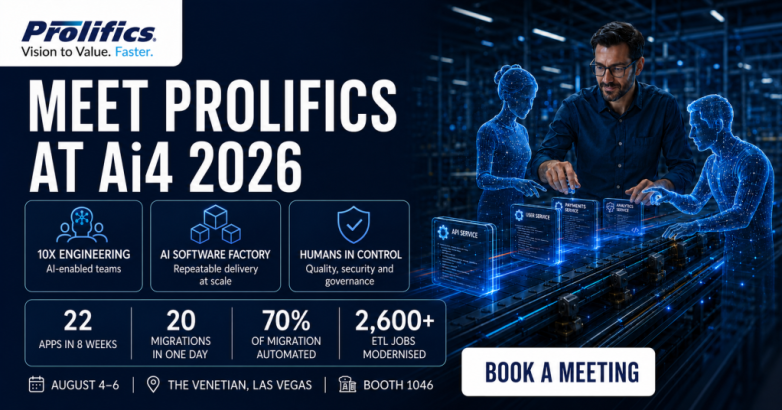
A process that previously completed approximately one customer migration every one to two weeks progressed to 20 customer migrations in one day.
For a Fortune 500 healthcare distributor migrating hundreds of undocumented MuleSoft integrations to IBM webMethods, an AI-assisted factory automated approximately 70% of the migration process, covering assessment, code generation, deployment and validation.
For a membership-based wholesale retailer, Prolifics modernised more than 2,600 complex Talend ETL jobs into optimised PySpark scripts. The approach delivered migration speeds of up to 75% faster, while maintaining consistent outputs and avoiding operational disruption.
These examples demonstrate an important shift: AI is no longer limited to helping someone write code faster. It can help industrialise large-scale transformation.
Quality Must Accelerate with Engineering
Generating software more quickly creates a corresponding need for faster, more intelligent assurance.
Prolifics applies AI throughout the software testing lifecycle—from analysing requirements and identifying coverage risks to generating test scenarios, creating privacy-safe synthetic data, prioritising regression tests and supporting defect analysis.
Its AI Quality Engineering Factory is designed to help organisations scale these capabilities across applications and programmes while maintaining human oversight, traceability and enterprise controls.
The principle is simple: AI can recommend, generate and execute, but people remain accountable for quality strategy and release decisions.
Governance Cannot Be Added at the End
An AI Software Factory depends on trusted data, secure platforms and a clear operating model. Without these foundations, organisations risk creating disconnected tools, duplicated effort, uncontrolled cloud spending and shadow AI.
Prolifics helps enterprises establish that foundation through readiness assessments and its Data & AI Centre of Excellence approach. This includes governance guardrails, use-case scoring, platform direction, role definitions, reusable assets and lifecycle processes.
The objective is not to slow innovation. It is to give successful ideas a secure route from pilot to production.
Meet Prolifics at Ai4 2026
The next stage of enterprise AI will not be defined by who launches the most experiments. It will be defined by who can turn AI into a repeatable, governed and measurable delivery capability.
At Ai4 2026, Prolifics will demonstrate how 10x engineering teams, intelligent agents and AI Software Factories can help enterprises modernise technology, strengthen quality and move from isolated pilots to production-scale impact.
Meet the Prolifics team from August 4–6, 2026, at Booth 1046, The Venetian, Las Vegas. Explore the Prolifics 10X Enterprise approach, then book a meeting with Prolifics at Ai4 2026 to discuss where an AI Software Factory could create the greatest value for your organisation.