Intelligent document processing (IDP) turns documents into validated, usable business data and actions. OCR remains an important component because it converts visual text into machine-readable text, but AI-native IDP goes further: it classifies and splits document packets, understands layout and context, extracts and normalizes fields, validates results, routes exceptions, and integrates approved outputs into business workflows. AWS describes modern IDP as supporting both controlled processing pipelines and direct multimodal processing with foundation models.
At enterprise scale, the real challenge is not whether a model can read one invoice, claim, form, or contract. It is whether the system can process changing document populations reliably, protect sensitive information, explain how each output was produced, absorb exceptions, and meet throughput, latency, and cost targets without weakening controls.
What AI-native IDP means
AI-native IDP uses AI as part of the document decision process rather than treating it as a decorative layer after OCR. The system can choose different processing paths based on document type, quality, complexity, language, risk, and downstream purpose. That may mean native text extraction for a digital PDF, OCR for a scan, a specialist model for an invoice, a vision-language model for an irregular contract schedule, deterministic rules for totals, and human review for a consequential exception.
Google Cloud’s Document AcaI overview separates digitization, extraction, normalization, classification, splitting, dataset review, and integration. That separation matters because extracting text is only one stage in a system that must decide what a document is, what information matters, whether the result is trustworthy, and what should happen next.
“AI-native” therefore should not be read as “OCR-free” or “LLM-only.” It describes an architecture that can use the most appropriate technique for each step and improve as documents, models, policies, and business requirements change.
Why OCR alone does not create an enterprise workflow
OCR answers a narrow but essential question: what characters appear on the page? A business workflow needs answers to several additional questions:
- What kind of document is this, and does a multi-document packet need to be split?
- Which fields, tables, clauses, signatures, and relationships are relevant to this process?
- How should dates, currencies, identifiers, addresses, and line items be normalized?
- Do extracted values agree with business rules, reference data, and other documents?
- Which results can proceed automatically, and which require a person with the right authority?
- What evidence, model version, confidence, and review history must be retained?
- Which system of record or workflow should receive the approved result?
A high character-recognition score can coexist with a damaging business error. One incorrect digit in a payment amount, policy number, or date may matter more than several harmless errors in body text. The quality target must therefore be tied to fields, document classes, decisions, and downstream consequences, not to OCR accuracy alone.
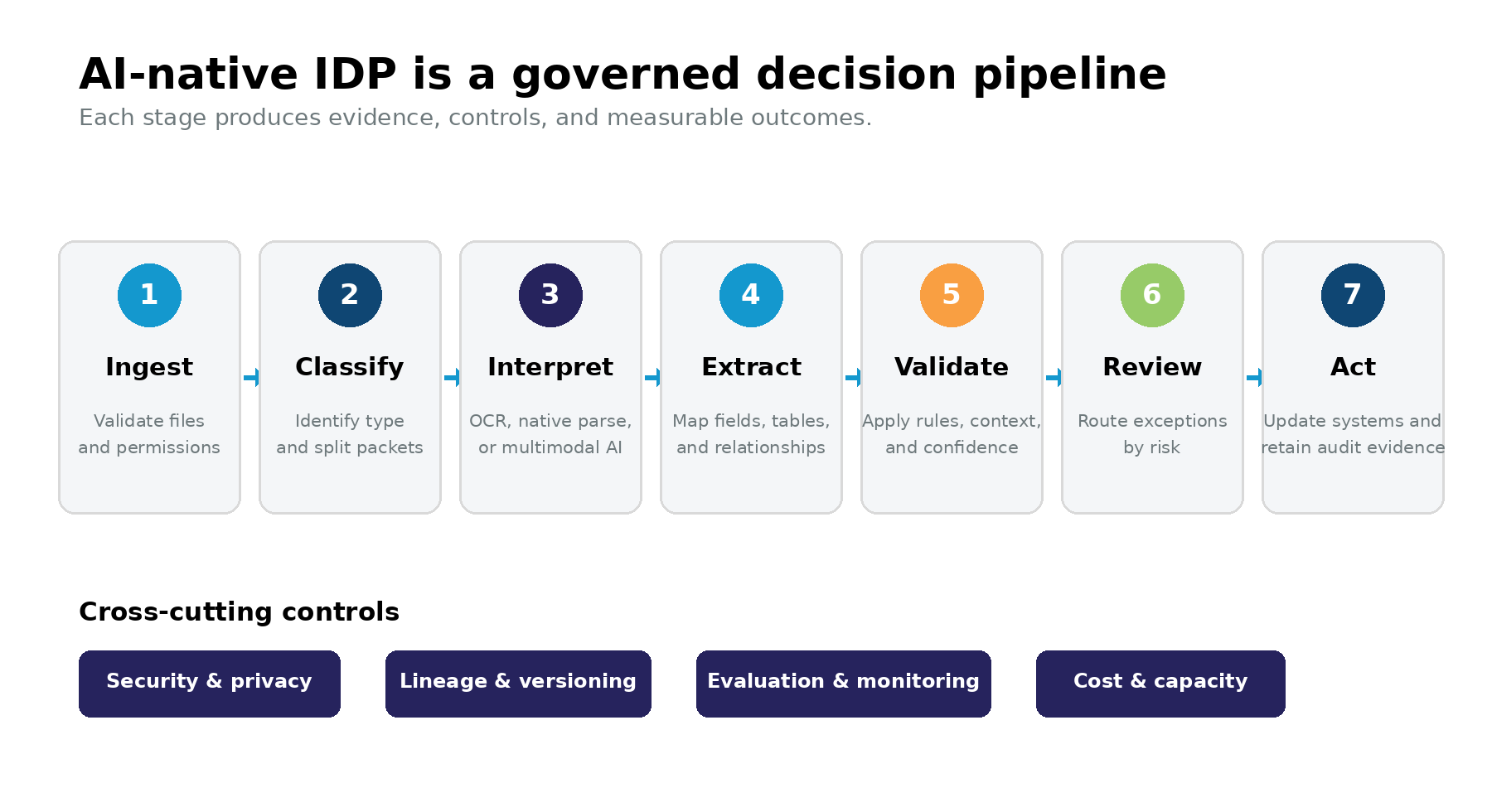
Figure 1. AI-native IDP connects document interpretation to validation, review, action, and cross-cutting controls.
How an AI-native IDP pipeline works at scale
1. Ingest and validate. Accept documents from email, portals, scanners, APIs, storage, or event streams. Validate file type, size, integrity, permissions, malware controls, and required metadata. Assign a stable document and transaction identifier so retries cannot create duplicate downstream actions.
2. Classify and split. Identify document type and separate composite packets before extraction. A mortgage package, claim file, or onboarding submission may contain multiple document classes that require different schemas, models, and reviewers.
3. Select the interpretation path. Use native parsing for machine-generated documents when available, OCR and layout analysis for scans, specialist processors for well-understood forms, and multimodal models where context or visual variability justifies them. Route by evidence rather than forcing every document through the same expensive model.
4. Extract and normalize. Map fields, tables, clauses, and relationships into a versioned schema. Normalize formats and preserve the source location so a reviewer can trace a value back to the page and region that produced it.
5. Validate and enrich. Apply cross-field checks, totals, reference data, duplicate detection, policy rules, and external lookups. A plausible model output is not automatically a valid business value.
6. Route exceptions by risk. Combine field confidence, validation results, document quality, transaction value, user impact, and regulatory sensitivity. Review only what needs judgment, while giving reviewers the source image, extracted value, evidence, and reason for escalation.
7. Act and observe. Send approved data to ERP, CRM, claims, case-management, content, or analytics systems through controlled APIs and events. Record the processor and model versions, decisions, corrections, latency, cost, and downstream outcome.
AWS recommends event-driven architectures, batching, robust error handling, and audit trails for IDP, and advises organizations to start with a specific document type before expanding. Those choices turn a model demonstration into an operable service.
Choose the architecture by document and risk
There is no universal winning model. A production platform typically uses three complementary patterns.
| Pattern | Best fit | Trade-offs |
| Controlled pipeline | High-volume, stable document classes; repeatable extraction; fine-grained controls. | More components and orchestration; can be brittle when document variation is poorly represented. |
| Direct multimodal model | Irregular layouts, mixed visual context, rapid schema exploration, and complex interpretation. | Requires careful evaluation, output validation, cost control, and defenses against unsupported or manipulated content. |
| Hybrid routing | Diverse portfolios where document type, quality, risk, and economics vary. | Adds routing logic and operational complexity, but allows each document to use the most suitable path. |
The decision should be based on representative evaluation data. Compare quality by critical field and document class, along with latency, throughput, review demand, unit cost, explainability, security, and the effort required to maintain schemas and models. A generative model may be valuable for one stage without becoming the system of record or final authority.
Scale is an operating model, not a volume number
A platform is scalable when it continues to meet service and control objectives as document volume, variety, model versions, and business demand change. That requires more than adding compute.
- Capacity and resilience: asynchronous processing, queues, concurrency controls, backpressure, retries, dead-letter handling, idempotency, and tested recovery.
- Versioned change: document schemas, prompts, rules, processors, models, and integrations must be versioned and released through controlled tests.
- Exception capacity: straight-through processing is useful only when the remaining review queue is staffed, prioritized, and measurable.
- Economic routing: use the least complex approach that meets the quality and risk requirement; track cost per page, document, field, and completed transaction.
- Observability: connect technical metrics to the document class, model version, confidence, validation result, reviewer correction, and downstream outcome.
- Reusable services: standardize intake, identity, access, schema management, review, audit, and integration patterns so new use cases do not rebuild the platform.
Measure field quality, workflow quality, and business outcomes together
Google’s evaluation guidance compares processor predictions with labeled test documents and reports precision and recall by label. It also shows that changing a confidence threshold trades recall for precision. A useful IDP scorecard should therefore span three layers.
| Layer | Measures | Decision supported |
| Model and field quality | Precision, recall, F1, false-positive and false-negative severity, performance by field, class, layout, language, and quality band. | Whether the model is reliable for the intended document population. |
| Operational performance | Straight-through-processing rate, exception rate, reviewer agreement, correction rate, latency, throughput, queue age, retry rate, availability, and unit cost. | Whether the service can run at the required scale. |
| Business and control outcome | Cycle time, rework, payment or claim leakage, service levels, downstream error rate, audit completeness, incidents, and time to correct. | Whether automation improves the process without creating unacceptable risk. |
Build the evaluation set from representative production variation, including difficult scans, uncommon layouts, missing fields, handwriting, multiple languages where relevant, adversarial or malformed inputs, and high-impact edge cases. Keep a protected test set for regression checks whenever a model, prompt, schema, rule, or preprocessing step changes.
Human review should follow risk, not a universal confidence score
Microsoft’s transparency guidance recommends pilots that reflect the intended use case so teams can determine confidence ranges for straight-through processing and human review. It also emphasizes human oversight for sensitive or consequential scenarios.
A confidence score is a routing signal, not proof of correctness. Thresholds should vary by field and action. An uncertain purchase-order description may be tolerable if it is informational; the same uncertainty may be unacceptable for a bank account, dosage, benefit decision, or payment amount. Combine confidence with validation rules, transaction value, user impact, document quality, and the reversibility of the downstream action.
Review design matters as much as model design. Show the source region and extracted value together, explain why the item was escalated, limit reviewers to authorized cases, record corrections, measure reviewer consistency, and feed verified corrections into controlled improvement cycles.
Build governance and security into the document path
Documents often contain personal, financial, health, commercial, or legal information. Governance must cover the original file, extracted text, embeddings, intermediate artifacts, prompts, outputs, reviewer decisions, logs, and downstream copies. Verify data-use, retention, residency, encryption, access, deletion, and audit terms for the exact service and region selected. A provider’s general cloud certification is not a substitute for use-case and regulatory assessment.
When language models can read documents or call tools, treat document content as untrusted input. OWASP notes that prompt injection can arrive through content and is not fully removed by retrieval-augmented generation or fine-tuning. Separate system instructions from document content, constrain tool permissions, validate structured outputs, isolate high-risk actions, and require confirmation for consequential changes.
NIST’s Generative AI Profile organizes risk work around Govern, Map, Measure, and Manage. For IDP, that translates into an inventory of use cases and document data, accountable owners, risk tiers, approved models and schemas, evaluation evidence, change history, monitoring, incident response, and retirement criteria.
A practical path from one document flow to a reusable platform
1. Select a bounded process. Choose a document flow with clear value, sufficient volume, accessible examples, known owners, and measurable downstream outcomes.
2. Define the decision and risk. Document what will be extracted, who uses it, which action follows, what an error costs, and where human authority must remain.
3. Build a representative evaluation set. Include normal cases, rare layouts, low-quality inputs, missing fields, and high-impact edge cases. Label critical fields and outcomes.
4. Compare processing paths. Test controlled, multimodal, and hybrid approaches using the same quality, latency, cost, and review criteria.
5. Integrate the full workflow. Test from intake through validation, review, system update, audit evidence, and exception recovery. Do not declare success at extraction.
6. Operate and expand deliberately. Monitor quality and business outcomes, version changes, retrain or reconfigure when evidence justifies it, and reuse platform services for the next document class.
How Prolifics can help
Prolifics helps organizations connect document-processing opportunities to the architecture, integration, data, and controls required for production. Its Data and AI services span data engineering, data management, MLOps, governance, analytics, and managed services, while its generative AI services support platform-aligned, vendor-neutral architectures.
That combination is useful for IDP because the work extends beyond selecting a model. It includes intake and orchestration, schema and data quality, workflow integration, evaluation, human review, privacy, monitoring, and ongoing optimization. Prolifics’ data and AI governance capabilities can help establish ownership, lineage, approval, versioning, security, and audit evidence, while AI as a Service provides a path from alignment and proof of value through pilot, scale, and optimization.
A sensible first step is to select one high-value document workflow, define its quality and risk thresholds, and assess the architecture, data, integration, governance, and operating-model gaps between today’s process and a production-ready IDP service.
Frequently Asked Questions
Is intelligent document processing the same as OCR?
No. OCR converts characters in an image or scan into machine-readable text. IDP can include OCR, but it also classifies documents, understands layout and context, extracts and normalizes fields, validates results, routes exceptions, and connects approved data to workflows.
Does AI-native IDP eliminate OCR and templates?
No. Native parsing, OCR, templates, rules, specialist models, and multimodal models each remain useful. AI-native IDP selects and combines them based on the document, quality requirement, risk, and economics.
How should an enterprise set confidence thresholds?
Use representative labeled documents and define thresholds by field, document class, action, and error impact. Validate the trade-off between precision, recall, review volume, and downstream risk. Do not copy an illustrative vendor threshold into production.
What makes IDP scalable?
Scalable IDP combines resilient asynchronous processing, controlled concurrency, versioned schemas and models, risk-based human review, observability, security, cost management, auditability, and reusable integration patterns. Volume alone is not evidence of scale.
How should enterprises evaluate IDP performance at scale?
Measure precision, recall, and F1 for critical fields and document classes using representative labeled test documents. Pair those measures with straight-through-processing rate, exception and correction rates, latency, throughput, queue age, unit cost, downstream errors, and audit completeness. Re-run regression tests whenever a model, prompt, schema, rule, or preprocessing step changes.