Generative AI introduced organizations to intelligent assistants that could summarize content, answer questions, and generate code. Today, enterprises are entering the next phase of AI adoption with agentic AI, autonomous AI systems capable of reasoning, planning, making decisions, and executing business processes across multiple applications with minimal human intervention.
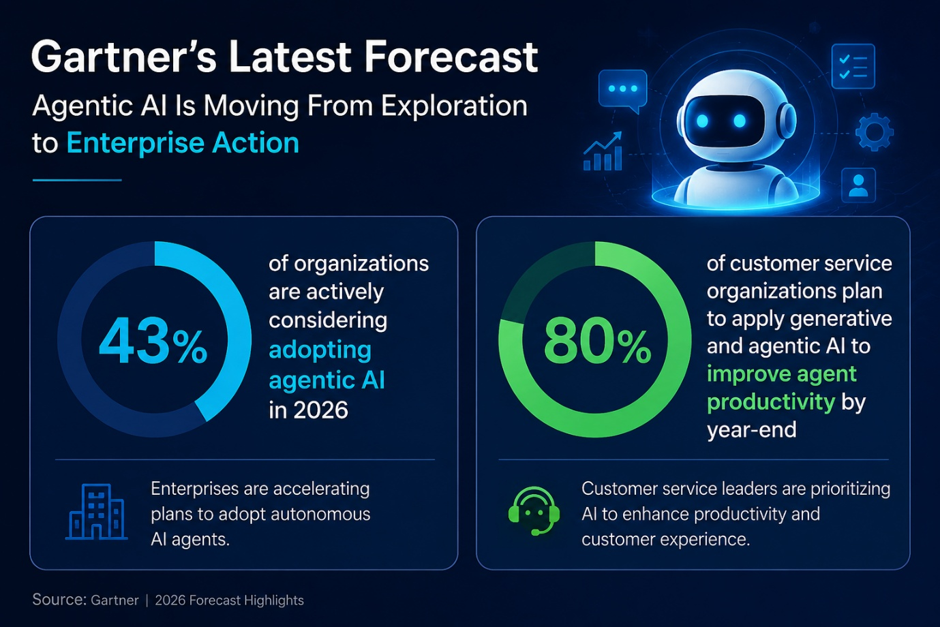
Gartner’s latest forecast provides additional context: 43% of organizations are actively considering adopting agentic AI in 2026, while 80% of customer service organizations plan to apply generative and agentic AI to improve agent productivity by year-end. IDC projects that 40% of roles in Global 2000 companies will involve direct engagement with AI agents by the end of 2026 – a figure that underscores just how deeply these systems are penetrating enterprise workflows. While the opportunity is enormous, so are the risks.
Unlike traditional AI models that simply generate recommendations, AI agents can access enterprise systems, invoke APIs, execute workflows, trigger financial transactions, update customer records, or initiate infrastructure changes. Without proper governance, these capabilities can introduce operational, security, compliance, and reputational risks.
The question enterprise leaders are asking is no longer:
“Can we build AI agents?”
It is:
“How do we govern autonomous AI agents safely at enterprise scale?”
The answer lies in combining governance, security, runtime guardrails, and human oversight into every stage of the AI lifecycle.
Why Traditional AI Governance Is No Longer Enough
Most enterprise AI governance programs were designed for predictive analytics or generative AI models where humans remained in control of every important decision.
Agentic AI fundamentally changes that model.
Modern AI agents can:
- Plan multi-step workflows
- Access enterprise applications
- Use business tools and APIs
- Collaborate with other AI agents
- Make contextual decisions
- Learn from previous interactions
This increased autonomy creates entirely new governance challenges.
Organizations must answer questions such as:
- What systems can an AI agent access?
- Which actions can it execute autonomously?
- When should human approval be required?
- How are AI decisions monitored?
- How are AI actions audited?
- How do we prevent unauthorized or unsafe behavior?
Industry leaders increasingly advocate adaptive, risk-based governance that classifies AI agents by risk level and applies controls appropriate to their business impact rather than relying on one-size-fits-all policies.
The Five Pillars of Enterprise AI Agent Governance
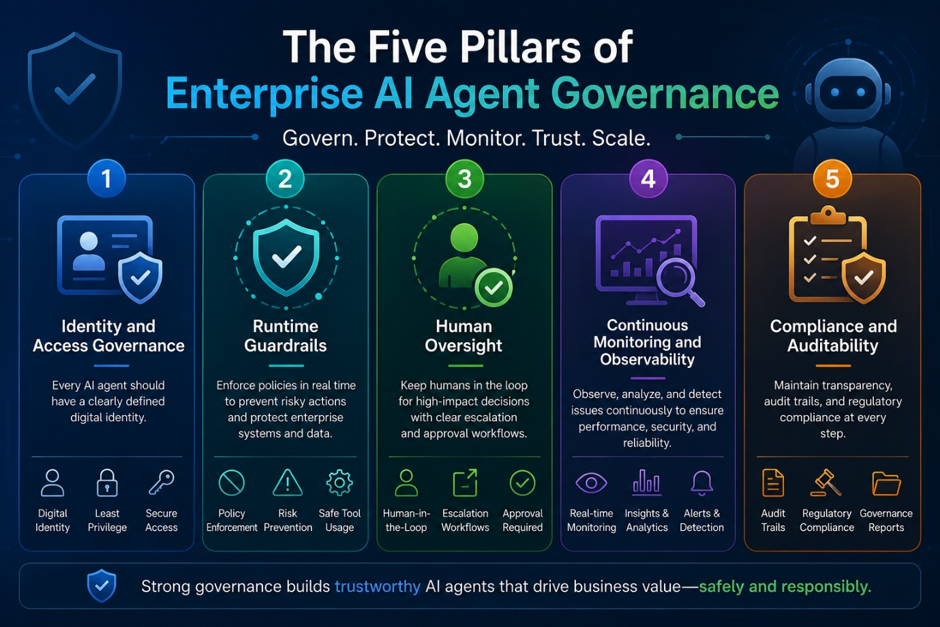
1. Identity and Access Governance
Every AI agent should have a clearly defined digital identity.
Organizations should apply Zero Trust principles by ensuring agents receive only the minimum permissions necessary to complete their assigned tasks.
Key practices include:
- Role-based access control
- Least privilege access
- Time-limited credentials
- API authorization
- Secure secrets management
- Multi-system identity federation
AI agents should never inherit unrestricted access simply because a user possesses elevated permissions.
2. Runtime Guardrails
Static governance policies alone are insufficient.
Because AI agents make decisions dynamically, governance must also occur during execution.
Runtime guardrails monitor AI behavior in real time and enforce predefined policies before actions are executed.
Examples include:
- Blocking access to restricted systems
- Preventing sensitive data exposure
- Validating tool usage
- Limiting transaction values
- Detecting prompt injection attacks
- Restricting high-risk workflows
Industry experts increasingly describe governance as something that must be enforced by the platform itself rather than relying on documentation or manual reviews.
3. Human Oversight
Autonomy should never eliminate accountability.
High-impact business decisions require humans to remain part of the decision process.
Examples include:
- Financial approvals
- Contract execution
- Healthcare recommendations
- Regulatory submissions
- Security policy changes
- Customer-impacting decisions
Organizations should establish escalation thresholds where AI agents pause and request human approval before proceeding.
This “human-in-the-loop” approach balances automation with responsible governance.
4. Continuous Monitoring and Observability
Enterprise AI cannot be trusted if organizations cannot observe its behavior.
Modern AI observability includes:
- Decision logs
- Agent reasoning traces
- Tool invocation history
- API activity
- Data lineage
- Security alerts
- Performance metrics
- Drift detection
Complete observability allows organizations to investigate incidents, satisfy compliance requirements, and continuously improve AI performance.
Security leaders increasingly view observability as a foundational capability for safe agentic AI deployments.
5. Compliance and Auditability
Enterprise AI deployments must align with evolving regulatory expectations.
Organizations should maintain:
- Complete audit trails
- Policy enforcement records
- Model version history
- Risk assessments
- Human approval logs
- Data access records
- Governance reports
Frameworks such as the NIST AI Risk Management Framework, ISO/IEC 42001, and emerging industry guidance provide useful foundations, but enterprises must translate these governance objectives into enforceable runtime controls for agentic systems.
Common AI Agent Security Risks
As AI agents gain broader enterprise access, security risks expand significantly.
Some of the most common threats include:
Prompt Injection
Malicious prompts manipulate agent behavior, causing unintended actions or disclosure of sensitive information.
Excessive Permissions
Overprivileged agents may access applications or data beyond their intended scope.
Data Leakage
Sensitive enterprise information may be unintentionally exposed through agent interactions.
Unauthorized Tool Usage
Agents may invoke APIs or business applications without appropriate authorization.
Shadow AI
Employees deploying unapproved AI agents create governance blind spots similar to Shadow IT.
Agent-to-Agent Risks
Multiple autonomous agents interacting without coordination may amplify errors or create cascading operational failures.
Mitigating these risks requires layered security, runtime controls, and continuous monitoring rather than relying solely on policy documents.
A Practical AI Agent Compliance Framework
Organizations can accelerate responsible AI adoption by implementing a structured governance model.
Discover
Identify AI agents, data sources, integrations, and business processes.
Classify
Assess risk based on business impact, autonomy level, regulatory exposure, and data sensitivity.
Govern
Define policies covering identity, permissions, security, compliance, and acceptable behaviors.
Control
Deploy runtime guardrails that enforce policies during execution.
Monitor
Continuously observe agent activities, security events, and business outcomes.
Improve
Use operational insights to refine policies, strengthen controls, and optimize performance over time.
This adaptive governance approach enables innovation while maintaining enterprise trust and accountability.
How Prolifics Helps Enterprises Build Responsible Agentic AI
At Prolifics, we help organizations move beyond AI experimentation to enterprise-scale deployment with governance built into every stage of the AI lifecycle.
Our Enterprise AI capabilities include:
- AI readiness assessments
- Agent architecture and design
- Governance strategy development
- AI security and risk assessments
- Enterprise guardrail implementation
- Responsible AI frameworks
- Microsoft Azure AI and Copilot integration
- IBM watsonx and enterprise AI solutions
- AI observability and monitoring
- Compliance and audit enablement
By combining deep AI expertise with cloud engineering, integration, and security capabilities, Prolifics enables organizations to deploy trustworthy AI agents that accelerate business outcomes without compromising governance or compliance.
The Future of Trustworthy Agentic AI
Enterprise AI is rapidly evolving from assistants that recommend actions to autonomous agents capable of executing complex workflows.
Organizations that succeed will not necessarily be those with the most sophisticated AI models.
They will be the ones with the strongest governance foundations.
Trustworthy AI requires more than accurate models. It requires continuous oversight, adaptive governance, secure identities, runtime guardrails, transparent decision-making, and human accountability.
By embedding governance into every layer of the AI ecosystem, enterprises can confidently move from AI pilots to production-scale autonomous operations while maintaining the trust of customers, regulators, employees, and stakeholders.
As organizations embrace the next generation of Agentic AI, governance is no longer a compliance exercise, it is a strategic business capability that enables innovation at scale.
Take Your Agentic AI Strategy from Pilot to Production at Ai4 2026
Ready to scale Agentic AI without compromising security, governance or human accountability?
Meet Prolifics at Ai4 2026 and discover how to design, govern and operationalise autonomous AI agents for secure, responsible and measurable enterprise impact. Connect with our AI leaders to explore practical strategies for runtime guardrails, human oversight, AI observability, compliance and production-scale deployment.
Move beyond AI experimentation and build trusted Agentic AI that delivers business value at scale.