AI in logistics helps enterprises optimize delivery routes, reduce transportation costs, improve service reliability, and make faster operational decisions using real-time data, predictive analytics, automation, and machine learning. For logistics-heavy industries such as retail, healthcare, finance, insurance, and the public sector, AI turns fragmented supply chain data into practical decisions that improve speed, cost control, and resilience.
Quick answer:
AI in logistics uses machine learning, predictive analytics, automation, and real-time data to improve route planning, fleet utilization, shipment visibility, cost control, and decision-making. It helps enterprises reduce manual planning, avoid delays, respond to disruption faster, and build more resilient, data-driven logistics operations.
What is AI in logistics?
AI in logistics is the use of artificial intelligence, machine learning, predictive analytics, automation, optimization models, and real-time data to improve how goods, vehicles, inventory, people, and decisions move across a supply chain. It helps logistics teams predict demand, plan routes, manage disruptions, reduce costs, improve service levels, and make faster operational decisions.
At an enterprise level, AI in logistics is not just a route optimization tool. It is part of a broader digital transformation strategy that connects transportation management systems, warehouse management systems, ERP platforms, order management systems, IoT data, customer data, and external signals such as weather, traffic, fuel prices, and supplier performance.
IBM explains that AI supports supply chain planning, management, and optimization by processing large volumes of data, predicting trends, performing complex tasks in real time, and improving data-driven decision-making. IBM also notes that AI can optimize routes, streamline workflows, improve procurement, reduce shortages, automate processes, cut fuel consumption, and lower operational costs.
For CTOs, IT directors, and digital transformation leaders, the real value is not only in automation. The bigger value comes from system integration, cloud migration, enterprise automation, data modernization, and intelligent decision-making across the logistics network.
How does AI in logistics optimize routes?
AI in logistics optimizes routes by analyzing live and historical data to recommend the most efficient path for each shipment, vehicle, driver, delivery window, and service commitment. Unlike static route planning, AI can adjust routes as conditions change.
Traditional route planning often depends on fixed rules, manual dispatching, spreadsheet-based planning, or historical driver knowledge. Those methods can work in predictable environments, but they struggle when traffic changes, weather disrupts movement, customer delivery windows shift, or inventory availability changes across locations.
AI-powered route optimization uses data from GPS systems, fleet telematics, traffic feeds, warehouse systems, order platforms, IoT devices, and logistics providers. It can evaluate multiple variables at once, including distance, time, fuel usage, driver availability, load capacity, delivery priority, service-level agreements, and cost-to-serve.
This matters because logistics decisions are rarely one-dimensional. The shortest route is not always the lowest-cost route. A slightly longer route may reduce missed delivery windows, avoid congestion, improve fleet utilization, or protect temperature-sensitive goods in healthcare and retail supply chains.
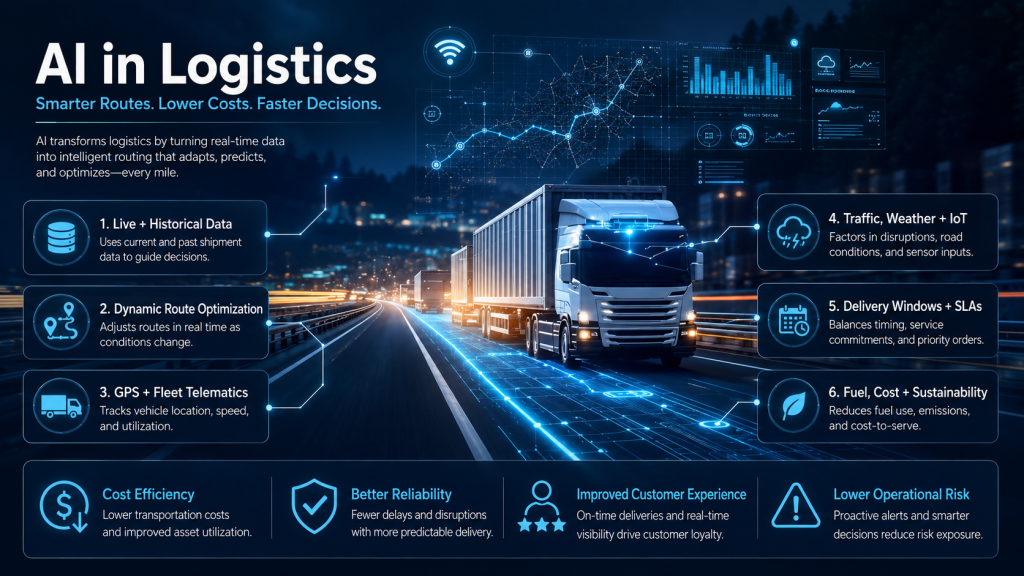
IBM notes that route optimization tools can use data from IoT devices, logistics providers, and supplier networks to optimize logistics networks, reduce fuel consumption, and improve supply chain workflows.
For enterprises, the goal is not just faster routing. The goal is better routing decisions that balance cost, reliability, customer experience, compliance, sustainability, and operational risk.
How does AI in logistics reduce operating costs?
AI in logistics reduces operating costs by improving route efficiency, lowering fuel consumption, reducing manual work, improving asset utilization, preventing delays, and helping teams make better inventory and transportation decisions.
Logistics cost is often hidden across multiple systems and teams. Transportation, warehousing, labor, inventory carrying cost, customer service, returns, penalties, and expedited shipping may all sit in different reporting structures. AI helps connect these signals so leaders can see where cost leakage is happening and act faster.
McKinsey reported that companies successfully implementing AI-enabled supply chain management have improved logistics costs by 15%, inventory levels by 35%, and service levels by 65% compared with slower-moving competitors. McKinsey also identifies demand forecasting, end-to-end transparency, integrated business planning, dynamic planning optimization, and automation of physical flows as key AI-enabled supply chain capabilities.
In practical terms, AI can reduce logistics costs by:
- Reducing unnecessary miles through smarter routing.
- Improving vehicle and driver utilization.
- Forecasting demand to avoid last-minute shipping.
- Reducing stockouts and overstock through better inventory planning.
- Identifying bottlenecks in warehouses, carrier networks, and delivery flows.
- Automating repetitive planning, tracking, and exception-management tasks.
- Improving supplier and carrier performance visibility.
For enterprise IT teams, cost reduction depends on data quality and integration. AI cannot optimize what it cannot see. Transportation, warehouse, ERP, customer, finance, and partner data need to be connected through modern integration architecture, APIs, cloud platforms, and reliable governance.
Why does AI in logistics improve enterprise decision-making?
AI in logistics improves enterprise decision-making by turning fragmented operational data into timely, explainable, and action-ready insights. It helps leaders move from reactive decision-making to predictive and prescriptive decision-making.
Most logistics teams already have data. The problem is that the data is often scattered across legacy systems, spreadsheets, carrier portals, warehouse tools, ERP platforms, customer service systems, and external data sources. This makes it difficult to answer basic questions quickly: Which shipment is at risk? Which route is most profitable? Which warehouse should fulfill this order? Which carrier is underperforming? Which customer commitments may be missed?
AI helps solve this by analyzing large datasets, identifying patterns, predicting outcomes, and recommending actions. For example, an AI model may detect that a specific delivery region has higher late-delivery risk when volume crosses a threshold, weather changes, and a certain carrier is assigned. Instead of waiting for the issue to appear in a weekly report, the system can flag the risk early and recommend a reroute, inventory shift, carrier change, or customer communication.
IBM states that AI agents in supply chain management can combine real-time data from enterprise systems, sensors, IoT devices, machine learning, predictive analytics, optimization, and reasoning models to evaluate tradeoffs and recommend or run actions. IBM also notes that these agents can help decisions happen closer to the point of impact, improving speed and consistency.
For decision-makers, this is where AI becomes more than automation. It becomes an enterprise intelligence layer across logistics, finance, operations, customer experience, compliance, and supply chain risk.
Which logistics processes should enterprises prioritize first?
Enterprises should prioritize AI use cases where logistics decisions are frequent, data-heavy, cost-sensitive, and measurable. The best starting points are route optimization, demand forecasting, shipment visibility, warehouse planning, carrier performance, exception management, and cost-to-serve analysis.
A practical AI logistics roadmap should start with business value, not technology excitement. Gartner found that only 29% of supply chain organizations had developed at least three of five competitive characteristics needed for future readiness. Gartner identified AI achievement capability and trade-policy navigation as future drivers of supply chain influence, while highlighting agility, resilience, regionalization, integrated ecosystems, and integrated enterprise strategy as important competitive characteristics.
A structured implementation process can help enterprises move faster without creating fragmented AI pilots.
- Identify the highest-cost logistics problem.
Start with measurable pain points such as delivery delays, high fuel cost, poor route utilization, manual dispatching, stockouts, excess inventory, or rising expedited freight. - Map the data sources.
Review ERP, TMS, WMS, CRM, carrier, telematics, IoT, weather, traffic, finance, and customer service data. - Fix data quality and integration gaps.
AI requires clean, connected, governed data. Poor master data, duplicate records, missing location data, or disconnected platforms will weaken results. - Choose one focused AI use case.
Start with a use case such as route optimization, demand forecasting, shipment risk prediction, or carrier performance scoring. - Define success metrics.
Measure cost per delivery, on-time delivery, fleet utilization, planning time, fuel consumption, inventory turns, customer satisfaction, and exception resolution time. - Run a controlled pilot.
Test AI recommendations against current planning methods in a specific region, business unit, product category, or customer segment. - Integrate into daily workflows.
AI should fit into dispatch, planning, warehouse, finance, and customer service workflows rather than becoming another disconnected dashboard. - Scale with governance.
Expand once the business case is proven, with human oversight, explainability, security controls, and continuous model monitoring.
This approach helps enterprises avoid isolated AI experiments and build a scalable foundation for IT modernization, enterprise automation, cloud migration, and system integration.
How does AI in logistics compare with legacy route planning?
AI in logistics is more adaptive, data-driven, and scalable than legacy route planning because it can evaluate real-time conditions, predict risk, and recommend better decisions across complex logistics networks.
Legacy route planning is often built around static rules. It may consider distance, location, and delivery sequence, but it usually cannot process large volumes of real-time signals or adjust dynamically across multiple constraints. AI-enabled logistics planning can analyze live traffic, weather, driver availability, delivery windows, vehicle capacity, inventory position, customer priority, and cost impact at the same time.
| Area | Legacy logistics planning | AI-enabled logistics planning |
| Route planning | Static routes and manual adjustments | Dynamic route optimization using real-time data |
| Decision speed | Slower, often dependent on planners | Faster recommendations and automated alerts |
| Data usage | Limited historical and operational data | Historical, real-time, external, and predictive data |
| Cost visibility | Often fragmented across systems | Better cost-to-serve and performance visibility |
| Disruption response | Reactive after delays occur | Predictive alerts and scenario-based recommendations |
| Scalability | Harder to scale across regions and networks | Easier to scale with cloud, APIs, and integrated platforms |
| Human role | Manual planning and exception handling | Oversight, validation, strategy, and exception management |
| Business impact | Efficiency depends heavily on people and static rules | Efficiency improves through continuous learning and optimization |
The point is not to remove experienced logistics teams from the process. The point is to give them better intelligence, faster recommendations, and stronger control. AI should augment human expertise, especially in regulated, high-risk, or customer-sensitive environments such as healthcare, insurance, finance, public sector logistics, and retail distribution.
What is a real-world AI logistics use case for enterprise buyers?
A strong enterprise use case is healthcare distribution, where AI can optimize routes, inventory, and delivery decisions for medical products moving across hospitals, pharmacies, clinics, labs, and regional distribution centers.
Healthcare logistics is complex because delivery reliability directly affects patient care, compliance, and operating cost. Products may have strict temperature requirements, expiration dates, service-level commitments, and regional demand variability. A delay is not just an inconvenience. It can create stockouts, emergency replenishment, compliance exposure, and higher shipping costs.
In this scenario, AI can analyze demand patterns, inventory availability, delivery windows, route performance, traffic, carrier reliability, and temperature-sensitive handling requirements. It can recommend which distribution center should fulfill an order, which route should be used, which shipments are at risk, and when inventory should be repositioned before demand spikes.
For example, a healthcare distributor serving hospitals and outpatient clinics could use AI to predict demand for critical supplies by region, optimize daily delivery routes, flag high-risk shipments, reduce emergency freight, and improve inventory placement. The business value would come from fewer stockouts, better service levels, lower transportation cost, reduced manual planning, and improved resilience.
This same model applies to retail store replenishment, insurance field operations, public sector emergency supply movement, and finance-related secure document or device logistics. The technology changes by industry, but the pattern is consistent: connect the data, predict the risk, optimize the decision, automate the workflow, and keep humans in control of exceptions.
What should CTOs and IT directors consider before implementing AI in logistics?
CTOs and IT directors should consider data readiness, integration architecture, security, governance, cloud scalability, workflow adoption, and measurable business value before implementing AI in logistics.
AI logistics success depends heavily on the quality of the enterprise technology foundation. If transportation data lives in one system, warehouse data in another, customer data in another, and finance data in spreadsheets, AI will struggle to produce reliable recommendations. This is why AI in logistics often requires data modernization, cloud migration, API-led integration, enterprise automation, and stronger governance.
Key considerations include:
- Data quality: Are location, order, inventory, shipment, carrier, and customer records accurate and standardized?
- System integration: Can ERP, TMS, WMS, CRM, telematics, and partner systems exchange data reliably?
- Cloud readiness: Can the architecture support real-time processing, model deployment, and scaling?
- Security and compliance: Are customer, shipment, operational, and partner data protected?
- Explainability: Can planners understand why the AI recommended a route, carrier, or inventory action?
- Human oversight: Which decisions can be automated, and which require approval?
- Measurement: Which KPIs will prove value after deployment?
For enterprise buyers, the safest path is to begin with a high-value use case, validate results, then scale into adjacent workflows. AI in logistics works best when it is embedded into operations, not treated as a standalone experiment.
Conclusion
AI is helping logistics enterprises reduce costs, improve delivery performance, and make faster decisions. By starting with a focused use case and building the right data and technology foundation, organizations can scale AI across their logistics operations with confidence. Prolifics helps enterprises move from fragmented processes to smarter, connected, and more resilient logistics.
FAQ
How can AI improve logistics route optimization?
AI analyzes traffic, weather, delivery windows, vehicle capacity, driver availability, and customer priorities to recommend faster and more cost-effective routes. It also helps logistics teams respond quickly to delays and disruptions.
What data is needed to use AI in logistics?
AI typically uses shipment, order, location, fleet, inventory, warehouse, carrier, traffic, weather, and customer data. This information should be clean, connected, governed, and accessible across enterprise systems.
How does AI reduce transportation and logistics costs?
AI lowers costs by reducing empty miles, improving fleet utilization, forecasting demand, preventing stockouts, optimizing routes, and automating planning tasks. It can also identify inefficiencies across carriers, warehouses, and delivery operations.
Is AI in logistics useful for regulated industries?
Yes. With strong security, governance, explainability, and human oversight, AI can support regulated industries. It can improve critical supply deliveries in healthcare and enable secure, traceable logistics in finance, insurance, and the public sector.
What AI logistics use case should enterprises start with?
Enterprises should start with a measurable, high-cost challenge such as route optimization, delay prediction, or demand forecasting. A focused pilot helps prove value before scaling.
Prolifics helps build the data, integration, cloud, and AI foundations needed for smarter, more efficient logistics.