Green AI reduces the environmental cost of enterprise AI by making computational efficiency, energy use, infrastructure utilization, and resource consumption part of AI design and deployment decisions. For enterprises, that means choosing appropriately sized models, eliminating unnecessary compute, optimizing cloud and data infrastructure, and measuring environmental efficiency alongside performance, cost, security, and business value.
Green AI is an approach to designing, deploying, and operating artificial intelligence with greater computational and environmental efficiency. Enterprises can apply it by right-sizing AI models, improving infrastructure utilization, optimizing inference and data pipelines, selecting efficient deployment environments, monitoring energy-related metrics, and scaling only AI workloads that produce measurable business value.
What is Green AI and why does it matter to enterprises?
Green AI is an approach to artificial intelligence that treats computational efficiency and resource consumption as important design criteria alongside accuracy, performance, and business outcomes. The concept was established in AI research as an alternative to pursuing incremental model improvements without accounting for the computational cost required to achieve them.
For enterprises, the definition needs to extend beyond model training. Environmental impact can occur across the complete AI lifecycle, including data preparation, model development, fine-tuning, inference, storage, networking, cooling, cloud infrastructure, and the hardware supporting those activities.
That matters because generative AI and agentic AI can turn isolated AI workloads into continuously running enterprise services. A model answering millions of requests, processing documents, generating code, supporting customer interactions, or coordinating AI agents may consume computing resources long after its initial deployment.
Green AI therefore should not sit apart from responsible AI, cloud optimization, digital transformation, or IT modernization. It should become another architecture and governance consideration.
The goal is not to minimize computing at the expense of business value. It is to avoid spending more compute, electricity, infrastructure capacity, and money than a use case genuinely requires.
This creates a practical question for CTOs and technology leaders: What is the least resource-intensive architecture that can still meet the required accuracy, latency, security, reliability, and business outcome?
That question is at the heart of enterprise Green AI.
Why is the environmental cost of enterprise AI increasing?
AI infrastructure is expanding rapidly because modern AI workloads require high-performance computing, accelerated servers, networking, storage, and cooling.
The scale is measurable. The International Energy Agency estimates that data centers consumed approximately 415 terawatt-hours of electricity in 2024, around 1.5% of global electricity consumption. Under its base case, data center electricity consumption rises to approximately 945 TWh by 2030, with AI identified as the most important driver of growth alongside other digital services.
Gartner’s June 2026 forecast estimates global data center electricity consumption will reach 565 TWh in 2026, 26% higher than 2025. It estimates AI-optimized servers will account for 31% of data center power consumption in 2026, with their power consumption surpassing conventional servers in 2027.
In the United States, Lawrence Berkeley National Laboratory estimates data center electricity consumption reached 176 TWh in 2023, equivalent to 4.4% of total US electricity consumption. Its scenarios place 2028 consumption between 325 and 580 TWh, or approximately 6.7% to 12% of projected US electricity use.
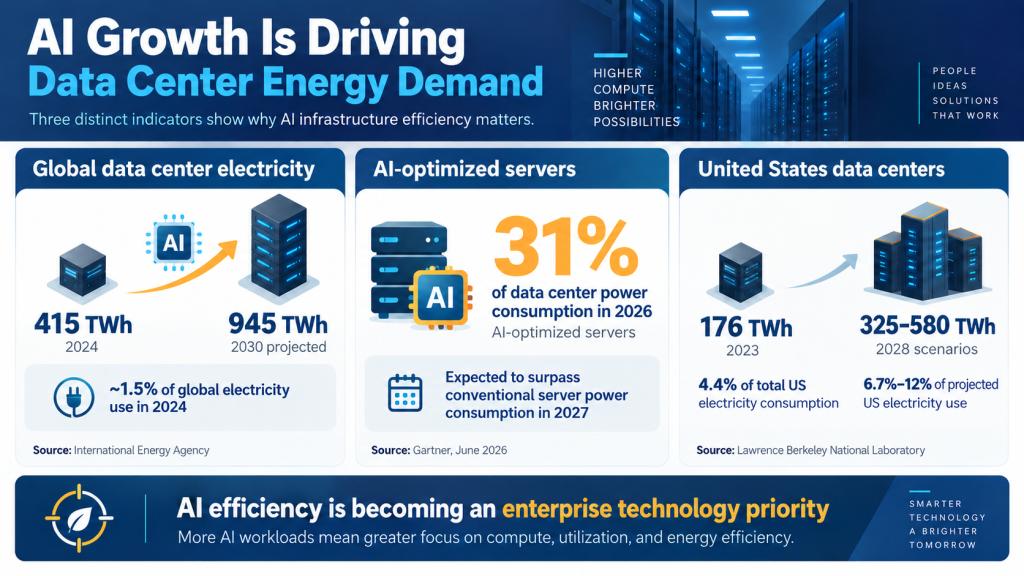
These estimates use different years, methodologies, and scopes, so they should not be treated as directly interchangeable forecasts. Together, however, they show why energy availability and AI infrastructure efficiency are becoming enterprise technology considerations rather than purely data center concerns.
Which parts of an AI deployment create environmental impact?
Enterprise AI has an environmental footprint across more than model training. Leaders should examine the entire architecture.
Model development and training can require accelerated computing for experimentation, tuning, and repeated training cycles. Large foundation models require substantially more infrastructure than smaller task-specific approaches.
Inference becomes particularly important after deployment. A model may be trained occasionally but invoked thousands or millions of times. Poorly optimized prompts, unnecessarily large models, excessive agent calls, or repeated retrieval operations can multiply compute demand.
Data infrastructure also contributes. AI depends on storage, data movement, transformation pipelines, vector databases, analytics platforms, APIs, and system integration. Duplicated datasets and inefficient pipelines increase both cost and computing requirements.
Infrastructure and cooling add another layer. GPU-intensive systems generate heat and require supporting power and cooling infrastructure. Both IBM and Forrester identify energy, cooling, water use, and infrastructure efficiency as important considerations as organizations scale AI.
Finally, hardware lifecycle considerations matter. Scaling AI may accelerate demand for servers, accelerators, networking equipment, and associated materials.
This means Green AI cannot be solved by changing one model setting. IBM similarly describes sustainable AI efficiency as a full-stack issue involving model architecture, training methods, workload orchestration, hardware, and infrastructure.
The enterprise architecture surrounding the model matters just as much as the model itself.
How can enterprises implement Green AI step by step?
A practical Green AI strategy should begin before an enterprise selects a model or purchases additional computing capacity.
- Define the business outcome first.
Establish the decision, process, customer experience, or productivity outcome the AI workload needs to improve. Avoid deploying AI simply because a capability is technically possible. - Create an AI workload baseline.
Measure request volumes, latency requirements, model utilization, compute consumption, storage, data movement, infrastructure cost, and other available resource indicators. - Choose the smallest effective model.
Do not automatically assign every task to the largest available foundation model. Smaller models, specialized models, retrieval techniques, routing, and deterministic automation may satisfy many enterprise requirements. - Optimize prompts, context, and agent workflows.
Long prompts, unnecessary context windows, repeated retrieval calls, and uncontrolled multi-agent loops can create avoidable inference workloads. - Modernize the supporting data foundation.
Improve data quality, eliminate unnecessary duplication, streamline pipelines, and reduce avoidable movement between platforms. AI efficiency depends heavily on efficient data engineering. - Right-size infrastructure and workload placement.
Match workloads with suitable cloud, hybrid, edge, or on-premises infrastructure based on utilization, performance, security, cost, and operational requirements. - Measure efficiency continuously.
Track business output relative to requests, compute, infrastructure utilization, latency, and cost. Where reliable energy or emissions data is available, incorporate those measures too. - Govern AI growth as a portfolio.
Retire low-value experiments, consolidate overlapping tools, and scale workloads only when measurable outcomes justify continued resource consumption.
IBM’s sustainability guidance similarly emphasizes rightsized models, workload placement, efficient platforms, and infrastructure optimization rather than relying on a single intervention.
The result is an AI operating model that evaluates value and efficiency together.
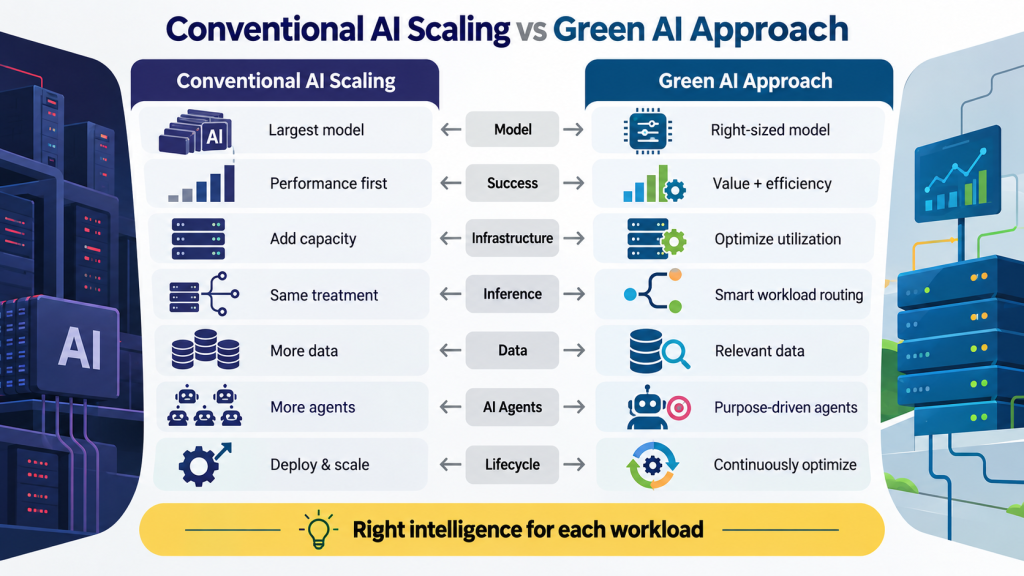
How does Green AI compare with conventional AI scaling?
A Green AI architecture changes what teams optimize for. Accuracy and user experience remain essential, but they are assessed alongside operational efficiency.
What does Green AI look like in a real enterprise use case?
Consider AI-driven demand forecasting in healthcare.
In a 2026 Prolifics engagement, a healthcare distribution organization used AI and machine learning to analyze historical usage and purchasing patterns, predict product demand, determine reorder requirements, and support inventory planning. The solution addressed excess inventory and shortages while helping procurement teams make better decisions.
The project is not presented as a Green AI case study, so no environmental savings should be attributed to it without measurement. It does, however, illustrate where Green AI principles can be introduced into a real enterprise architecture.
A healthcare organization running this type of workload could examine whether every product requires identical forecasting frequency, whether retraining needs to occur continuously, whether historical data can be tiered, and whether smaller models can handle predictable product categories.
High-volatility inventory could receive more frequent AI analysis. Stable categories could run less often. Models could retrain when data drift crosses a defined threshold instead of following an arbitrary schedule.
The organization could then connect model performance with operational measures such as forecast accuracy, infrastructure consumption, processing time, and cost per forecast.
That produces a better question than simply asking whether the company can deploy more AI.
The question becomes whether each additional unit of computing produces enough operational value to justify it.
That is applicable across healthcare, banking, insurance, retail, and public-sector AI deployments.
How should enterprises measure Green AI performance?
Green AI needs measurable governance, or it risks becoming a sustainability statement without operational impact.
Technology leaders should start with metrics their infrastructure can reliably provide rather than inventing carbon figures from incomplete data.
Useful measures can include:
- Compute consumed per successful AI transaction.
- Infrastructure utilization for AI workloads.
- Cost per completed AI business process.
- Inference requests by model and workload.
- Average tokens processed per transaction.
- Model latency relative to compute requirements.
- Percentage of requests routed to smaller models.
- Training and retraining frequency by model.
- Storage and data-transfer requirements.
- Energy consumption where measurable and attributable.
These metrics should connect to business KPIs. An AI workload that uses more computing may still be justified if it creates proportionately greater value, reduces another resource-intensive process, or improves a critical outcome.
This is why Green AI belongs within FinOps, MLOps, cloud governance, enterprise architecture, and responsible AI rather than operating as an isolated sustainability program.
Enterprises also need to distinguish efficiency from renewable energy sourcing. Running an inefficient AI workload on lower-carbon electricity does not automatically make the workload efficient. Conversely, an optimized model still has environmental impact if it runs at enormous scale.
Leaders need visibility into both sides: how much infrastructure AI consumes and how efficiently that infrastructure produces useful outcomes.
Conclusion
Green AI gives enterprises a practical way to scale artificial intelligence without treating infrastructure consumption as an unlimited resource. The strongest approach connects model efficiency, modern data architecture, cloud optimization, governance, and measurable business outcomes across the complete AI lifecycle. Prolifics helps enterprises build and operationalize governed AI, modern data platforms, cloud architectures, and AI-ready operating models designed around measurable value and responsible scale. Explore Prolifics AI Services and Prolifics Data & AI Solutions to start evaluating where efficiency should become part of your enterprise AI roadmap.
FAQs
What is Green AI in enterprise technology?
Green AI designs and operates AI systems with computational and environmental efficiency in mind. It reduces unnecessary resource use across models, infrastructure, data, and governance.
How can companies reduce the energy use of generative AI?
Companies can use smaller suitable models, optimize prompts and retrieval, and improve infrastructure utilization. They can also reduce unnecessary model calls, agent activity, and low-value workloads.
Are smaller AI models always more sustainable?
Not always. Sustainability also depends on workload volume, hardware efficiency, retraining needs, data movement, and deployment architecture.
How should CIOs measure the environmental impact of AI?
CIOs should track compute usage, infrastructure utilization, inference volume, training frequency, storage, and data transfer. Reliable energy and emissions data can then be added to AI governance metrics.
Can Green AI reduce enterprise AI costs?
Yes, Green AI practices can reduce waste from idle capacity, oversized infrastructure, and unnecessary model usage. Cost savings should still be validated against performance, efficiency, and business outcomes.