Multi-agent AI orchestration is the architecture and coordination layer that enables multiple AI agents to work together toward a shared enterprise objective. Rather than relying on a single large language model (LLM), orchestration manages task distribution, communication, memory, governance, and decision-making across specialized agents to improve accuracy, scalability, and business outcomes.
As enterprises move from AI pilots to production, multi-agent AI orchestration is becoming a foundational capability for building reliable, autonomous systems that integrate with enterprise applications, adhere to governance policies, and execute complex business workflows.
Quick answer
Multi-agent AI orchestration is the process of coordinating multiple specialized AI agents to collaborate on complex business tasks. An orchestration layer manages planning, task routing, agent communication, memory, security, and monitoring, enabling enterprises to build scalable, governed AI systems that outperform isolated AI assistants for multi-step workflows.
What is multi-agent AI orchestration?
Multi-agent AI orchestration is the coordinated management of multiple AI agents that each perform specialized functions while working toward a common business objective.
Unlike a single AI assistant that attempts to complete every task, an orchestrated system assigns responsibilities to different agents based on expertise.
For example:
- Planner Agent creates an execution strategy.
- Research Agent gathers information.
- Integration Agent retrieves enterprise data.
- Compliance Agent validates policy requirements.
- Execution Agent performs approved actions.
- Monitoring Agent observes outcomes and triggers improvements.
The orchestration platform determines:
- Which agent should execute each task.
- When agents should collaborate.
- How information is shared.
- How conflicts are resolved.
- When human approval is required.
This creates an AI agent network for enterprise environments that is modular, resilient, and easier to govern than monolithic AI systems.
Definition
Multi-agent AI orchestration is the architecture, policies, and runtime coordination that allow multiple autonomous AI agents to communicate, share context, delegate work, and execute enterprise workflows securely while maintaining governance, auditability, and human oversight.
Why are enterprises moving toward multi-agent AI orchestration?
Single-agent AI works well for isolated tasks but struggles with enterprise operations involving multiple systems, business rules, approvals, and data sources.
Modern enterprises require AI systems that can:
- Access ERP, CRM, HR, and finance platforms.
- Coordinate across departments.
- Handle long-running workflows.
- Make context-aware decisions.
- Escalate exceptions.
- Maintain governance and compliance.
According to Gartner, organizations are rapidly evolving from AI assistants toward autonomous business agents capable of coordinating business processes. IBM similarly identifies orchestration as a key capability for enterprise-scale generative AI because governance becomes increasingly difficult as AI complexity grows.
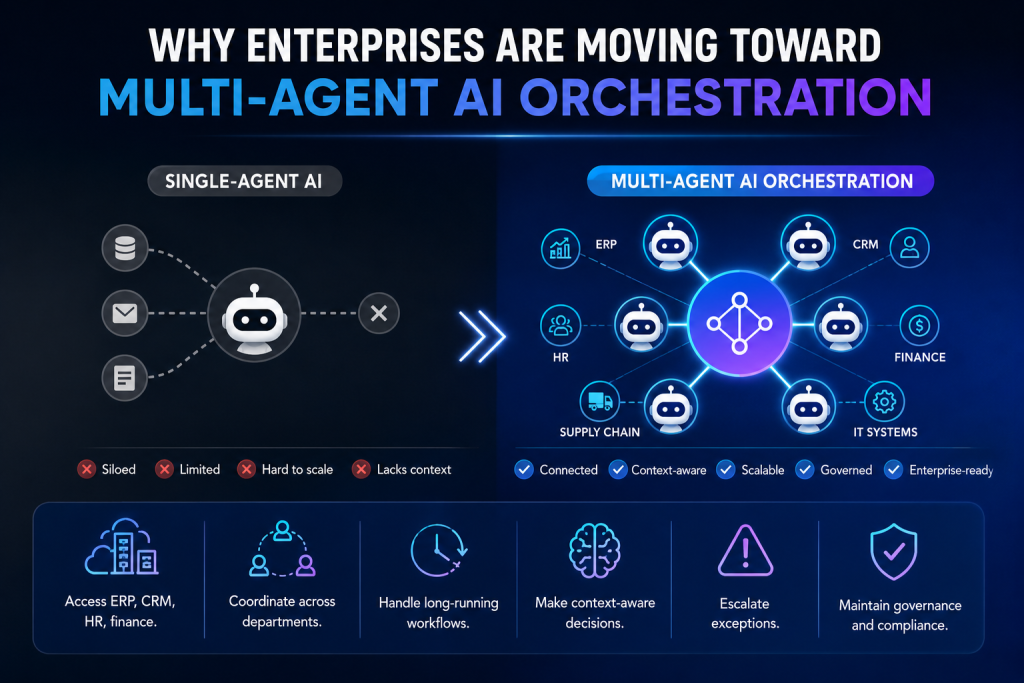
For enterprises pursuing digital transformation, LLM orchestration becomes the layer that connects AI with existing applications rather than replacing enterprise systems.
How does multi-agent AI orchestration work?
A typical orchestration architecture contains several coordinated layers.
1. User Request
A user submits a request such as:
Generate a commercial insurance quote.
2. Planning Agent
The planner determines:
- Required tasks
- Dependencies
- Required enterprise systems
- Required approvals
3. Specialized Agent Workflow
Tasks move through a sequence of purpose-built agents.
Research Agent → Risk Analysis Agent → Pricing Agent → Compliance Agent → Document Generation Agent
4. Agent Communication
Agents exchange structured information rather than free-form conversations.
Typical communication includes:
- Task status
- Shared memory
- Retrieved documents
- Confidence scores
- Validation results
5. Human Approval
Critical business decisions may require approval before execution.
Examples include:
- Financial transfers
- Healthcare recommendations
- Insurance underwriting
- Regulatory reporting
6. Execution
Approved agents update enterprise applications, including:
- SAP
- Salesforce
- ServiceNow
- Microsoft Dynamics
- Core banking platforms
7. Monitoring
The orchestration platform tracks:
- Response quality
- Latency
- Errors
- Token consumption
- Business KPIs
- Security events
Why is orchestration more effective than a single AI agent?
| Single AI Agent | Multi-Agent AI Orchestration |
| Handles one broad task | Coordinates multiple specialized agents |
| Limited context | Shared enterprise memory |
| Difficult to scale | Modular architecture |
| Minimal governance | Central policy enforcement |
| Higher hallucination risk | Cross-agent validation |
| Harder to maintain | Individual agents can evolve independently |
| Limited enterprise integration | Designed for enterprise applications |
For complex enterprise workflows, orchestration improves reliability because multiple agents validate, enrich, and refine outputs before execution.
How do AI agents communicate in enterprise environments?
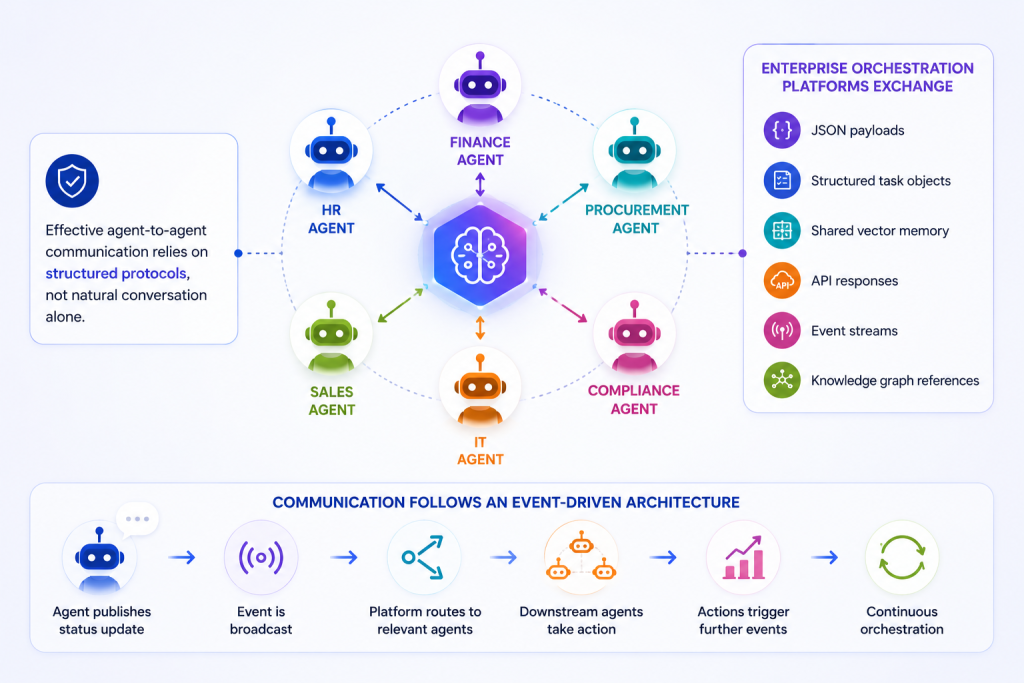
Effective agent-to-agent communication relies on structured protocols rather than natural conversation alone.
Enterprise orchestration platforms typically exchange:
- JSON payloads
- Structured task objects
- Shared vector memory
- API responses
- Event streams
- Knowledge graph references
Communication often follows an event-driven architecture where each agent publishes status updates that trigger downstream actions.
Example: Customer Onboarding Workflow
Identity Verification Agent → Fraud Detection Agent → Risk Assessment Agent → Compliance Review Agent → Account Creation Agent
Each agent contributes a specialized decision while the orchestration engine maintains the overall workflow.
Which enterprise use cases benefit most from multi-agent AI orchestration?
Several industries are already well suited for coordinated AI systems.
Financial Services
Multiple agents collaborate to:
- Verify customer identity.
- Assess credit risk.
- Detect fraud.
- Generate loan documentation.
- Route approvals.
This reduces manual effort while maintaining regulatory controls.
Healthcare
Agents can coordinate to:
- Summarize patient records.
- Retrieve clinical guidelines.
- Check insurance eligibility.
- Recommend treatment pathways.
- Schedule follow-up appointments.
Human clinicians remain responsible for final decisions.
Retail
Retail organizations can orchestrate agents for:
- Inventory optimization.
- Demand forecasting.
- Dynamic pricing.
- Supplier coordination.
- Customer service.
These coordinated workflows improve operational efficiency across the supply chain.
Insurance
Claims processing benefits from specialized agents handling:
- Document extraction.
- Fraud detection.
- Policy verification.
- Damage estimation.
- Settlement recommendations.
Rather than replacing adjusters, AI accelerates administrative tasks while maintaining oversight.
How can enterprises design a scalable multi-agent AI system?
A successful implementation requires more than connecting several LLMs. Enterprises need an architecture that balances autonomy with governance.
Recommended design principles
- Define business outcomes before selecting AI models.
- Assign each agent a single, specialized responsibility.
- Use an orchestration layer to coordinate workflows and resolve dependencies.
- Integrate agents with enterprise systems through secure APIs.
- Implement shared memory and contextual retrieval to maintain continuity across tasks.
- Apply governance controls, including authentication, authorization, and audit logging.
- Introduce human approval for high-risk decisions.
- Continuously monitor agent performance, latency, costs, and business outcomes.
- Test workflows under production-scale conditions before broad deployment.
- Refine orchestration logic based on operational feedback and evolving business requirements.
This approach supports long-term scalability while reducing operational risk.
What challenges should enterprises address before deploying autonomous AI systems?
Moving from pilots to production introduces several architectural and operational challenges.
Common considerations include:
- Hallucination management.
- Identity and access control.
- Data privacy.
- Cross-agent consistency.
- Model version management.
- Cost optimization.
- Regulatory compliance.
- Observability.
- Human oversight.
- Integration with legacy applications.
A centralized orchestration platform provides visibility and governance across all participating agents, making enterprise AI systems easier to manage and audit.
What does the future of AI workflow orchestration look like?
Industry analysts expect enterprise AI to evolve from isolated assistants toward autonomous AI systems that coordinate business processes across departments.
Future orchestration platforms will increasingly include:
- Dynamic agent discovery.
- Self-optimizing workflows.
- Multi-model routing.
- Cross-enterprise collaboration.
- Event-driven automation.
- Policy-aware reasoning.
- Real-time business optimization.
Rather than replacing enterprise software, these capabilities will augment existing investments in ERP, CRM, cloud, and integration platforms.
Conclusion
Multi-agent AI orchestration is emerging as the operating model for enterprise AI, enabling specialized agents to collaborate securely across business processes rather than functioning as isolated assistants. By coordinating task execution, enforcing governance, and integrating with enterprise systems, orchestration improves scalability, reliability, and operational efficiency.
As organizations transition from AI experimentation to production, the focus should shift from individual models to well-designed orchestration architectures that support long-term business outcomes. Prolifics helps enterprises design, integrate, and operationalize governed multi-agent AI systems that align with existing cloud, data, and application ecosystems.
Frequently Asked Questions
What is multi-agent AI orchestration?
Multi-agent AI orchestration coordinates multiple specialized AI agents through a centralized orchestration layer that manages planning, communication, task delegation, governance, and execution. It enables enterprises to automate complex workflows more reliably than a single AI assistant.
How is multi-agent orchestration different from using one large language model?
A single LLM attempts to solve every problem itself, while multi-agent orchestration distributes work among specialized agents with distinct responsibilities. This improves scalability, governance, resilience, and accuracy for enterprise workflows.
Why do enterprises need AI workflow orchestration?
Enterprise processes span multiple systems, approvals, and business rules. AI workflow orchestration coordinates these activities, integrates with existing applications, maintains governance, and ensures AI actions align with organizational policies and compliance requirements.
Which industries benefit most from multi-agent AI systems?
Financial services, healthcare, retail, insurance, manufacturing, and public sector organizations benefit significantly because they rely on complex workflows involving multiple stakeholders, regulatory requirements, and enterprise applications.
What should enterprises evaluate before implementing multi-agent AI orchestration?
Organizations should evaluate governance, security, integration architecture, data quality, human oversight, monitoring, scalability, and business outcomes before deploying production-grade multi-agent AI systems. A phased approach helps validate performance while reducing operational risk.