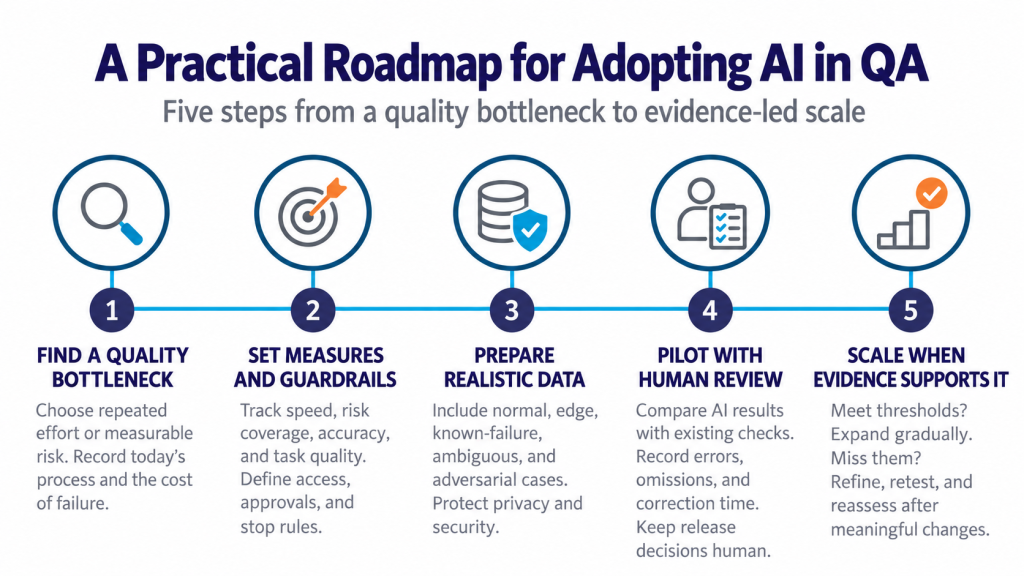
Many teams build an AI pilot in a few weeks. The demo looks great. Leaders get excited. Then the project slows down. Questions about accuracy, safety, cost and trust appear, and nobody has clear answers.
AI-TLC gives teams a simple way to answer those questions. It treats testing as a full journey, not a last step before launching. This blog explains how it works and how to use it.
Why AI pilots struggle to reach production?
A pilot only needs to work in a controlled setting. Production must work for real users, real data and real risk. That gap is where many projects get stuck.
Common reasons include:
Teams test with only a few easy examples.
Nobody defines what a good answer looks like.
Data quality problems show up late in delivery.
Safety and privacy checks start after the build.
Model behavior changes and nobody tracks the change.
Ownership between business and IT teams stays unclear.
Traditional testing does not fit well here. A normal app gives the same output for the same input. An AI app may answer differently each time. So teams need new methods.
What AI-TLC means for enterprise AI?
AI-TLC is a lifecycle approach to testing AI systems. It covers the use case, the data, the model, the application and life after release. The goal is simple: build trust in AI before users depend on it.
It rests on three ideas:
Test early, from the first use case discussion.
Test often, because AI behavior changes over time.
Test wide, covering quality, safety, security and speed.
AI-TLC also brings business, risk, data and engineering teams together. Everyone agrees on what success means. That shared view makes release decisions faster and clearer.
The five stages of an AI-TLC approach
AI-TLC has five stages. Each stage builds on the one before it.
Stage 1: Define use cases, intended behavior and risk boundaries
Start with the problem. Write down who will use the AI, what it should do and what it must never do.
Name the exact use case and expected user.
Describe the intended behavior in clear, plain words.
Set risk limits for privacy, bias and harm.
Agree on success measures before any build starts.
Stage 2: Prepare data, prompts, context and test scenarios
Good tests need good inputs. Gather the material your AI will use and the cases it will face.
Clean and label the data used for grounding.
Version your prompts so every change is traceable.
Collect real user questions, including messy, unclear ones.
Build scenarios for normal, rare and risky cases.
Stage 3: Evaluate accuracy, relevance, consistency and safety
Now measure how the AI behaves against your goals. Use both automated scoring and human review.
Check accuracy against trusted answers and source documents.
Test relevance so answers fit the question asked.
Run the same prompt often to check consistency.
Probe for unsafe, biased or private information leaks.
Stage 4: Assure applications, integrations, agent actions, security and performance
Evaluation looks at the AI. Assurance looks at the whole system around it.
Test every link with apps, databases and APIs.
Check each action an AI agent can take.
Run security tests for prompt injection and leaks.
Measure speed and cost under real traffic loads.
Stage 5: Improve through retesting, drift reviews and ongoing refinement
Release is not the finish line. Models, data and users keep changing.
Retest after every model, prompt or data change.
Review quality drift on a clear regular schedule.
Turn user feedback and failures into new tests.
Track key trends on a shared quality dashboard.
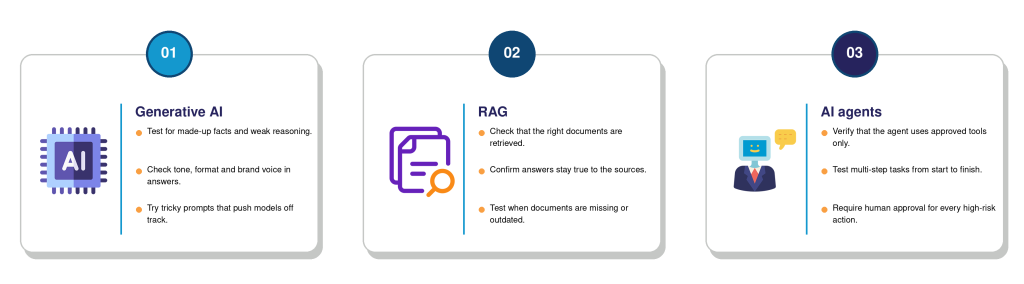
4. Applying AI-TLC to generative AI, RAG and AI agents
Each type of AI has its own risks. Focus your testing where the risk is highest.
5. Integrating AI testing into the software delivery lifecycle
AI testing should sit inside your normal delivery flow, not beside it.
Add AI test suites to your CI/CD pipeline.
Block releases when quality scores fall below limits.
Run quick safety checks on every code change.
Share results with product, risk and security owners.
This way, AI quality becomes part of daily work. Developers get fast feedback, and leaders get clear proof before go live.
6. How to measure AI readiness for production
Ask one simple question: is this AI ready for real users? Use clear scores to answer it.
Accuracy: share of answers that match trusted sources.
Safety: number of harmful or private outputs found.
Consistency: how stable answers are across repeated runs.
Performance: response time and cost for each request.
Coverage: how many risky scenarios your tests include.
Set a pass mark for each score. Then review them together before every release. Prolifics can help you define these scores and pass marks for your own use cases.
7. How Prolifics helps teams build confidence in AI
Prolifics helps enterprises move AI from pilot to production with confidence. With deep experience in testing, data and digital engineering, the team brings structure to every AI-TLC stage.
Prolifics can help you:
Define use cases and risk limits with stakeholders.
Build test data, prompts and realistic evaluation scenarios.
Run quality, safety and security testing at scale.
Automate AI checks inside your existing delivery pipelines.
Set up monitoring for drift and ongoing improvement.
Whether you run a chatbot, a RAG tool or a group of agents, Prolifics can meet you where you are. The team works as a partner, so your people learn the practices and keep them.
8. Moving from experimentation to responsible scale
AI delivers value only when people trust it. Trust comes from proof, not promises. AI-TLC gives you that proof at every step.
Start small. Pick one use case, define its limits, build a test set and measure the results. Then repeat with the next one. Teams that work this way ship faster, face fewer surprises and protect their users and their brand. If you want a partner for the journey, Prolifics can help you plan, test and scale with confidence.
Conclusion
AI-TLC is a lifecycle approach to testing AI systems. Unlike traditional testing, which checks fixed outputs, it accepts that AI answers can change. It treats testing as a continuous journey that covers the use case, data, model, application and life after release. Its goal is trust.
It rests on three ideas: test early, test often and test wide. Early testing finds risks while fixes are cheap. Frequent testing catches changes in behavior. Wide testing covers quality, safety, security and speed.
Frequently asked questions
How is AI-TLC different from traditional software testing?
Traditional testing checks fixed rules and expects the same result every time. AI-TLC works differently because AI answers can change. It tests for quality, safety and consistency, not just pass or fail. It also covers data, prompts and agent actions, and it continues after release through drift reviews and regular retesting, so quality stays high as things change.
When should AI-TLC begin in an AI project?
It should begin on day one, during use case planning. Early work on intended behavior, risk limits and success measures saves time later. Teams that wait until the build is finished often find problems that are costly to fix. Starting early also helps you collect the right data and test scenarios while the project is still flexible.
What should teams test before deploying an AI application?
Teams should test accuracy, relevance, consistency and safety of answers. They should also test integrations, agent actions, security, cost and speed. Add checks for privacy and bias too. Finally, confirm that a human can step in when the AI is unsure or the risk is high, and that the team can roll back quickly.
How can teams monitor AI quality after release?
Track the same scores you used before launch, using live traffic and sampled conversations. Set alerts for drops in accuracy, rising unsafe outputs and unusual cost. Review drift on a fixed schedule, and retest after any model, prompt or data change. Feed real user issues back into your test sets so they improve over time. Prolifics can set up this monitoring and reporting for you.
Imagine an inspection robot moving through a factory, detecting an unusual vibration before a machine fails. It identifies the affected asset, sends evidence to the maintenance team, and helps them intervene before production is disrupted.
This is the opportunity behind physical AI: connecting intelligence with machines and environments where decisions have immediate operational consequences.
For business leaders, the appeal is clear. Earlier detection, more responsive equipment, and better use of physical assets can improve performance. Realizing those benefits, however, requires a plan for integrating, validating, and operating intelligent systems beyond the pilot.
What physical AI means for enterprises
Physical AI enables machines to interpret their surroundings and act within the physical world. Sensors and cameras capture information; AI models interpret conditions; control systems translate decisions into actions. Feedback from those actions helps teams assess performance and improve the system.
Examples include mobile robots navigating changing spaces, inspection drones examining infrastructure, and intelligent equipment adjusting to operating conditions. The appropriate level of autonomy depends on the task, its risks, and the controls surrounding it.
Physical environments introduce constraints that software teams must address explicitly. Machines encounter friction, vibration, heat, obstructions, and unreliable connectivity. Their intelligence must work within hardware limits and respond quickly enough for the intended operation. 1,2
Where physical AI can create business value
Manufacturing and maintenance. Intelligent inspection systems can gather equipment data more frequently and flag emerging problems for investigation. When connected to maintenance workflows, those findings can support earlier intervention and more informed scheduling.
Warehousing and material movement. Mobile robots can use environmental data to navigate designated areas and adjust their movement when conditions change. The business case should examine throughput, congestion, operator interventions, and how reliably tasks are completed.
Infrastructure inspection. Drones and other mobile systems can collect observations from locations that are difficult to inspect routinely. AI can help identify anomalies for qualified teams to review, supporting decisions about where further inspection or maintenance is needed.
These opportunities are most compelling when tied to a specific operational problem. A useful starting question is which recurring delay, inspection gap, or equipment issue creates enough measurable cost to justify intervention.
Why promising pilots struggle to scale
A controlled demonstration may use clean data, consistent lighting, and dependable connectivity. Production introduces mixed equipment, shifting conditions, incomplete records, and people moving through shared spaces. Each variation can affect performance.
Integration also determines whether intelligence becomes useful. An inspection finding needs asset context, a destination in the maintenance process, and someone accountable for responding. Without those connections, teams can accumulate alerts without improving operations.
Costs change as deployments expand. Device management, energy use, network traffic, model updates, and support all affect the business case. A pilot that works technically still needs to prove that its operating model remains affordable across additional sites. 1
Five priorities for a successful deployment
1. Define the outcome and baseline. Choose a focused problem and document current performance. Useful measures might include inspection coverage, downtime, task completion time, or cost per inspection. Agree on acceptable error rates and intervention requirements alongside productivity targets. This gives operational and technology teams a shared definition of success before they select equipment or models.
2. Connect data to operational workflows. Map how sensor readings, asset records, AI decisions, and downstream actions will move through the organization. Establish data quality checks, access controls, and clear interfaces with existing applications. Preserve traceability so teams can investigate which inputs informed a decision and what happened afterward. Assign ownership across IT, operational technology, and business teams.
3. Place intelligence where the task requires it. Time-sensitive decisions may need to run locally on devices or nearby computing infrastructure. Cloud environments can support training, analysis, and coordination across sites. Evaluate response time, connectivity, power, memory, and maintenance together. Define how the system should behave when a connection fails or its inputs become unreliable.
4. Validate the complete system. Use simulation and digital twins where appropriate to explore operating scenarios before introducing physical changes. Then validate behavior under representative real conditions, including sensor faults, unusual obstacles, and changing workloads. Test integration, security, recovery, and human intervention as well as model accuracy. Simulation helps reveal weaknesses, but physical testing remains necessary.
5. Expand through measured operational stages. Begin in a bounded environment with defined supervision and acceptance criteria. Review results with frontline users before increasing scope. Train operators to recognize exceptions and intervene appropriately. Establish monitoring, controlled updates, and support responsibilities from the outset. Expansion should follow evidence that the system remains useful, manageable, and reliable as conditions change. 1
Measure value across the operating lifecycle
Evaluate the economics over the life of the deployment. Include hardware, integration, connectivity, energy, monitoring, maintenance, and retraining. Compare those costs with verified improvements in output, inspection effort, asset availability, or service quality. Avoid assuming that every detected anomaly represents a prevented failure; operational teams need to confirm what changed and why.
Keep reviewing performance after launch. New products, equipment changes, and environmental shifts can alter the conditions a model encounters. Record operator feedback and investigate repeated overrides or false alarms. A deployment that initially saves time can lose value if staff must continually correct its decisions. Regular reviews help teams decide when to adjust the system, expand it, or pause further rollout. These reviews should inform funding decisions for each additional site. 1
Build your enterprise AI foundation with Prolifics
Physical AI initiatives depend on strong enterprise capabilities around the equipment itself. Prolifics brings AI consulting, data engineering, integration, cloud services, and Quality Engineering to help organizations strengthen that foundation. 3,4
Our AI Assessment and Health Check provides a practical starting point for evaluating business opportunities, use-case feasibility, data and architecture readiness, and governance. These areas help clarify the enterprise requirements that a physical AI initiative must address alongside specialist hardware and operational engineering. 3
Start the conversation with one use case, your current performance baseline, and the systems involved. Together, we can explore the data, integration, and validation priorities that should shape your next step.
Modern data stack decisions should start with workloads, governance, skills, and unit economics, not a platform label. Use a cloud data warehouse for governed SQL analytics and predictable reporting; use a lakehouse for mixed data, engineering, streaming, and AI; use both only when each has a defined role, shared governance, and a plan to prevent duplicate pipelines and uncontrolled data movement.
A warehouse is usually the fastest path for structured BI, financial reporting, and SQL-centric teams. A lakehouse fits diverse data, data science, streaming, and open-format requirements. Use both when workloads genuinely differ, and the operating model defines ownership, data movement, governance, and cost controls across the two platforms.
What is a modern data stack?
A modern data stack is a modular set of cloud or hybrid services that ingests, stores, transforms, governs, and serves enterprise data for analytics, reporting, automation, and AI. Its value comes from reliable data products and clear operating controls, not from the number of tools or whether one vendor labels the platform a warehouse or lakehouse.
The stack normally spans source integration, batch and streaming pipelines, storage, compute, transformation, metadata, data quality, security, semantic models, observability, and consumption. Those capabilities may sit in one platform or across several connected services. A good design makes ownership and service levels visible from ingestion to dashboard or model, supports system integration without proliferating copies, and gives teams a practical route to retire legacy components.
The original CIDR lakehouse paper described an architecture based on direct access to open data formats with first-class support for machine learning and data science. IBM’s current comparison adds an important qualification for enterprise buyers: warehouses, lakes, and lakehouses can serve different functions in one governed data estate. The modern choice is therefore an operating-model decision as much as a storage decision.
How do a lakehouse and data warehouse differ?
A data warehouse prioritizes modeled, structured data and high-performance SQL analytics. A lakehouse adds warehouse-style transactions, metadata, and governance to low-cost object storage so teams can work with structured, semi-structured, and unstructured data through multiple engines. The difference is narrowing, but the operating experience, workload fit, and skills required can still be materially different.
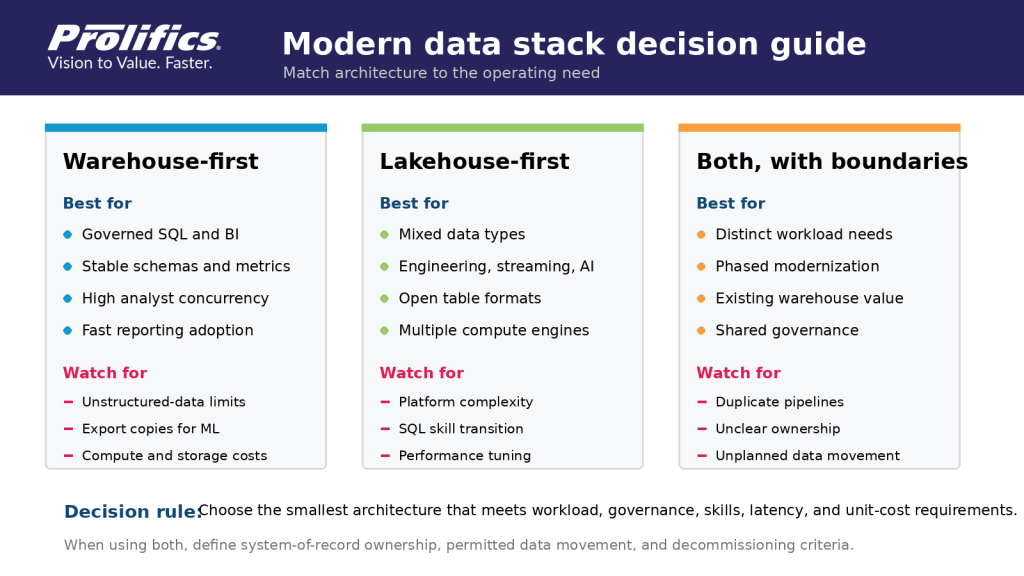
Decision factor
Warehouse-first
Lakehouse-first
Both, with boundaries
Primary fit
Governed BI, financial reporting, repeatable SQL
Engineering, streaming, data science, AI, varied data
Distinct workloads with shared governance
Data model
Schema-on-write and curated relational models
Open files and tables with schema enforcement and evolution
Curated products move only when a consumer requires it
Skills
SQL, dimensional modeling, BI administration
SQL plus Spark/Python, open-table and platform engineering
Cross-platform architecture, FinOps, lineage, and ownership
Performance
Predictable for relational joins and high concurrency
Strong when formats, layout, caching, and compute are tuned
Fit-for-purpose, but integration overhead must be controlled
Cost pattern
Simple consumption model, but compute can grow with concurrency
Low-cost storage, with engineering and compute costs to manage
Potentially higher unless duplication and data movement are limited
Main risk
Copies for AI and nonrelational workloads
Complexity or weak SQL serving experience
Two platforms become two versions of truth
Microsoft’s Fabric decision guide similarly maps a warehouse to enterprise data warehousing, SQL BI, OLAP, and full SQL transaction needs, while mapping a lakehouse to big data, machine learning, varied formats, and data engineering. Treat product claims as inputs, then validate them against your own workload tests and governance requirements.
When should a modern data stack use a warehouse?
Use a warehouse when the dominant need is trusted, repeatable analysis over structured data and the organization already operates effectively in SQL. Finance, risk, sales, and regulatory teams often need stable dimensions, reconciled measures, predictable access controls, and high-concurrency dashboards more than they need direct access to raw files or several compute engines.
A warehouse-first path can also accelerate IT modernization when legacy reporting is the immediate constraint. It gives analysts familiar tools, supports controlled semantic models, and reduces the change burden on business users. That faster adoption can improve efficiency sooner than a technically broader platform that demands new engineering skills before it delivers a usable report.
Choose warehouse-first when most source data is structured; service levels center on SQL and BI; multi-table transactions or relational integrity matter; and the team can forecast query, concurrency, and retention costs. Keep an escape route for data science and unstructured content through open integration patterns. A warehouse should not become the landing zone for every workload merely because procurement has already approved it.
When should a modern data stack use a lakehouse?
Use a lakehouse when the same governed data must support engineering, streaming, exploratory analytics, machine learning, and AI across varied formats. Open table formats and decoupled storage and compute can reduce unnecessary copies and let different processing engines work on a shared foundation. That flexibility is especially useful for telemetry, documents, images, clickstreams, and other data that does not fit a conventional relational model early in its lifecycle.
IBM defines a data lakehouse as a platform that combines flexible, low-cost lake storage with warehouse-style data management and analytics. The metadata layer is the dividing line: schema enforcement, transaction consistency, lineage, versioning, and access controls turn object storage into a governed analytical platform rather than a file collection.
Choose lakehouse-first when data engineering and AI are strategic workloads, data types and arrival patterns vary, open access matters, and the organization can operate the required catalog, quality, security, and performance controls. Do not assume object storage makes the total solution cheap. Query engines, idle compute, small-file problems, data egress, duplicated transformations, and scarce platform skills can erase storage savings.
When should a modern data stack use both?
Use both when the workloads are genuinely different and each platform has a named responsibility. A common pattern lands and refines diverse data in a lakehouse, then serves certified, performance-sensitive models through a warehouse. Another pattern preserves a valuable warehouse for core reporting while a lakehouse becomes the foundation for streaming, data science, and AI. Both can work, but “both” is not a license for indefinite duplication.
Define the system of record for every data product, the consumers that justify movement, freshness requirements, transformation ownership, and where quality rules are enforced. Share the catalog, lineage, identity, and policy model across platforms. Set measurable decommissioning criteria for duplicate pipelines and legacy marts. Without those boundaries, cloud migration can reproduce the same integration and governance debt in two newer tools.
Forrester’s 2026 lakehouse perspective emphasizes AI readiness, trust, openness, and operational intelligence as enterprise evaluation criteria. That reinforces the practical decision: choose an architecture that supplies governed context to BI and AI, rather than selecting a lakehouse or warehouse from a feature checklist alone.
Why does modern data stack architecture affect business value?
Architecture affects cost, delivery speed, data trust, and the amount of work required to produce each decision. A simpler fit between workloads and platform capabilities can reduce redundant storage, repeated transformations, manual reconciliations, and specialist handoffs. Separating storage and compute may improve unit economics, while a focused warehouse can lower adoption costs for SQL-centric teams. Neither benefit is automatic; it depends on measurement and operational discipline.
Cost control belongs in the design. Flexera’s 2025 State of the Cloud findings reported that 84% of more than 750 surveyed cloud professionals viewed managing cloud spend as their top cloud challenge, and 87% used cost efficiency or savings as the leading measure of cloud progress. Platform teams should therefore track cost per pipeline, query, data product, and business outcome, not only the monthly invoice.
The business case should connect architecture to measurable service levels: report latency, data-quality incidents, time to onboard a source, analyst self-service, model deployment lead time, audit evidence, and cost per workload. This is where enterprise automation, observability, and clear product ownership matter. A modern platform creates value when trusted data reaches a decision or automated process faster and with less operating friction.
How should you build a modern data stack step by step?
Build the stack as a portfolio of governed data products, beginning with measurable use cases and an explicit exit plan for legacy components. The following sequence keeps technology selection tied to value and reduces the risk of an expensive platform that never becomes the default way of working.
1. Prioritize business decisions: Select two or three outcomes, name their users, and establish current baselines for latency, cost, quality, and manual effort.
2. Inventory workloads and constraints: Classify data types, volumes, freshness, concurrency, transaction needs, residency, retention, security, and existing contracts.
3. Choose the minimum viable architecture: Map each workload to warehouse, lakehouse, or both. Reject components that do not serve a named requirement.
4. Design governance with the platform: Define ownership, catalog, lineage, quality controls, identity, encryption, and policy enforcement before migrating sensitive data.
5. Prove performance and unit economics: Benchmark representative pipelines and queries, including peak concurrency, recovery, egress, operations, and support effort.
6. Migrate in value slices: Move one end-to-end data product at a time, automate testing and reconciliation, and train producers and consumers together.
7. Measure adoption and retire duplication: Track business use, service levels, and cost per outcome; then decommission redundant marts, pipelines, licenses, and infrastructure when acceptance criteria are met.
Figure 1. A workload-led decision guide for warehouse-first, lakehouse-first, or both.
What do Prolifics client examples show?
Prolifics client work shows that modernization value comes from deleting unnecessary complexity, governing critical data, and improving access, not from adopting an architecture label.
Health insurance cost and scope control. A health insurance payer serving more than 3.5 million members needed to replace costly analytics technology and consolidate its enterprise data warehouse. Prolifics reduced the estimated migration cost from $2 million to $700,000 and identified 20–40% of existing data processes that did not need to move. The resulting platform supported on-demand data for plan pricing, member segmentation, claims analysis, and regulatory reporting.
Insurance governance and productivity. Another insurer reported that employees spent 70% of their time looking for the right data. Prolifics established a centralized master-data and governance platform, automated policy handling, and trained more than 140 employees. The case connects architecture to faster issue resolution, fewer manual errors, better customer insight, and improved decision-making.
Automotive data and AI foundation. For a leading automotive manufacturer, Prolifics implemented Azure Data Lake, Azure Data Factory, Databricks, automated pipelines, a metadata-driven framework, data-quality controls, and Unity Catalog. The published outcomes include faster reporting, reduced integration complexity, improved governance, and a scalable foundation for analytics and AI.
How can Prolifics help modernize your data stack?
Prolifics Data & AI services connect strategy, architecture, data engineering, management, analytics, MLOps, governance, and managed services. Prolifics designs lake, lakehouse, and warehouse architectures across AWS, Azure, Google Cloud, and hybrid environments, with business KPIs, security, compliance, and operating ownership defined from the start.
That end-to-end view matters when architecture crosses cloud migration, system integration, data quality, semantic models, and enterprise automation. Prolifics can assess the existing estate, prioritize high-value use cases, benchmark platform options, build governed pipelines, enable self-service analytics, and operate the environment after launch. The goal is not to maximize platform footprint. It is to reduce delivery friction, control unit cost, improve trust, and create reusable data products that support reporting and AI.
Engagements can begin with a focused assessment and roadmap, then progress through co-delivery, build-operate-transfer, or managed services as the operating model matures.
Should my enterprise replace its data warehouse with a lakehouse?
Keep a warehouse when it reliably serves governed SQL, financial reporting, or high-concurrency BI. Add or migrate to a lakehouse when varied data, engineering, streaming, or AI requirements justify it. Replace the warehouse only after representative workloads meet performance, governance, cost, and adoption criteria and duplicate systems can be retired.
Is a lakehouse cheaper than a cloud data warehouse?
A lakehouse can lower storage costs and reduce data copies, but total cost also includes compute, engineering, catalog operations, performance tuning, egress, observability, and support. Compare cost per workload or data product under volumes and concurrency. The cheaper architecture is the one that meets service levels with the lowest unit cost.
Can a lakehouse support regulatory reporting and business intelligence?
Yes, when the lakehouse provides transactional tables, schema enforcement, quality controls, access, lineage, audit evidence, performant SQL, and governed semantic models. Regulated reporting requires reconciliation, control ownership, retention, and tested service levels. Platform capability does not replace the operating controls required by finance, insurance, or healthcare teams.
When should an enterprise use both a lakehouse and a warehouse?
Use both when separate workloads create value: for example, a lakehouse for varied data, engineering, streaming, and AI, plus a warehouse for certified relational models and high-concurrency BI. Define one system of record per data product, shared governance, permitted movement, service levels, cost allocation, and criteria for retiring duplicate pipelines.
How should we migrate to a modern data stack without disrupting reporting?
Migrate one business data product at a time. Baseline current reports, automate source-to-target reconciliation, run old and new outputs in parallel for a validation period, and obtain business-owner acceptance before cutover. Preserve lineage and rollback paths, train users, then retire legacy pipelines only after adoption and service-level criteria are met.
AI in higher education is reshaping learning through personalized support, faster feedback, accessible content, and new forms of assessment. At the same time, it is changing campus operations by augmenting advising, enrollment, service delivery, finance, HR, research administration, facilities, and IT. The institutions most likely to create durable value will connect both sides through trusted data, clear governance, workforce capability, human oversight, and measurable outcomes.
The debate is no longer about whether AI belongs on campus. Students already use it, faculty are adapting courses and assessments, and staff are applying it to daily work. The strategic question is whether institutions will manage these changes as scattered tool adoption or as one coordinated transformation.
At Prolifics, we help higher education institutions connect AI initiatives across learning and campus operations through trusted data, clear governance, and practical integration. We support workforce readiness, human oversight, and measurable outcomes to help institutions make AI adoption coordinated and sustainable.
AI Adoption Is Outpacing Institutional Readiness
The evidence shows why coordination matters. A 2026 UK survey found that 95% of undergraduates used AI in at least one way, yet only 36% felt encouraged by their institution to use it and 38% said their institution provided AI tools (HEPI Student Generative AI Survey 2026).
In the United States, California State University reported more than 94,000 responses across students, faculty, and staff. More than half of the students, six in ten faculty, and two-thirds of staff said they regularly used AI-powered tools (CSU systemwide AI survey).
That adoption creates opportunity, but it also exposes a familiar institutional gap: technology can spread much faster than policy, data readiness, training, and measurement.
How AI Is Reshaping Learning
1. Personalized support at a scale people alone cannot provide
AI-enabled tutoring and course assistants can offer explanations, practice questions, translation, study planning, and feedback outside office hours. Used well, they give students more opportunities to ask questions and revisit difficult concepts. They can also support accessibility by helping transform content into different formats or levels of explanation.
The design constraint is educational purpose. A useful assistant prompts a learner to explain reasoning, compare alternatives, test assumptions, and reflect on feedback. A poorly designed assistant simply delivers an answer. Institutions should evaluate learning tools against course outcomes, accessibility requirements, data boundaries, and evidence of actual learning, not engagement alone.
2. Faculty productivity with academic judgment intact
Faculty can use AI to generate first drafts of lesson plans, examples, rubrics, practice activities, summaries, or alternative explanations. It can also help organize literature, identify themes, and improve the accessibility of course materials. These uses may reduce preparation time, but subject-matter review remains essential because generated material can be incomplete, biased, or wrong.
The goal is not to automate teaching. It is to return time to the work that requires disciplinary expertise, mentoring, discussion, feedback, and the design of meaningful learning experiences.
3. Assessment designed for an AI-rich environment
Assessment is already changing. HEPI reported that 65% of surveyed UK undergraduates believed assessment had changed significantly in response to AI, while 12% said they directly included AI-generated text in assessed work, up from 8% in 2025 and 3% in 2024 (HEPI 2026 findings).
A durable response goes beyond detection. Programs can use oral defense, iterative drafts, applied projects, process notes, source verification, and explicit disclosure of permitted AI use. Clear, assessment-specific guidance gives students and faculty a stronger basis for consistency and fairness.
4. AI literacy as a graduate capability
Students need more than prompt-writing tips. They need to understand model limitations, source evaluation, privacy, intellectual property, bias, appropriate disclosure, and when not to use AI. Those capabilities should appear across disciplines because graduates will encounter AI in law, business, health, engineering, public service, the arts, and research.
How AI Is Reshaping Campus Operations
The quieter transformation is happening across the work of the university. In a 2026 EDUCAUSE survey, 94% of respondents had used AI tools for work in the previous six months. The most frequently selected opportunities were automating repetitive processes, reducing administrative burden, and analyzing large datasets.
Student services and advising
A governed virtual assistant can answer routine questions about registration, deadlines, policies, financial aid documentation, or campus resources. AI can also help advisors summarize complex records, identify missing steps, and prepare for conversations. High-impact decisions should remain reviewable by qualified people, especially when recommendations affect progression, funding, discipline, or access to support.
Enrollment, retention, and student success
Predictive models can help institutions understand application patterns, forecast demand, and identify students who may benefit from timely outreach. The useful outcome is not a risk score by itself. It is a well-designed intervention that accounts for context, gives staff usable information, and avoids stigmatizing students or treating correlation as destiny.
Finance, HR, procurement, and research administration
Document intelligence can classify forms, extract data, route approvals, and flag exceptions. Generative tools can summarize policies, prepare first drafts, and help staff navigate institutional knowledge. In research administration, AI may help organize grant requirements, compare submissions with checklists, or synthesize prior documentation. Each workflow still needs appropriate access controls, retention rules, validation, and accountable approval.
Facilities, IT, and service management
AI can assist with demand forecasting, energy analysis, maintenance prioritization, support-ticket triage, knowledge retrieval, and incident response. These use cases often offer a practical starting point because outcomes can be measured against existing service levels, resolution times, energy consumption, backlog, or system availability.
The Shared Foundation Is Trusted Data and Integration
Learning and operations depend on many of the same systems: the student information system, learning management platform, CRM, identity services, finance and HR applications, research systems, and data platforms. AI cannot compensate for fragmented records, inconsistent definitions, unclear ownership, or insecure access.
Institutions should define which data an AI service may access, why access is necessary, how long inputs and outputs are retained, whether data can train an external model, and how users can challenge or correct results. They also need integration patterns that keep source systems authoritative and prevent a chatbot from becoming an uncontrolled shadow record.
Prolifics connects this foundation to higher education digital transformation through secure platform integration, cloud modernization, student lifecycle capabilities, and AI-ready data. Its Data and AI services emphasize governed data platforms, responsible AI, and measurable business outcomes.
The Risks Are Manageable When Controls Match the Use Case
AI risk is not one category. EDUCAUSE respondents identified misinformation, use of data without consent, loss of independent-thinking skills, insufficient data protection, copyright concerns, and uneven capability among urgent issues (EDUCAUSE 2026).
A practical control model should address at least six areas:
• Privacy and security: minimize data, control access, review vendor terms, protect sensitive records, and monitor usage.
• Accuracy and reliability: test on representative scenarios, require source checking, define confidence thresholds, and provide escalation paths.
• Bias and fairness: examine data and outcomes across relevant groups, involve affected stakeholders, and document mitigations.
• Academic integrity and learning: define permitted use at course and assessment level, require disclosure where appropriate, and redesign assessment around authentic evidence of learning.
• Accessibility and equity: ensure tools work for disabled users, provide alternatives, and avoid making paid consumer access a hidden course requirement.
• Accountability and transparency: name owners, document intended use and limitations, keep human review for consequential decisions, and make appeal or correction possible.
The NIST AI Risk Management Framework provides a useful structure through Govern, Map, Measure, and Manage. In the UK, the Information Commissioner’s Office advises organizations to assess risks to people’s rights and apply proportionate technical and organizational measures when AI processes personal data (NIST AI RMF; ICO AI and data protection guidance).
A Six-Step Roadmap for Responsible Scale
Step 1: Start with institutional priorities
Choose a problem connected to learning, student experience, workforce capacity, risk, or cost. Avoid beginning with a tool in search of a use case.
Step 2: Assess readiness
Review data quality, integration, security, policy, skills, operating ownership, and change capacity. A readiness assessment should produce a prioritized roadmap, not only a maturity score.
Step 3: Select one bounded, measurable use case
Favor a workflow with clear users, available data, manageable risk, and an existing baseline. Define what will remain under human control.
Step 4: Design governance into the pilot
Document purpose, data flows, decision rights, evaluation criteria, access rules, testing, monitoring, and an exit plan before launch.
Step 5: Measure outcomes and unintended effects
Compare results with the baseline. Include learning quality, service quality, adoption, workforce impact, equity, risk events, and total cost, time saved.
Step 6: Scale the capability, not just the tool
Reuse integration, identity, data, evaluation, procurement, and governance patterns. Continue training and monitor performance as models, policies, and user behavior change.
A structured AI maturity and readiness assessment can help leaders connect use-case value with data, technology, governance, and workforce readiness before committing broad deployment.
Measure Value Across Five Dimensions
Measurement is still immature. Only 13% of respondents in the EDUCAUSE workforce study said their institution measured ROI for work-related AI. A useful scorecard should combine leading and lagging indicators across five dimensions:
• Learning: demonstrated mastery, quality of feedback, course completion, accessibility, and student confidence in evaluating AI output.
• Student experience: response time, issue resolution, successful handoffs, satisfaction, and equitable access to support.
• Workforce: task time, backlog, adoption, error rates, training completion, and employee experience.
• Risk and trust: privacy or security incidents, unsupported outputs, bias findings, escalations, overrides, and successful appeals.
• Financial and operational value: total cost, avoided effort, cycle time, service capacity, infrastructure consumption, and value delivered against the baseline.
Not every pilot needs a conventional revenue return. Universities can still define the value of better learning, faster service, reduced risk, improved access, and more staff time for high-value work.
What Comes Next for Higher Education
AI will become less visible as it is embedded in learning platforms, service workflows, analytics, and everyday productivity tools. That makes institutional design more important, not less. Leaders will need a consistent way to decide where AI belongs, what evidence is required, which decisions remain human, and how benefits and harms are measured over time.
The institutions that move well will not be the ones that adopt the most tools. They will be the ones that connect pedagogy, operations, data, governance, and change management around a small number of valuable outcomes.
Build a Governed Path from AI Vision to Campus Value
Prolifics helps higher education institutions modernize connected campus platforms, build AI-ready data foundations, integrate core systems, and move from readiness assessment to governed implementation. Start with one meaningful use case, establish a measurable baseline, and design the controls needed to scale with confidence.
Conclusion
AI is reshaping higher education by personalizing learning, strengthening student support, and streamlining campus operations. Institutions that pair innovation with trusted data, responsible governance, skilled people, and clear measurement can create lasting value at scale.
Frequently Asked Questions
How is AI being used in higher education?
Institutions use AI for tutoring and learning support, course and content preparation, accessibility, advising, student services, enrollment analysis, document processing, finance and HR workflows, research administration, facilities, cybersecurity, and IT support. High-stakes decisions should remain subject to appropriate human review.
What are the main benefits of AI in higher education?
The main potential benefits are more timely and personalized support, reduced administrative burden, faster knowledge access, improved service capacity, and better use of institutional data. Benefits depend on sound process design, trusted data, training, and measurement.
What are the biggest risks?
Key risks include inaccurate output, privacy and security failures, bias, intellectual-property concerns, academic-integrity issues, unequal access, skill erosion, overreliance, and unclear accountability. Risk should be assessed by use case and managed throughout the AI lifecycle.
Will AI replace professors or university staff?
AI is more likely to change tasks than eliminate the need for educators and staff. Teaching, mentoring, care, judgment, accountability, and complex institutional decisions remain human responsibilities. The practical goal is to augment people and redesign work around higher-value activity.
How should a university start implementing AI?
Begin with an institutional priority, assess readiness, choose one bounded and measurable use case, design governance into the pilot, compare results with a baseline, and scale reusable capabilities only after evidence supports expansion.
NASA and IBM have launched the NASA–IBM Lunar Foundation Model, an open-source artificial intelligence model designed to help scientists analyze the Moon’s surface, locate potential water-ice deposits and identify safer landing locations for future missions.
Trained primarily on data collected by NASA’s Lunar Reconnaissance Orbiter, the model enables researchers to analyze vast volumes of lunar imagery and terrain data more efficiently. It was trained using approximately two million image tiles, including more than one million high-resolution camera images and nearly 964,000 multispectral images. It also incorporates data from NASA’s GRAIL and Lunar Prospector missions and the Japan Aerospace Exploration Agency’s SELENE mission.
Turning Lunar Data into Actionable Intelligence
Scientists can adapt the foundation model for several lunar research tasks without developing separate AI systems from the ground up. Potential applications include mapping craters, detecting volcanic formations and predicting where ice could remain stable near the Moon’s poles.
Locating lunar ice is especially important because it could provide water and oxygen for astronauts and potentially support the production of rocket fuel. This could reduce the amount of material transported from Earth and help enable a sustained human presence on the Moon.
The model can also identify and classify craters at meter-scale resolution. Detailed crater mapping can help researchers study the Moon’s geological history while supporting the assessment of landing locations, surface hazards and possible sites for long-term infrastructure.
According to IBM, the model reduced errors in identifying areas with strong ice potential by up to 22% compared with a widely used baseline model. It also delivered improved crater-detection performance at context-scale resolution while using less training data.
The model, supporting datasets and code are publicly available through Hugging Face and GitHub, allowing scientists worldwide to test, adapt and improve the technology.
The Prolifics–IBM Partnership
This development demonstrates how trusted AI, advanced data engineering and open innovation can transform complex data into actionable insight.
As a long-standing IBM Business Partner, Prolifics helps enterprises apply IBM technologies to their own data-intensive challenges. Combining IBM’s AI and hybrid-cloud platforms with Prolifics’ expertise in data engineering, AI governance, application modernization, automation and quality engineering, the partnership helps organizations move AI initiatives from experimentation into secure, scalable production.
While lunar exploration represents an extraordinary use case, the underlying opportunity is relevant across industries: unify fragmented data, discover patterns faster and make better-informed decisions with enterprise-grade AI.
Imagine a prospect who attends your webinar, explores a solution page, and downloads a case study. Your systems capture every interaction. Yet the next email they receive repeats an introductory message, and sales never sees the pattern behind their interest.
That missed connection is where AI in marketing operations can make a difference. When customer signals inform timely action, marketing teams can improve relevance, reduce repetitive work, and give sales better context for the next conversation.
The challenge is translating experimentation into results. McKinsey reports that while 90% of CMOs are experimenting with AI use cases, fewer than 10% have scaled AI or captured value across marketing workflows.
Connect the work that drives revenue
AI can contribute at several points in a marketing workflow. Predictive models estimate likely customer behavior. Generative AI drafts content. AI agents can coordinate tasks across connected applications, within defined permissions. McKinsey describes a shift toward continuously connected marketing capabilities, with insights feeding creative work, personalization, and execution.
For the webinar prospect, that could mean bringing engagement history together, suggesting a relevant technical guide, and preparing a summary for the account owner. A marketer reviews the recommendation before it reaches the customer. Sales then records whether the conversation produced a qualified opportunity.
This proposed workflow gives each team a clear role and creates a way to test whether better context actually improves follow-up.
Prioritize use cases with measurable outcomes
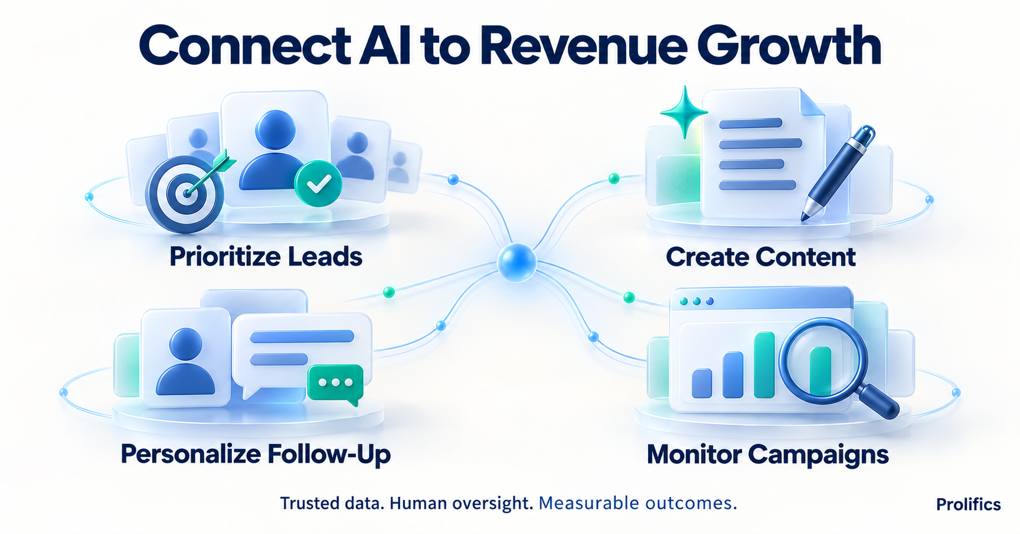
Start where a recurring delay or weak decision affects customer experience or revenue. Four applications offer useful starting points.
Prioritize leads using relevant signals. Predictive analytics can support lead scoring by identifying patterns in customer behavior. Test whether those scores improve sales acceptance and opportunity conversion. Give sellers visibility into the signals behind a recommendation so they can challenge unsuitable leads.
Accelerate content production. Generative AI can create email drafts, campaign variations, and localized materials. Ground outputs in approved messaging and product information, then review factual accuracy and brand voice. Track time to an approved asset, including editing and rework.
Make follow-up more relevant. AI can help segment audiences and recommend content based on customer behavior. For example, a technical evaluator might receive an integration guide, while a business sponsor receives a value assessment. Test whether the distinction improves meaningful engagement.
Monitor campaigns and coordinate action. AI agents can flag unusual performance and support corrective workflows. Establish which changes require approval, especially audience changes and spending decisions. Start with recommendations that a campaign owner can inspect before allowing bounded automated actions.
Make customer data reliable enough to act on
Disconnected CRM, marketing automation, and analytics platforms make it difficult to maintain a consistent customer view. Reliable integration and governed data are foundations for AI in marketing operations. [3]
Begin with the information required for the chosen workflow. Check whether contact records match across systems, engagement events arrive promptly, and customer preferences are available where decisions happen. Assign someone to resolve discrepancies before they trigger outreach.
Build quality checks around realistic failures. Would the workflow email someone who opted out? Could it promote an unavailable service? Would missing data produce an inappropriate recommendation? These questions help translate governance into acceptance criteria that marketing and IT can test together.
Make your expertise visible in AI search
McKinsey also identifies marketing to AI agents as an emerging capability. For enterprise marketers, that suggests reviewing whether buyers and AI systems can find clear, current answers about what the business offers. Product specifications, implementation details, and evidence supporting claims should be easy to locate and understand.
Consider a buyer comparing integration partners. A precise page explaining supported platforms, delivery scope, and a documented customer outcome gives them useful material for evaluation. Assign owners to keep that information current. Measure the quality of resulting inquiries, and ask prospects how they discovered the company. This connects content planning with the questions buyers actually bring into sales conversations.
Measure growth alongside productivity
Agree on a baseline before introducing AI. Record campaign preparation time, review effort, cost per qualified opportunity, and conversion through the relevant sales stages. Choose measures that match the workflow’s purpose.
Then run a controlled comparison wherever practical. Give comparable audiences the existing experience and the AI-supported experience, keeping other major variables stable. Allow enough time for the sales cycle before judging revenue impact.
Include integration, model usage, human review, and ongoing maintenance in the cost assessment. Treat hours saved as available capacity until the team demonstrates how it used them. If content production accelerates but approvals remain delayed, the next investment may belong in the review process.
Prove one workflow before scaling
Choose a bounded pilot such as webinar follow-up or campaign reporting. Name a business owner, agree on the success threshold, and bring marketing, sales, data, and IT into the design. Document the current process so the team can identify where AI changes the result.
During the pilot, review exceptions as carefully as successful outputs. Capture why people override recommendations and whether corrections reveal missing information, poor instructions, or integration problems. Use that evidence to improve the workflow.
Expand only when quality, operating cost, and business performance meet the agreed criteria. Reuse the connections, approved content, and monitoring practices that worked. Train each new team on its decisions and responsibilities before extending automation.
Build your next growth opportunity with Prolifics
Prolifics brings AI consulting, enterprise integration, generative AI, and responsible governance capabilities to business transformation. Its AI Assessment and Health Check covers opportunity prioritization, use-case feasibility, ROI analysis, and readiness across data, architecture, and platforms.
For marketing leaders, this provides a practical starting point for evaluating where AI could improve a specific workflow and what needs to change before implementation. The goal is a clear business case with an achievable path to delivery. Start with the handoff slowing your campaigns.
Where does your marketing workflow lose its strongest opportunities? Talk to Prolifics about an AI Assessment and Health Check to identify a valuable starting point, assess readiness, and define how success will be measured.
Real-Time AI uses event-driven architecture to process live data, apply AI models, and support decisions as business events occur. By connecting event streaming, real-time analytics, and low-latency inference, enterprises can detect changes and respond without waiting for scheduled data processing. With the right architecture, selected workloads can achieve millisecond-level processing and decision latency.
Real-Time AI combines continuous data streams, event-driven architecture, and AI inference to support immediate, context-aware decisions. Instead of analyzing historical data alone, it processes events as they happen. This enables enterprises to detect fraud, identify operational risks, personalize customer experiences, and automate time-sensitive actions with reduced decision latency.
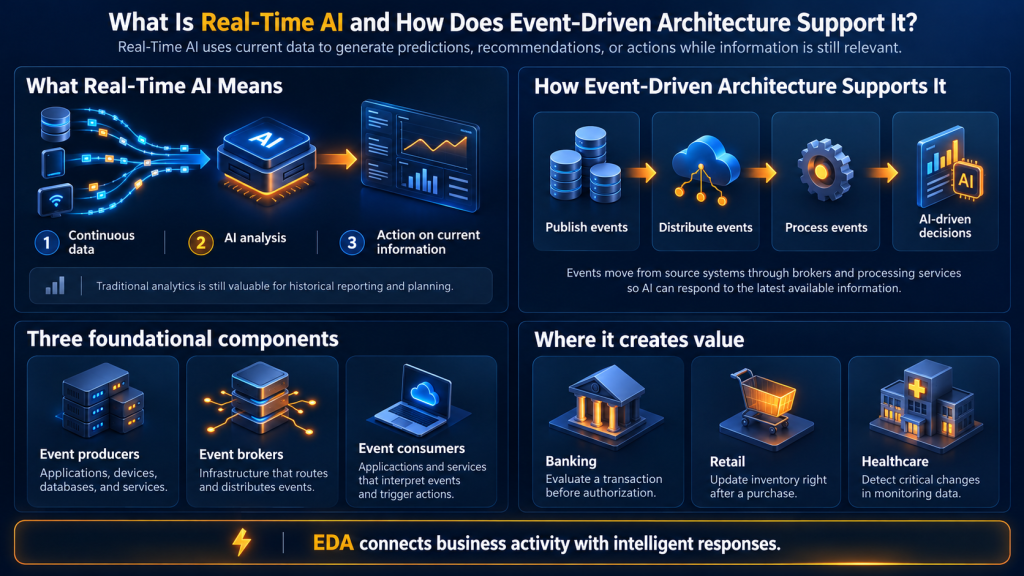
What Is Real-Time AI and How Does Event-Driven Architecture Support It?
Real-Time AI is an approach to artificial intelligence in which systems analyze continuously arriving data and generate predictions, recommendations, or actions within a defined time window. It integrates event streaming, stream processing, AI inference, and business rules to support operational decisions while information remains relevant. Its defining characteristic is not simply processing speed but the ability to act on current information.
Traditional enterprise analytics often relies on scheduled data movement and processing. Data is collected from multiple systems, transformed, stored, and analyzed before decisions are made. This remains valuable for historical reporting, forecasting, and strategic planning.
However, certain business situations require decisions before the next processing cycle.
A bank may need to evaluate a transaction before authorization. A retailer may need to update inventory availability immediately after a purchase. A healthcare organization may need to identify a critical change in patient-monitoring data.
Event-driven architecture supports these requirements by enabling applications to publish and respond to changes as they occur.
Event producers: Applications, devices, databases, and services that generate events.
Event brokers: Infrastructure that distributes events to the appropriate systems.
Event consumers: Applications and processing services that interpret events and initiate actions.
AI extends this model by analyzing events, identifying patterns, and supporting decisions based on the latest available information.
The result is an architecture that connects business activity with intelligent responses.
Why Does Real-Time AI Matter for Enterprise Decision-Making?
Real-Time AI matters because the value of business information often depends on how quickly an organization can act on it.
A fraud warning generated after a payment has been completed may have less preventive value than one generated during authorization. Similarly, identifying equipment failure after production has stopped offers fewer opportunities for preventive intervention.
For enterprise leaders, the objective is to reduce the time between detecting a relevant event and taking an appropriate action.
Real-time intelligence supports this objective across several operational priorities.
Improved customer experiences: Respond to customer interactions using current behavioral and transactional information.
Intelligent automation: Initiate appropriate workflows without unnecessary manual intervention.
Operational resilience: Identify system changes and trigger responses before issues escalate.
Better decision context: Combine recent events with historical data and business policies.
The value of AI also depends on measurable outcomes.
In an IBM article on AI and real-time event processing, IBM cites a 2023 Institute for Business Value survey of 2,500 global executives. The research reported an average AI project ROI of 5.9%, compared with 13% among best-in-class companies.
These figures reflect broader AI initiatives rather than the specific ROI of event-driven architecture. They nevertheless reinforce the importance of connecting AI investment with measurable business outcomes.
For organizations modernizing enterprise technology, the focus should therefore extend beyond model performance to include decision speed, operational effectiveness, and business impact.
How Does Event-Driven Architecture Enable Millisecond AI Decisions?
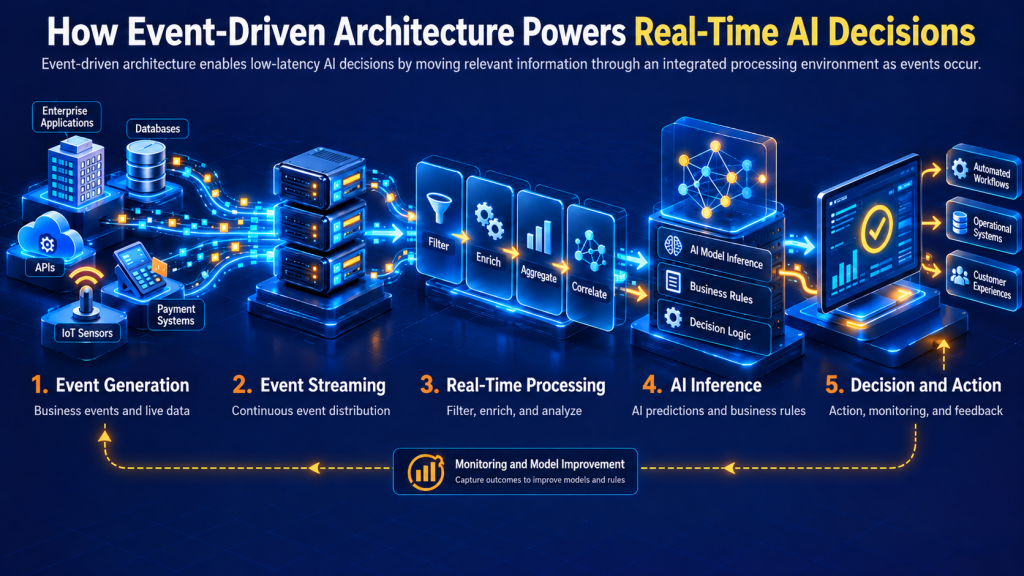
Event-driven architecture enables low-latency AI decisions by moving relevant information through an integrated processing environment as events occur.
Instead of requiring applications to repeatedly request updates, event producers publish information that interested systems can consume.
This reduces unnecessary polling and allows processing services to respond independently.
A typical Real-Time AI architecture includes five connected capabilities.
1. Event generation and data ingestion
Business applications, APIs, databases, connected devices, and operational platforms generate events. These can include payment requests, customer interactions, inventory updates, or equipment readings.
2. Event streaming and distribution
An event streaming platform receives and distributes events to downstream processing services. Technologies such as Apache Kafka support durable event storage, partitioned processing, and continuous event consumption.
3. Real-time data processing
Stream processing engines filter, transform, aggregate, and correlate incoming events. This prepares the information required for accurate analysis and AI inference.
4. AI inference and decision logic
AI models evaluate relevant information to produce predictions or classifications. Business rules then determine whether a recommendation, automated action, or human review is appropriate.
5. Action and operational monitoring
The decision is delivered to the relevant business application, workflow, or operational system. Monitoring captures latency, decision outcomes, errors, and model performance.
The Apache Kafka documentation describes event streaming as capturing, storing, processing, and routing events continuously.
However, millisecond performance is not automatic. Network delays, model complexity, data retrieval, processing queues, and downstream dependencies all contribute to total response time.
Enterprises must therefore evaluate the complete decision path rather than measuring event delivery speed alone.
Which Technologies Support Real-Time AI Architecture?
Real-Time AI requires coordinated technologies for collecting, processing, analyzing, and acting on continuous data streams.
No single platform delivers the entire architecture. The appropriate technology stack depends on existing enterprise systems, required performance, deployment environments, and governance standards.
Several technology categories play important roles.
Event streaming platforms: Apache Kafka and managed streaming services enable continuous distribution and consumption of event data.
Stream processing engines: Apache Flink and comparable technologies support stateful processing, aggregation, and event correlation.
AI inference services: Deployed machine learning models evaluate incoming information and generate predictions or classifications.
Data integration technologies: APIs, connectors, and change data capture mechanisms connect operational databases and enterprise applications.
Workflow automation platforms: Decision engines and orchestration services translate model outputs into business actions.
Cloud and infrastructure services: Scalable computing, networking, storage, and monitoring support workload performance and reliability.
A critical architectural consideration is how these technologies interact.
The Role of Prolifics Data Engineering
Prolifics helps enterprises build scalable data foundations that support real-time analytics and AI-driven decision-making. Through modern data engineering, streaming data pipelines, and enterprise integration, Prolifics enables organizations to connect diverse data sources, improve data accessibility, and process information continuously. These capabilities help businesses establish reliable data flows for intelligent automation, operational insights, and faster decision-making.
For example, a stream processing engine may enrich a transaction event with recent account activity before passing it to a fraud detection model. The prediction then informs a decision service that applies predefined authorization rules.
Each capability must be designed around the same decision requirements.
For enterprise IT leaders, platform selection should prioritize interoperability, latency requirements, operational resilience, and long-term maintainability rather than individual technology features.
How Can Enterprises Implement Real-Time AI Step by Step?
Implementing Real-Time AI requires a structured approach that connects business priorities, architecture design, AI capabilities, and operational governance.
A phased implementation reduces complexity and helps organizations validate business value before expanding into additional use cases.
A practical six-step implementation roadmap
Step 1. Identify time-sensitive business decisions
Start with a decision where latency has a measurable business impact. Examples include fraud detection, real-time inventory allocation, or equipment anomaly detection.
Define the required response time and expected business outcome.
Step 2. Assess existing systems and data sources
Identify which applications generate relevant events and determine whether the required information is available in real time.
Evaluate data accessibility, quality, integration dependencies, and current processing limitations.
Step 3. Establish an event-driven data foundation
Introduce event ingestion, routing, and processing capabilities that support reliable information exchange.
Define event schemas, access controls, retention policies, and recovery mechanisms.
Step 4. Integrate AI models into operational workflows
Deploy appropriate models and connect inference services with relevant event streams.
Use contextual data and business rules to determine how model outputs influence decisions.
Step 5. Validate latency, accuracy, and resilience
Test the complete workflow under realistic conditions, including peak event volumes and infrastructure failures.
Measure decision latency, model performance, throughput, and processing reliability.
Step 6. Scale with governance and continuous monitoring
Expand successful use cases while maintaining visibility into data quality, security, model drift, operational costs, and decision outcomes.
Establish ownership for platform operations and AI governance.
For enterprise modernization programs, Real-Time AI adoption should complement existing cloud migration, data modernization, and system integration initiatives.
A carefully selected pilot can demonstrate value while establishing reusable capabilities for subsequent applications.
Which Industries Benefit Most from Real-Time AI?
Real-Time AI is particularly relevant to industries where transactions, customer interactions, and operational conditions change continuously.
The strongest use cases involve decisions that must be made within a defined time window to protect revenue, reduce risk, or maintain service quality.
Financial services and insurance
Financial institutions can evaluate transaction activity, account behavior, and risk signals as events occur.
AI models can identify unusual patterns and support decisions such as additional verification, transaction review, or fraud investigation.
Insurance organizations can apply similar capabilities to claims-event monitoring, suspicious activity detection, and operational workflow prioritization.
Healthcare and pharmaceuticals
Healthcare organizations can analyze patient-monitoring events, equipment information, and operational signals to identify conditions requiring attention.
For example, a monitoring system could detect an abnormal pattern in incoming device readings and prioritize an alert for clinical evaluation.
Such systems require validated models, reliable data, appropriate oversight, and clinical governance. Real-time detection supports professionals rather than replacing clinical judgment.
Retail and consumer products
Retailers can respond to inventory changes, customer interactions, and transaction events using current information.
Potential applications include inventory synchronization, order exception detection, demand monitoring, and context-aware product recommendations.
Manufacturing and logistics
Industrial organizations can analyze telemetry, production signals, and supply chain events to identify equipment anomalies or operational disruptions.
Early detection can support maintenance decisions, production adjustments, and improved resource coordination.
Government and public sector
Public sector organizations can apply event-driven processing to service monitoring, infrastructure operations, and authorized workflow automation.
These implementations require strong controls over sensitive information, transparency, accountability, and system reliability.
Across industries, the primary benefit is the ability to connect timely information with decisions that influence business operations.
What Does Real-Time AI Look Like in a Financial Services Use Case?
Consider a financial institution processing digital transactions across mobile banking, payment platforms, and merchant channels.
Each transaction generates an event containing relevant information, such as transaction amount, time, payment channel, and account identifiers.
An event-driven fraud detection workflow could operate as follows:
A payment request generates a transaction event.
An event streaming service delivers the information to the risk processing system.
Stream processing combines the transaction with recent account activity and available risk indicators.
An AI model evaluates the enriched information and produces a fraud risk score.
A decision service applies authorization policies and determines whether to approve, challenge, or escalate the transaction.
The outcome is recorded for monitoring, investigation, and future model evaluation.
This illustrative architecture demonstrates how event streaming and AI inference can support time-sensitive risk decisions.
The architecture must also satisfy operational and regulatory requirements.
A low-latency prediction provides limited value if account data is outdated, the decision logic is unreliable, or downstream services cannot complete the required action.
Performance targets must therefore cover the full authorization workflow.
For example, an organization might establish an internal target of 100 milliseconds for its fraud scoring service, while measuring the broader payment authorization process separately. This is an illustrative engineering target, not a universal industry benchmark.
The expected business outcomes include faster risk assessment, more consistent decision execution, and improved visibility into suspicious activity.
Actual improvements must be established through production testing and outcome measurements.
What Challenges Must Enterprises Address Before Scaling Real-Time AI?
Scaling Real-Time AI introduces challenges that extend beyond deploying AI models or event streaming infrastructure.
Enterprise systems must process information consistently while supporting performance, security, governance, and operational reliability.
Five areas require particular attention.
Data quality and consistency
AI predictions depend on reliable information. Missing events, inconsistent schemas, duplicate messages, and stale contextual data can affect decision quality.
Event validation and data governance must be incorporated into the architecture.
Latency and infrastructure performance
Each stage introduces processing time, including event ingestion, feature retrieval, model inference, network communication, and downstream execution.
Organizations should measure end-to-end latency at realistic transaction volumes, including high-percentile performance.
Reliability and event handling
Distributed environments must address retries, duplicate processing, event ordering, and consumer failures.
Appropriate recovery processes and idempotent operations help prevent incorrect or repeated actions.
Security and compliance
Sensitive business and customer information requires strong authentication, authorization, encryption, auditability, and retention controls.
Automated decisions may also require explainability and human oversight depending on their impact.
Model monitoring and operational governance
AI performance can change as business behavior and data patterns evolve.
Organizations need continuous model evaluation, drift monitoring, controlled deployment, and clear escalation mechanisms.
AWS guidance on publish-subscribe architecture highlights both the scalability benefits of asynchronous communication and considerations involving eventual consistency and delivery guarantees.
The enterprise objective is not simply faster processing. It is dependable decision-making within clearly defined operational boundaries.
How Should Enterprises Measure the Success of Real-Time AI?
Real-Time AI initiatives should be evaluated using technical performance and measurable business outcomes.
Model accuracy alone does not establish whether an architecture delivers operational value.
A successful implementation should demonstrate that relevant information reaches the decision process quickly, decisions remain dependable, and resulting actions improve business performance.
Key performance indicators include:
End-to-end decision latency: Time from event occurrence or receipt to an actionable decision.
Processing throughput: Number of events processed successfully within a defined interval.
Decision accuracy: Quality of model predictions against validated outcomes.
System availability: Ability to maintain required processing services and response capabilities.
Event processing reliability: Successful handling of events, retries, failures, and recovery.
Business impact: Changes in fraud losses, operational costs, customer response times, or other use-case-specific outcomes.
Latency should be evaluated using percentiles rather than averages alone. For example, p95 and p99 measurements help reveal slower responses that average processing times may conceal.
Business measures should also reflect the consequences of incorrect decisions.
In fraud detection, a lower decision time must be considered alongside detection performance and false-positive rates. In healthcare monitoring, alert timeliness must be evaluated alongside clinical relevance and patient safety.
A balanced measurement framework connects technical performance with real operational results.
For CTOs and enterprise technology leaders, this creates a clearer basis for determining which applications justify further investment.
Frequently Asked Questions
What is real-time AI in enterprise applications?
Real-Time AI processes live information and applies AI models to support immediate decisions. Enterprises use it for applications such as fraud detection, operational monitoring, intelligent automation, and customer interaction analysis.
How does event-driven architecture improve AI performance?
Event-driven architecture delivers relevant changes to processing services as they occur, reducing dependence on scheduled data updates. It supports timely AI inference, but total performance also depends on model complexity, data access, and infrastructure latency.
Can real-time AI make decisions in milliseconds?
Yes, selected Real-Time AI workloads can achieve millisecond-level decision latency with optimized infrastructure and models. Actual response times depend on event ingestion, processing, inference, network performance, and downstream application requirements.
Which platform is best for enterprise real-time AI?
There is no universal best platform. Enterprises should evaluate technologies such as Apache Kafka and Apache Flink alongside AI inference services, based on integration requirements, processing volume, latency objectives, security, and operational capabilities.
How can businesses start implementing real-time AI?
Businesses should begin with a measurable, time-sensitive use case, assess data availability, and establish an event-driven processing foundation. A controlled pilot can validate model performance, decision latency, reliability, and business value before broader deployment.
How Can Enterprises Move Forward with Real-Time AI?
Real-Time AI connects event-driven architecture, continuous data processing, and intelligent decision-making to help enterprises respond when information matters most. Successful implementation depends on reliable integration, well-governed AI models, measurable latency, and resilient operations. By starting with high-value use cases, organizations can build scalable capabilities that support faster and more informed business decisions. Prolifics helps enterprises modernize their data, integration, and AI foundations to turn real-time intelligence into measurable business value.
Artificial intelligence is changing how quality assurance teams design tests, analyze failures, and manage release risk. With clear controls, AI can help teams focus on important scenarios and reduce repetitive work, while people remain responsible for test strategy and release decisions.
For enterprise teams, AI in QA has two connected meanings: using AI to improve software testing, and testing AI features in products and workflows. A useful strategy covers both, applying AI to defined quality activities while checking AI-enabled systems in realistic conditions.
Prolifics help organizations strengthen quality engineering across applications, data, and AI systems. Our experts combine proven practices, automation, and scalable solutions to help reduce risk and release confidence.
What does AI in QA mean?
AI in QA uses machine learning, generative AI, and related techniques across quality activities. These systems can suggest testing, classifying failures, identifying patterns in results, or prioritizing work. Some tools also adjust automation when an interface changes. Their value depends on input quality, recommendation accuracy, and human checks.
Teams should distinguish between two workstreams. AI-assisted testing uses AI to help validate conventional software. Testing AI systems checks software shaped by models, prompts, retrieval, data, or autonomous actions. This work must assess qualities such as answer relevance, factual grounding, fairness, safety, robustness, and consistency alongside ordinary software behavior. ISTQB’s current Certified Tester AI Testing syllabus addresses testing AI-based systems as a dedicated professional discipline.
A chatbot may phrase the same correct answer differently on separate runs, so an exact-string assertion may miss whether it met the user’s needs. Use task-specific rubric, representative examples, and human review for high-impact cases. Evaluate the whole application, including prompts, data, business rules, interface, and downstream actions.
Where AI can support quality assurance
AI helps most when a team can identify a repeated task, supply usable data, and verify results. Common applications include the following.
Generate test scenarios from clear requirements and recent code changes.
Prioritize relevant regression tests using change risk and defect history.
Identify unstable tests by comparing execution patterns across repeated builds.
Assist testers with log analysis, failure grouping, and defect triage.
Create useful synthetic test data that protects sensitive production information.
Monitor changing AI outputs for drift, safety, and policy compliance.
These examples describe assistance, not proof of quality. A generated scenario may miss a business rule, or a prioritized suite may overlook a rare but serious failure. A self-healing script may keep running after the workflow changes unexpectedly. Testers should check suggestions against requirements and risk, preserve traceability, and confirm that automated checks still verify the right behavior.
AI can group similar failures or summarize likely causes across large test result sets. Engineers still confirm root causes before changing tests or closing defects because plausible summaries can omit context or misread failures.
Benefits depend on the problem being solved
AI does not improve quality by itself. It can help teams use testing capacity more effectively when a measurable bottleneck exists. A team with slow regression cycles might test risk-based selection on a representative application. A team with high maintenance effort might assess whether locator suggestions reduce repairs without hiding real interface defects. Teams testing generative AI need evaluation methods that reflect user tasks, not only generic benchmarks.
A pilot should compare current and AI-supported processes. Track effort, coverage, accuracy, and escape defects together. Faster runs have little value if they drop critical checks or increase false alarms. More generated cases do not prove stronger coverage unless they test distinct risks and meaningful outcomes.
Set a baseline, define an acceptable error rate, and assign an owner. AI may produce useful drafts that need expert revision. Report reviewed results rather than treating raw output as completed work.
Risks teams need to manage
AI introduces quality risks alongside efficiencies. Generated tests can repeat assumptions in their requirements. Models can misclassify failures, expose sensitive data through prompts, or change output after model or data updates. An AI agent may exceed its intended boundary if teams fail to test permissions and recovery behavior.
These risks call for a broader test approach. NIST’s AI Risk Management Framework encourages organizations to consider trustworthiness through AI design, development, use, and evaluation. Its Generative AI Profile gives additional guidance on risks specific to generative systems. Google’s responsible AI evaluation guidance also recommends testing against application-specific datasets and adversarial queries, not relying only on general benchmarks. Those sources support a practical rule: define the failure modes that matter in your workflow, then build tests that can reveal them.
Teams should pay particular attention to practical controls such as these:
Protect confidential test data with approved environments and access controls.
Test outcomes for bias across relevant user groups and realistic scenarios.
Review AI-generated tests before adding them to critical release gates.
Record relevant model, prompt, source data, and evaluation changes over time.
Require human approval before allowing a consequential or irreversible system of actions.
Monitor production behavior and investigate meaningful quality shifts across contexts.
A control needs a clear owner. Define who reviews model changes, approves thresholds, and handles incidents. Link requirements, test data, model or prompt versions, results, and decisions so teams can explain release approvals and later behavior changes.
A practical roadmap for adopting AI in QA
A phased rollout lets a team learn about a bounded problem before it depends on AI in a critical workflow.
1. Identify a specific quality bottleneck
Start with an activity that consumes repeated effort or creates measurable risk, such as regression selection, test data preparation, failure triage, or evaluation of an AI feature. Record the current process and failure of cost. Choose a workflow that matters to the business and produce evidence the team can inspect.
2. Set the success measures and boundaries
Choose a few measures tied to the use case. For test prioritization, compare execution time with risk coverage and escape defects. For failure grouping, measure classification accuracy and review effort. For an AI application, measure task success, grounding, safety, and consistency. Define system access, approval points, and conditions that stop the pilot.
3. Prepare representative data and tests
Use data that reflects real workflows while meeting privacy and security requirements. Include normal cases, edge cases, and known failures. For generative AI, build an evaluation set from realistic requests, including ambiguous and adversarial inputs. Google recommends application-specific safety data alongside standard benchmarks [3]. Document the dataset’s source and limits.
4. Run a controlled pilot with human review
Integrate AI into a bounded test workflow. Keep existing checks available while the team compares results. Ask reviewers to record useful output, errors, omissions, and correction time. Test access, logging, handoffs, and recovery. Never let an unvalidated recommendation become a release decision.
5. Expand only after evidence supports it
Review results with engineering, QA, security, data, and business stakeholders. If the system meets thresholds, extend it gradually and monitor it. If it misses them, adjust data, prompts, workflow, or model, then retest. Reassess after meaningful changes because AI behavior and application context can shift.
How to measure AI quality assurance
Choose measures that expose tradeoffs instead of adoption alone. Track test design and maintenance effort, regression duration, stability, risk-weighted coverage, defect escapes, and recommendations accepted after review. For AI products, add task success, relevance, groundedness, safety, and performance across defined user groups. Select metrics based on the system and potential harm.
Use a stable evaluation set, then add cases when users encounter meaningful failures. Review summary scores and examples because averages can hide poor results for an important user group or request. Keep human review for ambiguous outputs and high-impact decisions. Automated evaluation informs decisions; it does not replace ownership.
Will AI replace QA testers?
AI can take on parts of repetitive test preparation, execution, and analysis. It cannot decide whether a requirement captures customer needs, whether behavior creates unacceptable risk, or whether release of evidence is sufficient. Quality engineers bring domain knowledge, exploratory thinking, system context, and judgment. Teams also need skills in evaluation design, data quality, risk analysis, and oversight.
AI should help people spend less time on repetitive tasks and more time investigating risk, challenging assumptions, and improving products. Redesign responsibilities around verified capabilities instead of assuming that a maturity ladder leads to autonomous testing.
Conclusion
AI can strengthen quality assurance when it addresses a risk, produces evidence teams can review, and keeps people accountable for release decisions. Start with a use case, measure results against a baseline, and expand only when safeguards work. Prolifics help enterprises build confidence through AI testing, automation, governance, and validation.
Frequently asked questions
What is the difference between AI in QA and AI testing?
AI in QA often means using AI to improve software testing. AI testing can also mean testing AI-based systems. Enterprise programs should address both and specify the relevant meaning for each use case.
Can generative AI create reliable test cases?
It can draft cases from requirements and examples, but teams must review accuracy, coverage, and assertions. Treat generated cases as suggestions until they pass established quality checks.
How should a company start using AI in QA?
Choose one bounded workflow, define a baseline and guardrails, and run a controlled pilot. Keep human review, inspect good and bad outputs, and expand only when evidence meets thresholds.
What should teams test in an AI-powered application?
Evaluate task success, relevance, grounding, safety, fairness where applicable, and robustness across realistic inputs. Also test access control, integration, performance, and recovery.
Databricks has introduced Adaptive Instructed-Retriever, a specialized artificial intelligence model designed to improve how enterprise AI agents search for and retrieve information from complex data environments.
Enterprise AI agents often need to search across tables, documents, notebooks, dashboards, and other rapidly changing assets. Straightforward questions may require only one search, while complex requests can involve multiple steps to collect and validate evidence. Traditional approaches can either stop too early and miss relevant information or perform unnecessary searches that increase response times and computing costs.
Adaptive Instructed-Retriever addresses this challenge by dynamically determining how much search effort each request needs. The model combines fast, parallel retrieval for simpler questions with sequential, multistep search for queries that require deeper investigation. It can stop early when sufficient evidence has been found or continue searching, within a defined limit, when additional steps are likely to improve the answer.
According to Databricks, the model delivered retrieval quality comparable to leading third-party and open-source models while achieving more than two times lower latency in its benchmark testing. The company reported an average response time of approximately 5.8 seconds for the evaluated workload.
The model was trained using synthetic enterprise retrieval environments and online reinforcement learning. Its reward system balances retrieval quality against the cost of additional search steps, helping the model learn when further investigation adds value and when it should return an answer.
This approach could strengthen data agents such as Databricks Genie Code, Genie One, and Genie Agents, which must locate relevant enterprise assets without relying on inefficient, brute-force exploration. Organizations can also select model configurations that prioritize speed for interactive applications or deeper retrieval quality for more complex analytical workloads.
What This Means for Enterprises
Faster retrieval can help organizations develop AI assistants and agents that deliver more relevant, context-aware responses without introducing excessive latency. Potential applications include financial research, customer service, compliance investigations, operational analytics, and enterprise knowledge discovery.
However, retrieval technology alone does not create a production-ready AI solution. Enterprises still need unified data foundations, effective governance, security controls, model lifecycle management, and integration with business workflows.
The Prolifics and Databricks Partnership
As a certified Databricks partner, Prolifics helps organizations convert Databricks innovations into scalable business solutions. Its capabilities include Lakehouse architecture implementation, data engineering, MLflow-based model lifecycle management, real-time analytics, generative AI, governance, and performance optimization.
By combining Databricks technology with Prolifics’ strategy, engineering expertise, and accelerators, enterprises can build governed retrieval pipelines, connect AI agents to trusted organizational data, evaluate response quality, and move promising AI use cases into production.
It is a Databricks retrieval model that adjusts the number of search steps according to the complexity of each request.
2. How does the model improve retrieval speed?
It returns early for straightforward searches and uses additional sequential steps only when they are likely to improve results.
3. What enterprise content can retrieval models search?
They can help AI agents identify relevant tables, documents, notebooks, dashboards, and other governed information assets.
4. How does Prolifics support Databricks AI initiatives?
Prolifics provides strategy, architecture, data engineering, AI implementation, governance, optimization, and managed services across the Databricks platform.
5. What should organizations do before deploying enterprise AI agents?
They should establish trusted data foundations, access controls, governance policies, evaluation processes, monitoring, and integration with relevant business workflows.
Imagine a customer asking why an order has been delayed. The answer may be spread across an order management system, a shipping update, and a service policy. Someone has to bring that information together before deciding what to do next.
This is the kind of work enterprise AI agents with Databricks can help address. Databricks provides capabilities for developing, deploying, evaluating and monitoring AI applications, alongside governance for the data and AI assets they use.
At Prolifics, we help organizations connect these capabilities to everyday business needs. The starting point is a process your team wants to improve, and a clear understanding of how an agent could help.
Why Databricks is a strong foundation for enterprise AI
An AI project quickly becomes a team effort. Developers need access to models and tools. Data teams need to manage the information those tools use. Business leaders need to know whether the investment is making a difference.
Choosing the Databricks platform for enterprise AI agents brings development, data governance and operational capabilities into a connected environment. Teams can work with hosted foundation models, external providers, and custom models, while using open-source frameworks and their own tools.
For businesses, that flexibility makes it possible to choose an approach around the task. A straightforward information request and a complex service workflow may have very different requirements for quality, response time, and cost.
How to build enterprise AI agents with Databricks
Start with one task whose outcome you can measure. For a service team, that might be preparing an accurate response to an order inquiry. Decide what the agent should handle and when a person should take over.
Next, identify the information it needs. Databricks Unity Catalog provides access controls, lineage and audit capabilities across data and AI assets. These help teams manage permissions and understand how information is being used.
Connect the agent to the tools required for the task. Databricks supports document searches, queries against structured data and external API calls, including connections through Model Context Protocol, or MCP.
In our delayed-order example, an agent could check an authorized order system, retrieve the relevant policy, and prepare a response for a service representative. You could design the workflow to request approval before a refund is issued.
The aim is to give the agent a useful, well-defined role that fits the way your team works.
Building production-ready AI agents with Databricks
Before putting an agent in front of more users, test it against the questions and situations it will encounter. Include incomplete requests, conflicting information, and cases that need human attention.
Databricks provides MLflow evaluation capabilities that use model-based judges and code-based checks to assess agent traces, the records of an agent’s execution. Teams can run repeatable evaluations, compare versions, and apply the same scorers to production monitoring.
Agree on what good performance looks like with the people who own the process. That could include correct answers, appropriate use of source information, successful task completion, and reliable escalation. Response time and operating cost also need to make sense for the work being done.
This gives the business a clearer basis for deciding when an agent is ready and where it needs more work.
Databricks AI agents for enterprise use cases
A useful first project often starts with a familiar frustration. Teams spend too long searching for information, switching between systems, or preparing routine responses. Possible applications include:
Customer support. Bring together order details and approved guidance to help representatives respond to inquiries.
Sales enablement. Find relevant proposals, product information, and case studies for an opportunity.
Internal knowledge. Help employees locate policies and understand the procedures that apply to their work.
Operations. Combine business records with procedural guidance to help teams investigate exceptions.
Start where the data is available, someone owns the process, and the benefit can be measured.
How to scale AI agents in the enterprise with Databricks
Once a pilot is useful, the next question is how to support it as demand grows. More users and more workflows create new expectations for performance, access, and support.
We recommend expanding the stages. Keep track of response quality and cost, review failures with business users, and make improvements before extending the agent’s responsibilities. Reuse approved data sources and evaluation practices where they fit the next use case.
Databricks bring deployment and monitoring capabilities into the broader AI workflow. How you configure and operate those capabilities should follow the needs of your business and the risks of each task.
How Prolifics helps you put Databricks to work
Successful Databricks enterprise AI agent development depends on the connections between your data, applications and people. An agent needs to fit into a working business process, with clear ownership and a plan for ongoing improvement.
Prolifics supports organizations across AI strategy, data engineering, integration, development, testing and optimization. Our work includes helping businesses design, deploy and manage AI architectures on Databricks.
Through our generative AI and agentic AI services, we help identify relevant use cases, prepare supporting data, connect agents to existing systems, and evaluate their performance. We also support ongoing optimization as business needs evolve.
The focus throughout is practical: define the problem, build something useful, and establish the evidence needed to decide what comes next.
Conclusion
Enterprise AI agents become valuable when they help people complete real work with information and actions they can trust. Databricks bring together many of the capabilities needed to build that foundation, while Prolifics helps connect the technology to your business priorities.
Start with one process worth improving. Set clear expectations, test the results, and expand as evidence supports it. That is a practical way to turn enterprise AI agents with Databricks into a lasting business capability.
Enterprise AI agents are applications that use AI models, business data and approved tools to carry out tasks, with human oversight where needed.
2. Why build enterprise AI agents with Databricks?
Databricks bring data governance, model access, development, evaluation and monitoring into a connected platform, helping teams manage agents from initial development through production. docs.databricks.com
3. Can Databricks work with existing AI models and tools?
Yes. Databricks supports hosted foundation models, external model providers, custom models and open-source frameworks, giving organizations flexibility in how they build their agents. docs.databricks.com
4. How do you know an AI agent is ready for production?
Test it against realistic scenarios and agreed criteria for answering quality, task completion, response time, cost, and escalation. Continue monitoring its performance after deployment.
5. How can Prolifics help with Databricks AI agent development?
Prolifics help organizations identify use cases, prepare data, integrate business systems, develop agents and evaluate performance, with ongoing support as requirements evolve.