Amazon Web Services (AWS) and Microsoft have announced a new collaboration designed to simplify private, high-performance connectivity between AWS and Microsoft Azure.
The solution combines AWS Interconnect – multicloud with Azure Multicloud Interconnect, enabling enterprises to connect workloads across the two cloud platforms through a streamlined, cloud-native experience. The collaboration addresses a longstanding multicloud challenge: establishing secure connectivity without manually coordinating physical connections, routing configurations, monitoring tools and operational processes across providers.
Built on an open API specification for network interoperability, the solution allows organizations to provision resilient private connections while reducing the infrastructure complexity traditionally associated with multicloud networking.
Simplifying Enterprise Multicloud Operations
Many enterprises distribute applications, infrastructure and data across multiple clouds to access specialized services, improve resilience and avoid dependence on a single platform. However, managing connectivity between environments can require significant time, specialist expertise and ongoing oversight.
The new AWS–Azure connection is designed to abstract much of this complexity. Enterprises can establish private connectivity more quickly while gaining improved network predictability, scalability and operational consistency.
The solution also extends to Azure Private Link, supporting an end-to-end private path between the two cloud environments. At general availability, Microsoft expects customers to be able to deploy connectivity at speeds of up to 100 Gbps, supporting data-intensive applications and demanding AI workloads. Microsoft Azure
AWS Interconnect – multicloud with Microsoft Azure is currently available in public preview in four AWS regions: US East (Northern Virginia), US West (Northern California), Asia Pacific (Sydney) and Europe (Frankfurt). Connections can be created through the AWS Management Console, Command Line Interface or API. Amazon Web Services
What This Means for Prolifics Clients
As a trusted partner of both AWS and Microsoft, Prolifics helps enterprises turn advances like this into secure, scalable and business-aligned cloud architectures.
Prolifics can support organizations with multicloud strategy, workload assessment, network and integration architecture, application modernization, data-platform engineering, security, governance and FinOps. This combination of AWS and Azure expertise can help enterprises determine where workloads should run, how data should move and which controls are required to maintain performance, compliance and cost visibility.
The AWS–Microsoft collaboration represents an important step toward a more open cloud ecosystem—giving enterprises greater flexibility to use the capabilities of both platforms without allowing networking complexity to slow innovation.
Software delivery is accelerating. Cloud-native applications, interconnected platforms, continuous releases, data-intensive systems and generative AI are helping enterprises innovate faster than ever. But speed also creates exposure. A single defect can interrupt revenue, compromise sensitive information, corrupt data, disrupt integrations or damage customer trust.
Traditional testing, often performed near the end of development, was not designed for this level of complexity or change. Enterprises need Quality Engineering (QE): a proactive discipline that builds confidence into every stage of the technology lifecycle.
Prolifics helps organizations engineer quality across applications, APIs, enterprise platforms, data migrations and AI systems. By combining deep testing expertise, intelligent automation, governance and purpose-built accelerators, we help businesses release faster, reduce risk and deliver dependable digital experiences.
Why Traditional Testing Is No Longer Enough
Many organizations have invested in testing tools and automation, yet familiar challenges continue to slow delivery:
Regression suites take too long to execute and maintain.
Test coverage targets what is easy to automate instead of what creates the greatest business risk.
Application, integration, data, performance and security testing operate in silos.
Inadequate test data delays development and can expose sensitive information.
AI-generated outputs cannot be assessed through predictable pass-or-fail checks alone.
Quality activities remain disconnected from continuous delivery pipelines.
Solving these issues requires more than adding resources. Quality must become a shared engineering discipline that begins with business risk and continues through development, deployment and production.
Quality Engineering Built Around Business Risk
Every Prolifics QE engagement begins with a critical question: What must not fail? The answer may be a customer journey, payment process, regulatory obligation, data migration, enterprise integration or AI-assisted decision. Once priorities are clear, coverage can be designed around business impact.
This risk-led approach directs time, talent and automation toward the areas that matter most. Prolifics supports functional, regression, automation, performance, security, accessibility, data migration, enterprise application and AI assurance.
Capabilities can be delivered through focused projects, embedded teams, managed testing services or a centralized Testing Center of Excellence.
Intelligent Automation That Keeps Pace with Change
Automation should reduce delivery effort, not create another expensive system to maintain. Prolifics establishes scalable automation across user interfaces, APIs, mobile applications, enterprise platforms and CI/CD pipelines. Our tool-agnostic approach aligns recommendations with each client’s architecture, objectives and existing technology landscape.
AI enhances this model through intelligent test generation, self-healing scripts, predictive analysis and risk-based regression selection. Requirements, user stories, support tickets and business journeys can become relevant test scenarios, while AI-assisted failure analysis helps teams distinguish genuine defects from broken automation.
Specialized agents can also support test design, execution, result analysis and defect routing. Human Quality Engineers remain accountable for risk, governance and release decisions, while AI handles repetitive and data-intensive work.
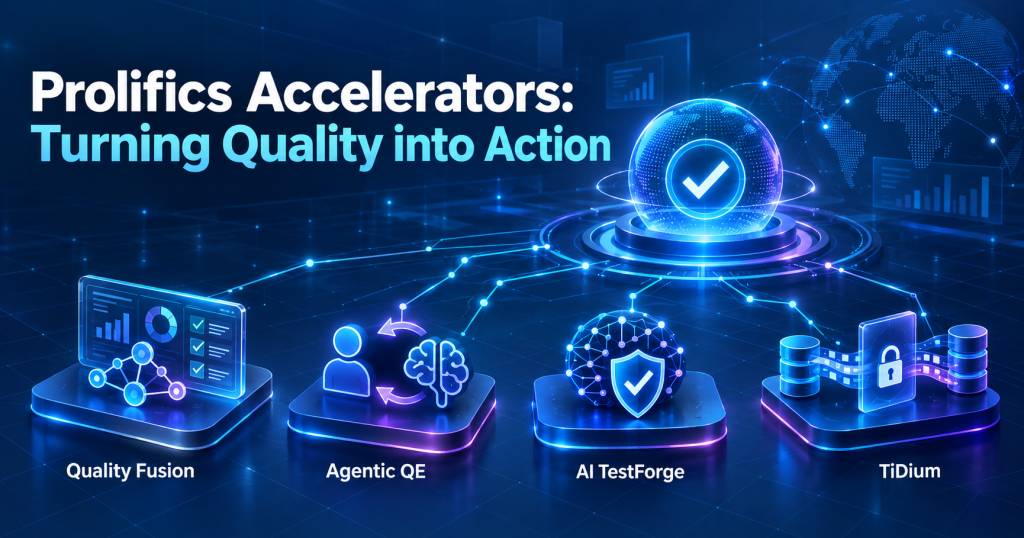
Prolifics Accelerators: Turning Quality into Action
Prolifics accelerators help organizations move from isolated improvements to connected, scalable quality operations:
Quality Fusion unifies Test Automation and TestOps, connecting requirements, code-free automation, performance and security testing, defect tracking, analytics and CI/CD integration to create a shared view of release quality.
Agentic QE combines human expertise with AI agents for test design, self-healing automation, defect triage, data validation, release-readiness assessment and AI governance, enabling more predictive quality operations.
AI TestForge provides repeatable validation for generative AI and RAG, assessing responses at scale across accuracy, relevance, faithfulness, context use, hallucination, bias, sensitive-data exposure and latency.
TiDium automates test data discovery, extraction, masking, context-preserved subsetting and loading, providing realistic data faster while helping protect personally identifiable information.
Together, these accelerators reduce fragmentation, shorten feedback loops and embed measurable quality controls across applications, data and AI.
Testing AI with AI
AI can improve testing, but AI systems must also be tested. Generative AI may return different answers to the same question, and a fluent response can still be inaccurate, biased, incomplete or unsupported by source content.
Prolifics evaluates AI behavior across functional quality, ethics, security and performance. Structured validation measures accuracy, relevance, faithfulness, context use, hallucination, bias, prompt-injection resilience, latency and guardrail effectiveness. This creates repeatable evidence that AI behaves responsibly under real-world conditions.
Secure Test Data for Faster Delivery
Testing is only as effective as its data, yet copying production information creates privacy and compliance risks. Prolifics discovers sensitive information, masks personal data and provisions context-preserved datasets through delivery pipelines, improving coverage while reducing exposure and delay.
Why Prolifics?
Prolifics has addressed complex enterprise technology challenges for more than 40 years, with a dedicated testing and QE practice established in 1999. Our global team includes more than 500 testing specialists, supported by expertise in cloud, data, integration, automation and AI. When testing exposes an underlying architecture, integration or data issue, we can help resolve it, not simply report it.
Our approach also protects client independence. Frameworks, scripts, test packs, data assets and documentation developed during an engagement are handed over for continued use, without creating unnecessary dependence on proprietary technology.
Make Quality a Business Accelerator
Quality should not be the final obstacle before release. It should be the continuous trust layer connecting applications, data, automation and AI. With intelligent, risk-based QE, enterprises can reduce production defects, accelerate transformation, strengthen governance and increase release velocity without sacrificing customer trust.
Ready to move from testing software to engineering confidence? Talk to Prolifics about an AI-powered Quality Engineering assessment and discover how to build quality into every stage of your digital transformation.
Frequently Asked Questions
1. What is Quality Engineering?
Quality Engineering embeds prevention, validation and continuous improvement throughout the software lifecycle. It combines risk-based testing, automation, performance, security, data management and quality controls to identify problems earlier.
2. How does Prolifics use AI in quality engineering?
Prolifics uses AI for test generation, self-healing automation, risk-based regression, predictive analysis and faster defect triage, with human experts retaining governance and decision-making responsibility.
3. Can Prolifics test generative AI and RAG applications?
Yes. Prolifics assesses accuracy, relevance, faithfulness, context use, hallucination, bias, security, latency and scalability to create repeatable evidence of AI quality.
4. What do the Prolifics QE accelerators address?
Quality Fusion unifies automation and TestOps; Agentic QE enables intelligent quality operations; AI TestForge validates generative AI and RAG; and TiDium delivers secure, production-like test data.
5. How can organizations engage Prolifics?
Organizations can choose a focused project, an embedded QE team, managed testing services or a Testing Center of Excellence, covering a specific need or end-to-end transformation assurance.
Green AI reduces the environmental cost of enterprise AI by making computational efficiency, energy use, infrastructure utilization, and resource consumption part of AI design and deployment decisions. For enterprises, that means choosing appropriately sized models, eliminating unnecessary compute, optimizing cloud and data infrastructure, and measuring environmental efficiency alongside performance, cost, security, and business value. Green AI is an approach to designing, deploying, and operating artificial intelligence with greater computational and environmental efficiency. Enterprises can apply it by right-sizing AI models, improving infrastructure utilization, optimizing inference and data pipelines, selecting efficient deployment environments, monitoring energy-related metrics, and scaling only AI workloads that produce measurable business value.
What is Green AI and why does it matter to enterprises?
Green AI is an approach to artificial intelligence that treats computational efficiency and resource consumption as important design criteria alongside accuracy, performance, and business outcomes. The concept was established in AI research as an alternative to pursuing incremental model improvements without accounting for the computational cost required to achieve them.
For enterprises, the definition needs to extend beyond model training. Environmental impact can occur across the complete AI lifecycle, including data preparation, model development, fine-tuning, inference, storage, networking, cooling, cloud infrastructure, and the hardware supporting those activities.
That matters because generative AI and agentic AI can turn isolated AI workloads into continuously running enterprise services. A model answering millions of requests, processing documents, generating code, supporting customer interactions, or coordinating AI agents may consume computing resources long after its initial deployment.
Green AI therefore should not sit apart from responsible AI, cloud optimization, digital transformation, or IT modernization. It should become another architecture and governance consideration.
The goal is not to minimize computing at the expense of business value. It is to avoid spending more compute, electricity, infrastructure capacity, and money than a use case genuinely requires.
This creates a practical question for CTOs and technology leaders: What is the least resource-intensive architecture that can still meet the required accuracy, latency, security, reliability, and business outcome?
That question is at the heart of enterprise Green AI.
Why is the environmental cost of enterprise AI increasing?
AI infrastructure is expanding rapidly because modern AI workloads require high-performance computing, accelerated servers, networking, storage, and cooling.
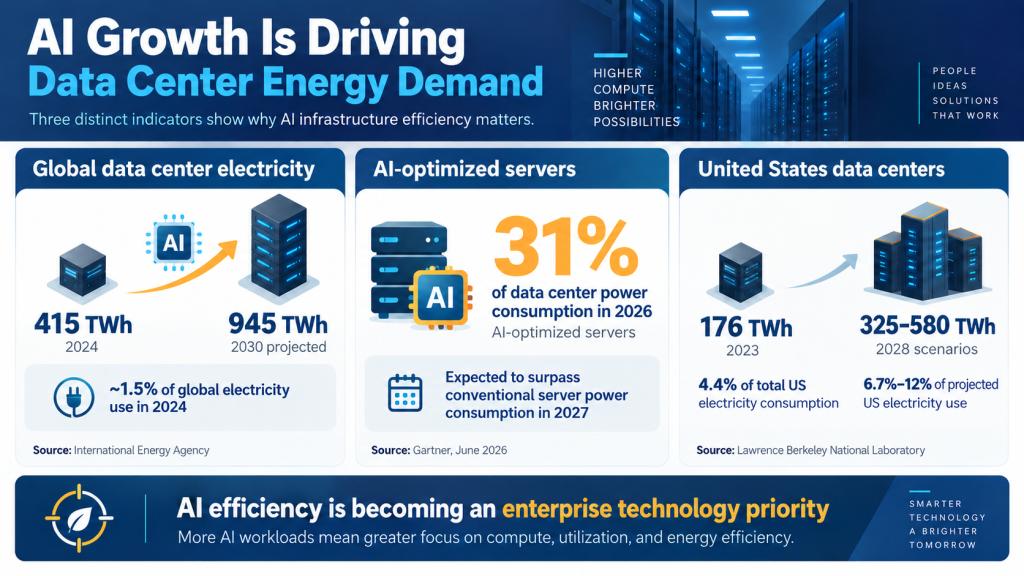
The scale is measurable. The International Energy Agency estimates that data centers consumed approximately 415 terawatt-hours of electricity in 2024, around 1.5% of global electricity consumption. Under its base case, data center electricity consumption rises to approximately 945 TWh by 2030, with AI identified as the most important driver of growth alongside other digital services.
Gartner’s June 2026 forecast estimates global data center electricity consumption will reach 565 TWh in 2026, 26% higher than 2025. It estimates AI-optimized servers will account for 31% of data center power consumption in 2026, with their power consumption surpassing conventional servers in 2027.
In the United States, Lawrence Berkeley National Laboratory estimates data center electricity consumption reached 176 TWh in 2023, equivalent to 4.4% of total US electricity consumption. Its scenarios place 2028 consumption between 325 and 580 TWh, or approximately 6.7% to 12% of projected US electricity use.
These estimates use different years, methodologies, and scopes, so they should not be treated as directly interchangeable forecasts. Together, however, they show why energy availability and AI infrastructure efficiency are becoming enterprise technology considerations rather than purely data center concerns.
Which parts of an AI deployment create environmental impact?
Enterprise AI has an environmental footprint across more than model training. Leaders should examine the entire architecture.
Model development and training can require accelerated computing for experimentation, tuning, and repeated training cycles. Large foundation models require substantially more infrastructure than smaller task-specific approaches.
Inference becomes particularly important after deployment. A model may be trained occasionally but invoked thousands or millions of times. Poorly optimized prompts, unnecessarily large models, excessive agent calls, or repeated retrieval operations can multiply compute demand.
Data infrastructure also contributes. AI depends on storage, data movement, transformation pipelines, vector databases, analytics platforms, APIs, and system integration. Duplicated datasets and inefficient pipelines increase both cost and computing requirements.
Infrastructure and cooling add another layer. GPU-intensive systems generate heat and require supporting power and cooling infrastructure. Both IBM and Forrester identify energy, cooling, water use, and infrastructure efficiency as important considerations as organizations scale AI.
Finally, hardware lifecycle considerations matter. Scaling AI may accelerate demand for servers, accelerators, networking equipment, and associated materials.
This means Green AI cannot be solved by changing one model setting. IBM similarly describes sustainable AI efficiency as a full-stack issue involving model architecture, training methods, workload orchestration, hardware, and infrastructure.
The enterprise architecture surrounding the model matters just as much as the model itself.
How can enterprises implement Green AI step by step?
A practical Green AI strategy should begin before an enterprise selects a model or purchases additional computing capacity.
Define the business outcome first. Establish the decision, process, customer experience, or productivity outcome the AI workload needs to improve. Avoid deploying AI simply because a capability is technically possible.
Create an AI workload baseline. Measure request volumes, latency requirements, model utilization, compute consumption, storage, data movement, infrastructure cost, and other available resource indicators.
Choose the smallest effective model. Do not automatically assign every task to the largest available foundation model. Smaller models, specialized models, retrieval techniques, routing, and deterministic automation may satisfy many enterprise requirements.
Optimize prompts, context, and agent workflows. Long prompts, unnecessary context windows, repeated retrieval calls, and uncontrolled multi-agent loops can create avoidable inference workloads.
Modernize the supporting data foundation. Improve data quality, eliminate unnecessary duplication, streamline pipelines, and reduce avoidable movement between platforms. AI efficiency depends heavily on efficient data engineering.
Right-size infrastructure and workload placement. Match workloads with suitable cloud, hybrid, edge, or on-premises infrastructure based on utilization, performance, security, cost, and operational requirements.
Measure efficiency continuously. Track business output relative to requests, compute, infrastructure utilization, latency, and cost. Where reliable energy or emissions data is available, incorporate those measures too.
Govern AI growth as a portfolio. Retire low-value experiments, consolidate overlapping tools, and scale workloads only when measurable outcomes justify continued resource consumption.
IBM’s sustainability guidance similarly emphasizes rightsized models, workload placement, efficient platforms, and infrastructure optimization rather than relying on a single intervention.
The result is an AI operating model that evaluates value and efficiency together.
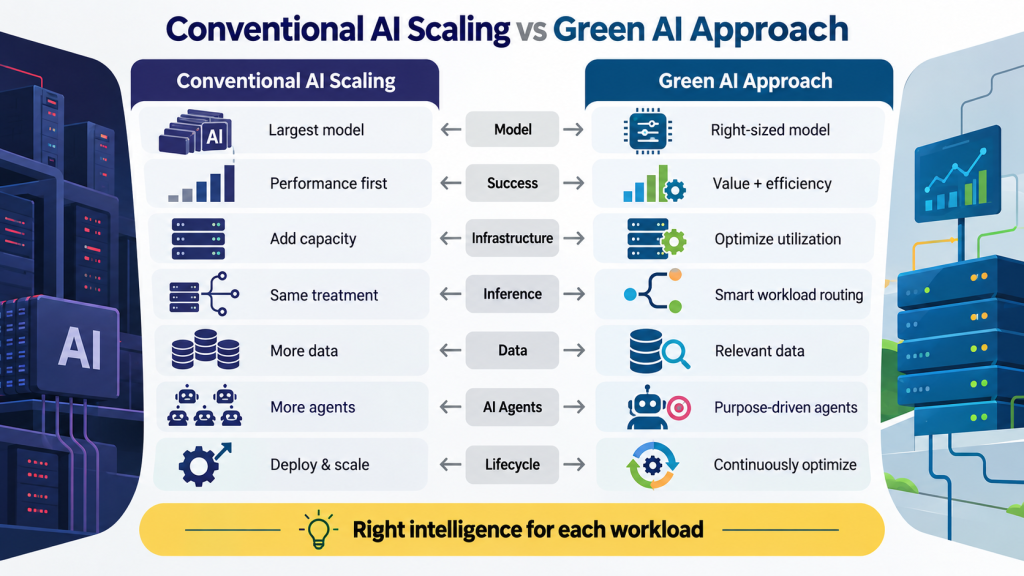
How does Green AI compare with conventional AI scaling?
A Green AI architecture changes what teams optimize for. Accuracy and user experience remain essential, but they are assessed alongside operational efficiency.
What does Green AI look like in a real enterprise use case?
Consider AI-driven demand forecasting in healthcare.
In a 2026 Prolifics engagement, a healthcare distribution organization used AI and machine learning to analyze historical usage and purchasing patterns, predict product demand, determine reorder requirements, and support inventory planning. The solution addressed excess inventory and shortages while helping procurement teams make better decisions.
The project is not presented as a Green AI case study, so no environmental savings should be attributed to it without measurement. It does, however, illustrate where Green AI principles can be introduced into a real enterprise architecture.
A healthcare organization running this type of workload could examine whether every product requires identical forecasting frequency, whether retraining needs to occur continuously, whether historical data can be tiered, and whether smaller models can handle predictable product categories.
High-volatility inventory could receive more frequent AI analysis. Stable categories could run less often. Models could retrain when data drift crosses a defined threshold instead of following an arbitrary schedule.
The organization could then connect model performance with operational measures such as forecast accuracy, infrastructure consumption, processing time, and cost per forecast.
That produces a better question than simply asking whether the company can deploy more AI.
The question becomes whether each additional unit of computing produces enough operational value to justify it.
That is applicable across healthcare, banking, insurance, retail, and public-sector AI deployments.
How should enterprises measure Green AI performance?
Green AI needs measurable governance, or it risks becoming a sustainability statement without operational impact.
Technology leaders should start with metrics their infrastructure can reliably provide rather than inventing carbon figures from incomplete data.
Useful measures can include:
Compute consumed per successful AI transaction.
Infrastructure utilization for AI workloads.
Cost per completed AI business process.
Inference requests by model and workload.
Average tokens processed per transaction.
Model latency relative to compute requirements.
Percentage of requests routed to smaller models.
Training and retraining frequency by model.
Storage and data-transfer requirements.
Energy consumption where measurable and attributable.
These metrics should connect to business KPIs. An AI workload that uses more computing may still be justified if it creates proportionately greater value, reduces another resource-intensive process, or improves a critical outcome.
This is why Green AI belongs within FinOps, MLOps, cloud governance, enterprise architecture, and responsible AI rather than operating as an isolated sustainability program.
Enterprises also need to distinguish efficiency from renewable energy sourcing. Running an inefficient AI workload on lower-carbon electricity does not automatically make the workload efficient. Conversely, an optimized model still has environmental impact if it runs at enormous scale.
Leaders need visibility into both sides: how much infrastructure AI consumes and how efficiently that infrastructure produces useful outcomes.
Conclusion
Green AI gives enterprises a practical way to scale artificial intelligence without treating infrastructure consumption as an unlimited resource. The strongest approach connects model efficiency, modern data architecture, cloud optimization, governance, and measurable business outcomes across the complete AI lifecycle. Prolifics helps enterprises build and operationalize governed AI, modern data platforms, cloud architectures, and AI-ready operating models designed around measurable value and responsible scale. Explore Prolifics AI Services and Prolifics Data & AI Solutions to start evaluating where efficiency should become part of your enterprise AI roadmap.
FAQs
What is Green AI in enterprise technology?
Green AI designs and operates AI systems with computational and environmental efficiency in mind. It reduces unnecessary resource use across models, infrastructure, data, and governance.
How can companies reduce the energy use of generative AI?
Companies can use smaller suitable models, optimize prompts and retrieval, and improve infrastructure utilization. They can also reduce unnecessary model calls, agent activity, and low-value workloads.
Are smaller AI models always more sustainable?
Not always. Sustainability also depends on workload volume, hardware efficiency, retraining needs, data movement, and deployment architecture.
How should CIOs measure the environmental impact of AI?
CIOs should track compute usage, infrastructure utilization, inference volume, training frequency, storage, and data transfer. Reliable energy and emissions data can then be added to AI governance metrics.
Can Green AI reduce enterprise AI costs?
Yes, Green AI practices can reduce waste from idle capacity, oversized infrastructure, and unnecessary model usage. Cost savings should still be validated against performance, efficiency, and business outcomes.
IBM has announced that the Dun & Bradstreet Commercial Graph™ is now available through a Model Context Protocol (MCP) server in the IBM watsonx Orchestrate Agent Catalog. The integration gives enterprises a more secure and standardised way to connect AI agents with verified commercial information and automate business-critical workflows.
As organisations move agentic AI from pilot projects into production, access to accurate and current information has become essential. Agents working with fragmented, incomplete or outdated data can generate unreliable results, particularly in areas such as credit assessment, procurement, regulatory compliance and supplier risk management.
The new integration addresses this challenge by connecting AI agents to Dun & Bradstreet’s trusted business identities and commercial context. Anchored by the D U N S® Number, the D&B Commercial Graph helps agents recognise the same verified organisation across multiple systems and records.
Connecting AI Agents Through MCP
Through the MCP server, organisations can enable agents to discover, retrieve and analyse Dun & Bradstreet’s commercial intelligence within watsonx Orchestrate.
MCP provides a standard, vendor-neutral method for connecting AI systems to external data and tools. It can reduce dependence on custom connectors that take considerable time to develop, secure and maintain.
IBM states that the D&B MCP server can be obtained directly from the Agent Catalog, potentially reducing agent-to-data integration timelines from months to days. Watsonx Orchestrate provides the central environment for building, monitoring, governing and scaling agents across cloud and on-premises systems.
Security and governance are built into the integration. Agents accessing the Commercial Graph operate within Dun & Bradstreet’s established data-quality, permission and audit frameworks, helping businesses align agent activity with their internal security and compliance policies.
Accelerating Adoption Through the IBM–Prolifics Partnership
As an established IBM Business Partner with recognised proficiency in watsonx Orchestrate, Prolifics can help organisations translate this new capability into production-ready business solutions.
Prolifics combines expertise in AI, data engineering, integration, automation and governance to help businesses assess suitable agentic AI use cases, connect watsonx Orchestrate with existing enterprise applications and establish the controls required for responsible deployment.
For example, Prolifics can help procurement teams design agents that monitor supplier stability, sales teams automate prospect research and risk professionals accelerate company verification. Its implementation and integration expertise can also help organisations embed D&B intelligence into end-to-end workflows rather than deploying AI agents as isolated tools.
Prolifics’ wider collaboration with IBM demonstrates its ability to turn IBM technologies into measurable business outcomes. In 2025, it received an IBM Partner Plus Award for North America in the Sustainability category for an AI-powered quality-control solution developed with IBM.
From Business Data to Confident Decisions
The D&B and IBM integration creates opportunities across sales, finance, procurement, compliance and operations. With implementation support from partners such as Prolifics, enterprises can build agents that securely apply trusted commercial context to daily decisions.
The announcement represents an important step towards practical enterprise agentic AI—combining authoritative data, open connectivity, centralised orchestration and experienced implementation support.
It provides verified business identities and commercial intelligence that help organisations consistently recognise companies across different systems and records.
2. What is IBM watsonx Orchestrate?
It is an enterprise platform for building, coordinating, monitoring and governing AI agents and automated workflows.
3. What role does MCP play?
Model Context Protocol provides a standardised way for AI agents to connect with external data sources and tools, reducing custom integration requirements.
4. How can Prolifics support implementation?
Prolifics can assist with use-case planning, architecture, data integration, workflow automation, security, governance and deployment using watsonx Orchestrate.
Imagine Monday morning at a warehouse. A multinational facilities manager checks citywide pollution reading, unsure whether it reflects conditions outside. Across town, a startup founder faces the same uncertainty, with fewer resources to investigate. Both need better local information.
AI-powered air quality monitoring offers a practical way to improve that information. Connected sensors collect local observations, while analytical models help correct readings, estimate missing values, and forecast pollution. Research shows that this combination can expand visibility, but success depends on calibration, validation, and responsible interpretation.
At Prolifics, we bring together AI, connected technologies and data engineering to help businesses turn environmental data into actionable insights. We help organizations connect data sources, improve visibility, and make more informed decisions about air quality monitoring.
Why air quality data gaps matter
The World Health Organization estimates that 99% of people worldwide lived in places exceeding its air quality guideline levels in 2019. It also estimates that outdoor air pollution caused 4.2 million premature deaths that year. These figures establish the global scale of the problem, rather than conditions at any individual workplace. WHO air pollution fact sheet.
Monitoring does not offer equal visibility everywhere. NASA reported in 2023 that shortages of reliable ground monitors leave many communities without detailed local information. Its CityAQ initiative addresses this challenge by combining atmospheric modelling with ground observations and machine learning. NASA’s account of CityAQ.
For businesses, air quality data gaps create uncertainty about conditions around facilities, delivery areas and neighboring communities. A regional reading provides context, but teams may need local observations to investigate a specific concern.
The question is therefore practical: what information would help the organization make a better decision?
How connected sensors expand monitoring coverage
IoT air quality monitoring links sensing devices to a platform that collects and organizes their readings. Teams can use the resulting information to examine differences between locations and changes throughout the day.
How do connected sensors measure air pollution?
Connected air quality sensors use different sensing methods for different pollutants. Optical particle sensors estimate particulate concentrations from scattered light. Electrochemical sensors measure certain gases through electrical responses. Teams must select devices according to the pollutants they need to monitor. EPA Air Sensor Guidebook.
Connectivity allows readings to reach a shared system through networks such as Wi-Fi or cellular services. However, communication speed and measurement quality address different needs. A device can transmit an inaccurate reading immediately.
For organizations using IoT sensors for air quality monitoring, deployment should therefore combine appropriate instruments, useful locations, and a clear quality assurance process.
What research reveals about measurement accuracy
Low-cost air quality sensors can extend monitoring networks, but their raw readings may differ substantially from reference instruments.
Calibration can materially improve readings
A 2021 study by EPA researchers analyzed almost 12,000 daily average PM2.5 measurements from Purple Air sensors and reference instruments across 16 US states.
The researchers found that raw sensor readings overestimated PM2.5 concentrations by approximately 40% under the conditions studied. A correction incorporating relative humidity reduced root mean square error from 8 to 3 µg/m³. This metric describes the typical scale of measurement error, with greater weight on larger errors. Barkjohn and colleagues, 2021.
The business lesson is straightforward: assess data quality before expanding the network. Purchasing more devices without checking their performance can multiply uncertainty.
Machine learning needs local validation
A 2024 study in Chandigarh evaluated two PM2.5 sensor types over ten months and compared five machine learning approaches for calibration. The researchers reported substantial improvements after correction and highlighted how humidity and local conditions influence performance. Ravindra and colleagues, 2024.
These findings support using machine learning to improve measurements. They do not establish that one model will perform equally well across every facility, climate, or pollution mixture.
Multinationals should validate performance across locations. Startups should establish dependable results within a focused pilot before scaling.
How AI can close air quality data gaps
AI can address different information problems, but teams should distinguish corrected measurements, estimated missing values and forecasts.
How does AI improve air quality monitoring?
AI can learn relationships between sensor outputs, reference measurements, and environmental conditions. Teams can use those relationships to correct systematic errors and improve interpretation.
However, complexity does not guarantee better results. In the EPA study, more complex multiplicative models did not substantially outperform the selected correction on independent test data. Organizations should compare proposed models against simpler alternatives. Barkjohn and colleagues, 2021.
How can AI estimate missing air quality data?
Models estimate missing values from relationships within available observations, sometimes incorporating weather or nearby measurements. This process, called imputation, can help analysts work with incomplete datasets.
Research also shows why method selection matters. A 2026 study examined missing measurements of PM2.5 chemical components. Its reconstruction method, which incorporated pollution source relationships, outperformed several comparison methods, including a deep learning model, on a two-month dataset. Zhu and colleagues, 2026.
The implication is practical: test whether a method suits the dataset and preserves meaningful patterns. Label estimates clearly, retain original observations, and avoid presenting reconstructed values as direct measurements.
During validation, reserve later observations for testing rather than relying only on random samples. This helps reveal whether a model remains useful over time, when weather, equipment performance and operating conditions may all change.
Can AI anticipate pollution changes?
AI and machine learning for air pollution prediction combine available observations with models to estimate future concentrations.
NASA’s CityAQ project used local monitoring data and machine learning to improve forecasts from the GEOS-CF atmospheric model. NASA reported that Bogotá incorporated CityAQ information into its air quality warning tools. NASA’s CityAQ findings.
For businesses, forecasts can support preparation and investigation. They still require checks against subsequent observations, especially when conditions change.
What the findings mean for businesses
Real-time air quality monitoring creates value when teams connect information to a specific operational question.
Consider a hypothetical logistics company investigating particulate peaks near a loading area. Its team could compare sensor readings with delivery schedules, wind conditions, and nearby background measurements.
If the evidence suggests a relationship with vehicle queues, managers could trial different arrangements and evaluate subsequent readings. This example illustrates a possible application, rather than a documented client outcome.
Air quality data analytics can support that investigation, but correlation alone cannot establish the pollution source. Weather and unrelated activities may also influence results.
For multinational companies, consistent methods can improve comparisons across sites. For startups, a narrower programme can help establish whether monitoring answers a valuable question before further investment.
Neither organization should treat additional data as an outcome by itself.
Building a monitoring programme that delivers value
Research supports a measured approach to improving air quality monitoring coverage: define the decision, validate the measurements, and establish a response.
Start with the question and location
Identify the pollutant, activity, and area of concern. Choose sensor positions that reflect the investigation rather than installation convenience.
The EPA recommends collocation, which involves operating sensors alongside a reference monitor to evaluate their performance. This step helps teams understand the readings before relying on them. EPA collocation guidance.
Establish ownership and quality checks
Give environmental sensor networks an operational owner and a realistic maintenance budget. Include connectivity, calibration, replacement devices, and analysis when assessing total costs.
Use these checks to keep the program focused and accountable.
Compare sensor performance against reference measurements before expanding monitoring coverage.
Distinguish measured readings from estimates across dashboards, reports, and alerts.
Assign clear owners for maintenance, investigations, escalation, and corrective actions.
When introducing connected sensors for real-time pollution monitoring, track data completeness, measurement error, and alert usefulness. Ask whether the information changes decisions or simply adds another dashboard.
Keep a record of model updates and review performance after operational or seasonal changes. For formal reporting, check applicable monitoring requirements before relying on supplemental sensor data. EPA performance guidance distinguishes informational applications from regulatory monitoring. EPA sensor performance guidance.
Conclusion
Research supports combining connected sensors with validated analytics to strengthen air pollution monitoring. Sensors extend local observations, while AI can improve calibration, reconstruct missing information, and support forecasts.
For businesses, the opportunity starts with a defined problem. Build trustworthy measurements, test models under relevant conditions, and give teams responsibility for acting on the findings. That approach turns better visibility into better environmental decisions.
Enterprise data has never been more valuable, or more difficult to manage. Over time, organizations accumulate legacy databases, disconnected applications, departmental data stores, spreadsheets, and multiple cloud environments. Each system may support an important business function, but collectively they create a fragmented landscape where data is difficult to access, reconcile, govern, and analyze.
The result is a widening gap between the data an enterprise owns and the value it can generate from it.
Enterprise data transformation closes that gap. It modernizes how data is collected, integrated, governed, processed, and consumed, creating a trusted foundation for real-time analytics, intelligent automation, generative AI, and faster decision-making.
However, successful transformation requires more than migrating information from legacy systems to the cloud. It demands a coordinated strategy connecting technology modernization with governance, operating models, business priorities, and measurable outcomes.
Why Legacy Data Environments Limit Business Growth
Legacy platforms often contain decades of valuable operational and customer information. The problem is not necessarily the data itself, it is the architecture surrounding it.
Different departments may use different definitions for the same customer, product, supplier, or transaction. Batch-based pipelines can delay reports by hours or days. Manual data preparation consumes analyst time, while undocumented dependencies make even small platform changes risky.
These limitations create several business challenges:
Inconsistent reporting across departments
Slow access to operational insights
High infrastructure and maintenance costs
Limited scalability for growing data volumes
Complex regulatory and compliance processes
Poor data quality and unclear ownership
Difficulty operationalizing analytics and AI
Dependence on specialized legacy knowledge
A modern analytics dashboard cannot solve these underlying problems. Neither can moving every workload to the cloud without redesigning how data flows through the enterprise.
The goal of transformation must be to make data trusted, connected, accessible, scalable, and actionable.
What Is Enterprise Data Transformation?
Enterprise data transformation is the strategic modernization of an organization’s data ecosystem. It encompasses architecture, platforms, integration, engineering, quality, governance, analytics, security, and organizational adoption.
Unlike a standalone migration project, data transformation considers the complete data lifecycle, from the moment information is created to the point where it supports a decision, customer interaction, automated workflow, or AI model.
A modern data ecosystem may combine cloud data warehouses, data lakes, lakehouse architectures, streaming technologies, APIs, business intelligence platforms, machine learning services, and governance solutions.
The right architecture depends on the organization’s objectives. What matters is that the components work together to deliver consistent, secure, and reusable data.
As the referenced discussion on enterprise data transformation emphasizes, modernization becomes sustainable when platforms, governance, analytics adoption, and operating models evolve together.
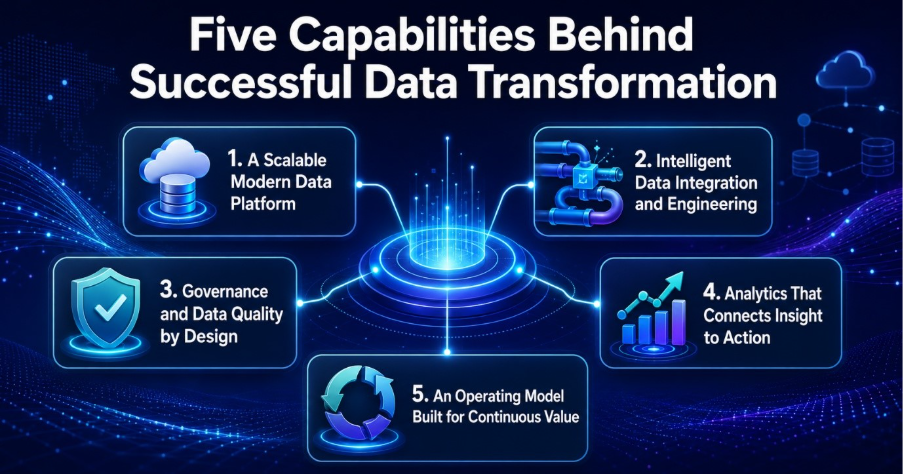
Five Capabilities Behind Successful Data Transformation
1. A Scalable Modern Data Platform
Modern cloud and hybrid data platforms allow enterprises to process larger and more diverse datasets without the limitations of traditional infrastructure.
Cloud-native warehouses and lakehouse architectures can separate storage from computing resources, enabling organizations to scale workloads based on demand. They can also support structured, semi-structured, and unstructured data for reporting, advanced analytics, and AI.
But platform selection should follow business requirements—not industry trends. Organizations must consider workload performance, security, interoperability, data residency, cost, and existing technology investments before choosing an architecture.
2. Intelligent Data Integration and Engineering
Modern analytics depends on reliable data movement.
Automated pipelines can ingest information from enterprise applications, databases, connected devices, partner ecosystems, and external sources. Batch processing may remain appropriate for some use cases, while streaming integration supports scenarios requiring immediate insight.
Data engineering also includes transformation, validation, orchestration, lineage, observability, and exception management. These capabilities reduce manual work and help ensure that analytics teams receive timely, usable information.
Reusable pipelines and metadata-driven automation can further accelerate migration while improving consistency across domains.
3. Governance and Data Quality by Design
Governance should begin at the start of transformation, not after the new platform is deployed.
A strong governance framework establishes who owns data, who can access it, how quality is measured, where information originated, and how it may be used. Catalogs, lineage, business glossaries, policy automation, and quality monitoring translate governance principles into daily operations.
This foundation becomes even more important when data is used to train or ground AI systems. Inaccurate, biased, poorly documented, or unauthorized data can undermine model performance and introduce regulatory, security, and reputational risks.
Trusted AI begins with trusted data.
4. Analytics That Connects Insight to Action
Modernization creates value only when people use the resulting information.
Self-service business intelligence can give authorized users faster access to consistent metrics. Predictive analytics can identify patterns and anticipate future conditions. Embedded analytics can deliver recommendations directly within the applications and workflows employees already use.
The objective is not simply to produce more dashboards. It is to shorten the distance between an event, an insight, a decision, and an action.
Successful organizations design analytics around specific business outcomes, such as reducing customer churn, improving inventory availability, identifying fraud, optimizing equipment maintenance, or accelerating financial reporting.
5. An Operating Model Built for Continuous Value
Data transformation is not a one-time implementation. Business requirements, regulations, source systems, analytical models, and technology platforms will continue to change.
Organizations therefore need an operating model that supports continuous improvement. Central platform teams can provide common standards and services, while domain teams take responsibility for the quality and usefulness of their data.
Treating important datasets as products, with owners, users, service expectations, documentation, and quality measures, can improve accountability and reuse.
A Practical Roadmap from Legacy Systems to Modern Analytics
A phased transformation can reduce disruption while producing measurable wins.
The journey should begin with a data maturity assessment covering architecture, applications, integration, quality, governance, skills, costs, and analytics adoption. This establishes a realistic baseline and identifies the highest-value gaps.
Next, organizations should define business outcomes and prioritize use cases. Instead of attempting to modernize everything simultaneously, they can focus on initiatives that demonstrate value and create reusable capabilities.
A typical roadmap includes:
Assess the current data estate and transformation readiness.
Define business outcomes, priorities, and success metrics.
Design the target platform, integration, security, and governance architecture.
Select high-value workloads for phased migration.
Build automated pipelines with validation and observability.
Establish governance, ownership, lineage, and quality controls.
Deliver analytics and AI use cases tied to operational workflows.
Measure adoption, performance, cost, and business impact.
Expand proven capabilities across additional business domains.
This incremental approach allows teams to learn, adjust, and build stakeholder confidence without losing sight of the enterprise-wide strategy.
Avoiding the “Modernized Silo” Problem
One of the greatest transformation risks is recreating legacy complexity on newer technology.
Migrating fragmented datasets without common definitions preserves inconsistency. Moving inefficient pipelines to the cloud preserves technical debt. Deploying a sophisticated analytics platform without user adoption produces an expensive reporting environment with limited impact.
Organizations should avoid measuring success only through technical milestones such as terabytes migrated or systems retired. Business-oriented measures provide a clearer picture, including:
Time required to produce critical reports
Data quality and reconciliation rates
Analytics adoption across business teams
Pipeline reliability and processing performance
Infrastructure and operational costs
Speed of introducing new data products
Time from insight to business action
AI model accuracy, traceability, and scalability
Turning Enterprise Data into an AI-Ready Advantage
Modern analytics and enterprise AI share the same essential requirement: accessible, governed, context-rich data.
When information remains fragmented, AI teams spend significant time finding, cleaning, and reconciling data. When the enterprise has reusable pipelines, consistent metadata, transparent lineage, and clear access policies, teams can develop and scale intelligent solutions more confidently.
This makes data transformation more than an infrastructure program. It becomes an enabler of intelligent operations, personalized experiences, predictive decisions, and responsible AI.
Accelerate Your Data Transformation with Prolifics
Prolifics helps organizations connect data strategy with implementation and measurable business outcomes. Its capabilities span data assessment, data engineering, data management, analytics, MLOps, governance, application modernization, cloud migration, integration, and AI-powered solutions. Prolifics’ Data & AI services are designed to help enterprises transform fragmented information into trusted insights and scalable intelligence.
Whether you are modernizing a legacy warehouse, building a cloud data platform, improving governance, enabling self-service analytics, or preparing enterprise data for generative and agentic AI, Prolifics can help you move from isolated initiatives to a connected transformation roadmap.
Ready to turn your enterprise data into a foundation for analytics and AI success?
Talk to Prolifics’ Data & AI experts to assess your current environment, identify high-value opportunities, and create a practical roadmap for transformation.
How intelligent, continuous and predictive Quality Engineering turns faster delivery into trusted business outcomes
AI can now generate code, tests and releases at machine speed. Confidence still must be engineered.
Quality is becoming the control layer for digital trust
AI is changing the economics of software delivery. Coding assistants and autonomous agents can interpret requirements, assemble features and propose changes in minutes. Cloud-native applications evolve continuously, data moves across platforms, and releases increasingly combine deterministic software with probabilistic AI behaviour.
This acceleration creates a new constraint. The enterprise may be able to build more change per sprint, but it still needs credible evidence that the change is safe, useful, resilient and ready. When validation capacity cannot keep pace with development capacity, Quality Engineering becomes both the bottleneck and the safeguard.
The answer is not to automate every test. It is to shorten the path from change to a trustworthy decision. That requires Quality Engineering to move beyond a downstream testing phase and become an operating capability spanning planning, build, validation, release and production.
The confidence gap in AI-accelerated delivery
AI-generated code can compile successfully while embedding an insecure pattern, a misunderstood business rule or a subtle integration failure. It can increase the volume of plausible defects at the same time that traditional regression suites struggle with design latency, brittle automation, constrained test data and fragmented reporting.
The defining question is therefore no longer whether AI belongs in software delivery. It is whether the enterprise can independently verify what AI creates, how embedded AI behaves and what risk autonomous systems introduce before a change reaches customers.
A responsible control model separates creation from evaluation. The generator cannot be the only judge of its own output. Prompts, supplied context, generated artifacts, human edits and approvals should be traceable. Before merge, risk-based functional, API, contract, security, accessibility and mutation tests should challenge both the implementation and the original intent.
Human judgment remains essential
The winning model is collaboration, not replacement. AI can generate variants, analyse change, maintain assets and detect patterns across evidence volumes that people cannot review manually. People remain accountable for business intent, risk tolerance, ethics, domain nuance, exceptions and the final release decision.
This Human + AI model expands coverage and feedback speed without surrendering accountability. Review thresholds should reflect risk: low-impact maintenance can be highly automated, while material changes and irreversible actions require explicit human authority.
Build one continuous confidence loop
Quality should be designed into the value stream. Each lifecycle stage should produce evidence for the next decision, while production signals should improve the next cycle of planning and validation.
Lifecycle stage
Quality action
Evidence produced
Plan
Translate critical journeys and business risks into measurable acceptance criteria
Risk tolerances, controls and testable outcomes
Build
Apply standards, code-level checks, API contracts and early automation
Traceable change and early defect signals
Validate
Prioritize by risk and test software, data, performance, security and AI
Coverage, findings and residual uncertainty
Release
Connect transparent, automated quality gates to CI/CD
A defensible release decision and governed exceptions
Operate
Feed reliability, experience and incident signals back into engineering
Continuous learning and recalibrated risk models
This loop changes the role of metrics. Test counts alone cannot tell leaders whether a release is safe. Useful measures connect engineering activity to flow, effectiveness, customer experience, trust and economics.
Flow: lead time for change, test-cycle duration, feedback latency and release frequency.
Effectiveness: escaped defects, defect-removal efficiency, flaky-test rate and automation health.
Experience: critical-journey success, accessibility, performance and customer impact.
Trust: data integrity, privacy controls, compliance evidence and AI quality.
Economics: cost of quality, maintenance effort, environment utilization, reuse and avoided loss.
Test automation and AI testing are different disciplines
Conventional test automation validates predictable interfaces, rules, APIs, data flows and end-to-end processes. AI testing evaluates variable behaviour and asks whether model outputs remain grounded, relevant, safe, robust and useful across changing contexts. Enterprises need both disciplines in one release flow.
For generative AI and retrieval-augmented generation, teams need governed evaluation datasets, model and prompt comparisons, retrieval checks, red-team scenarios, statistical measures and expert adjudication. The evidence should cover relevance, accuracy, faithfulness, context precision and recall, consistency, contradiction, hallucination risk, bias, sensitive-information exposure, latency and cost.
Responsible implementation also requires intended use, prohibited behaviour, thresholds, lineage, monitoring and escalation to be documented. Prompts, datasets, models, retrieval configurations, guardrails and results should be versioned so teams can compare changes rather than evaluate each release in isolation.
Agentic systems must be tested as workflows
An AI agent is not just a model response. It plans, retrieves data, calls tools, maintains state and acts. Quality must therefore cover the complete path from user intent to final outcome.
Goal quality: does the agent achieve the intended business outcome across realistic scenarios?
Process quality: are plans, tool choices, parameters, memory and handoffs correct and efficient?
Safety and control: does it respect permissions, data boundaries, approval points and escalation rules?
Resilience: can it recover from unavailable tools, incomplete context, partial failures and adversarial input?
Governance: are traces, evaluations, approvals and production monitoring reproducible and audit-ready?
Autonomy should expand only as confidence and observability improve. Agents may plan and execute approved low-risk activities, but uncertainty, policy exceptions and high-impact failures should route to people. Learning should come from confirmed outcomes, not unreviewed assumptions.
Predictive Quality directs attention before defects are committed
As regression estates grow, executing everything on every change becomes slow and economically unsustainable. Predictive Quality combines commit differences, requirements, service dependencies, defect history, test health, ownership, complexity and production telemetry to identify where failure is most likely.
The goal is not an opaque risk score. It is an explainable recommendation for reviewers, test scope, data needs, performance checks and release controls. Human override, drift monitoring and outcome-based calibration keep the model accountable. When risk is assessed while requirements and code are still changing, remediation is faster and less expensive.
Solve the enterprise constraints around testing
AI-enabled testing cannot succeed on generation alone. The broader quality system must remove the operational constraints that delay evidence.
Enterprise constraint
Modern QE response
Business value
Unsafe or unavailable test data
Discover sensitive fields; mask, tokenize or synthesize; provision context-preserved subsets through repeatable services
Faster testing with stronger privacy control
Performance and resilience risk
Model peak business events, dependencies, saturation, failure and recovery against service objectives
Protection of revenue, productivity and continuity
Migration and data risk
Reconcile counts, totals, keys, mappings, transformations and referential integrity at scale
Use a federated Testing Center of Excellence to set standards and enable product teams
Comparable evidence without central delivery friction
A federated Testing Center of Excellence makes quality scalable
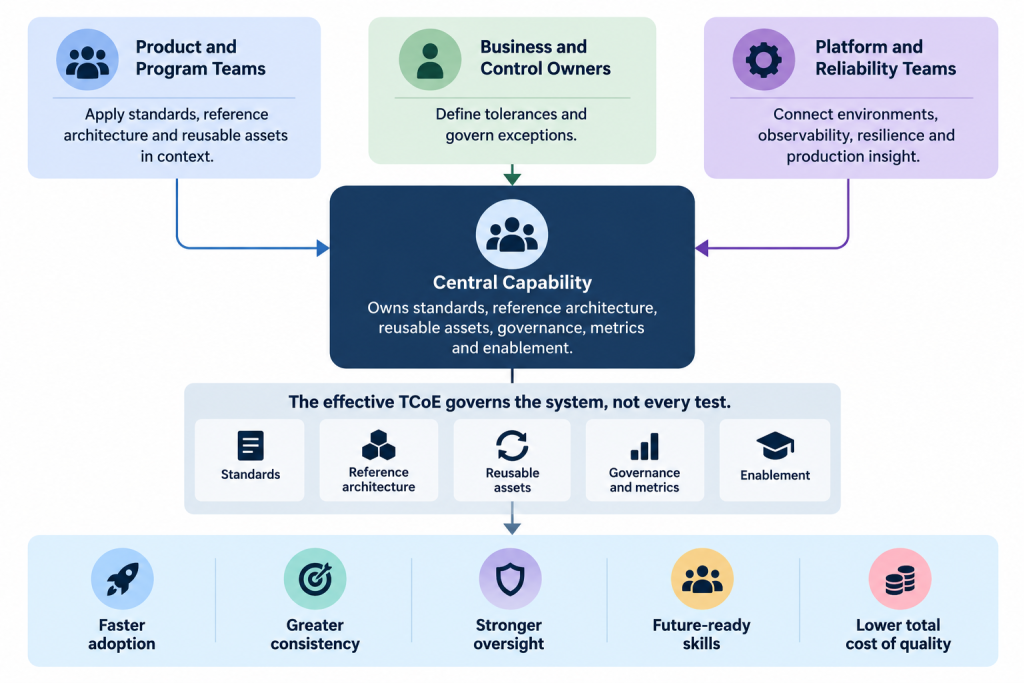
Enterprise quality cannot depend on isolated specialists or one successful program. A central capability should own standards, reference architecture, reusable assets, governance, metrics and enablement. Product and program teams should apply them in context, while business and control owners define tolerances and govern exceptions. Platform and reliability teams connect environments, observability, resilience and production insight.
The effective TCoE governs the system, not every test. Its value lies in paved roads for automation, test data, metrics and governance: faster adoption, greater consistency, stronger oversight, future-ready skills and a lower total cost of quality.
What measurable transformation looks like
The Quality Engineering CTB includes customer evidence across automation, modernization, test data and operating-model transformation. These examples show why the target is not simply more scripts; it is improved engineering flow and business confidence.
Transformation
Intervention
Reported outcome
Global payments technology leader
LLM-assisted test generation with human review
Coverage increased about 30%; execution accuracy improved from 60% to 80%; automated cases per sprint rose from 55 to 72
Global law firm
Centralized Tosca, Vision AI and NeoLoad automation and performance engineering
Recurring monthly regression fell from 11 days to 8-10 hours; application execution time reductions reached 85-90%; £1 million projected cost avoidance
Global healthcare leader
Enabled SAP subject-matter experts to configure low-code tests
30% reduction in automation effort and 25% reduction in maintenance cost
Mortgage lender
Metrics-driven TCoE with shared methods, risk-based planning and reusable assets
More consistent release-readiness decisions and a scalable foundation for continuous improvement
Reported outcomes should be interpreted in context: realized results are distinct from future projections, and benefit ranges should be validated against each client’s environment, baseline and governance model.
A focused 90-day path from bottleneck to capability
Transformation can begin with one product, migration wave, critical journey or AI use case where slow evidence visibly constrains a business decision. The aim is to prove value through a thin vertical slice while building reusable foundations.
Days 0-30: baseline
Interview product, engineering, business, risk and reliability owners to map critical journeys and decision points.
Select one journey, define tolerances and agree accountable owners and success measures.
Design the minimum architecture, test assets, data services and governance needed for the proof.
Days 31-60: prove
Use a live change to connect requirements, risk-based testing, compliant data, automation and transparent evidence.
Evaluate deterministic software and any AI behaviour with the appropriate mix of assertions, measures and human review.
Integrate the reusable components into delivery rather than running an isolated demonstration.
Days 61-90: scale
Measure cycle time, coverage, accuracy, stability, human overrides and decision outcomes.
Review false positives, escapes and operational feedback, then refine controls and thresholds.
Codify reusable patterns, ownership and exception paths, and approve the next portfolio wave.
The executive outcome should be a working proof, a quantified baseline and an investment roadmap tied to business risk.
How Prolifics connects the quality system
Prolifics approaches quality as a business capability expressed through engineering. Work begins with the outcome an organization needs to protect – revenue, service continuity, regulatory trust, transformation value or customer experience – and works backward into the controls, automation, data, environments and governance required to release confidently.
Quality Fusion. A connected Test Automation and TestOps foundation that brings requirements, planning, automation, defects, CI/CD integration, metrics and release visibility into one quality system.
Agentic Quality Engineering. A Human + AI operating model in which specialized agents support test design, self-healing automation, defect triage, data validation, release readiness and AI governance under explicit controls.
AI TestForge. A structured approach to evaluating generative AI, RAG and agentic solutions across functional quality, groundedness, ethical risk and performance, from individual scenarios to repeatable regression datasets.
TiDium. AI-enabled test-data management for data discovery, masking, context-preserved subsetting, automated provisioning, role-based access and CI/CD integration.
Effecta. High-volume data validation for migrations, transformations, APIs and enterprise platforms, connecting reconciliation evidence from source rules to target outcomes.
The differentiator is not one accelerator in isolation. It is the ability to combine strategy, independent assurance, enterprise integration, data, reusable engineering and accountable delivery around the business journeys that matter most.
Conclusion
AI will continue to increase the speed and volume of change. Whether that acceleration becomes advantage or exposure depends on the quality system surrounding it.
The enterprises best positioned to scale AI will treat quality as a continuous control layer: independent enough to challenge machine-generated change, intelligent enough to focus effort where risk is highest, integrated enough to validate software, data and agents together, and governed enough to keep people accountable for consequential decisions.
Confidence is the product. Quality Engineering is how it is built.
FAQ’s
Why is Quality Engineering important in AI-driven software development?
AI can accelerate software development, but speed alone does not guarantee reliable outcomes. Quality engineering provides independent validation so releases remain safe, resilient, and trustworthy.
How is AI testing different from traditional test automation?
Traditional automation validates predictable applications, APIs, rules, and workflows. AI testing evaluates variable outputs for accuracy, relevance, safety, robustness, and reliability.
What is Predictive Quality?
Predictive Quality uses change data, defect history, dependencies, and telemetry to identify potential risks. It helps teams focus testing where failures are most likely before defects reach production.
How should enterprises test AI agents?
AI agents should be tested across goals, processes, tool usage, permissions, resilience, and governance. High-risk decisions and uncertain outcomes should continue to involve human oversight.
How does Prolifics support modern Quality Engineering?
Prolifics combines Quality Fusion, Agentic Quality Engineering, AI TestForge, TiDium, and Effecta. Together, these capabilities strengthen software, AI, test data, automation, and enterprise quality.
Turning Parking Availability into a Dynamic Revenue Opportunity
Parking demand can change in minutes. A concert, sporting event, traffic disruption or change in weather can rapidly increase demand at one location while spaces remain underused elsewhere.
For a leading US parking management company, responding to these shifts was difficult. Although its facilities generated real-time occupancy and capacity data, that information remained distributed across satellite servers and reached central systems only through scheduled batch uploads.
The resulting delays limited the company’s ability to adjust prices, optimise inventory and give customers accurate availability through its digital reservation channels. Discover how Prolifics helped transform fragmented parking data into a connected, AI-powered platform for growth.
The Challenge
Without a real-time view of its parking portfolio, the company could not respond quickly to changing market conditions. It needed to:
Identify increases in demand as they occurred
Adjust pricing based on events, location and availability
Direct customers to nearby facilities with open spaces
Improve utilisation across its property portfolio
Provide reliable availability through web and mobile applications
Maximise revenue during high-demand periods
A major local event, for example, could create an opportunity for premium pricing. But delayed data and limited predictive insight meant the business could not act quickly enough to capture its full commercial value.
The Prolifics Solution
Prolifics developed an end-to-end transformation strategy combining real-time data, hybrid cloud technology, APIs, analytics and AI-assisted dynamic pricing.
Real-time feeds replaced scheduled batch updates, giving the organisation a current view of capacity across multiple locations. A secure hybrid cloud environment provided the scalability needed to process growing data volumes while maintaining appropriate control over sensitive information.
Prolifics also created AI and machine learning models to analyse demand patterns, compare pricing scenarios and identify effective price points for specific locations and conditions. Analysis that could previously take weeks or months could now be completed in hours.
Human oversight remained central. Business intelligence specialists reviewed model recommendations before deployment, while drift analysis helped identify declining model accuracy as customer behaviour changed.
APIs connected parking databases with mobile applications, web reservation platforms and mapping services such as Google Maps. When one facility reached capacity, customers could be directed to another nearby client-owned location, helping retain business and improve portfolio-wide utilisation.
Business Outcomes
Respond to demand with AI-assisted dynamic pricing
Accelerate analytical modelling from weeks or months to hours
Improve data quality, security and governance
Optimise occupancy across multiple parking properties
Strengthen customer confidence in digital reservations
Support new opportunities for revenue growth and market expansion
Build a Smarter and More Responsive Business with AI
AI delivers its greatest value when supported by trusted data, connected platforms and human expertise. Prolifics brings these capabilities together to help organisations turn operational information into faster decisions, better customer experiences and measurable business value.Download the case study to discover how Prolifics turned parking availability into an intelligent, responsive and revenue-generating capability.
Discover how Prolifics helped a premier home furnishings and kitchenware retailer transition from legacy mainframe systems to Manhattan WMS, supporting modern warehouse operations across multiple distribution centers and hubs.
The Challenge
Modernize Complex Operations While Maintaining Reliability
The retailer needed more than a warehouse platform upgrade. Its transformation required reliable, coordinated operations across inventory, automated picking, shipping, transportation, and returns, while maintaining the stability and performance of business-critical systems.
The Prolifics Approach
End-to-End Modernization Backed by Quality Engineering
Prolifics combined Quality Engineering, system configuration, performance validation, and production support to help deliver the transformation. Testing covered inbound, inventory, outbound, shipment, and returns processes across the integrated warehouse environment.
The solution brought together Manhattan WMS, Savoye, ProShip, Descartes, Optoro, and enterprise messaging technologies to create a more connected, scalable, and resilient warehouse environment.
Business Outcomes
Faster operations. Improved warehouse throughput, picking productivity, and accuracy.
Greater visibility. Better real-time inventory visibility and shipment visibility.
Streamlined logistics. More efficient returns handling and improved service levels.
The modernized environment also established a scalable foundation for future distribution requirements, omnichannel operations, and growth.
Get the Full Case Study
Explore the challenges, integrated solution, and operational improvements behind this warehouse modernization journey.
IBM has introduced Granite 4.2, a new family of open large language models designed to meet growing enterprise demand for AI that can run across cloud, on-premises and edge environments.
Available in 3-billion, 8-billion and 30-billion parameter variants, Granite 4.2 combines native reasoning, coding, instruction-following and tool-calling capabilities. The models are intended to support agentic AI systems that can do more than generate responses, they can evaluate problems, plan actions, select tools and complete multi-step tasks.
Flexible AI for Different Enterprise Needs
Granite 4.2 arrives as interest in local LLMs continues to grow. Organizations increasingly want greater control over sensitive data, deployment architecture, operating costs and model customization. Locally deployable models can help businesses keep selected workloads within their own infrastructure while reducing dependence on external AI services.
The three model sizes allow organizations to align AI capacity with each use case. The compact 3B model is suited to edge devices and resource-constrained environments. The 8B model balances efficiency with general-purpose enterprise performance, while the 30B model targets complex reasoning, coding and specialized workflows.
All three models support a 128,000-token context window, while the 30B model can be extended to 512,000 tokens. They also offer full, low-effort and non-thinking modes, enabling developers to balance reasoning depth, response speed and computational cost for every interaction.
Built for Agentic AI
A central feature of Granite 4.2 is reasoning-augmented tool calling. Before invoking a tool or enterprise application, the model can reason about which resource it needs and how it should be used. This capability can support AI agents across software engineering, IT operations, research, customer service and process automation.
IBM says the models underwent a multi-stage training process incorporating supervised fine-tuning, reinforcement learning and agent-focused training. They were also trained on one trillion tokens of synthetic code generated through IBM’s CodeAlchemy pipeline. Speculative decoding is used to accelerate output and support more efficient inference.
Released under the Apache 2.0 license, Granite 4.2 can be downloaded, customized and deployed for commercial or academic use. The models are available through platforms including Hugging Face, Ollama, GitHub and IBM watsonx.
What Granite 4.2 Means for Enterprises
Granite 4.2 reflects a broader shift from AI experimentation toward governed, task-oriented enterprise systems. Its range of model sizes and flexible deployment options could help organizations build AI architectures that combine local processing with cloud scalability.
As an IBM Business Partner, Prolifics helps organizations assess, design and operationalize enterprise AI solutions using IBM technologies. From selecting the right models and integrating enterprise data to implementing governance and agentic workflows, Prolifics can help businesses move Granite-powered use cases from experimentation to measurable business outcomes.
Ready to explore secure, scalable enterprise AI with IBM Granite and watsonx? Connect with Prolifics to identify and accelerate your highest-value AI opportunities.
Granite 4.2 is IBM’s family of open reasoning language models built for enterprise applications, including AI agents, coding, tool use and multi-step workflows.
2. What model sizes are available?
The family includes 3B, 8B and 30B parameter models, allowing organizations to choose between lightweight deployment, balanced performance and advanced reasoning.
3. Can Granite 4.2 run locally?
Yes. Granite 4.2 is designed for deployment across local infrastructure, private environments, the cloud and edge devices, depending on the model size and available hardware.
4. Is Granite 4.2 open source?
The models are released under the Apache 2.0 license, enabling organizations to download, customize and use them for commercial and academic applications.
5. What business use cases can Granite 4.2 support?
Potential applications include software engineering agents, enterprise search, IT automation, customer support, research assistance, process orchestration and other workflows requiring reasoning and tool use.