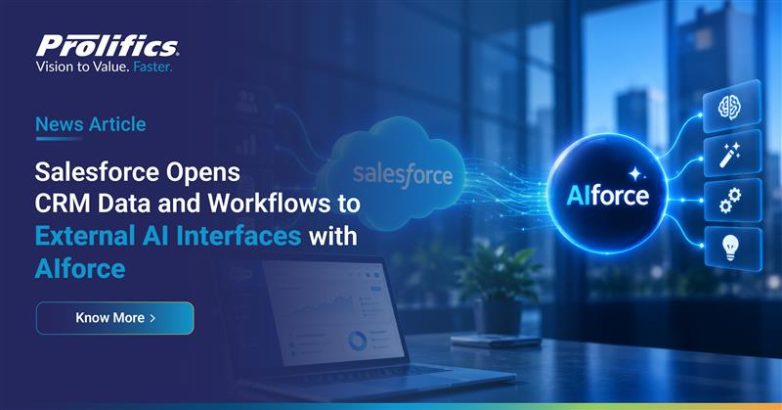
Salesforce has introduced AIforce, a new interface layer designed to make its customer data, business logic and workflows accessible through external artificial intelligence tools. Announced at Dreamforce on September 16, 2026, the technology represents a significant shift from traditional application-based CRM toward a more open, conversational and agent-driven model.
Rather than requiring employees to open Salesforce and navigate dashboards, records and menus, AIforce brings Salesforce capabilities directly into the environments where they already work. Users can ask questions, update customer records, generate insights and trigger workflows from AI interfaces such as Claude and Slack—all while using the trusted enterprise context held within Salesforce.
According to Salesforce, AIforce connects AI tools with the data, metadata, workflows, permissions, semantics and governance controls already configured across its platform. This means an external AI assistant could analyse account activity, review support cases, identify an at-risk customer and initiate an approved follow-up process without forcing the employee to move between applications.
The architecture is powered by Salesforce’s Headless Toolkit, which exposes platform capabilities through Model Context Protocol servers, APIs, plug-ins, skills and developer tools. MCP provides a standardised way for AI agents to communicate with enterprise data and software. Salesforce says existing access permissions and business rules continue to apply, helping ensure that users and agents can access only authorised information.
AIforce will initially support three major experiences: Claudeforce, Slackforce and Agentforce Coworker. Salesforce in Claude is launching in beta with 37 prebuilt sales skills, covering activities such as prospecting and pipeline management. Slackforce brings CRM context and actions into conversations, while Agentforce Coworker operates within the Salesforce Lightning interface.
The company is also emphasising data protection. Salesforce says AIforce supports Zero Data Retention, meaning business data used to answer a request is not retained by the external model provider. However, organisations will still need robust governance, testing and monitoring to ensure that AI-generated actions remain accurate, compliant and aligned with internal policies.
The announcement could help organisations gain more value from their existing CRM investments. Sales representatives may receive account intelligence without manually searching records, service teams could access customer histories within collaboration tools, and developers could build specialised AI experiences without recreating Salesforce’s underlying security and business logic.
How Prolifics Can Help
As a Salesforce partner with capabilities across CRM transformation, data, AI, integration, automation and Quality Engineering, Prolifics can help organisations turn this open architecture into secure, production-ready business solutions.
Prolifics can assess high-value use cases, prepare and govern enterprise data, connect Salesforce with wider business systems through MuleSoft, configure AI-enabled workflows and validate agent behaviour before deployment. Its Salesforce expertise spans Sales, Service, Marketing, Experience and Field Service Clouds, supported by integration, analytics and managed services.
By combining Salesforce’s AIforce architecture with Prolifics’ implementation and governance expertise, businesses can move from isolated AI experiments to connected, trusted experiences that improve sales productivity, customer service and operational decision-making.
Media Contact: Chithra Sivaramakrishnan | +1(646) 362-3877 | chithra.sivaramakrishnan@prolifics.com
Frequently Asked Questions
1. What is Salesforce AIforce?
AIforce is an interface layer that allows people and AI agents to access Salesforce data, workflows, business logic and approved actions from external AI and collaboration environments.
2. Which interfaces will initially support AIforce?
Salesforce has initially announced Claudeforce, Slackforce and Agentforce Coworker. Additional interfaces and ecosystem integrations are expected to follow.
3. What is the role of Model Context Protocol?
MCP provides a standard method for connecting AI assistants and agents with enterprise tools and data. Salesforce uses MCP alongside APIs, plug-ins and skills to expose governed platform capabilities.
4. How does Salesforce protect business data?
Requests are governed by existing Salesforce permissions and business rules. Salesforce also states that AIforce uses Zero Data Retention, so the model provider does not retain business data after processing a request.
5. How can Prolifics support an AIforce initiative?
Prolifics can help identify use cases, integrate enterprise systems, improve data readiness, configure workflows, establish governance, test AI agents and provide ongoing optimisation and managed support.