Prolifics has been helping clients navigate digital transformation for nearly 50 years, through mainframe to client-server, on-premise to cloud, waterfall to agile. Multiple waves of technology change, and each time the same essential challenge: working out what the shift actually means for how software gets built and delivered.
The AI wave is something different.
Previous shifts changed the tools engineers used. This one is changing what an engineer is and what software itself looks like. The skills that defined seniority a few years ago are being redistributed. Design decisions that once took weeks of experienced hands can happen in hours. Solutions that would have required large teams and long timelines are being assembled in days. Software is being fundamentally reimagined: how it’s conceived, how it’s built, and what it’s capable of. The organizations that grasp this early and act on it, not just study it, will move at a pace that becomes very hard for others to match.
What sets this moment apart for us is that we’re not observing this shift from the outside. We’re living it. Prolifics has been transforming our own engineering workflows, building our own AI-powered tools, and accumulating hard-won experience in what works and what doesn’t. When we talk to clients about AI transformation, we speak from inside the journey.
Every few months, we run an Innovation Spotlight: a session where engineering teams share what they’ve actually built, using live demos rather than slides. The June 2026 session gave us the clearest view yet of how far that transformation has come, and what it looks like when it’s working. The numbers surprised even us.
Here’s what we showed.
$6 Million in Impact. Five AI-Powered Assets. Eight Weeks of Work.
Before the demos started, we shared some context on where the investments have landed.
Over the past few months, Prolifics’ AI initiatives have generated approximately $6 million in business impact across customer wins and delivery efficiencies. We’ve produced five AI-powered engineering assets that are already running in live client engagements. And the lessons from building those assets, including the hard ones, have shaped how we now approach every new project.
Those are the headline numbers. The demos showed how we got there.
22 Applications. 2 Months. $660 in AI Tooling.
The first demo came from our internal automation team, led by Ravi Thalluri, and the numbers they opened with set the tone for the entire session.
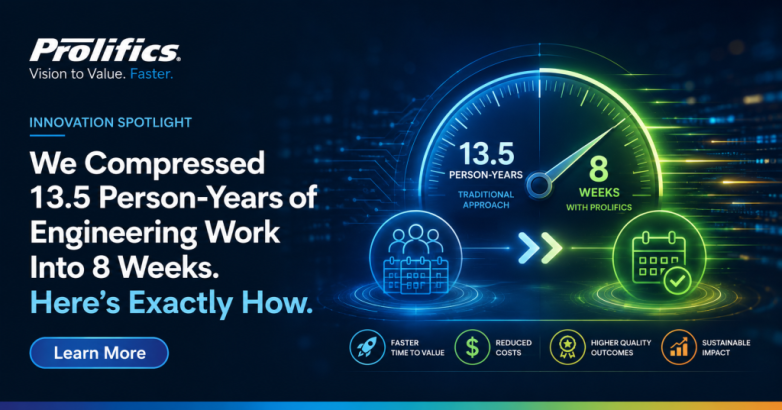
In two months, a nine-person team built 22 production applications. When they measured what that would have cost using traditional methods, they calculated 13.5 person-years of equivalent effort, delivered in eight weeks. Total AI tooling spend across the entire project: $660.
The productivity gains came from a disciplined shift in how software gets built.
Traditional delivery cycles are slow at the back end , requirements get written, code gets built, and the rework happens after shipping, when it’s most expensive. Ravi’s team inverted this. Instead of writing specification documents, they use AI to build a working prototype in days, put it in front of stakeholders immediately, and get feedback on something tangible. Rework happens at the design stage. Code generation only begins once the prototype is approved.
One example from the session illustrated the impact. The team took a flat financial reporting table, rows of numbers, sorted alphabetically, that you had to interpret manually, and transformed it into a visual management dashboard: KPI cards, drill-down detail by business entity, and a live revenue forecast that overlays pipeline data to show where the business lands at different conversion rates. Time from idea to prototype: two days. Time from approved prototype to production: seven days.
When questions came in about governance, specifically, whether generating code ten times faster means you need ten times as many senior engineers to review it, Ravi’s answer was instructive. For every utility built, the team creates a test harness alongside the prototype. The harness encodes non-negotiables: how the UI renders, how calculations work, how screens navigate, how totals reconcile. Every change to the prototype runs against the harness. That same harness ships to production.
The team of nine, most with around a year of experience, are producing output that competes with senior engineers because AI is handling the design heavy lifting. But accountability stays with the team. The AI generates; humans verify, own, and ship.
The return on the AI tooling investment: 225x.
One Customer in Two Weeks → Twenty Customers in a Day
The second strand of demos shifted to what this looks like when applied to client work at scale – and how purpose-built AI factories change the economics of complex migrations.
Rajeev Sharma presented the work his team built for a large global logistics provider migrating from legacy integration platforms (BizTalk and Seeburger) to MuleSoft. This is the kind of project that’s traditionally expensive and slow, dozens of customers, hundreds of integration flows, significant manual effort at every step.
The team built a purpose-specific migration factory using Prolifics’ Agentic Assembly Framework (AAF). The process: ingest the client’s existing integrations, generate a structured catalog using AI and custom scripts (data formats, flow direction, protocol, complexity), then spin up agents that produce MuleSoft-ready canonical files, DataWeave transformation files, and push the artifacts directly to the client’s GitHub. The demo showed this running live, selecting a customer, triggering the migration, watching the agent work in real time, and downloading the generated artifacts.
Before the factory: one customer migration took one to two weeks.
After: twenty customer migrations in a single day.
And the asset doesn’t expire at the end of this engagement. The same framework, tuned for BizTalk today, can be adapted for Seeburger, Lobster, or WebMethods tomorrow. Each engagement makes the factory more capable.
From Jira Ticket to Coded Test Stub – Without Leaving the Platform
The testing side of the software delivery lifecycle has its own version of this problem: the gap between a vague ticket and a testable, automated requirement burns significant team time.
Our team demonstrated work built for a major financial services client using Quality Fusion, Prolifics’ test automation platform. The client was onboarding multiple acquired entities, user stories were incomplete, and the engineering team was losing time bridging the gap manually.
The solution: two AI-driven capabilities embedded directly into Quality Fusion.
Starting from a sparse one-liner Jira story, the platform generates a fully enriched version, business value, acceptance criteria, edge cases, grounded in existing project knowledge and linked artefacts. From there, one click produces BDD scenarios in Gherkin format. Another generates functional test cases. A third produces Java code stubs that the automation team can build from directly. Everything syncs back to Jira.
The full chain, vague ticket to testable, coded test stub, in one tool, with no manual handoffs.
The Architecture That Makes It All Composable
Running through every demo in the session was a structural point worth making explicit: the Agentic Assembly Framework.
Every time an AI capability is built as a standalone tool, it risks becoming a silo, hard to share, impossible to combine with the next project’s agents. AAF is Prolifics’ answer to that. It’s a framework for building AI agents and tools in a standardised way so that they can be composed, recomposed, and reused across different software factories and business applications.
The University of Lancashire migration demo made this concrete. The platform ingested the university’s existing integration code, extracted domain concepts, business logic, and use cases, and generated data mappings between systems, including bridge mappings for moving from an on-premise system to SaaS. The test generation capabilities shown in the Quality Fusion demo ran inside the same interface, because they’re built on the same framework.
The reference implementation, a working e-commerce application, showed the architectural shift this enables. Instead of a separate API endpoint for every piece of business logic, the backend becomes a single endpoint backed by a dynamic agent that routes to the right tool based on context. Configure a tool, expose it through AAF, and the agent orchestrates everything.
Alongside AAF, we’ve built an AI Workbench: a management layer for the toolkits running in any given environment. At runtime, you can see what agents and tools are active, what’s being called, and what each interaction costs in tokens. That last point is one of the disciplines that makes agentic systems viable at scale, controlling token burn so that the economics work as you grow.
Finding Where Agents Belong – Before You Build Anything
Not every process should be automated. Not every workflow is a good fit for agentic AI. Knowing which is which is often where organizations get stuck.
Salem Hadim presented Prolifics’ approach to Agentic Business Transformation, a structured consulting engagement designed to answer exactly that question before a line of code gets written.
The process runs in structured workshops. Current workflows get mapped, every persona and task gets documented, and each use case gets scored on two dimensions: the value that automation would generate, and how well the process actually fits an agentic model. Processes that are deterministic, standardised, and data-complete score well. Everything else gets deprioritized – or ruled out entirely.
Prolifics ran this process internally, across HR, resource management, and sales operations. The scoring identified which processes to build first and sized the potential return before any investment was committed.
For the HR onboarding process, the numbers were clear: more than 1,500 hours saved from a 2,000-hour total, a reduction of over 70%. Factoring in implementation and running costs, the projected ROI landed at 56%. The sales process scored higher.
Those projections are now being built. Abhishek Mishra demoed the first steps of the HR onboarding toolkit live: scanning new joinee records, drafting personalised welcome emails via agent, and surfacing document status from the onboarding portal in real time, with plain-language queries answered on the spot. Three steps live. Thirty to forty more are in development.
What This Means for Organizations Undergoing Their Own AI Transformation
The question we hear most from clients is some version of: “Where do we actually start?”
The June session gave a practical answer, not through theory, but through working examples at every layer of the software delivery lifecycle.
For engineering teams, the shift is about changing how work gets structured: using AI for design heavy lifting, generating from approved prototypes, and testing with harnesses rather than hoping. For delivery at scale, it’s about building purpose-specific factories, not applying off-the-shelf AI to generic problems, but building agents tuned to the specific transformation you’re running. And for business operations, it’s about scoring before building, and understanding where agents genuinely reduce effort versus where they add complexity.
Across all of it, the human accountability stays. The AI amplifies; engineers direct, review, and own the outcome.
The results from June, $6 million in impact, 225x ROI on tooling, twenty migrations a day, 70% reduction in operational hours, aren’t projections. They’re what’s already running.
Interested in what an AI-powered software factory or agentic business transformation could look like for your organization?
FAQ’s
How much ROI can AI tooling deliver for software engineering teams?
Prolifics achieved a 225x return on AI tooling investment – delivering 13.5 person-years of engineering output in 8 weeks at a total AI tooling cost of $660.
What is the Agentic Assembly Framework (AAF)?
AAF is Prolifics’ proprietary framework for building composable AI agents that can be reused across software factories and business applications – enabling structured, scalable agentic delivery.
How does AI reduce software delivery timelines?
By using AI to generate working prototypes in 2 days, validate with stakeholders before writing code, and ship to production in 7 days – replacing traditional slow requirement-to-rework cycles.
How long does a MuleSoft migration take with AI automation?
With Prolifics’ AI-powered migration factory, 20 customer migrations are completed in a single day – compared to 1–2 weeks per customer using traditional methods.
What is Agentic Business Transformation?
It’s a structured consulting process by Prolifics that maps and scores business workflows on automation value and AI-fit before any code is written – identifying ROI-positive use cases first.