Enterprise automation is evolving rapidly. For years, Robotic Process Automation (RPA) has helped organizations streamline repetitive tasks, reduce operational costs, and improve efficiency. But as businesses face increasingly dynamic workflows, unstructured data, and the need for real-time decision-making, a new paradigm is emerging: agentic AI.
The discussion around Agentic AI vs. RPA is no longer about replacing one technology with another. Instead, it is about understanding how intelligent, autonomous systems can complement and elevate traditional automation strategies. Modern enterprises are now moving from task automation to decision automation, and agentic AI is at the center of this transformation.
What is RPA?
Robotic Process Automation (RPA) is a technology that uses software bots to automate repetitive, rules-based tasks. These bots mimic human interactions with digital systems, such as logging into applications, copying data, generating reports, or processing transactions.
According to Forrester’s 2026 Enterprise Automation Study, nearly 45% of enterprise automation budgets are now quietly diverted from building new capabilities to maintaining existing, fragile RPA bot ecosystems. That number is the clearest signal that the first era of enterprise automation has hit its ceiling. It’s also the reason a growing number of Fortune 500 enterprises are shelving their RPA rollouts, not because automation failed, but because a fundamentally more capable approach has arrived.
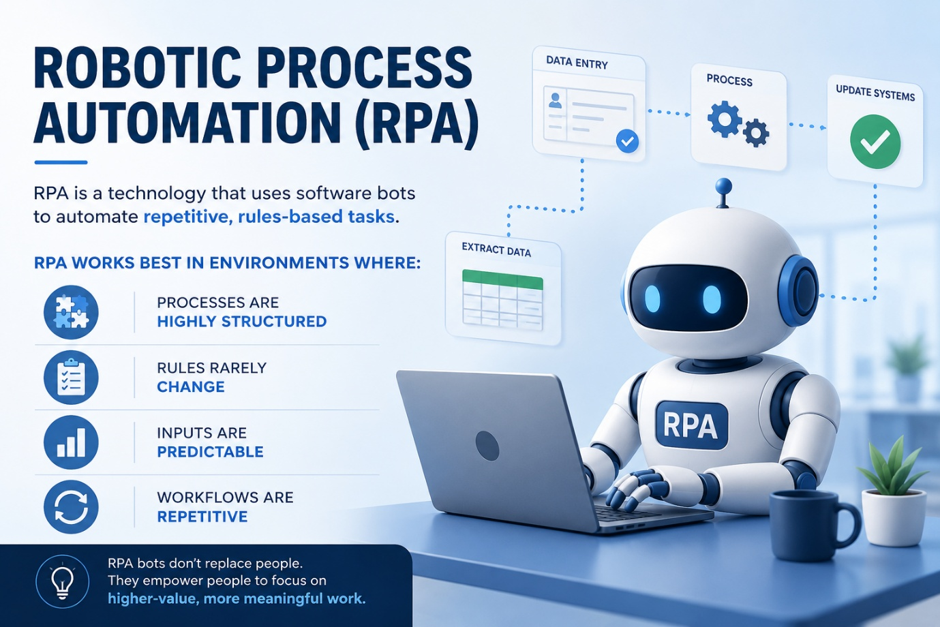
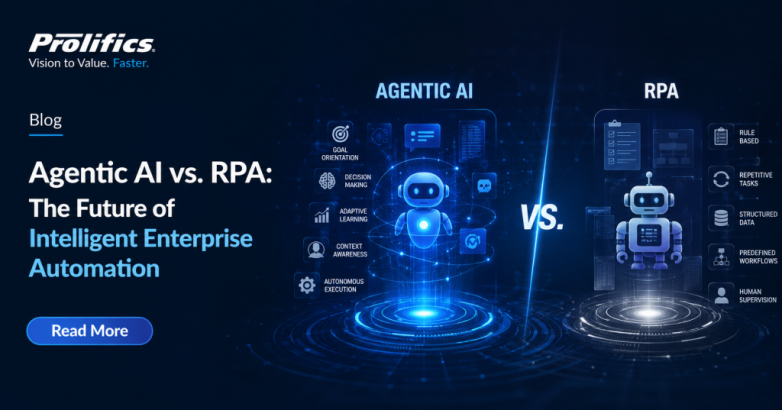
RPA works best in environments where:
- Processes are highly structured
- Rules rarely change
- Inputs are predictable
- Workflows are repetitive
Organizations across finance, healthcare, retail, and manufacturing have successfully adopted RPA for tasks such as invoice processing, claims management, employee onboarding, and customer data entry. According to industry reports, RPA implementations often deliver significant ROI by reducing manual workloads and improving operational accuracy.
However, RPA has limitations. Traditional bots struggle when workflows become unpredictable or when systems require contextual understanding and decision-making.
What is Agentic AI?
Agentic AI refers to autonomous AI systems capable of perceiving, reasoning, planning, and taking action toward a specific objective. Unlike RPA bots that strictly follow predefined scripts, Agentic AI agents can dynamically adapt to changing conditions and determine the best path to achieve outcomes.
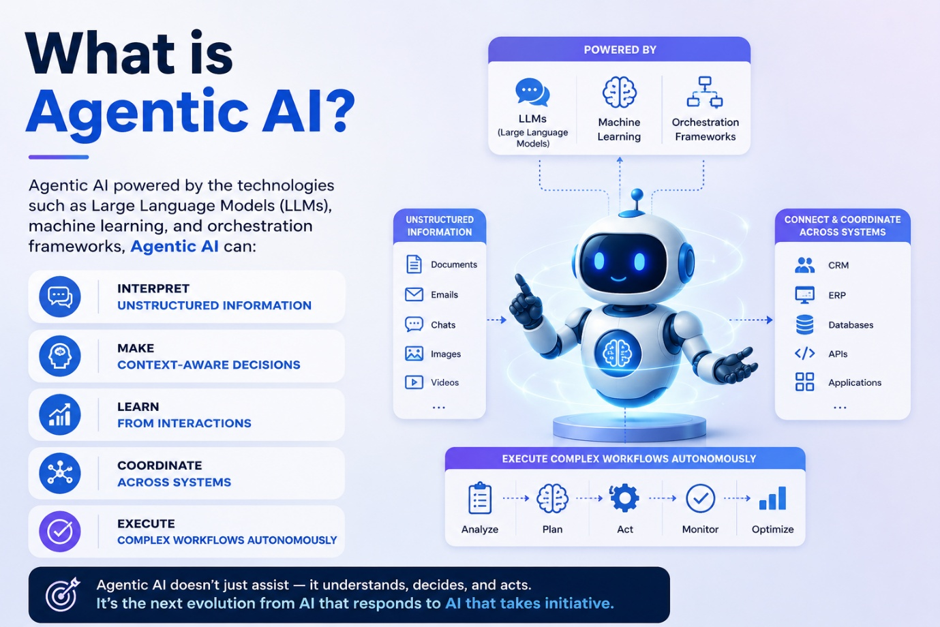
Powered by technologies such as Large Language Models (LLMs), machine learning, and orchestration frameworks, Agentic AI can:
- Interpret unstructured information
- Make context-aware decisions
- Learn from interactions
- Coordinate across systems
- Execute complex workflows autonomously
The fundamental shift from RPA to agentic AI is not just technological it is strategic. RPA answers the question “How do we do this faster?” while Agentic AI answers “How do we decide what to do next?” This distinction matters enormously for enterprise leaders mapping their automation roadmap. According to Gartner, by 2027, over 50% of enterprises that deployed RPA standalone will begin layering agentic AI on top to handle exception management, contextual decisions, and dynamic process orchestration tasks that traditional bots simply cannot perform.
For organizations working with Prolifics, this transition is already underway, with hybrid automation architectures replacing legacy bot farms and unlocking a new class of intelligent, self-correcting enterprise workflows.
Where RPA Still Excels
Despite the rise of Agentic AI, RPA remains highly valuable. Businesses should not assume that traditional automation is obsolete.
RPA continues to excel in:
- High-volume transactional processes
- Legacy system integration
- Data migration
- Compliance-heavy operations
- Standardized workflows
For example, banking institutions use RPA for KYC verification, payroll automation, and reconciliation tasks because these processes are stable and highly structured.
RPA also offers predictability. Since bots follow predefined rules, organizations can maintain strong control over execution and compliance.
Where Agentic AI Creates Greater Value
Agentic AI shines in environments where complexity, variability, and decision-making are essential.
Some high-impact use cases include:
- Intelligent customer support
- Supply chain optimization
- Predictive IT operations
- Autonomous incident management
- Dynamic workflow orchestration
- Personalized healthcare recommendations
Agentic AI can analyze vast amounts of information, adapt to changing scenarios, and continuously improve its responses. This makes it ideal for modern enterprises dealing with massive data volumes and rapidly changing business conditions.
For example, in IT operations, AI agents can proactively identify anomalies, diagnose issues, and initiate corrective actions before users even notice a disruption. This shifts enterprises from reactive support models to proactive operational intelligence.
The Hybrid Future: Agentic AI + RPA
The future of enterprise automation is not RPA versus Agentic AI—it is RPA plus Agentic AI.
Industry leaders increasingly recognize that combining deterministic RPA execution with intelligent AI reasoning creates the most effective automation strategy.
In this hybrid model:
- Agentic AI handles interpretation, planning, and decision-making
- RPA executes repetitive backend actions reliably
For example:
- An AI agent receives a customer request via email
- It interprets the request contextually
- It determines the required workflow
- RPA bots execute the required transactions across enterprise systems
- The AI agent validates completion and communicates with the customer
This combination enables enterprises to automate not just tasks, but entire business processes end-to-end.
Challenges Enterprises Must Address
While Agentic AI offers enormous promise, organizations must approach adoption strategically.
Key challenges include:
- Data quality and governance
- Security and compliance concerns
- AI hallucinations and trust issues
- Integration complexity
- Ethical and regulatory considerations
Experts also warn against “agent washing,” where vendors simply rebrand traditional automation tools as Agentic AI without true autonomous capabilities.
Organizations must focus on building strong AI governance frameworks, secure infrastructure, and transparent orchestration models to scale Agentic AI responsibly.
Conclusion
Enterprise automation is entering a new era. RPA laid the foundation for operational efficiency, but Agentic AI is expanding automation into intelligent decision-making and autonomous execution.
Rather than replacing RPA entirely, Agentic AI enhances it by bringing adaptability, reasoning, and contextual understanding into enterprise workflows. Businesses that successfully combine RPA’s reliability with Agentic AI’s intelligence will gain a significant competitive advantage in operational efficiency, customer experience, and innovation.
As enterprises navigate this transformation, partnering with experienced technology experts becomes essential. Prolifics helps organizations accelerate intelligent automation journeys by combining AI, automation, cloud, and integration expertise to build scalable, future-ready enterprise solutions. From RPA modernization to Agentic AI implementation, Prolifics enables businesses to unlock the full potential of next-generation automation.
FAQs
1. What is the main difference between Agentic AI and RPA?
RPA automates repetitive, rule-based tasks using predefined workflows, while Agentic AI uses reasoning and autonomy to achieve broader business goals dynamically.
2. Can Agentic AI replace RPA completely?
Not entirely. RPA remains highly effective for structured, repetitive processes. Most enterprises will benefit from a hybrid approach that combines both technologies.
3. Which industries benefit most from Agentic AI?
Industries such as healthcare, finance, retail, logistics, telecommunications, and IT operations can significantly benefit from Agentic AI due to their complex and dynamic workflows.
4. Is Agentic AI secure for enterprise use?
Yes, but organizations must implement strong governance, security controls, and monitoring frameworks to ensure responsible AI adoption and compliance.
5. How can businesses start adopting Agentic AI?
Businesses should begin by identifying high-value workflows that require decision-making and adaptability. Partnering with experienced automation providers like Prolifics can help accelerate implementation and reduce risk.