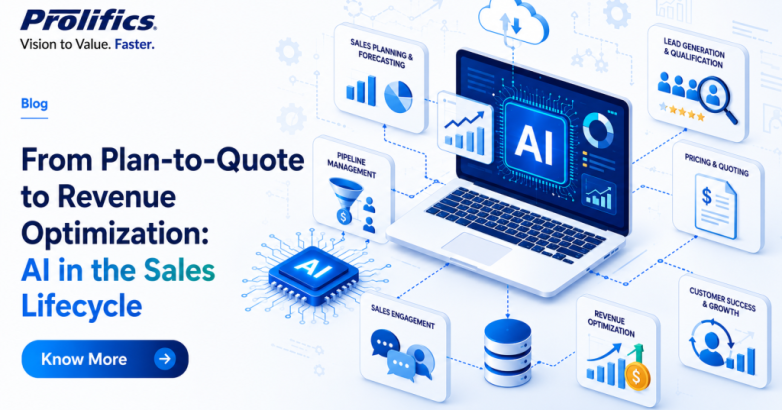
Artificial intelligence is reshaping how organizations plan, sell, forecast, and grow revenue.
Sales leaders now face growing pressure to speed up deal cycles, improve forecast accuracy, and deliver personalized customer experiences while controlling costs.
Through AI sales lifecycle optimization, enterprises can make faster, data-driven decisions across the buyer journey.
At Prolifics, we help organizations modernize sales operations with automation, analytics, machine learning, and intelligent decision support. By embedding AI across the sales lifecycle, businesses can accelerate growth, improve productivity, and build a more predictable revenue engine.
What is AI Sales Lifecycle Optimization?
AI sales lifecycle optimization is the use of artificial intelligence, including machine learning, predictive analytics, and agentic AI to automate and improve every stage of B2B revenue generation: from sales planning and lead qualification to plan-to-quote automation, CPQ, pricing, and post-sale revenue growth.
Understanding the Sales Lifecycle from Planning to Revenue
The modern sales lifecycle encompasses every activity that influences revenue generation, from strategic planning and lead acquisition to quoting, deal closure, customer retention, and expansion. Each stage contributes directly to business performance and customer satisfaction.
AI enhances visibility, automation, and decision-making across this lifecycle. Instead of managing isolated activities, organizations can create connected, data-driven sales ecosystems that continuously improve performance and outcomes.
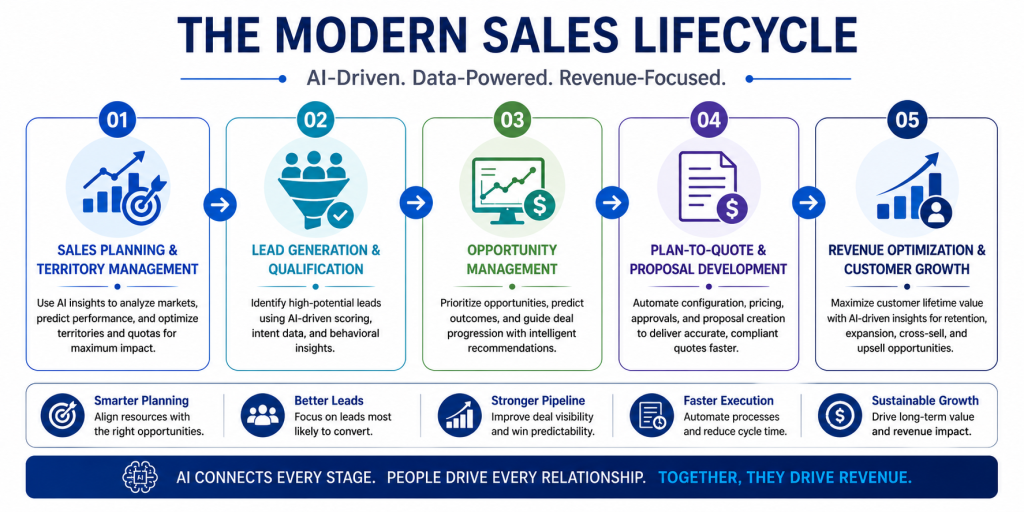
The following are key stages of the modern sales lifecycle:
- Sales Planning & Territory Management.
- Lead Generation & Qualification.
- Opportunity Management.
- Plan-to-Quote & Proposal Development.
- Revenue Optimization & Customer Growth.
When organizations integrate AI across these stages, they gain the ability to anticipate customer needs, identify opportunities earlier, and respond more effectively to market changes.
AI in Sales Planning, Forecasting, and Territory Optimization
AI-Powered Sales Planning
Effective sales planning requires a deep understanding of customer behavior, historical performance, competitive dynamics, and market trends. AI analyzes vast amounts of structured and unstructured data to identify patterns that human teams may overlook.
Machine learning models can evaluate previous sales outcomes, customer purchasing trends, seasonal fluctuations, and economic indicators to generate more accurate planning recommendations. Sales leaders can use these insights to set realistic targets, allocate resources efficiently, and prioritize strategic accounts.
These capabilities deliver several advantages:
- Forecast future demand using historical and real-time intelligence.
- Allocate resources efficiently across high-value markets and accounts.
- Improve strategic planning through actionable predictive business insights.
AI-Driven Revenue Forecasting
Revenue forecasting remains one of the most challenging responsibilities for sales leadership. Traditional forecasting often depends on subjective assessments and outdated spreadsheets, resulting in inconsistent projections.
AI improves forecasting accuracy by continuously analyzing pipeline activity, customer engagement signals, opportunity progression, and historical conversion patterns. The system identifies risks and opportunities in real time, helping leaders make informed decisions before issues affect revenue performance.
Organizations gain significant value through:
- Improve forecast accuracy using continuously updated predictive models.
- Detect revenue risks before impacting quarterly business performance.
- Provide executives with greater pipeline visibility and confidence.
AI-Based Territory Optimization
Sales territory management directly influences productivity and revenue generation. Uneven territory assignments often create workload imbalances and missed opportunities.
AI evaluates geographic data, market potential, customer density, buying patterns, and seller capacity to optimize territory structures. Organizations can align resources more effectively and ensure sales representatives focus on the highest-value opportunities.
Key advantages include:
- Balance territories based on opportunity potential and workload.
- Expand market coverage through intelligent territory assignment strategies.
- Increase productivity by reducing inefficient account management activities.
Smarter Lead Generation and Opportunity Prioritization
Traditional lead qualification processes often depend on manual scoring systems and subjective judgment. While these methods can provide value, they frequently miss emerging opportunities and consume significant sales resources.
AI changes this approach by evaluating thousands of behavioral and demographic signals simultaneously. It identifies prospects most likely to convert and continuously updates lead scores based on real-time activity.
Traditional vs AI-Powered Lead Management
Traditional lead management often depends on manual scoring, broad targeting, and static qualification rules. AI-powered lead management uses predictive insights and real-time behavior to prioritize better opportunities.
| Traditional Approach | AI-Powered Approach |
| Manual lead scoring | Predictive lead scoring |
| Broad prospect targeting | Precision audience targeting |
| Reactive sales engagement | Proactive opportunity identification |
| Static qualification criteria | Dynamic behavioral analysis |
| Limited scalability | Scalable real-time prioritization |
AI-powered lead management helps organizations focus resources on opportunities with the highest probability of success. By combining predictive analytics, intent data, and behavioral insights, sales teams improve conversion rates while reducing time spent on low-value prospects.
This capability becomes especially important for organizations seeking how to implement AI in B2B sales process to increase win rates, as better lead qualification directly influences pipeline quality and revenue outcomes.
Transforming Plan-to-Quote with AI Automation
For many enterprises, the plan-to-quote process represents one of the most complex and time-consuming stages of the sales lifecycle. Multiple stakeholders, pricing rules, approval workflows, product configurations, and compliance requirements often create bottlenecks that delay deal progression.
AI plan-to-quote automation simplifies and accelerates these activities by automating repetitive tasks and improving decision-making throughout the quoting process.
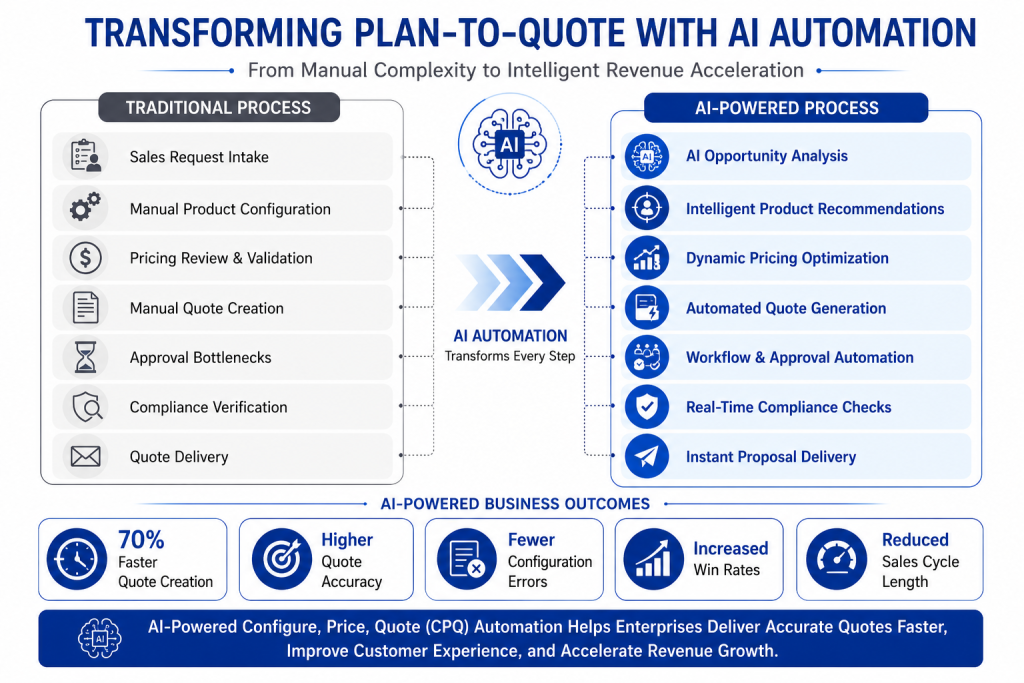
One of the most impactful capabilities involves AI-powered configure price quote automation for enterprise sales. Intelligent CPQ systems help sales teams configure products accurately, recommend complementary solutions, and generate compliant pricing structures based on customer requirements.
AI also improves quote generation by analyzing historical deals, customer preferences, and business rules. Instead of manually creating proposals, sales representatives can generate accurate, customized quotes within minutes.
Additional AI capabilities include:
- Automated product and solution recommendations.
- Intelligent quote generation based on customer requirements.
- Approval workflow automation and escalation management.
- Compliance validation and pricing governance enforcement.
- Real-time error detection during quote creation.
These improvements deliver measurable business outcomes:
- Accelerate quote delivery for improved customer responsiveness.
- Reduce manual effort across complex enterprise sales processes.
- Improve quote accuracy through automated validation and controls.
- Enhance customer experience with faster proposal turnaround times.
Organizations seeking to reduce sales cycle length with AI automation for enterprise deals often achieve significant improvements through AI-enabled quoting and approval processes. Faster quote generation enables buyers to make decisions sooner while helping sellers maintain momentum throughout the sales journey.
AI-Powered Pricing, Proposals, and Sales Engagement
AI-Powered Pricing
Pricing decisions have a direct impact on revenue, profitability, and competitiveness. Many organizations still rely on static pricing models that fail to account for changing market conditions.
AI analyzes customer behavior, competitor activity, historical transactions, and market trends to recommend optimal pricing strategies. Dynamic pricing models help organizations maximize margins while maintaining competitiveness.
These systems can identify pricing opportunities that increase profitability without negatively affecting win rates. Sales teams gain confidence knowing recommendations are backed by real-time market intelligence.
AI-Generated Proposals
Proposal creation often consumes valuable selling time. AI helps automate this process by generating personalized proposals that align with customer requirements and organizational standards.
Modern AI systems can:
- Create tailored proposal content automatically.
- Recommend relevant case studies and references.
- Maintain consistent messaging across sales teams.
- Reduce administrative effort during proposal development.
This approach improves efficiency while ensuring every proposal reflects organizational expertise and value propositions.
Intelligent Sales Engagement
AI also enhances how sales teams interact with prospects and customers. Intelligent engagement platforms analyze conversations, emails, meetings, and customer behavior to recommend next-best actions.
Examples include:
- Personalized outreach recommendations.
- Automated follow-up suggestions.
- Conversation intelligence and coaching insights.
- Opportunity progression guidance.
These capabilities help sellers engage more effectively while improving customer experiences throughout the buying journey.
The result is stronger pipeline performance, improved conversion rates, higher seller productivity, and more consistent revenue generation.
Revenue Optimization Beyond the Sale
Revenue growth does not end when a contract is signed. Long-term business success depends on customer retention, expansion opportunities, and maximizing lifetime value.
AI enables organizations to move beyond transactional selling and focus on sustained customer growth.
Customer Retention Analytics
Retaining existing customers often costs less than acquiring new ones. AI analyzes customer engagement patterns, support interactions, usage trends, and satisfaction metrics to identify retention risks before they become serious problems.
Organizations can proactively address concerns and strengthen customer relationships through targeted interventions.
Churn Prediction
Machine learning models detect early indicators of customer attrition by analyzing behavioral changes and engagement patterns.
Sales and customer success teams can take preventive action when AI identifies customers at risk of leaving. This proactive approach improves retention and protects recurring revenue streams.
Cross-Sell and Upsell Recommendations
AI identifies opportunities to expand customer relationships through additional products and services. By evaluating customer needs, purchase history, and behavioral data, organizations can deliver highly relevant recommendations.
This increases revenue while providing customers with solutions that support their business goals.
Customer Lifetime Value Optimization
AI helps organizations understand which customers generate the greatest long-term value. These insights support smarter investment decisions and more effective account management strategies.
By prioritizing high-value relationships, businesses can maximize profitability and improve overall revenue performance.
AI Quote-to-Cash Automation
An increasingly important component of revenue operations involves AI quote-to-cash automation benefits for revenue operations teams. Quote-to-cash processes connect sales, finance, billing, and customer management activities into a unified workflow.
AI streamlines invoicing, payment processing, contract management, and revenue recognition activities while reducing errors and delays.
Organizations benefit through:
- Increased recurring revenue through proactive customer growth strategies.
- Improved satisfaction from personalized customer engagement initiatives.
- Stronger predictability across revenue planning and forecasting activities.
Building an Intelligent Revenue Engine with Agentic AI
The next evolution of enterprise sales involves autonomous and semi-autonomous AI agents that actively support revenue generation. Organizations increasingly explore agentic AI in sales pipeline management and revenue forecasting to improve operational efficiency and decision-making.
Unlike traditional automation, agentic AI systems can analyze situations, recommend actions, execute tasks, and continuously learn from outcomes. These intelligent agents support sales teams by monitoring opportunities, updating forecasts, identifying risks, and recommending interventions.
For example, an AI agent might detect declining engagement within a strategic account, recommend outreach actions, suggest relevant solutions, and notify stakeholders before the opportunity becomes at risk.
As adoption accelerates, agentic AI will play a critical role in helping enterprises scale sales operations while maintaining personalized customer experiences.
Organizations implementing AI revenue optimization strategies for B2B sales teams 2026 increasingly view agentic AI as a competitive differentiator capable of driving measurable business value.
Conclusion: Building an AI-Driven Revenue Engine
AI sales lifecycle optimization helps organizations improve planning, forecasting, quoting, engagement, and revenue growth through data-driven decision-making. Technologies such as AI plan-to-quote automation, intelligent forecasting, and AI-powered configure price quote automation for enterprise sales help accelerate sales cycles, improve accuracy, and enhance customer experiences.
At Prolifics, we help businesses implement scalable AI solutions, including agentic AI in sales pipeline management and revenue forecasting, to drive smarter revenue operations. By combining automation, analytics, and industry expertise, we help organizations reduce sales cycle length with AI automation for enterprise deals, increase win rates, and achieve sustainable growth.