AI cybersecurity in 2026–27 is increasingly about controlling what autonomous AI agents are allowed to see, decide and do. The main risk is no longer limited to AI-generated phishing or unsafe model outputs; it includes agents with legitimate credentials, excessive permissions, poisoned context or compromised tools acting across enterprise systems at machine speed. Enterprises should combine agent-specific identity, least privilege, continuous monitoring, data governance, policy enforcement, and human approval for high-impact actions.
AI cybersecurity for agentic systems means treating every AI agent as a governed non-human identity. Enterprises should inventory agents, classify them by autonomy, restrict data and tool access, validate context, log every action, monitor behavior continuously, require approval for high-risk decisions, and maintain rollback or shutdown controls for unsafe behavior.
What is AI cybersecurity for agentic AI?
AI cybersecurity is the discipline of protecting AI models, agents, data, identities, tools and workflows from misuse, compromise and unsafe autonomous behavior. For agentic AI, the focus extends beyond protecting the model itself to governing what an agent can access, which actions it can execute, how it proves its identity and how its activity can be audited or stopped.
That distinction matters because an AI assistant typically recommends or drafts; an AI agent can potentially act. It may query databases, call APIs, update records, send messages, trigger enterprise automation or coordinate with other agents. A security failure can therefore become an operational event rather than only a bad answer.
For CTOs and IT leaders, the practical question is not whether an agent is simply “trusted.” It is what authority the agent has within each system integration, data domain and business process. A strong control model applies zero-trust principles to non-human identities: verify the agent, limit permissions, constrain tools, monitor actions and require stronger controls as autonomy increases. This makes AI governance part of broader IT modernization and digital transformation architecture rather than a separate policy exercise.
Why must AI cybersecurity change for 2026–27?
AI cybersecurity must change because enterprise AI is moving from generating content to executing work. Once agents can take action, traditional controls built around human users, static applications and predictable workflows become less effective unless they are extended to agent identity, delegated authority, runtime behavior and context.
Gartner reported in May 2026 that by 2027, 40% of enterprises will demote or decommission autonomous AI agents because governance gaps are discovered after production incidents. IBM’s Cost of a Data Breach Report 2025 put the global average breach cost at $4.4 million; 63% of organizations lacked AI governance policies, while 97% of organizations that reported an AI-related security incident lacked proper AI access controls. IBM also reported $1.9 million in breach-cost savings for organizations with extensive use of AI in security.
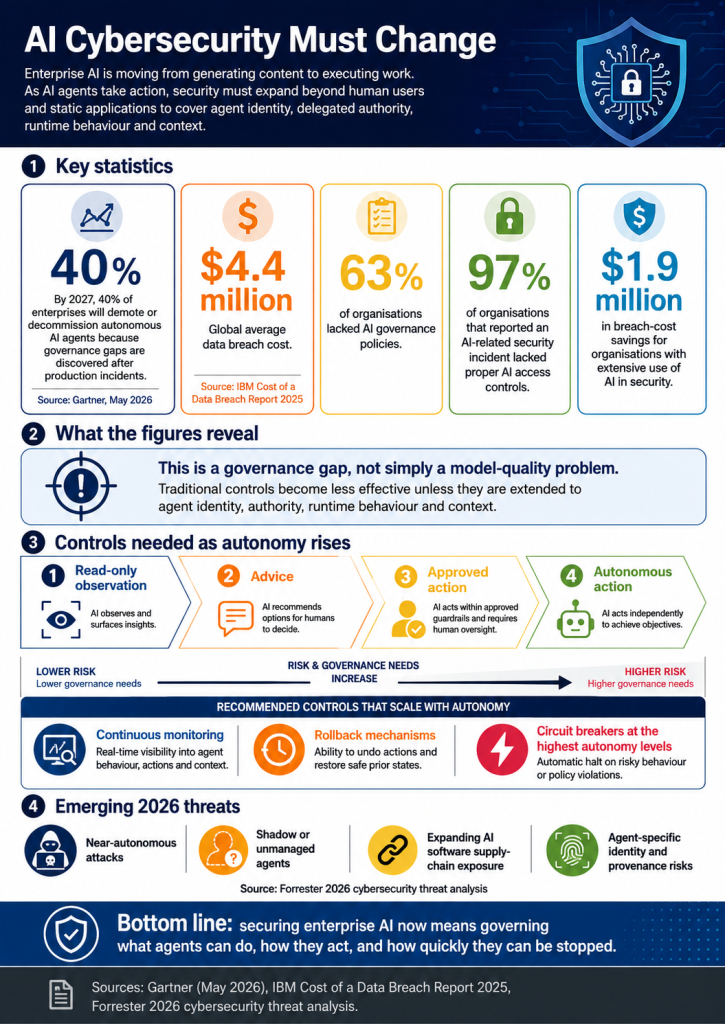
These figures point to a governance gap, not simply a model-quality problem. Gartner recommends stronger controls as agents move from read-only observation to advice, approved action and autonomous action, including continuous monitoring, rollback mechanisms and circuit breakers at the highest autonomy levels.
Forrester’s 2026 cybersecurity threat analysis adds another dimension: organizations should prepare for near-autonomous attacks, shadow or unmanaged agents, expanding AI software supply-chain exposure, and agent-specific identity and provenance risks.
What agentic AI threats should enterprises prioritize?
Enterprises should prioritize threats that combine legitimate access with autonomous action. The most serious agentic failures may not look like traditional malware; they can look like an authorized process doing the wrong thing quickly, repeatedly and at scale.
- Over-privileged agent identities: An agent receives broad credentials or inherits human permissions that exceed its task.
- Prompt injection and malicious context: Untrusted email, documents, web content or retrieved data manipulate the agent’s instructions or decision path.
- Tool and API abuse: A compromised or misdirected agent invokes legitimate enterprise tools in unsafe sequences.
- Shadow agents: Employees connect personal agents to browsers, inboxes, files or SaaS applications without security visibility.
- AI supply-chain compromise: Models, plugins, tools, agent skills, open-source components or external APIs introduce unverified behavior or malicious dependencies.
- Cascading multi-agent failures: One agent’s faulty output becomes trusted context for another, allowing errors or malicious instructions to propagate at machine speed.
Forrester’s 2026 threat analysis specifically identifies agent threats, AI software supply-chain risk, and the need for agent-specific identity, provenance and access controls. Those risks become more material during cloud migration, enterprise automation and large-scale system integration because agents can cross more trust boundaries and interact with more systems.
How should enterprises build an AI cybersecurity control model?
The most effective approach is to govern agent authority before scaling agent autonomy. A practical enterprise control model can follow these eight steps:
- Inventory every agent. Record its owner, purpose, model, data sources, tools, environment, vendors and connected systems. Unknown agents cannot be governed effectively.
- Classify autonomy and business impact. Separate read-only agents from advisory agents, approval-gated actors and fully autonomous agents. Apply stricter controls as potential consequences increase.
- Assign a unique non-human identity. Do not allow agents to rely on generic service accounts or employee credentials. Identity should map every action to a specific agent and accountable owner.
- Enforce least privilege. Give the agent only the data, APIs, commands and duration of access required for its task. Prefer narrowly scoped authorization and short-lived credentials where practical.
- Protect context and tools. Validate retrieved content, distinguish trusted instructions from untrusted data, restrict tool invocation and evaluate third-party models, connectors and dependencies.
- Create approval gates for high-impact actions. Require meaningful human review for payments, account changes, customer notifications, production configuration changes and regulated decisions.
- Monitor behavior and preserve audit trails. Log prompts, relevant context, tool calls, approvals, outputs, transactions and policy violations. Monitoring must examine behavior, not only authentication events.
- Design containment before production. Establish rate limits, rollback processes, circuit breakers, credential revocation and an incident path capable of stopping the agent without disrupting the wider environment.
Gartner’s 2026 guidance similarly distinguishes between agents that observe, advise, act with approval and operate autonomously, with governance requirements increasing alongside autonomy and access.
This control model should connect AI governance with identity governance, data governance, application architecture and operational resilience rather than creating a separate AI-only control island.
How does AI cybersecurity differ from traditional cybersecurity?
Traditional cybersecurity remains essential, but agentic AI introduces a new security principal: software that can interpret context, choose among actions and act through delegated authority. The goal is therefore not to replace established cybersecurity controls, but to extend them to dynamic and increasingly autonomous behavior.
| Control area | Traditional enterprise security | Agentic AI cybersecurity |
| Primary identity | Human user, service account, application | Agent-specific non-human identity plus accountable owner |
| Permissions | Role- or service-based, relatively static | Task-scoped, time-bound and autonomy-aware |
| Attack surface | Endpoints, applications, networks and APIs | Models, prompts, context, tools, memory, agents, APIs and dependencies |
| Decision path | Mostly deterministic application logic | Model-driven reasoning and dynamic tool selection |
| Monitoring | Login, network, endpoint and application events | Complete action chain: context, tool calls, approvals, outputs and outcomes |
| Failure speed | Often bounded by human or system interaction | Potentially machine-speed with multi-agent propagation |
| Safety control | Block, isolate, patch and revoke | Also pause agents, reduce autonomy, roll back actions or activate circuit breakers |
The operating question therefore shifts from “Can this identity access the system?” to “Should this agent perform this action, with this data, at this moment, under this level of autonomy?”
That is a meaningful architecture change for organizations pursuing AI-led digital transformation.
Which financial-services use case shows the risk clearly?
A real-world class of financial-services use case is an AI agent that investigates payment exceptions or suspicious transactions. The agent may retrieve customer and transaction records, call fraud-scoring APIs, review case history, prepare an investigation summary and recommend whether a payment should be held, released or escalated.
The efficiency case is clear, but so is the security exposure. If a malicious document, email or external data source alters the agent’s context, the agent could prioritize the wrong evidence. If its credentials are too broad, it could access unrelated customer information. If it can take action without approval, a bad decision can become a customer-impacting event immediately.
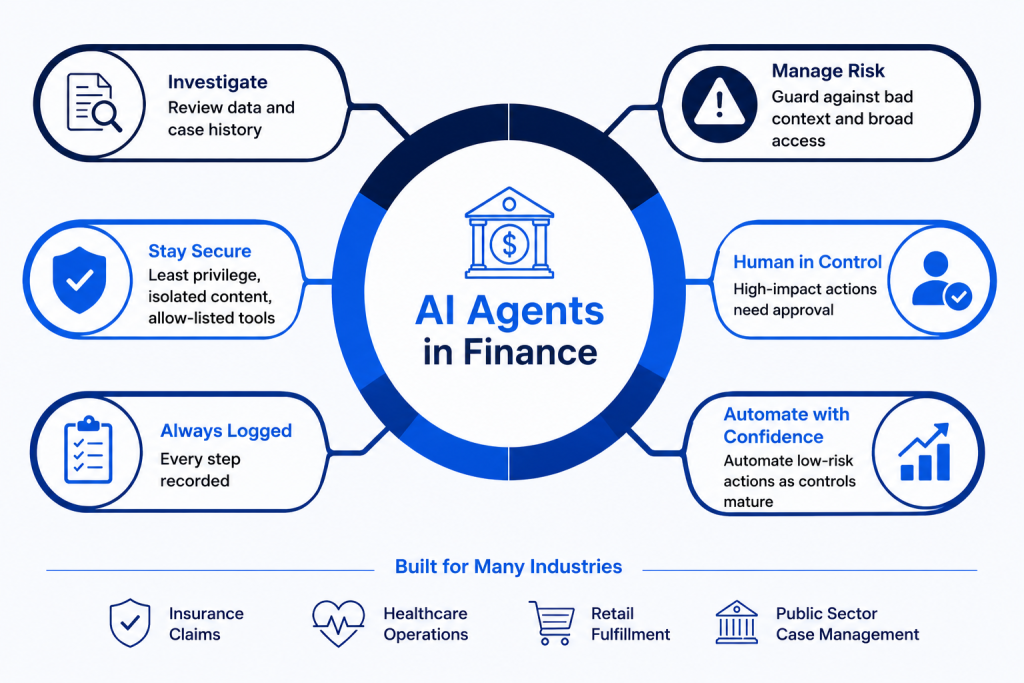
A safer design begins with read-only investigation and recommendations. Each agent receives its own identity; access is limited to the relevant case; untrusted content is isolated; tool calls are allow-listed; high-impact actions require human approval; and every step is logged.
As confidence and controls mature, selected low-risk actions can be automated. The same pattern applies to insurance claims, healthcare operations, retail fulfillment and public-sector case management: increase autonomy only when identity, data, policy and rollback controls can support it.
When should humans stay in the loop for agentic AI?
Humans should remain in the loop when an agent can create material financial, regulatory, safety, customer or production impact. Approval is especially appropriate for money movement, account suspension, benefits or claims decisions, sensitive-data disclosure, legal commitments, production changes, mass communications and actions that are difficult to reverse.
Human review should be risk-based rather than universal. Read-only research and low-risk recommendations may not need transaction-by-transaction approval, while autonomous actions should operate inside narrow policy boundaries with exception handling.
Gartner’s 2026 agent-governance guidance follows this proportional approach: controls should increase with autonomy, while highly autonomous agents require continuous monitoring, enforced guardrails, rapid rollback and mechanisms capable of stopping unsafe operation.
The key is to make approval meaningful. A reviewer needs enough context to understand what the agent plans to do, why it intends to do it, which data it used and what the consequence will be. Approval fatigue is not an effective control. For high-volume enterprise automation, a stronger pattern is to automate low-risk cases, route exceptions to humans and continuously test whether the decision boundary remains valid.
FAQ’s
How do we secure AI agents with access to enterprise systems?
Give each AI agent a unique identity, least-privilege access, and permission to use only approved data and tools. Monitor actions continuously, log tool usage, and require human approval for high-impact decisions.
What is the biggest cybersecurity risk of agentic AI?
The biggest risk is giving AI agents more authority than the controls around them can safely manage. Excessive permissions, malicious context, or unsafe tool use can allow an authenticated agent to cause real operational harm.
Do AI agents need their own identities and permissions?
Yes. Each agent should have a unique non-human identity with permissions linked to its specific task and level of autonomy. This improves accountability, auditing, access reviews, and rapid credential revocation when needed.
How should we monitor autonomous AI agents in production?
Monitor the full activity chain, including data access, tool calls, approvals, actions, outcomes, and policy violations. Use anomaly detection, rate limits, rollback mechanisms, and circuit breakers to contain unsafe behavior quickly.
What controls should we require from agentic AI vendors?
Require strong identity controls, clear data-handling policies, audit logs, human-approval options, rollback capabilities, and documented incident response. Vendors should also explain how they manage prompt injection, supply-chain risk, access revocation, and model or tool changes.
What should enterprises do next?
Enterprises should increase AI-agent autonomy only as identity, access, monitoring, and governance controls mature. A phased approach helps organizations gain automation benefits while reducing security, compliance, and operational risk.