Imagine a prospect who attends your webinar, explores a solution page, and downloads a case study. Your systems capture every interaction. Yet the next email they receive repeats an introductory message, and sales never sees the pattern behind their interest.
That missed connection is where AI in marketing operations can make a difference. When customer signals inform timely action, marketing teams can improve relevance, reduce repetitive work, and give sales better context for the next conversation.
The challenge is translating experimentation into results. McKinsey reports that while 90% of CMOs are experimenting with AI use cases, fewer than 10% have scaled AI or captured value across marketing workflows.
Connect the work that drives revenue
AI can contribute at several points in a marketing workflow. Predictive models estimate likely customer behavior. Generative AI drafts content. AI agents can coordinate tasks across connected applications, within defined permissions. McKinsey describes a shift toward continuously connected marketing capabilities, with insights feeding creative work, personalization, and execution.
For the webinar prospect, that could mean bringing engagement history together, suggesting a relevant technical guide, and preparing a summary for the account owner. A marketer reviews the recommendation before it reaches the customer. Sales then records whether the conversation produced a qualified opportunity.
This proposed workflow gives each team a clear role and creates a way to test whether better context actually improves follow-up.
Prioritize use cases with measurable outcomes
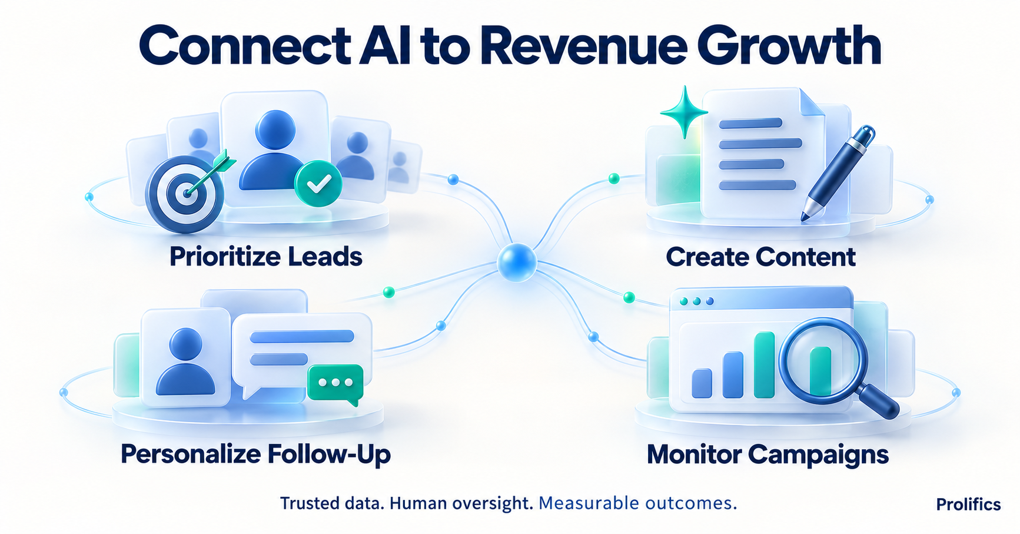
Start where a recurring delay or weak decision affects customer experience or revenue. Four applications offer useful starting points.
- Prioritize leads using relevant signals. Predictive analytics can support lead scoring by identifying patterns in customer behavior. Test whether those scores improve sales acceptance and opportunity conversion. Give sellers visibility into the signals behind a recommendation so they can challenge unsuitable leads.
- Accelerate content production. Generative AI can create email drafts, campaign variations, and localized materials. Ground outputs in approved messaging and product information, then review factual accuracy and brand voice. Track time to an approved asset, including editing and rework.
- Make follow-up more relevant. AI can help segment audiences and recommend content based on customer behavior. For example, a technical evaluator might receive an integration guide, while a business sponsor receives a value assessment. Test whether the distinction improves meaningful engagement.
- Monitor campaigns and coordinate action. AI agents can flag unusual performance and support corrective workflows. Establish which changes require approval, especially audience changes and spending decisions. Start with recommendations that a campaign owner can inspect before allowing bounded automated actions.
Make customer data reliable enough to act on
Disconnected CRM, marketing automation, and analytics platforms make it difficult to maintain a consistent customer view. Reliable integration and governed data are foundations for AI in marketing operations. [3]
Begin with the information required for the chosen workflow. Check whether contact records match across systems, engagement events arrive promptly, and customer preferences are available where decisions happen. Assign someone to resolve discrepancies before they trigger outreach.
Build quality checks around realistic failures. Would the workflow email someone who opted out? Could it promote an unavailable service? Would missing data produce an inappropriate recommendation? These questions help translate governance into acceptance criteria that marketing and IT can test together.
Make your expertise visible in AI search
McKinsey also identifies marketing to AI agents as an emerging capability. For enterprise marketers, that suggests reviewing whether buyers and AI systems can find clear, current answers about what the business offers. Product specifications, implementation details, and evidence supporting claims should be easy to locate and understand.
Consider a buyer comparing integration partners. A precise page explaining supported platforms, delivery scope, and a documented customer outcome gives them useful material for evaluation. Assign owners to keep that information current. Measure the quality of resulting inquiries, and ask prospects how they discovered the company. This connects content planning with the questions buyers actually bring into sales conversations.
Measure growth alongside productivity
Agree on a baseline before introducing AI. Record campaign preparation time, review effort, cost per qualified opportunity, and conversion through the relevant sales stages. Choose measures that match the workflow’s purpose.
Then run a controlled comparison wherever practical. Give comparable audiences the existing experience and the AI-supported experience, keeping other major variables stable. Allow enough time for the sales cycle before judging revenue impact.
Include integration, model usage, human review, and ongoing maintenance in the cost assessment. Treat hours saved as available capacity until the team demonstrates how it used them. If content production accelerates but approvals remain delayed, the next investment may belong in the review process.
Prove one workflow before scaling
Choose a bounded pilot such as webinar follow-up or campaign reporting. Name a business owner, agree on the success threshold, and bring marketing, sales, data, and IT into the design. Document the current process so the team can identify where AI changes the result.
During the pilot, review exceptions as carefully as successful outputs. Capture why people override recommendations and whether corrections reveal missing information, poor instructions, or integration problems. Use that evidence to improve the workflow.
Expand only when quality, operating cost, and business performance meet the agreed criteria. Reuse the connections, approved content, and monitoring practices that worked. Train each new team on its decisions and responsibilities before extending automation.
Build your next growth opportunity with Prolifics
Prolifics brings AI consulting, enterprise integration, generative AI, and responsible governance capabilities to business transformation. Its AI Assessment and Health Check covers opportunity prioritization, use-case feasibility, ROI analysis, and readiness across data, architecture, and platforms.
For marketing leaders, this provides a practical starting point for evaluating where AI could improve a specific workflow and what needs to change before implementation. The goal is a clear business case with an achievable path to delivery. Start with the handoff slowing your campaigns.
Where does your marketing workflow lose its strongest opportunities? Talk to Prolifics about an AI Assessment and Health Check to identify a valuable starting point, assess readiness, and define how success will be measured.