Enterprise applications have long served as systems of record. ERP platforms store financial and operational data. CRM systems organise customer information. Service management tools track incidents, while collaboration platforms connect employees across locations.
These systems are essential, but they have traditionally depended on people to interpret information, coordinate decisions and initiate the next action.
AI agents are changing that model.
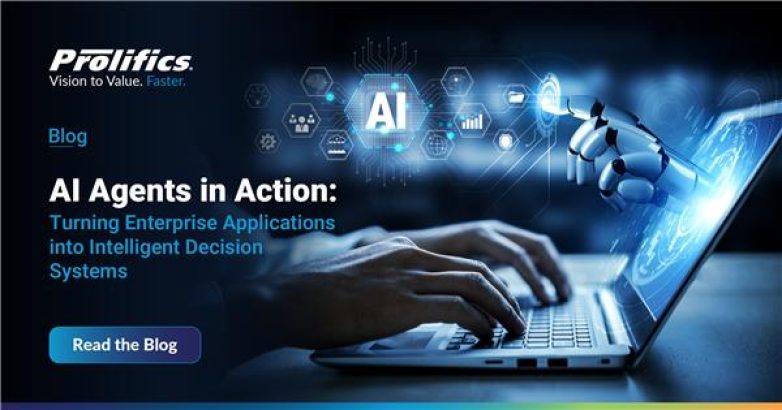
By combining artificial intelligence, enterprise data, APIs, automation and business rules, AI agents can detect events, understand context, recommend responses and execute approved actions across multiple applications. The result is a fundamental shift: enterprise applications are evolving from passive systems of record into intelligent decision systems.
Moving Beyond Copilots and Isolated Automation
The first wave of enterprise generative AI focused largely on personal productivity. Copilots helped employees draft content, summarise documents, retrieve knowledge and write code faster.
Furthermore, these tools improved individual tasks, but they did not always resolve the wider operational bottlenecks surrounding them. Approvals still moved slowly. Teams continued to reconcile conflicting data. Customer escalations crossed multiple departments, and insights often remained disconnected from execution.
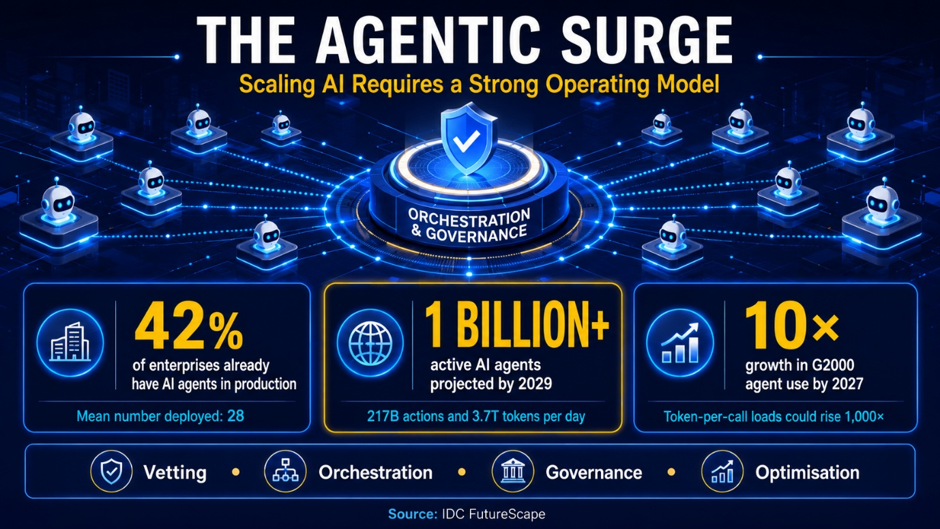
The next phase of enterprise AI is about embedding intelligence directly into business processes.
Unlike a conventional chatbot that responds to a prompt, an AI agent can work towards a defined goal. It can gather information, evaluate options, interact with enterprise systems and take action within established controls. According to CIO, this capability is helping enterprise applications evolve beyond reporting and visualisation to detect irregularities, interpret cross-system context, recommend next-best actions and coordinate workflows.
This is where AI begins to influence business performance, not simply by helping people complete tasks, but by improving how decisions move from signal to action.
What Is an Intelligent Decision System?
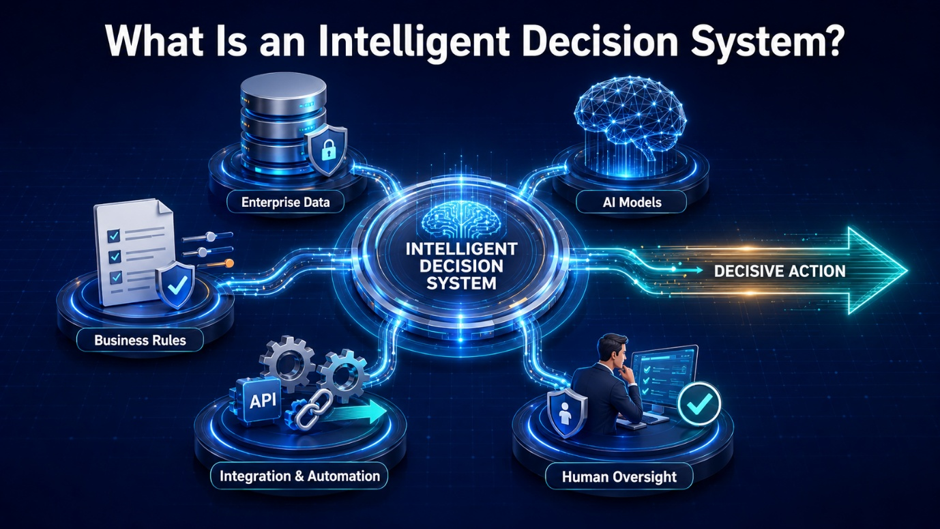
An intelligent decision system connects five critical capabilities:
- Enterprise data that provides trusted business context
- AI models that interpret information and identify patterns
- Business rules that define policies, thresholds and constraints
- Integration and automation that initiate downstream actions
- Human oversight that governs exceptions and higher-risk decisions
For example, consider a supply chain disruption. A traditional system may generate an alert and leave a procurement manager to investigate it. An AI-enabled decision system can assess inventory levels, supplier performance, open orders, financial limits and delivery commitments. It can then recommend alternative suppliers, calculate the operational impact and initiate the appropriate approval workflow.
However, the objective is not to remove people from every decision. It is to reduce the time and effort required to gather context, evaluate routine options and coordinate the response.
From Single Agents to Multi-Agent Systems
A single AI agent can deliver value within a focused workflow. However, enterprise processes rarely remain within one function or application.
A customer order may involve CRM, inventory, finance, logistics and customer service. An IT incident may require observability data, service management records, infrastructure tools, knowledge bases and security controls.
This interconnected environment is driving interest in multi-agent systems.
In a multi-agent model, specialised agents work together towards a shared outcome. One agent may analyse demand, another check inventory, a third evaluate financial constraints and another coordinate fulfilment. These agents exchange context and operate across applications while an orchestration layer manages their roles, permissions and dependencies.
ETCIO describes 2026 as a structural shift from isolated AI agents towards coordinated multi-agent systems that support autonomous workflows and prescriptive decision-making across enterprise functions.
For enterprises, this represents more than an automation upgrade. It introduces a new operating model in which intelligence flows across departments instead of remaining trapped within separate tools.
Turning Enterprise Conversations into Action
Communication is another important source of enterprise intelligence.
Meetings, service calls, emails and collaboration channels contain decisions, commitments, customer concerns and operational knowledge. Yet much of this information is lost, manually documented or disconnected from the systems responsible for the next step.
AI agents can turn these conversations into business workflows.
After a sales meeting, an agent could summarise the discussion, identify agreed actions, draft follow-up communication and update the CRM. In a contact centre, it could transcribe a conversation, detect sentiment, recommend a resolution and create a service case.
Voice&Data reports that enterprises are increasingly embedding AI into communication-intensive workflows because these interactions generate significant downstream administrative work. The opportunity is to make conversations searchable, reusable and actionable, not merely recorded.
The Economics of Agentic AI Matter
Greater autonomy also introduces a new cost model.
Agentic workflows may involve repeated model calls, planning cycles, tool use, validation and response refinement. A widely reported McKinsey analysis indicates that response refinement can account for approximately 60% of agentic AI costs. This highlights an important point: the most capable agent is not automatically the most commercially sustainable one.
Enterprises should therefore evaluate AI agent economics alongside technical performance:
- How many model calls are required to complete a workflow?
- Is a premium model necessary for every step?
- Can deterministic automation handle predictable tasks?
- How often does the agent retry or refine an answer?
- What is the cost per completed business outcome?
- Does the improvement justify the infrastructure and operating costs?
An effective architecture may combine advanced models for complex reasoning, smaller models for routine classification and conventional automation for predictable execution. Observability is equally important, enabling teams to track token consumption, latency, failure rates, human intervention and business results.
Governance Must Be Designed into the Workflow
As AI agents gain access to enterprise applications, governance can no longer be added after deployment.
Organisations need clear controls covering identity, permissions, data access, decision authority and accountability. Every agent should operate with the minimum access required for its role. High-impact actions should include approval checkpoints, while decisions and system interactions should be logged for review.
A responsible agentic AI framework should address:
- Role-based access and least-privilege permissions
- Approved data sources and data-handling policies
- Human-in-the-loop controls for sensitive decisions
- Decision logs, audit trails and explainability
- Testing for accuracy, bias, security and reliability
- Continuous monitoring for performance and behavioural drift
- Clear ownership of business and technology outcomes
Governance should enable confident adoption. When teams understand what an agent can access, which actions it can take and when a person must intervene, the organisation can scale automation without surrendering control.
Building the AI-Agent Enterprise
Successful agentic AI adoption begins with business outcomes, not the number of agents deployed.
Organisations should identify high-volume, high-friction workflows where slow decisions, repetitive coordination or fragmented data directly affect revenue, cost, risk or customer experience. They can then redesign the workflow, establish measurable success criteria and introduce agents with carefully defined responsibilities.
The strongest opportunities are often found in customer service, IT operations, supply chain management, finance, sales enablement, software engineering and enterprise knowledge management.
Move from AI Pilots to Intelligent Execution with Prolifics
Prolifics helps enterprises design, build and deploy secure, production-ready AI agents across complex technology environments. Our capabilities bring together AI strategy, enterprise data, multi-agent orchestration, integration, automation, testing and responsible AI governance.
Whether you want to improve a critical workflow, connect AI agents with ERP and CRM platforms or scale a proof of value into an enterprise-wide capability, Prolifics can help you move from experimentation to measurable execution.
Ready to turn your enterprise applications into intelligent decision systems?
Schedule an AI discovery session with Prolifics and identify the workflows where agentic AI can create the greatest business impact.