Artificial intelligence is rapidly moving from isolated experiments to mission-critical enterprise operations. AI copilots, intelligent agents, predictive models, and automated decision systems are now interacting with sensitive data and influencing real business outcomes.
However, scaling AI introduces two fundamental challenges. Enterprises need access to timely, trusted data, and they must ensure that every AI-driven insight or action is secure, governed, transparent, and accountable.
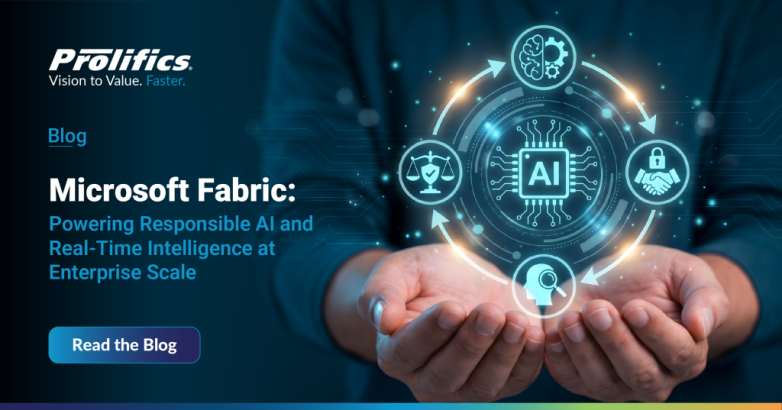
Microsoft Fabric is evolving to address both requirements. By combining a unified data foundation, embedded governance, AI-powered analytics, and Real-Time Intelligence, Fabric helps organizations move from fragmented data and delayed reporting to trusted, event-driven decision-making.
Why Enterprise AI Needs a Stronger Data Foundation
AI is only as reliable as the data supporting it. Yet many organizations still operate with data distributed across disconnected warehouses, lakes, applications, and business units. Different teams may apply different definitions, access policies, quality standards, and security controls.
According to the Cost of Data Breach Report 2025, 63% of organizations lack AI governance initiatives. For those organizations with high levels of shadow AI, the cost of a data breach increases by a staggering USD 670,000.
These inconsistencies create significant risks when organizations attempt to scale AI:
- Sensitive information may be exposed to unauthorized users or AI systems.
- Models may generate answers from incomplete or outdated data.
- Teams may struggle to trace the origin of AI-generated insights.
- Governance policies may be applied inconsistently.
- Compliance investigations may require time-consuming manual analysis.
- Business leaders may lack confidence in automated recommendations.
Microsoft Fabric addresses this challenge by bringing data integration, engineering, data science, real-time analytics, business intelligence, and governance into a unified software-as-a-service environment.
At the center of this architecture is OneLake, a unified data lake that allows teams to work from a consistent data foundation while reducing unnecessary duplication and movement. This helps organizations establish shared policies, improve lineage, and create a trusted source of data for analytics, copilots, and AI agents.
Responsible AI Becomes Part of the Platform
Responsible AI cannot be added as a final compliance checkpoint. It must be incorporated throughout the data and AI lifecycle, from ingestion and preparation to model access, deployment, monitoring, and business consumption.
Recent Microsoft Fabric advancements strengthen this approach through OneLake Security, Fabric Data Agents, Copilot experiences, and deeper Microsoft Purview integration.
OneLake Security enables centralized row-level and column-level controls across Fabric workloads. Instead of separately configuring permissions for every analytics engine, organizations can apply consistent access rules to the underlying data. This can reduce administrative complexity while helping prevent users, applications, and AI systems from accessing information outside their authorized scope.
Microsoft Purview adds another important layer of visibility and control. Supported capabilities for Copilot interactions include auditing, data classification, Data Security Posture Management, Insider Risk Management, eDiscovery, and lifecycle management. Microsoft notes that Purview support currently varies across Fabric Copilot and Data Agent experiences, with some integrations still in preview. Enterprises should therefore validate feature availability as part of their implementation planning.
Together, these capabilities can help organizations improve:
- Data discovery, classification, and ownership
- Access control and sensitive-data protection
- Lineage across pipelines, models, dashboards, and AI interactions
- Monitoring and auditing of AI activity
- Regulatory and internal policy alignment
- Accountability for AI-generated outputs and actions
Governed Copilots and Data Agents
Microsoft Fabric is also changing how users interact with enterprise data. Copilot experiences can assist teams across workloads such as Power BI, Data Factory, Data Science, and data warehousing.
Rather than replacing data professionals, Microsoft positions Copilot as an assistive technology that augments human capabilities. It can help users explore information, develop analytics assets, generate queries, and create visualizations more efficiently. Microsoft’s Copilot in Fabric overview emphasizes the continuing role of human users in creating, validating, and managing Fabric assets.
Fabric Data Agents extend this conversational experience by enabling domain-focused interaction with organizational data. A finance team could ask questions about cash flow, while an operations team could investigate equipment performance or supply chain disruptions.
The value is not simply natural-language access. The more important advantage is that these experiences can operate within the security and governance boundaries of the Fabric environment. Users receive answers based on data they are authorized to access, while administrators retain oversight of the underlying platform.
From Historical Reporting to Real-Time Action
Responsible AI depends on governed data, but intelligent decisions must also arrive at the right time. An insight delivered tomorrow may be useless when a transaction, equipment failure, security event, or customer interaction requires an immediate response.
Microsoft Fabric Real-Time Intelligence provides an end-to-end environment for ingesting, transforming, storing, analyzing, visualizing, and acting on continuously changing data. It supports structured, semi-structured, and unstructured information from sources such as IoT devices, operational applications, databases, system logs, and event platforms. Microsoft Fabric Real-Time Intelligence can process data in motion and trigger responses as events occur.
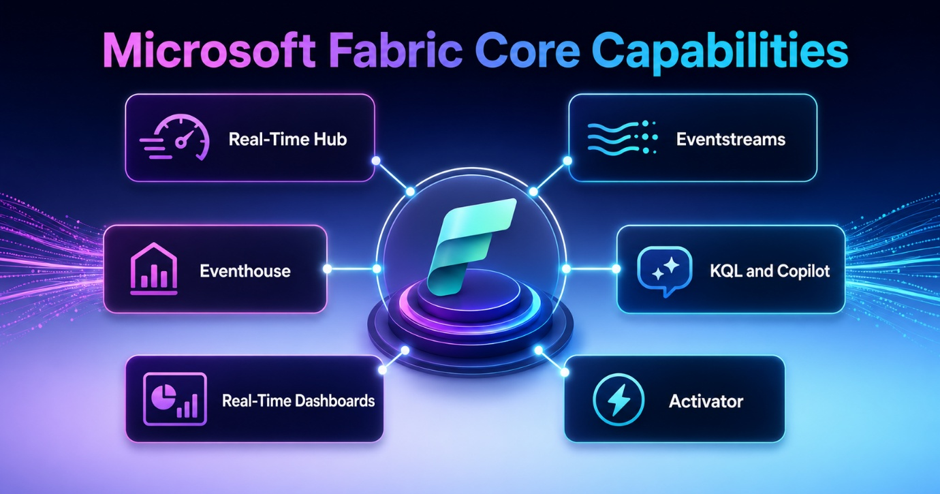
Its core capabilities include:
- Real-Time Hub: A central location for discovering, managing, and sharing data streams.
- Eventstreams: No-code and low-code tools for ingesting, filtering, transforming, and routing streaming data.
- Eventhouse: A scalable analytics engine designed for time-based and event-driven data.
- KQL and Copilot: Flexible options for querying and exploring streaming and historical information.
- Real-Time Dashboards: Live operational views that help teams identify patterns and anomalies.
- Activator: Event-driven alerts and automated actions based on defined conditions.
This architecture can turn a continuous flow of events into timely business action. A manufacturer could detect abnormal equipment behavior and initiate a maintenance workflow. A retailer could identify sudden inventory changes and alert store operations. A financial institution could flag unusual transactions for investigation. An energy provider could monitor grid performance and respond to emerging disruptions.
Industry reporting has previously highlighted route optimization, grid monitoring, predictive maintenance, and inventory management as high-value use cases for Fabric’s real-time capabilities.
Where Responsible AI Meets Real-Time Intelligence
The real opportunity emerges when governance and real-time analytics work together.
Organizations can stream AI application telemetry, agent interactions, operational events, and content-safety signals into Fabric. Eventhouse can support low-latency analysis, while dashboards and anomaly detection help teams recognize unusual patterns. Activator can then initiate an alert, launch a workflow, or route an event for human review.
This creates the foundation for AI systems that are not only intelligent, but observable and controllable.
For example, an enterprise could monitor AI-agent activity for repeated policy violations, suspicious access patterns, or elevated content-safety scores. When a threshold is exceeded, Fabric could notify the responsible team or initiate a remediation workflow. This transforms responsible AI from a static policy document into an operational capability.
Building a Trusted Microsoft Fabric Strategy with Prolifics
Technology alone does not guarantee responsible AI or real-time value. Organizations need a clear business case, modern architecture, governed data, implementation expertise, and an operating model that connects technology teams with security, compliance, and business stakeholders.
Prolifics helps enterprises transform complex data environments into scalable platforms for analytics and AI. Our capabilities span data assessment, data engineering, analytics, AI and machine learning, MLOps, data governance, cloud modernization, integration, and managed services. This end-to-end approach helps connect platform investments with measurable operational outcomes.
Whether your organization is beginning its Microsoft Fabric journey or expanding an existing environment, Prolifics can help you:
- Assess data, AI, security, and governance readiness
- Define a business-led Fabric adoption roadmap
- Design OneLake and real-time data architectures
- Establish access, lineage, quality, and compliance controls
- Develop governed analytics, copilots, and AI solutions
- Implement event-driven intelligence and automated workflows
- Monitor, optimize, and manage the platform at scale
Responsible AI requires more than powerful models. It requires trusted data, continuous oversight, and the ability to turn insights into timely, controlled action.
Ready to build a governed, real-time data and AI foundation with Microsoft Fabric? Talk to the Prolifics experts and turn your enterprise data into trusted intelligence and measurable business value.