How does confidential computing protect AI workloads? It encrypts sensitive data, model weights, prompts, and application memory during processing inside hardware-based trusted execution environments (TEEs), then uses attestation to verify the environment before protected data or secrets are released. This adds data-in-use protection to encryption at rest and in transit, strengthening zero-trust AI security for regulated enterprise workloads.
Confidential computing protects AI workloads by isolating processing inside a hardware-backed TEE, encrypting memory, and using cryptographic attestation to verify that approved code is running on trusted infrastructure. It reduces exposure to privileged infrastructure access and compromised host software while supporting secure AI workloads across cloud and hybrid environments.
What is confidential computing for enterprise AI?
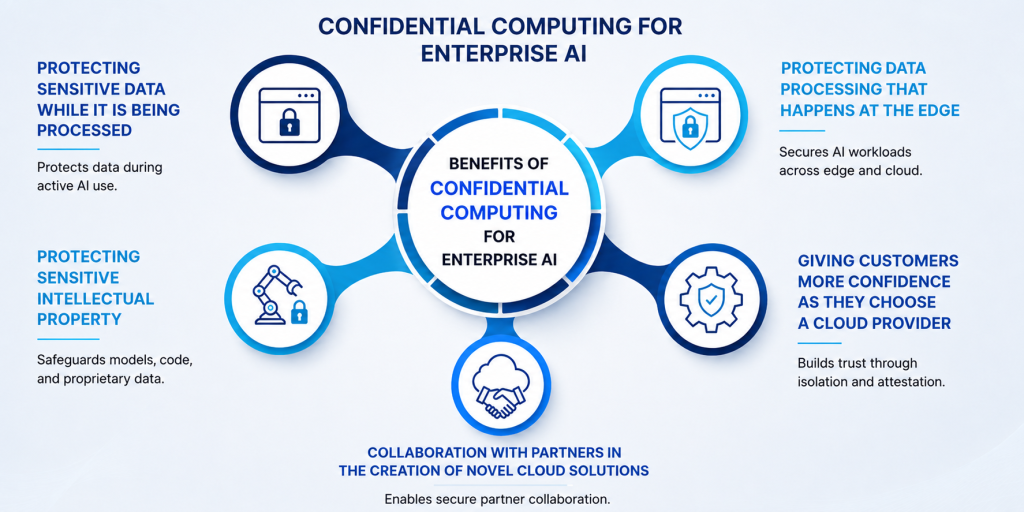
Confidential computing is a security approach that protects sensitive data while it is actively being processed. It uses a hardware-based, attested Trusted Execution Environment (TEE) to isolate data and code from the surrounding infrastructure. This is especially important for enterprise AI, where sensitive information must be available to processors during activities such as model training, inference, retrieval, analytics, and AI agent execution. By combining hardware-enforced isolation with attestation, confidential computing gives organisations stronger technical assurance that AI workloads are running in an approved and protected environment.
- Protects data during processing: Extends protection beyond data at rest and data in transit to data actively being used by AI systems.
- Creates an isolated environment: sensitive code, models, and data operate inside a hardware-protected Trusted Execution Environment.
- Uses attestation: Provides evidence that a workload is running in an approved environment before sensitive data or resources are released.
- Reduces infrastructure exposure: Helps protect AI workloads running in cloud, hybrid, or third-party environments outside the organisation’s direct control.
- Strengthens the trust model: Organisations rely on technical, hardware-enforced protections rather than solely on infrastructure provider assurances.
- Supports enterprise AI adoption: Helps organisations use AI for sensitive workloads while supporting cloud migration, IT modernisation, and digital transformation.
How does confidential computing protect AI workloads in a zero-trust model?
Confidential computing protects AI workloads in a zero-trust model by reducing the number of infrastructure components that must be implicitly trusted. Sensitive code, data, prompts, credentials, and model assets execute within a TEE that is isolated from software operating outside the trusted boundary.
This model is particularly relevant to enterprise AI because an AI transaction may cross several security domains. A single request can involve an application, an API gateway, a vector database, a foundation model, an orchestration layer, a cloud platform, a system integration layer, and an external data source. Traditional identity controls remain essential, but they do not by themselves protect information after an authorized workload begins processing it.
Attestation adds another control point. Before an enterprise releases encryption keys, credentials, protected datasets, or other sensitive assets, the environment can be checked against an approved configuration. NIST’s 2026 draft guidance on hardware-enabled confidential computing specifically identifies trusted execution environments, roots of trust, key management, identity and access management, and zero-trust considerations as part of the security architecture.
For CTOs and security leaders, the practical shift is from “trust the infrastructure because access is restricted” toward “verify the execution environment before allowing the workload to access sensitive assets.” That principle aligns confidential computing closely with enterprise zero-trust AI security.
Why do AI workloads need protection while data is in use?
AI workloads need data-in-use protection because some of their most valuable assets are exposed precisely when computation occurs. Training datasets, customer information, proprietary model weights, retrieval context, prompts, embeddings, credentials, business rules, and inference results can all become sensitive runtime assets.
This risk becomes more material as organizations scale enterprise AI. IBM’s 2025 Cost of a Data Breach Report found that 13% of organizations surveyed had experienced breaches involving AI models or applications, and 97% of those organizations reported lacking proper AI access controls. IBM also found that 63% of breached organizations either lacked an AI governance policy or were still developing one.
The financial context is equally significant. IBM reported a global average breach cost of USD 4.44 million in 2025. Organizations with extensive use of AI and automation in security reduced average breach costs by USD 1.9 million and shortened breach lifecycles by an average of 80 days compared with organizations that did not use those capabilities extensively.
Confidential computing does not eliminate these risks on its own. It adds a hardware-enforced security layer specifically around runtime processing, complementing AI governance, identity controls, encryption, monitoring, application security, and enterprise automation.
How does confidential computing protect AI workloads in the cloud?
Confidential computing protects AI workloads in the cloud by encrypting and isolating data while processors are actively using it. This helps organizations extend sensitive AI processing into cloud infrastructure without relying exclusively on logical separation, contractual controls, or perimeter security.
Google Cloud, for example, states that its Confidential VMs protect data in use through hardware-backed memory encryption, with confidential computing capabilities available for AI models and data as well as deep-learning and inference workloads.
For an enterprise, that creates several practical security patterns.
A financial institution can run fraud detection or risk models against regulated transaction data while reducing exposure of runtime information to surrounding infrastructure. A healthcare organization can process clinical data within a protected execution environment. An insurer can apply machine learning to claims information while maintaining stronger isolation of policyholder data. Retail organizations can protect customer profiles and proprietary recommendation models during inference.
These architectures can also support AI compliance and data sovereignty strategies. Data residency determines where information is located; confidential computing addresses a different question: who or what can access the information while computation is taking place?
That distinction is critical during cloud migration. A secure AI workload requires controls across storage, networks, identities, keys, runtime environments, applications, models, and governance rather than treating cloud security as a single control plane.
How should enterprises implement confidential computing for AI?
Enterprises should implement confidential computing as part of the AI architecture rather than adding it after models reach production. The strongest approach starts with workload classification, defines the trust boundary, and ties access to verified execution environments.
A practical implementation process is:
- Identify high-value AI workloads. Prioritize workloads processing regulated data, intellectual property, financial records, health information, proprietary algorithms, confidential prompts, or sensitive model weights.
- Map the AI data flow. Document where information is stored, transmitted, decrypted, processed, cached, logged, and integrated with other enterprise systems.
- Define the threat model. Determine whether protection is required against compromised host software, privileged administrators, malicious insiders, infrastructure operators, neighboring workloads, or unauthorized execution environments.
- Select the appropriate TEE architecture. Evaluate confidential VMs, containers, CPU-based isolation, GPU-enabled confidential computing, and cloud-native options according to workload requirements. Google Cloud documents confidential computing options for AI processing, including hardware protection for models and data.
- Integrate attestation with key release. Sensitive keys or credentials should be released only when the execution environment satisfies defined security policy.
- Connect confidential computing to existing controls. Integrate identity, key management, logging, data governance, security operations, system integration, and compliance processes.
- Benchmark production performance. Test latency, throughput, accelerator requirements, resilience, observability, operational complexity, and cost before broad deployment.
This turns confidential computing from an infrastructure feature into an enforceable enterprise AI security control.
Which finance and healthcare use cases benefit most?
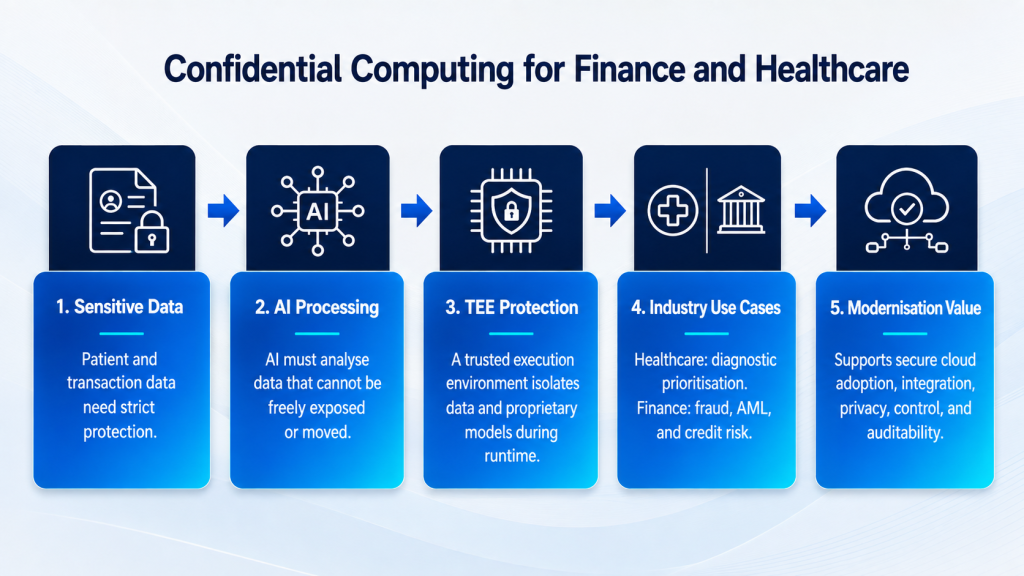
Finance and healthcare are strong candidates because AI often needs to process information that cannot simply be anonymized, exposed to additional operators, or moved freely between security domains.
IBM Research describes a healthcare confidential-computing use case in which a proprietary AI model analyzes confidential patient information. The objective is to protect both sensitive healthcare data and the intellectual property represented by the model while computation occurs.
Consider how the pattern extends to a healthcare system using AI to prioritize diagnostic cases. Patient information may need to be combined with proprietary models and cloud computing resources. A TEE can create a hardware-isolated runtime boundary around that processing while established controls continue protecting the surrounding data platform, identities, networks, and application services.
Financial institutions face a similar problem with fraud detection, anti-money-laundering models, credit risk, customer intelligence, and digital asset workflows. Sensitive transaction data may need to interact with proprietary models or external computing infrastructure.
For both industries, confidential computing can become part of a broader IT modernization strategy: modernize the application and data estate, establish governed cloud platforms, implement secure system integration, and introduce AI without abandoning established requirements for privacy, control, and auditability.
What should enterprises evaluate before production deployment?
Enterprises should evaluate confidential computing against the complete workload architecture, not solely against the availability of a confidential VM or TEE.
Start with the trust boundary. Security teams need to understand exactly which hardware, firmware, operating-system components, application components, models, libraries, keys, and data are inside or outside the protected environment. NIST’s confidential-computing guidance places the technology within a layered security model that also includes identity, key management, roots of trust and zero-trust controls.
Performance must also be tested against the actual AI workload. Training a large model, running high-volume inference, executing retrieval-augmented generation, and operating an AI agent create different CPU, GPU, memory, network, and storage requirements. Confidential computing should therefore be benchmarked with production-representative workloads rather than evaluated only through security documentation.
Governance is equally important. IBM’s 2025 breach research found substantial gaps between AI adoption and AI governance, demonstrating why infrastructure security cannot substitute for clear access policies, model inventories, monitoring, incident response, and accountability.
The right question is not whether confidential computing makes an AI system “secure.” The question is whether it meaningfully reduces defined runtime risks while fitting the organization’s broader security, compliance, cloud and operating model.
What are the most common enterprise buyer questions about confidential computing?
Is confidential computing required for enterprise AI in regulated industries?
Not always. It is most valuable when sensitive data is processed on shared or cloud infrastructure and stronger data-in-use protection is required.
Can confidential computing protect generative AI prompts and model weights?
Yes. It can protect prompts, model weights and runtime data within trusted execution environments, depending on the platform, architecture and hardware support.
Does confidential computing replace zero-trust security?
No. It complements zero-trust by protecting data during processing, while identity, access controls, monitoring, segmentation and key management remain essential.
Can confidential computing work across hybrid and multi-cloud environments?
Yes. It can support hybrid and multi-cloud architectures, provided organisations maintain consistent policies for attestation, identity, encryption keys and governance.
What should we evaluate before moving AI workloads to confidential computing?
Assess data sensitivity, regulatory requirements, threats, TEE capabilities, CPU or GPU needs, compatibility, performance and cost. Adoption should be based on the specific workload and risk.
What should enterprises do next?
Confidential computing can strengthen enterprise AI by protecting sensitive data and models during processing. Prolifics can help organisations assess security gaps and build governed AI and cloud modernisation strategies.