Across industries, organizations have invested heavily in generative AI, copilots, intelligent automation, and agentic AI. Teams are experimenting with coding assistants, AI-powered testing, intelligent document processing, and customer service agents. Yet despite the excitement, many executives continue to ask the same question:
“Where is the business value?”
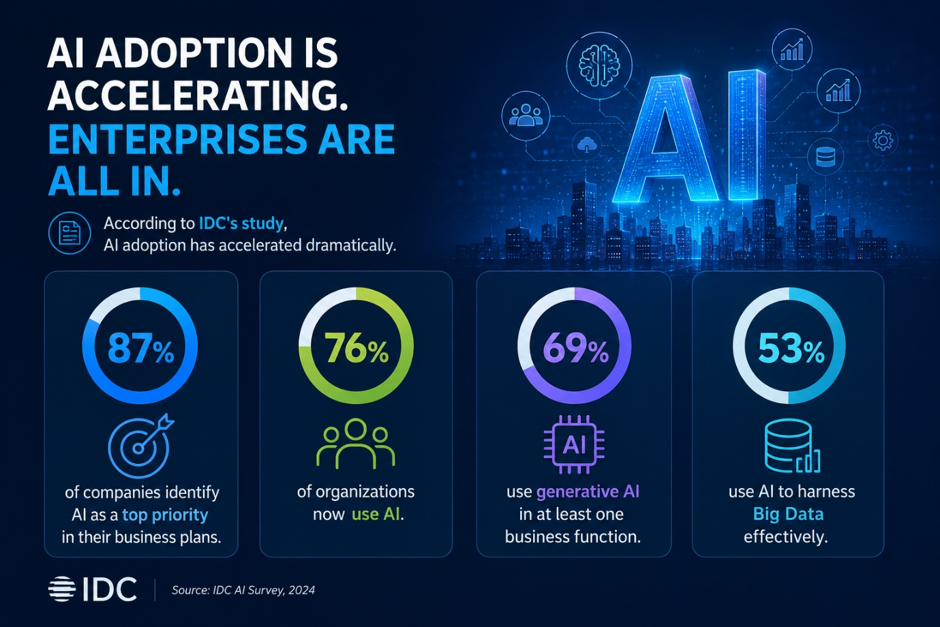
According to IDC’s study, AI adoption has accelerated dramatically, with 87% of companies identifying AI as a top priority in their business plans. The study also reveals that 76% of organizations now use AI, 69% use generative AI in at least one business function, and 53% use AI to harness Big Data effectively.
The problem isn’t AI. The problem is that most organisations are optimising individual tasks rather than transforming entire business systems.
At Prolifics, we believe enterprise AI success requires more than deploying new tools. It requires a structured operating model that combines people, intelligent automation, and business transformation.
That’s why we’ve developed a proven three-pillar approach that helps organizations close the AI productivity gap and transform isolated experiments into enterprise-wide outcomes.
The AI Productivity Gap
Many organizations begin their AI journey with enthusiasm.
- Developers receive AI coding assistants.
- Business teams experiment with ChatGPT.
- Customer service launches a chatbot.
- Marketing creates AI-generated content.
- Operations explore automation.
- Each initiative delivers incremental improvements.
Yet months later, executive dashboards still show:
- Software delivery cycles remain slow.
- Technical debt continues to grow.
- Data isn’t AI-ready.
- Business processes remain fragmented.
- Operational costs continue to increase.
- Productivity gains are difficult to measure.
Why?
Because isolated AI tools don’t create enterprise productivity.
It is created by connected systems, repeatable delivery models, and organizational transformation.
Why AI Experiments Fail to Scale
The biggest misconception about AI is that buying technology automatically creates business value.
In reality, most organizations struggle because they lack three critical elements:
1. AI-enabled people
Employees have access to AI tools but lack structured ways of working.
2. Industrialized delivery
Projects remain manual, inconsistent, and dependent on individual expertise.
3. Business transformation
AI is layered onto existing processes instead of redesigning how work gets done.
Closing the productivity gap requires all three.
The Prolifics Three-Pillar Framework
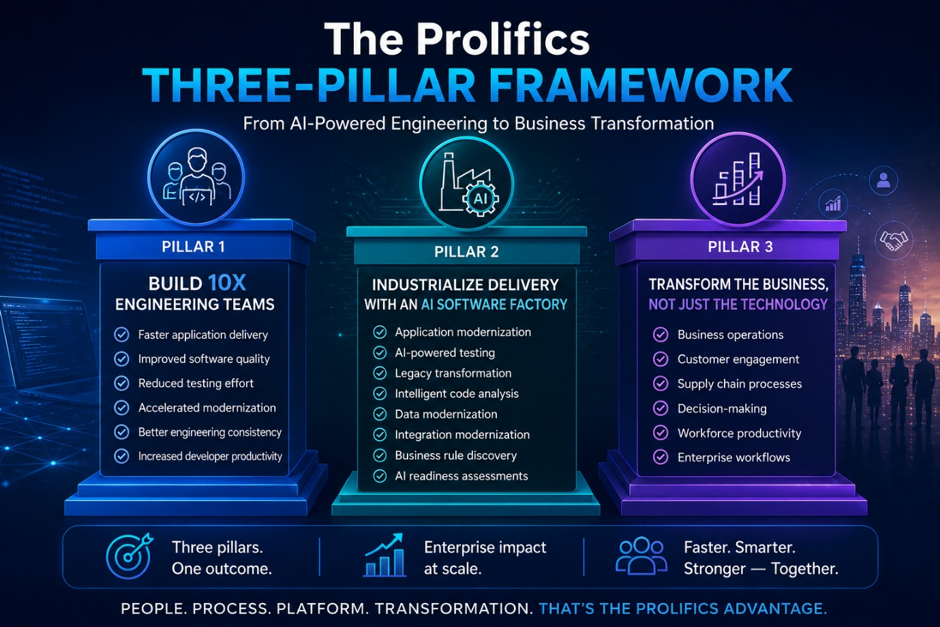
At Prolifics, enterprise AI transformation is built on three interconnected pillars that reinforce one another.
Pillar 1: Build 10x Engineering Teams
The future is not about replacing developers.
It is about creating engineers who can accomplish significantly more by combining their expertise with AI.
Our AI-enabled engineering approach empowers teams across the software development lifecycle by integrating intelligent assistants into requirements analysis, architecture, coding, testing, documentation, quality assurance, and modernization.
Rather than automating isolated coding tasks, we create AI-assisted engineering workflows that increase velocity while improving quality.
Benefits include:
- Faster application delivery
- Improved software quality
- Reduced testing effort
- Accelerated modernization
- Better engineering consistency
- Increased developer productivity
Organizations adopting this model move beyond AI-assisted coding to AI-enabled software engineering.
Pillar 2: Industrialize Delivery with an AI Software Factory
Individual productivity improvements are valuable.
Repeatable enterprise delivery is transformational.
The Prolifics AI Software Factory combines reusable accelerators, proven delivery frameworks, automation assets, governance, and AI-powered workflows to consistently deliver outcomes at scale.
Instead of reinventing every engagement, organizations leverage repeatable AI patterns for:
- Application modernization
- AI-powered testing
- Legacy transformation
- Intelligent code analysis
- Data modernization
- Integration modernization
- Business rule discovery
- AI readiness assessments
This factory-based approach enables organizations to reduce delivery risk while accelerating implementation.
Our repeatable solution model focuses on outcomes that matter most to enterprise leaders:
- Increase software delivery speed and quality
- Reduce technology costs and technical debt
- Accelerate data readiness for AI
- Improve operational efficiency
- Grow revenue through AI-enabled customer experiences
Rather than isolated projects, enterprises gain a scalable operating model that can be replicated across business units.
Pillar 3: Transform the Business, Not Just the Technology
Technology alone rarely creates competitive advantage.
Business transformation does.
Organizations achieve the highest ROI when AI becomes embedded into how decisions are made, processes operate, and employees collaborate.
This means reimagining:
- Business operations
- Customer engagement
- Supply chain processes
- Decision-making
- Workforce productivity
- Enterprise workflows
AI becomes an intelligent layer across the organization rather than another disconnected technology investment.
This transformation-first mindset enables organizations to move from experimentation to sustainable competitive advantage.
What Enterprise AI Success Looks Like
When these three pillars work together, organizations begin seeing measurable improvements across the enterprise.
- Engineering teams deliver software faster.
- Testing becomes intelligent and highly automated.
- Legacy modernization accelerates through AI-powered analysis.
- Data platforms become AI-ready.
- Business rules become discoverable and reusable.
- Operations become more predictive.
- Customer experiences become more personalized.
Instead of isolated productivity gains, organizations experience enterprise-wide transformation.
The Shift from Automation to Intelligence
The first wave of digital transformation focused on automation.
The next wave focuses on intelligence.
Modern enterprises are moving beyond traditional robotic process automation toward AI-powered agents capable of reasoning, learning, and supporting complex business decisions.
This evolution enables organizations to:
- Modernize legacy applications faster
- Improve engineering efficiency
- Accelerate AI adoption
- Enhance decision-making
- Reduce operational complexity
- Unlock new revenue opportunities
The organizations that embrace this shift today will define tomorrow’s competitive landscape.
Turning AI Investments into Business Outcomes
Enterprise leaders are under increasing pressure to demonstrate measurable returns from AI investments.
Success is no longer measured by the number of AI pilots launched.
It is measured by business outcomes such as:
- Faster software delivery
- Lower operational costs
- Higher engineering productivity
- Improved customer experiences
- Better business agility
- Increased revenue growth
The organizations that achieve these outcomes recognize that AI is not a technology initiative.
It is a business transformation strategy.
Why Prolifics
For more than four decades, Prolifics has helped global enterprises modernize technology, accelerate innovation, and solve complex business challenges.
Today, we combine deep engineering expertise with AI-powered delivery, industry accelerators, and repeatable transformation frameworks to help organizations move confidently from experimentation to enterprise-scale adoption.
Our proven approach combines:
- AI-enabled engineering teams
- AI Software Factory delivery
- Application modernization expertise
- AI-powered quality engineering
- Data modernization and AI readiness
- Intelligent automation
- Business transformation consulting
The result is faster implementation, lower risk, measurable productivity improvements, and long-term business value.
The Future Belongs to AI-Native Enterprises
The AI race is no longer about who adopts AI first.
It is about who scales it successfully.
Organizations that connect people, repeatable delivery, and business transformation will create sustainable competitive advantage while others remain trapped in endless experimentation.
The productivity gap is real.
But it is also solvable.
The future belongs to enterprises that transform how they build software, modernize technology, empower employees, and deliver value at scale.
With the right strategy, the right operating model, and the right partner, AI moves beyond experimentation and becomes a measurable business advantage.
Ready to Close the AI Productivity Gap?
Whether you’re modernizing legacy applications, building an AI Software Factory, enabling 10x engineering teams, or transforming enterprise operations with AI, Prolifics can help you accelerate your journey from pilot projects to enterprise-wide impact.
Talk to a Prolifics AI expert today and discover how to turn AI investments into measurable business outcomes.
FAQ’s
What is the enterprise AI productivity gap?
The enterprise AI productivity gap is the disconnect between AI experimentation and measurable business outcomes. Many organizations adopt AI tools but fail to achieve enterprise-wide value because AI is not integrated into business processes and operating models.
Why do enterprise AI initiatives fail to deliver business value?
Enterprise AI initiatives often fail because organizations focus on individual AI tools instead of enabling people, standardizing delivery, and transforming business processes. A scalable AI strategy requires all three.
How can organizations close the enterprise AI productivity gap?
Organizations can close the enterprise AI productivity gap by combining AI-enabled engineering teams, an AI Software Factory for repeatable delivery, and business transformation that embeds AI into operations and decision-making.
What is an AI Software Factory?
An AI Software Factory is a standardized delivery model that combines AI-powered workflows, reusable assets, governance, and automation to accelerate software delivery, improve quality, and reduce implementation risk.
How does enterprise AI improve business outcomes?
Enterprise AI improves business outcomes by increasing engineering productivity, modernizing legacy systems, reducing operational costs, accelerating AI adoption, and enabling data-driven decision-making across the organization.