The quality of AI-generated code depends not only on the model, but on the information, tools, constraints and memory surrounding every decision.
Imagine asking an AI coding agent to modernise a customer-facing application. It can inspect files, propose a plan, modify code, run tests and iterate. Yet a fluent answer is not the same as an enterprise-ready outcome. If the agent cannot see the relevant architecture decisions, security policies, dependency constraints, test expectations or approved tools, it may produce code that works locally while creating risk elsewhere.
That is why context engineering is becoming a non-negotiable discipline for agentic coding. Prompt engineering asks, “How should we phrase the instruction?” Context engineering asks the broader and more valuable question: “What should the agent know, retrieve, remember and act on at each step?”
What is context engineering?
Context engineering is the deliberate design, selection, structuring and optimisation of everything available to a large language model at inference time. This includes the system prompt, user request, repository files, architecture standards, message history, retrieved documents, tool definitions, tool outputs, memory and environmental state.
Prompt engineering remains important, but it is only one layer. IBM positions prompt engineering and retrieval-augmented generation within a wider context-engineering framework that also covers selection, compression, sequencing, tool use and memory integration. For coding agents that operate across many steps, this broader system determines whether the model can reason accurately and choose the right action.
Why agentic coding changes the equation
A conventional coding assistant responds to a request. An agentic coding system operates in a loop: it analyses the situation, plans, invokes tools, observes results, evaluates progress and continues until the goal is achieved or human intervention is needed. Every loop produces new information—search results, diffs, logs, compiler messages, test reports and decisions. Some of it is critical; much of it quickly becomes noise.
Anthropic describes context as a critical but finite resource. As an agent runs for longer, its evolving state must be continuously curated. More context is not automatically better: increasing token volume can dilute attention and make relevant facts harder to retrieve, a problem often described as “context rot.” The engineering goal is therefore not to fill the window, but to supply the smallest high-signal set that supports the next decision.
Five reasons context engineering is non-negotiable
1. It anchors the agent in the real codebase. Repository structure, naming conventions, configuration, dependency files and architecture records tell an agent how the software actually works. Just-in-time retrieval lets it discover the relevant subset instead of loading the entire estate.
2. It turns standards into executable guidance. Concise project instructions can encode coding conventions, security controls, accessibility expectations and testing rules. Task-specific context then adds the files, examples and constraints needed for the change at hand.
3. It improves tool selection and execution. Agents need more than tool access; they need context about when a tool is appropriate, what it is authorised to change and how its output should be interpreted. Clear boundaries reduce wasted calls, unsafe actions and dead ends.
4. It preserves coherence over long-running work. Migrations, refactoring and incident remediation can exceed a single context window. Compaction, structured summaries, progress files and durable decision records help the agent continue without repeatedly rediscovering the same facts.
5. It strengthens quality, cost and governance. Irrelevant tokens increase consumption while weak context increases rework. Curated context improves traceability: teams can examine which instructions, evidence and permissions influenced a change rather than treating AI output as an unexplained result.
From better prompts to a context operating model
Enterprises should treat context as governed infrastructure rather than an ad hoc bundle attached to a chatbot. Start by defining authoritative sources for architecture, policy and code quality. Create concise repository-level instructions, then retrieve task-specific files and documentation on demand. Separate trusted instructions from untrusted data, filter tool outputs, summarise completed work and preserve important decisions outside the model’s short-term memory.
The emerging “Context Engineering 2.0” perspective reinforces that context now extends beyond dialogue history. It can include users, applications, environments, tools, memory systems and model capabilities. For technology leaders, the implication is strategic: scalable agentic development requires architecture for context collection, context management and context use, not simply access to a stronger model.
Place this section directly after “What is context engineering?”
Prompt engineering vs context engineering
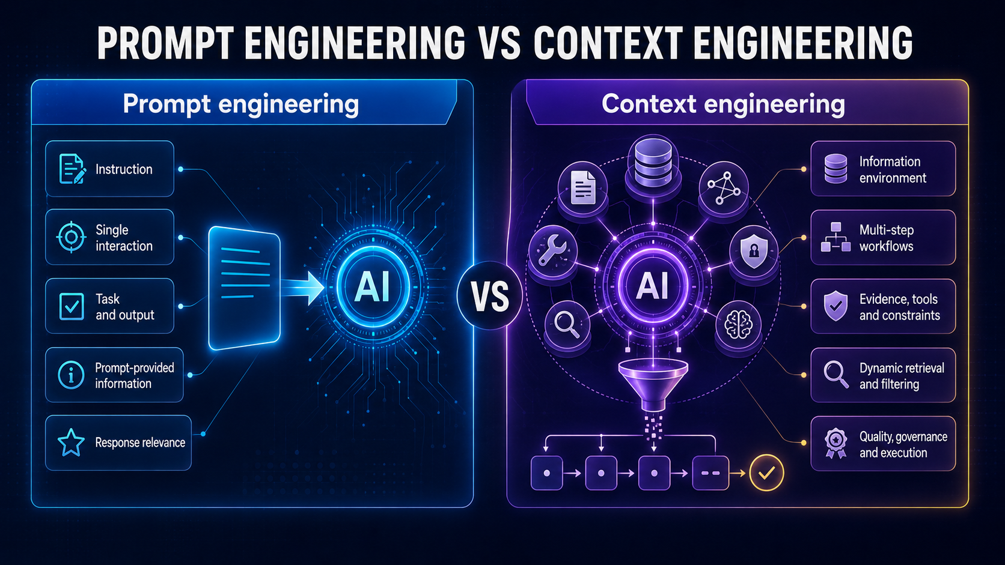
Prompt engineering and context engineering are complementary, but they operate at different levels. Prompt engineering focuses on crafting clear instructions that guide a model towards a desired response. It defines the immediate task: what the model should do, how it should respond and which requirements it should follow.
Context engineering designs the wider information environment in which that instruction is interpreted and executed. It determines which repository files, architecture decisions, policies, examples, tools, memories and environmental signals the model can access, and when each should be introduced.
| Prompt engineering | Context engineering |
| Optimises the instruction | Optimises the complete information environment |
| Primarily shapes a single interaction | Supports multi-step, evolving workflows |
| Specifies the task and desired output | Supplies the evidence, tools and constraints needed to complete it |
| Typically relies on information placed directly in the prompt | Retrieves, filters, sequences and compresses information dynamically |
| Improves response relevance | Improves decision quality, consistency, governance and execution |
For example, a prompt might instruct an agent to update an authentication service securely. Context engineering ensures the agent can also access the relevant service files, approved security patterns, dependency restrictions, test requirements and deployment policies. A well-written prompt tells the agent what success looks like; well-engineered context gives it what it needs to achieve that success.
This distinction becomes critical in agentic coding. As an agent plans, modifies code, invokes tools and evaluates results, its information needs continually change. Prompt engineering initiates the work, while context engineering keeps every subsequent decision grounded in the right evidence.
Make agentic coding enterprise-ready
The competitive advantage will not come from giving every developer an AI agent and hoping productivity follows. It will come from designing an environment in which agents consistently receive the right evidence, follow the right standards, use the right tools and escalate the right exceptions.
Prolifics can help organisations move from isolated AI coding experiments to governed, production-ready engineering. Our specialists can assess your development landscape, design context and knowledge architectures, integrate secure agent tools, establish quality guardrails and create measurable adoption roadmaps across application modernisation, DevSecOps and digital experience delivery.
Three questions technology leaders should ask
Before scaling agentic coding, leaders should test the foundation, not just the model. First, can the agent reliably identify the authoritative source for architecture, security and delivery standards? Second, can teams trace which context, tools and permissions shaped a generated change? Third, does the operating model define when the agent may proceed autonomously and when it must pause for human review? If any answer is unclear, the organisation has an orchestration and governance gap. Closing that gap early helps convert promising pilots into repeatable delivery capability, while protecting code quality, developer trust and enterprise risk posture.
Ready to give your coding agents the context to perform with confidence? Talk to Prolifics about building a secure, scalable context-engineering foundation for agentic software delivery.
Frequently Asked Questions
1. What is context engineering?
Context engineering is the process of supplying an AI system with the most relevant instructions, data, conversation history, retrieved knowledge and tool outputs needed to complete a task accurately.
2. How does context engineering differ from prompt engineering?
Prompt engineering focuses on wording an individual instruction effectively. Context engineering designs the model’s entire information environment, including prompts, business data, memory, examples, tools, policies and output constraints.
3. Why is context engineering important for AI agents?
AI agents perform multi-step tasks and make decisions using information collected throughout a workflow. Context engineering helps them retain important details, use reliable knowledge, avoid repeated mistakes and take actions aligned with the intended objective.
4. What are the main challenges of context engineering?
Common challenges include context-window limitations, irrelevant or outdated information, poor data quality, rising token costs and exposure of sensitive data. Excessive context can also distract the model and reduce the quality of its responses.
5. How can businesses implement context engineering effectively?
Businesses should define clear task objectives, connect AI systems to trusted data sources, retrieve only relevant information and structure context consistently. They should also apply access controls, summarise lengthy histories, monitor performance and regularly update the knowledge provided to the model.