Imagine a worker who qualifies for a role but loses the opportunity because an automated migration system misreads a document, penalizes a language pattern, or demands digital access they cannot afford. For employers and startups, that becomes a talent problem.
Artificial intelligence now influences visa processing, identity verification, border management, migration forecasting, and integration services. These applications can improve speed and consistency, but they can also deepen inequality when organizations deploy them without inclusive data, transparent governance, or meaningful human oversight.
That tension defines AI in migration and global inequality. The issue is not whether organizations should use AI. The real question is how they can use it without making geography, income, language, gender, or nationality stronger predictors of opportunity.
Why AI Has Become Central to Migration Management
Migration systems process enormous volumes of sensitive information. IOM estimates that around 304 million international migrants lived outside their countries of birth by mid-2024, about 3.7 percent of the global population. UNHCR counted 117.8 million people living in forced displacement at the end of 2025.
Governments need faster ways to manage applications, identity records, security checks, humanitarian cases, and cross-border mobility. AI can help teams analyze large datasets, automate administrative tasks, identify patterns, and prioritize cases that need specialist review.
IOM documents AI use across the migration cycle, including identity checks, visa processing, border procedures, compliance analysis, and migration forecasting. It also notes that these tools can reduce processing times when organizations govern them responsibly.
Where AI Can Create Real Value
AI does not automatically make migration systems unfair. Well-designed systems can remove repetitive work and help officials focus on complex cases that need human judgment.
Intelligent document processing can flag missing information before an officer reviews an application. Language technologies can support multilingual guidance. Data models can help governments anticipate housing, employment, and integration needs. The OECD notes that Norway and Canada use data modelling to anticipate settlement needs, while Switzerland has piloted AI-supported refugee placement.
These capabilities create value when organizations measure success through fairness, accessibility, and outcomes, not processing speed alone. Ethical AI in migration management should improve efficiency without reducing a person to a risk score.
How AI Affects Global Migration Inequality
The central risk comes from unequal starting conditions.
AI systems rely on data, connectivity, documentation, and digital literacy. People do not have equal access to them. ITU estimated that 2.2 billion people remained offline in 2025. Internet usage reached 94 percent in high-income countries but only 23 percent in low-income countries.
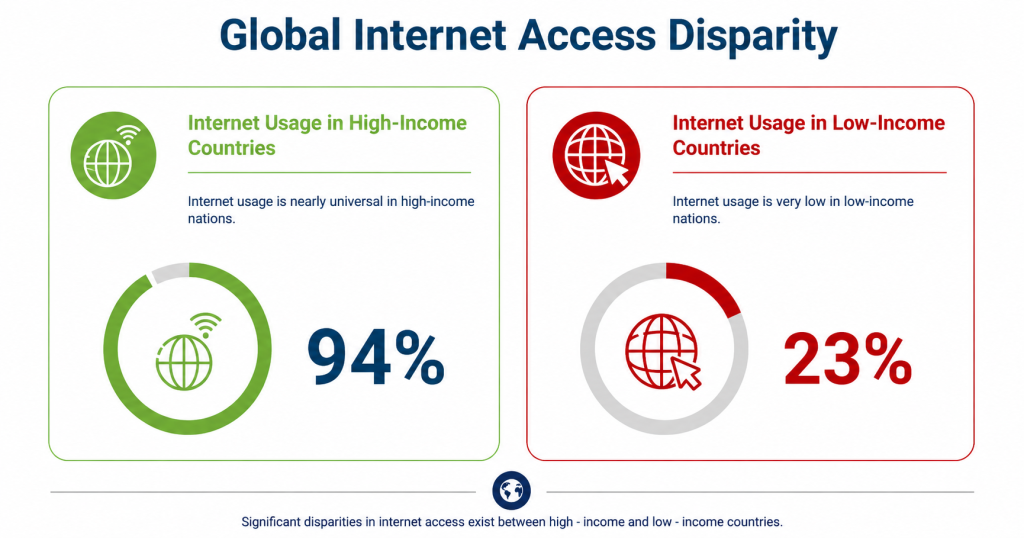
That gap matters as migration services move online. A digital-first application may work smoothly for someone with reliable broadband, modern devices, fluent language skills, and complete records. The same process can block a displaced person using shared connectivity, limited data, older devices, or incomplete documentation.
When governments digitize migration faster than communities gain meaningful digital access, technology can convert economic inequality into administrative inequality.
A 2025 UNHCR assessment in Ethiopia illustrates the problem. Fewer than 15 percent of refugees surveyed used the internet as much as they wanted, while refugee women were 23 percent less likely than men to own smartphones.
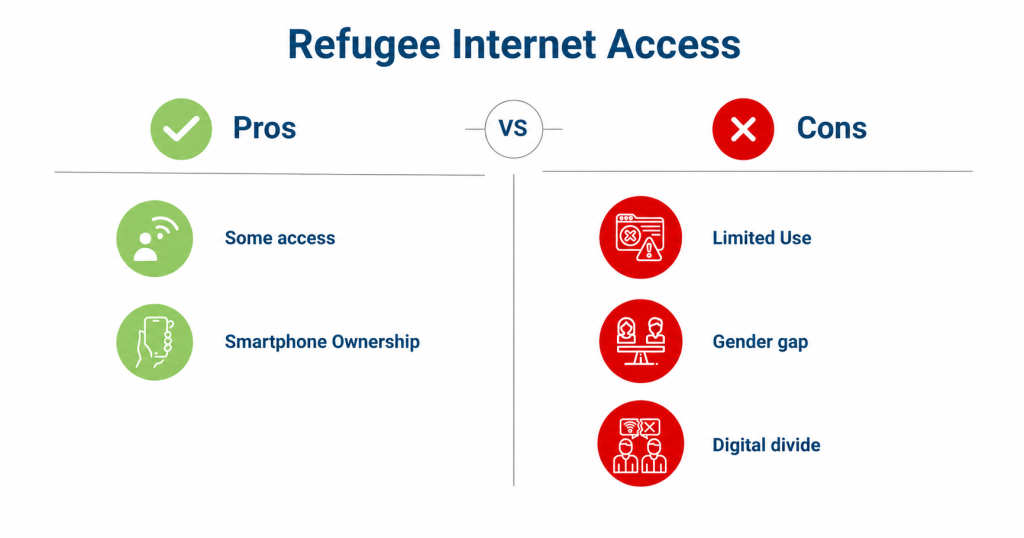
These numbers show how AI affects global migration inequality before an algorithm even evaluates an application.
AI Bias in Immigration and Border Control
Historical migration data reflects past policy choices, enforcement patterns, geopolitical relationships, and social inequality. If developers train systems on those patterns without careful review, AI can reproduce them at greater scale.
IOM warns that AI can amplify existing human bias and potentially institutionalize discriminatory outcomes. It also highlights transparency and recourse concerns when systems support visa, asylum, or risk-profiling decisions.
This makes AI bias in immigration and border control more than a technical accuracy issue. A model can perform well overall while producing weaker outcomes for specific nationalities, languages, genders, or demographic groups.
Organizations should evaluate both overall accuracy and subgroup performance. They should also test whether seemingly neutral variables act as proxies for sensitive characteristics.
The EU AI Act treats certain AI uses in migration, asylum, and border control as high-risk, including automated visa examinations. Current rules schedule key high-risk obligations in these areas from December 2, 2027.
The Challenges of AI in Migration Decision Making
Migration decisions can affect employment, family unity, legal status, safety, and access to services. That makes explainability essential.
People should understand when automated systems influence their cases, what information those systems use, and how they can challenge incorrect outcomes. Human reviewers also need enough context to question model recommendations instead of simply confirming them.
Organizations should address several safeguards before scaling automated decisions.
- Audit training data for nationality, language, gender, and socioeconomic bias patterns.
- Keep human reviewers accountable for every high-impact migration decision.
- Publish clear explanations showing applicants how automated assessments influence outcomes.
- Give migrants accessible appeal channels independent of automated decision systems.
These controls directly address the challenges of AI in migration decision making because they protect accountability where technology affects real people.
How to Reduce AI Inequality in Migration Systems
The strongest approach combines technical controls, policy safeguards, and inclusive service design.
1. Design for Unequal Access
Teams should test services under realistic conditions, including slow connections, low-cost devices, limited language proficiency, and interrupted sessions. They should preserve non-digital support where digital exclusion could block essential rights or services.
2. Measure Fairness Continuously
Migration patterns change, applicant populations shift, and model performance can drift. Teams should compare error rates, escalation rates, processing times, and adverse outcomes across relevant groups before and after deployment.
3. Minimize Sensitive Data
Migration systems often process biometrics, identity data, travel history, and family information. Organizations should collect only necessary data, restrict access, define retention periods, and protect information throughout its lifecycle.
IOM’s 2026 assessment of biometrics and AI in identity management highlights potential gains in efficiency and inclusion alongside risks involving privacy, discrimination, and accountability.
4. Build Meaningful Human Oversight
Reviewers need authority to challenge outputs, request additional evidence, and document why they accepted or rejected an AI recommendation. Human oversight should change decisions, not merely observe them.
5. Include Migrants in System Design
Teams cannot build AI for fair and inclusive migration policies without understanding migrant experiences. User research should include different languages, literacy levels, migration statuses, genders, ages, and accessibility needs.
A responsible implementation should include these operational practices.
- Test models across languages, nationalities, age groups, and genders regularly.
- Minimize collected data and define strict retention periods clearly upfront.
- Monitor outcome disparities continuously and investigate meaningful performance gaps promptly.
- Include migrant communities when designing services, safeguards, and appeals processes.
What Ethical AI in Migration Management Looks Like
Responsible migration technology needs accountable ownership across policy, legal, security, data, engineering, and operations teams.
Leaders should define which decisions AI may support, which require human authorization, and which uses carry unacceptable risk. They should document datasets, model limitations, decision logic, monitoring thresholds, and escalation procedures.
Independent reviews also matter for high-impact systems. External scrutiny can reveal blind spots, especially when technical performance looks strong but social outcomes differ across groups.
How Prolifics Helps Organizations Build Fairer Migration Systems
Prolifics helps organizations modernize complex migration and workforce mobility processes with secure, data-driven, and human-centered technology solutions. Our approach combines AI, automation, integration, analytics, and governance to improve efficiency without compromising fairness or accountability.
- Automate document intake, validation, classification, and workflow routing to reduce manual processing delays.
- Integrate immigration, HR, case management, identity, and compliance systems through scalable digital platforms.
- Apply AI governance, explainability, audit trails, and human-in-the-loop controls to high-impact decisions.
- Use analytics and dashboards to monitor processing performance, access barriers, bias indicators, and outcome disparities.
- Design inclusive digital experiences that support multilingual users, accessibility needs, assisted service channels, and secure data management.
With Prolifics, organizations can create migration technology ecosystems that are faster, more transparent, and better equipped to serve diverse populations responsibly.
Can AI Support Fairer Migration Policies?
Yes, if organizations use AI to expand access rather than narrow it.
AI can help identify service gaps, translate information, forecast demand, reduce administrative backlogs, and connect people with employment or integration support. Those benefits depend on data quality, digital inclusion, transparent decisions, and human accountability.
The goal should not be a fully automated immigration system. The goal should be a migration system where technology handles complexity without hiding responsibility.
Conclusion: Bridging the Gap Requires Governance by Design
AI in migration and global inequality will become a larger policy and business issue as governments digitize more migration services. Technology can improve speed, planning, and access, but weak governance can scale exclusion just as efficiently.
Organizations can reduce that risk by designing for real-world access, testing for bias, limiting sensitive data, strengthening human review, and giving affected people clear explanations and meaningful appeal routes.
The question is no longer whether AI will shape migration. It already does. The more important question is whether governments, technology providers, and employers will shape that AI around fairness, transparency, and human dignity.