Large language models in finance can accelerate document-heavy work, improve knowledge of access, support customer and employee interactions, and strengthen analytical workflows. But the model itself is not the value proposition. The value comes from placing an LLM inside a governed workflow with trusted data, explicit permissions, deterministic controls, accountable human review, and continuous monitoring.
That distinction matters in financial services. A fluent answer can still be wrong, incomplete, biased, insecure, or unsuitable for a regulated decision. Financial institutions therefore need to evaluate LLMs as part of a business and control system, not as a standalone chatbot.
What are large language models in finance?
A large language model, or LLM, is an AI model trained to interpret and generate language. In financial services, LLM applications combine that language capability with institution-specific data, systems, policies, and workflows. The most useful implementations often retrieve approved information, apply business rules, call enterprise services, and preserve evidence for review rather than relying on the model’s general training alone. The ESMA, Alan Turing Institute, and Institut Louis Bachelier report on LLMs in finance describes both the opportunity to improve efficiency and decision support and the need to manage robustness, security, fairness, and regulatory compliance.
This makes an enterprise LLM solution a stack of capabilities:
- A clearly defined workflow and measurable business outcome.
- Authorized data sources with quality, lineage, privacy, and retention controls.
- Retrieval, prompts, tools, and orchestration that constrain what the system can see and do.
- A selected model or models matched to accuracy, latency, security, and cost requirements.
- Testing, guardrails, human review, monitoring, incident response, and audit evidence.
Why finance leaders are moving from pilots to operating models
The adoption signal is strong. In its 2026 survey of AI in UK financial services, the Bank of England and FCA reported that 86% of respondents were using AI. GenAI systems accounted for 56% of reported AI systems, although the authorities caution that the 2024 and 2026 measures are not directly comparable. Operations and IT were the most common homes for reported GenAI use, followed by risk and compliance.
The shift does not mean every pilot is ready to scale. It means institutions need repeatable ways to select use cases, connect data, assess model and vendor risk, validate outputs, approve releases, monitor behavior, and prove that value exceeds total operating cost. The operating model is becoming as important as the model.
Where LLMs create value in financial services
The strongest candidates share three traits: language-intensive work, a bounded information domain, and a clear point where people or deterministic systems can verify the output.
1. Knowledge search and document intelligence
LLMs can help employees find, compare, extract, and summarize information across policies, procedures, research, contracts, filings, claims, loan documents, and regulatory material. Retrieval-augmented generation, or RAG, can ground responses in approved sources and return citations. This can reduce search and handling effort while making the answer easier to verify.
2. Employee copilots for service and operations
An employee-facing assistant can surface the next relevant procedure, draft a response, summarize customer interaction, or prepare a case handoff. The design keeps the employee accountable for the decision while reducing repetitive work. Prolifics’ graph-powered RAG banking case study describes a contact-center platform designed to improve response accuracy, consistency, explainability, resolution time, and agent productivity.
3. Customer service with controlled boundaries
Customer-facing assistants can answer product and process questions, explain documents, collect information, and route requests. They need authenticated context, approved content, disclosure rules, escalation paths, and strict limits on advice or transactions. A useful assistant should know when to stop generating and hand the conversation to a qualified person or deterministic service.
4. Compliance and regulatory change analysis
LLMs can compare policy text, identify obligations, map changes to controls, and draft review materials. They can also help compliance teams search for internal evidence and prepare examination responses. The model can accelerate analysis, but accountable experts must validate legal interpretation, applicability, and final action.
5. Fraud and investigation support
LLMs can summarize cases, connect narrative information, explain alerts, and help investigators navigate policies and prior evidence. They complement, rather than replace, graph analytics, anomaly detection, rules, and case-management systems. Prolifics has documented an AI-driven fraud detection engagement for investment banking, illustrating how AI can support financial crime prevention within a broader operating process.
6. Lending, claims, and underwriting assistance
LLMs can extract terms, classify evidence, summarize applications, and help staff navigate guidelines. They should not independently determine creditworthiness, coverage, pricing, or adverse action unless the institution has established a compliant, explainable, validated decision framework. Even then, the language model is usually best used around the decision, not as an unconstrained decision maker.
7. Software engineering and control documentation
Financial institutions can use LLMs to assist with code, tests, migration analysis, runbooks, and technical documentation. These workflows still require secure development practices, code review, dependency controls, testing, and change management. Productivity gains do not remove software risk.
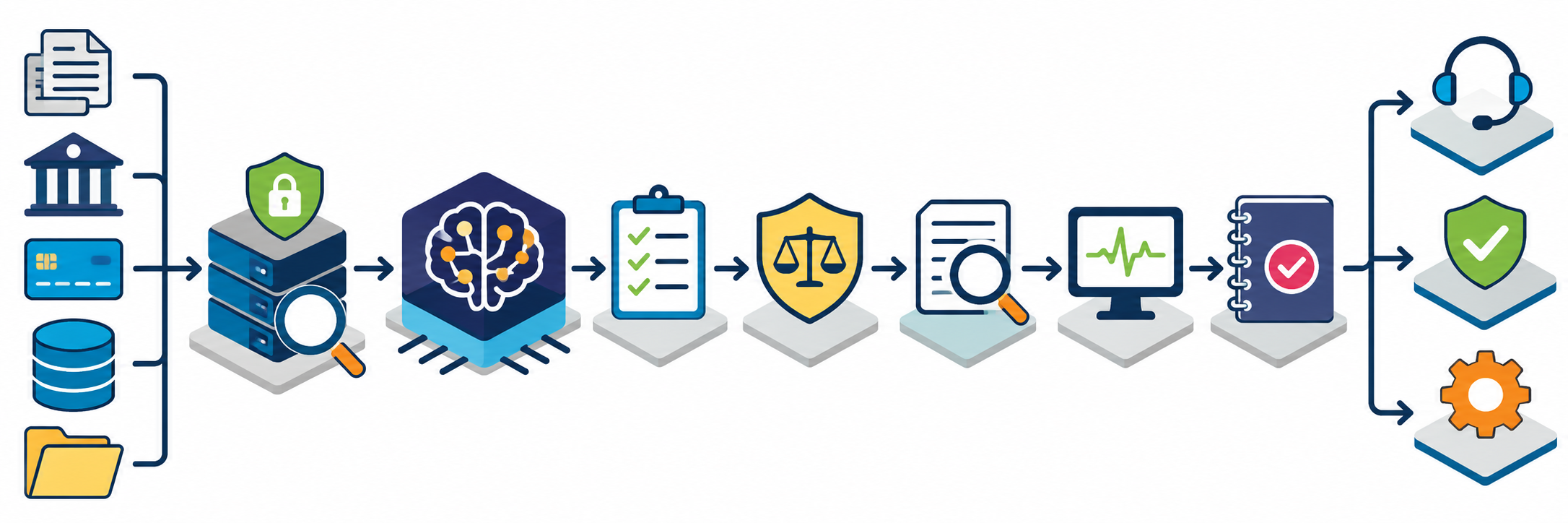
A production LLM workflow connects governed sources to retrieval, model processing, validation, policy controls, monitoring, human review, and approved actions.
The control architecture behind a production LLM
A production design should make every material boundary visible. Five layers are especially important.
- Governed data: Define source ownership, quality rules, access controls, sensitive-data handling, retention, lineage, and permitted use. Retrieval cannot be trusted if the underlying content is stale, conflicting, or exposed to the wrong user.
- Retrieval and orchestration: Use authorization-aware retrieval, source ranking, prompt templates, tool permissions, and business rules to assemble the context. RAG improves grounding, but it does not guarantee truth or policy compliance.
- Model selection and routing: Match models to the task. A smaller or specialized model may be preferable when latency, privacy, repeatability, or cost matters more than open-ended reasoning. Preserve the ability to change providers without rebuilding the entire workflow.
- Validation and human accountability: Use structured outputs, schema validation, calculations outside the LLM, policy checks, confidence thresholds, citations, separation of duties, and mandatory review for material decisions.
- Monitoring and evidence: Track quality, unsupported claims, retrieval failures, prompt attacks, access violations, drift, latency, cost, override rates, complaints, incidents, and business outcomes. Retain the evidence needed for audit and remediation.
This lifecycle view aligns with the NIST Generative AI Profile, which applies the AI Risk Management Framework across generative AI design, development, use, and evaluation, and with the Financial Stability Board’s 2026 consultation on responsible AI adoption, which proposes twelve sound practices for organization-wide governance and AI lifecycle management.
The risks are manageable only when the operating model changes
The US Treasury report on AI in financial services highlights risks involving data privacy, bias, and third-party providers and recommends that firms review AI use cases for compliance before deployment and reevaluate them periodically. The US Government Accountability Office also identifies bias, data quality, privacy, and cybersecurity risks and notes that hallucinations are one reason institutions avoid generative AI in work requiring very high accuracy.
| Risk | Why it matters | Example controls |
| Unsupported or incorrect output | Wrong summaries, fabricated citations, or unreliable reasoning can influence staff or customers. | Grounding, citations, validation, test suites, thresholds, and human review. |
| Data leakage and privacy | Sensitive data can enter prompts, logs, training pipelines, or third-party services. | Classification, masking, least privilege, contractual controls, secure hosting, retention limits, and monitoring. |
| Bias and consumer harm | Generated content can reproduce unequal treatment or unsuitable recommendations. | Representative testing, prohibited-use rules, outcome monitoring, explainability, complaints analysis, and accountable review. |
| Prompt injection and cyber risk | Malicious content can redirect retrieval or tool use and expose data or actions. | Input isolation, content scanning, tool allowlists, sandboxing, authorization checks, and red-team testing. |
| Third-party and concentration risk | Institutions may depend on a small number of models, clouds, or integrators. | Due diligence, exit plans, portability, fallback services, incident terms, and resilience testing. |
| Operational and model drift | Sources, prompts, models, user behavior, and regulations change after launch. | Versioning, regression tests, change approval, monitoring, rollback, and periodic revalidation. |
A practical path from pilot to governed value
- Start with a workflow, not a model. Map the user, decision, current effort, failure modes, systems, evidence, and regulatory obligations. Define what the LLM may recommend, draft, retrieve, or execute.
- Set a baseline and success metrics. Measure cycle time, handling time, quality, rework, user adoption, escalation, cost per completed task, and risk indicators before the pilot. Avoid claiming value from model usage alone.
- Classify the risk. Separate low-impact drafting and search from customer-facing communication, regulated advice, eligibility, pricing, fraud disposition, and transaction execution. Increase controls as a consequence and autonomy rise.
- Prepare the data and integration layer. Resolve ownership, permissions, quality, metadata, APIs, identity, event flows, and audit logging. Many apparent model problems are data or process problems.
- Build a testable control pattern. Create representative evaluation sets, adversarial tests, policy checks, human-review criteria, fallback behavior, incident response, and release gates before production traffic.
- Scale through reusable platforms and ownership. Standardize approved models, retrieval, guardrails, observability, evaluation, and evidence. Give business, technology, data, risk, legal, compliance, security, and operations teams clear decision rights.
When an LLM is not the right tool
An LLM should not be the default simply because a workflow contains text. Prefer deterministic rules, search, analytics, optimization, or conventional machine learning when the task requires exact calculations, stable outputs, full reproducibility, low ambiguity, or direct high-consequence decisions. A hybrid design is often strongest: the LLM interprets or explains language while validated services perform calculations, enforce policy, and execute actions.
How Prolifics helps financial institutions move forward
Prolifics helps enterprises connect strategy, architecture, data engineering, analytics, MLOps, governance, and managed operations through Data and AI services. For financial institutions, that means selecting workflows tied to measurable outcomes, building AI-ready and permission-aware data foundations, integrating LLMs with existing systems, and operationalizing monitoring and controls.
Organizations that need to establish accountability and lifecycle controls can use Prolifics’ Data and AI governance capabilities to address ownership, policies, privacy, security, explainability, model approval, and ongoing oversight. Teams that are still deciding where to begin can start with an AI maturity and readiness assessment to identify gaps across platforms, data, governance, and organizational capabilities.
The goal is not to put an LLM everywhere. It is to build a small number of trusted patterns that improve real work, produce evidence, and can be scaled responsibly. Talk with Prolifics about turning a priority financial service workflow into a governed, measurable implementation.
Frequently Asked Questions
What are LLMs used for finance?
LLMs are used for document extraction and summarization, knowledge search, employee assistance, customer-service support, compliance analysis, investigation support, software engineering, and reporting. The safest early uses are bounded, verifiable, and paired with human or deterministic validation.
Are large language models safe for financial services?
They can be used responsibly when the workflow includes trusted data, access controls, testing, grounding, validation, human accountability, monitoring, incident response, and regulatory review. Safety depends on the use case and operating controls, not on the model alone.
What is RAG in financial services?
Retrieval-augmented generation supplies an LLM with selected, authorized content at the time of a request. It can make answers more current and traceable, especially when citations are returned. RAG does not eliminate hallucination, data-quality, permission, or prompt-injection risk, so it must sit inside a wider control architecture.
Should a bank build or buy an LLM?
There is no universal answer. Institutions should compare use-case fit, data sensitivity, performance, explainability, latency, integration, resilience, switching cost, vendor risk, and total operating cost. Many will use a modular mix of third-party models, specialized components, and institution-owned data and controls.
How should financial institutions measure LLM value?
Measure the workflow before and after deployment. Useful indicators include cycle time, handling time, quality, rework, escalation, user adoption, cost per completed task, customer outcomes, control exceptions, and incidents. Model usage is not a business outcome.