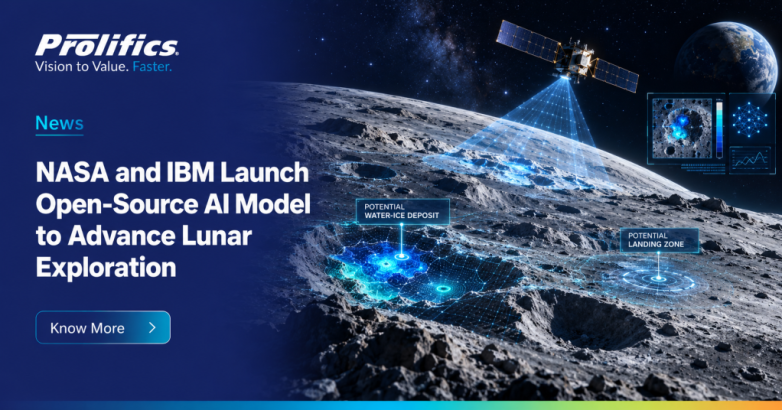
NASA and IBM have launched the NASA–IBM Lunar Foundation Model, an open-source artificial intelligence model designed to help scientists analyze the Moon’s surface, locate potential water-ice deposits and identify safer landing locations for future missions.
Trained primarily on data collected by NASA’s Lunar Reconnaissance Orbiter, the model enables researchers to analyze vast volumes of lunar imagery and terrain data more efficiently. It was trained using approximately two million image tiles, including more than one million high-resolution camera images and nearly 964,000 multispectral images. It also incorporates data from NASA’s GRAIL and Lunar Prospector missions and the Japan Aerospace Exploration Agency’s SELENE mission.
Turning Lunar Data into Actionable Intelligence
Scientists can adapt the foundation model for several lunar research tasks without developing separate AI systems from the ground up. Potential applications include mapping craters, detecting volcanic formations and predicting where ice could remain stable near the Moon’s poles.
Locating lunar ice is especially important because it could provide water and oxygen for astronauts and potentially support the production of rocket fuel. This could reduce the amount of material transported from Earth and help enable a sustained human presence on the Moon.
The model can also identify and classify craters at meter-scale resolution. Detailed crater mapping can help researchers study the Moon’s geological history while supporting the assessment of landing locations, surface hazards and possible sites for long-term infrastructure.
According to IBM, the model reduced errors in identifying areas with strong ice potential by up to 22% compared with a widely used baseline model. It also delivered improved crater-detection performance at context-scale resolution while using less training data.
The model, supporting datasets and code are publicly available through Hugging Face and GitHub, allowing scientists worldwide to test, adapt and improve the technology.
The Prolifics–IBM Partnership
This development demonstrates how trusted AI, advanced data engineering and open innovation can transform complex data into actionable insight.
As a long-standing IBM Business Partner, Prolifics helps enterprises apply IBM technologies to their own data-intensive challenges. Combining IBM’s AI and hybrid-cloud platforms with Prolifics’ expertise in data engineering, AI governance, application modernization, automation and quality engineering, the partnership helps organizations move AI initiatives from experimentation into secure, scalable production.
While lunar exploration represents an extraordinary use case, the underlying opportunity is relevant across industries: unify fragmented data, discover patterns faster and make better-informed decisions with enterprise-grade AI.
Media Contact: Chithra Sivaramakrishnan | +1(646) 362-3877 | chithra.sivaramakrishnan@prolifics.com
Frequently Asked Questions
1. What is the NASA–IBM Lunar Foundation Model?
It is an open-source AI model created to analyze lunar imagery, terrain and scientific observations.
2. What can the model identify?
It can support crater mapping, volcanic-feature detection, surface-change analysis and estimates of polar ice stability.
3. Why is lunar ice important?
Ice could provide water, oxygen and resources for producing rocket fuel during future missions.
4. Is the model publicly available?
Yes. NASA and IBM have released the model, code and supporting datasets for research and experimentation.
5. How does Prolifics support enterprise AI adoption?
Prolifics combines IBM technology with expertise in data, AI, governance, automation and hybrid cloud to build secure, scalable AI solutions.