Neuromorphic computing uses brain-inspired hardware and computing models to process information through highly parallel, event-driven architectures designed for lower latency and energy consumption. For enterprises, neuromorphic and other next-generation AI chips could expand where AI runs, particularly for real-time inference, edge intelligence, pattern recognition, and workloads constrained by power, latency, or connectivity.
Neuromorphic computing is an emerging approach to AI hardware that mimics aspects of biological neural systems, often using event-driven processing and spiking neural networks. It could help enterprises run selected AI workloads with lower power consumption and faster response times, especially at the edge, although commercial adoption remains relatively early.
Neuromorphic computing is a brain-inspired approach to hardware and algorithm design that attempts to make artificial neural processing more efficient. Instead of continuously moving data between separate processors and memory, neuromorphic architectures can use distributed computing, local memory, sparse activity, and event-driven communication to process information only when relevant events occur.
What is neuromorphic computing and how does it work?
Neuromorphic computing attempts to reproduce some of the efficiency principles found in biological nervous systems rather than simply making conventional processors faster.
Traditional CPUs and GPUs generally execute instructions using architectures in which computation and memory remain logically or physically distinct. Moving data between those components consumes time and energy. AI workloads can intensify this challenge because neural networks often require large numbers of repeated mathematical operations and memory accesses.
Neuromorphic processors take a different approach. Many use spiking neural networks, or SNNs, where artificial neurons communicate through discrete events called spikes. Computation can remain inactive until an event occurs, helping reduce unnecessary processing.
Several architectural principles commonly appear:
- Event-driven computation activates processing when relevant signals arrive.
- Local memory reduces repeated movement between memory and processors.
- Parallel neurons process multiple streams of information simultaneously.
- Sparse activation limits computation to relevant portions of networks.
- Continuous processing supports streaming data without heavy reliance on batching.
Intel’s Loihi architecture, for example, combines asynchronous event-based processing, integrated memory and computation, and sparse connectivity. Its Hala Point research system uses 1,152 Loihi 2 processors and supports up to 1.15 billion artificial neurons and 128 billion synapses.
That does not mean neuromorphic systems will replace CPUs or GPUs. They are more likely to serve as specialized accelerators for selected workloads within increasingly heterogeneous enterprise computing environments.
Why does neuromorphic computing matter for enterprise AI?
Neuromorphic computing is relevant to enterprise AI because researchers are targeting challenges including energy consumption, latency, data movement, and infrastructure efficiency.
These considerations become particularly important for AI workloads that process continuous streams of information or operate under power, connectivity, or response-time constraints.
Generative AI has focused enterprise attention on GPU capacity, but many business AI workloads look very different from training a large language model.
Fraud monitoring, industrial sensing, computer vision, cybersecurity detection, robotics, and real-time customer interactions may require continuous analysis of incoming events. Processing every signal through centralized infrastructure can create additional network latency, data movement, and infrastructure requirements.
Neuromorphic computing provides another architectural option.
Intel reports that its Hala Point research system can deliver more than 15 trillion 8-bit operations per second per watt on specific conventional deep-learning experiments. The system contains 140,544 neuromorphic processing cores and has a maximum power consumption of 2,600 watts.
These are experimental results rather than universal enterprise benchmarks, but they illustrate the efficiency researchers are pursuing.
Source: Intel
Gartner has also identified event detection, pattern recognition, and training with small datasets among potential early use cases for neuromorphic computing.
Source: Gartner
For CTOs, the takeaway is not to replace existing GPU infrastructure. The more useful question is which workloads could eventually benefit from specialized AI hardware alongside cloud, edge, and data-center environments.
What are next-generation AI chips?
Next-generation AI chips are specialized processors designed to address performance, efficiency, and data-movement limitations that can arise when conventional computing architectures run artificial intelligence workloads.
Neuromorphic processors are one category, but next-generation AI hardware also includes:
- AI accelerators and neural processing units.
- In-memory and near-memory computing.
- Analog AI processors.
- Spatial computing architectures.
- Application-specific AI accelerators.
- Photonic AI computing.
- Event-driven and neuromorphic processors.
These technologies should not be treated as interchangeable.
IBM Research’s NorthPole, for example, is a brain-inspired neural inference architecture, but it should not be classified in exactly the same way as event-driven neuromorphic processors such as Intel Loihi.
NorthPole focuses heavily on reducing data movement by tightly integrating compute and memory on-chip.
On the ResNet-50 image-classification benchmark, IBM reported that NorthPole achieved 25 times greater energy efficiency, measured in frames per second per watt, and 22 times lower latency than a GPU using a comparable 12-nanometer manufacturing process.
These results are specific to the reported benchmark and should not be interpreted as universal performance advantages across AI workloads.
Source: IBM Research
IBM has separately demonstrated analog AI hardware using 35 million phase-change memory devices across 34 tiles, reaching up to 12.4 TOPS/W in reported chip-sustained performance.
The broader trend is therefore larger than neuromorphic computing alone. AI infrastructure is becoming increasingly specialized.
How is neuromorphic computing different from CPUs, GPUs and AI accelerators?
The main difference lies in how computation is organized and when processing occurs.
| Architecture | Main design approach | Strongest fit | Key consideration |
|---|---|---|---|
| CPU | General-purpose computing | Enterprise applications, orchestration, business software | Flexible but not optimized for every AI workload |
| GPU | Highly parallel mathematical processing | AI training and high-throughput inference | Strong performance with higher infrastructure demands |
| Traditional AI accelerator | Specialized tensor or neural processing | AI inference and model acceleration | Optimized for specific AI operations |
| Neuromorphic processor | Event-driven, brain-inspired processing | Sensors, pattern detection, continuous edge AI | Emerging ecosystem and specialized use cases |
| In-memory AI architecture | Moves computing closer to stored data | Efficient neural inference | Requires different deployment models |
| Analog AI processor | Uses physical device properties for computation | Matrix operations and energy-efficient AI | Hardware and software maturity remain developing |
GPUs remain central to training many modern neural networks and running demanding inference workloads.
Neuromorphic processors target a different problem: efficiently processing sparse, asynchronous, or continuously changing information.
This makes heterogeneous computing increasingly relevant.
A future enterprise architecture could combine CPUs, GPUs, neural accelerators, and specialized processors, with workloads routed to the technology best suited to their performance, latency, energy, and cost requirements.
The infrastructure question may gradually shift from:
“Which processor should we standardize on?”
to:
“Which architecture provides the right performance, latency, and cost for each AI workload?”
Which enterprise use cases could benefit from neuromorphic computing?
The strongest potential applications involve continuous streams of information where events must be identified quickly without processing every signal at maximum computational intensity.
Financial services
A financial institution could use event-driven processing to continuously evaluate streams of payment, transaction, or market data for unusual patterns.
Rather than treating every incoming data point identically, a neuromorphic system could potentially help identify changes or anomalies as they occur and route meaningful events into established fraud, risk, or decision systems.
Healthcare
Wearable devices and connected medical equipment continuously generate sensor information.
Low-power edge processing could potentially identify abnormal patterns locally and send selected events to downstream systems rather than continuously transmitting all raw sensor data.
Retail
Smart stores can generate continuous video, movement, and sensor information.
Specialized edge AI could support inventory monitoring, queue detection, or store analytics while reducing unnecessary transmission of raw data to centralized environments.
Insurance
Telematics devices collect continuous driving information such as acceleration, braking, movement, and location-related events.
Event-driven computing could potentially analyze relevant behavioral changes closer to the device before forwarding selected information to enterprise insurance systems.
These are potential architecture patterns, not claims about current Prolifics client deployments.
The important enterprise principle is workload selection. Gartner’s research similarly highlights event detection and pattern recognition as potential early areas for neuromorphic computing.
How should enterprises evaluate neuromorphic computing?
Enterprises should begin with the workload and business objective rather than the processor.
A practical evaluation can follow seven steps:
Identify latency-sensitive AI workloads.
Find processes where response time, connectivity, or continuous processing materially affects outcomes.
Measure current infrastructure requirements.
Document compute utilization, energy requirements, inference latency, and data movement.
Separate training from inference.
Hardware suited to model training may differ from infrastructure needed for production inference.
Identify edge-processing opportunities.
Determine where devices generate enough data to justify local intelligence.
Evaluate workload compatibility.
Assess whether event-driven, sparse, or streaming workloads align with available neuromorphic architectures.
Run a controlled proof of value.
Compare latency, accuracy, energy consumption, integration complexity, and cost against existing infrastructure.
Plan for heterogeneous infrastructure.
Design integration patterns that allow specialized accelerators to complement CPUs, GPUs, cloud platforms, and enterprise applications.
This approach helps prevent an emerging technology from becoming a hardware-first experiment without a measurable business objective.
It also connects neuromorphic exploration with broader priorities including IT modernization, enterprise AI, cloud migration, system integration, enterprise automation, and data modernization.
When will neuromorphic computing become enterprise-ready?
Neuromorphic computing remains an emerging technology rather than a mainstream enterprise computing platform.
Research systems demonstrate increasingly sophisticated capabilities, but software ecosystems, development tools, workload compatibility, hardware availability, and production deployment models are still maturing.
One indicator of progress is the scale of current research platforms.
Intel’s Hala Point supports up to 1.15 billion artificial neurons, more than ten times the neuron capacity of its predecessor, Pohoiki Springs. Intel describes the platform as a research system intended to advance neuromorphic AI and address power and latency challenges in real-time AI applications.
A 2025 Nature review examining neuromorphic computing at scale describes the field as being at a critical juncture and identifies architecture, applications, scalability, and ecosystem development as areas requiring continued progress.
For enterprise leaders, this creates an important distinction between technology readiness and strategic readiness.
Organizations do not necessarily need to deploy neuromorphic processors today to prepare for them.
They can instead make AI architectures modular, improve data pipelines, modernize integration, strengthen observability, and establish meaningful workload benchmarks.
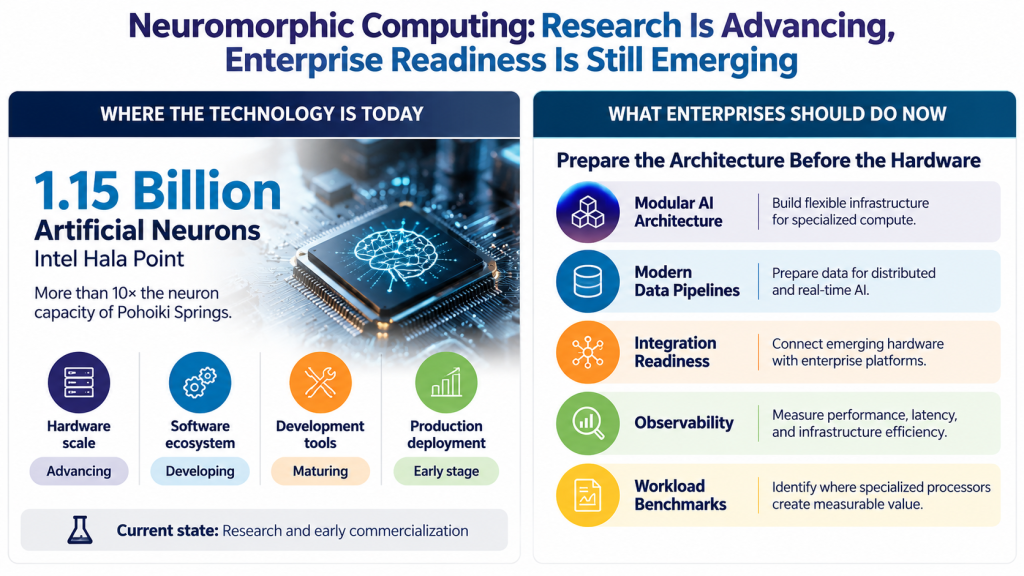
Those capabilities provide enterprise value even if a particular neuromorphic architecture never becomes part of the production environment.
What should CTOs consider before investing in next-generation AI chips?
CTOs should evaluate next-generation AI hardware against business workloads rather than headline performance specifications.
Five questions are especially important.
What workload are we optimizing?
Training, batch inference, streaming inference, and edge intelligence have very different infrastructure requirements.
Where does the data originate?
Sensor-heavy workloads may benefit from edge processing, while enterprise knowledge workloads may remain better suited to cloud or data-center environments.
What is the complete operating cost?
Hardware efficiency should be evaluated alongside software engineering, integration, infrastructure, support, security, and talent requirements.
How mature is the software ecosystem?
A processor is only useful when development frameworks, monitoring, security, and integration capabilities can support production operations.
Can the architecture evolve?
Hardware innovation is moving quickly. Enterprises should avoid tightly coupling applications to infrastructure that cannot be replaced or extended.
This is where broader digital transformation and IT modernization strategies become relevant.
AI hardware cannot be evaluated separately from cloud architecture, applications, data platforms, APIs, governance, security, and enterprise integration.
Enterprise AI strategy therefore needs to address the full technology stack, from computing infrastructure to business workflows.
What could neuromorphic computing mean for the future of enterprise AI?
Neuromorphic computing could make some AI workloads more distributed, event-driven, and energy-aware.
Today, much enterprise AI relies on centralized infrastructure. Data moves from applications or devices into cloud or data-center environments, models process it, and results return to applications.
Next-generation AI hardware could gradually shift selected computation closer to where information is generated.
That could create architectures where intelligent processing occurs across cloud platforms, enterprise data centers, edge devices, and specialized accelerators.
However, significant technical challenges remain.
Programming models are less mature than mainstream CPU and GPU ecosystems. Workloads must be suited to neuromorphic processing. Hardware availability is still limited, and many advanced systems remain research platforms.
Enterprises should therefore avoid treating neuromorphic computing as a universal replacement for current AI infrastructure.
Its significance is broader.
The assumption that every AI workload should run through similar computing architectures is weakening. Specialized processors are giving enterprise architects more options for balancing latency, energy consumption, throughput, performance, and cost.
That makes workload-aware AI architecture increasingly important.
Preparing Enterprise AI for the Next Generation of Compute
Neuromorphic computing signals a broader evolution in AI infrastructure toward specialized, workload-aware computing.
CPUs and GPUs will remain essential, while neuromorphic, in-memory, analog, and other specialized architectures could provide additional options for workloads where latency, power efficiency, or edge processing are critical.
For enterprise leaders, the immediate priority is not replacing existing infrastructure. It is building modular AI architectures, modern data pipelines, and integration capabilities that make it easier to evaluate and adopt new computing technologies as they mature.
Prolifics helps organizations connect AI strategy with data, cloud, integration, and modernization capabilities to build enterprise AI environments designed for measurable business outcomes.
Frequently Asked Questions
What is neuromorphic computing in simple terms?
Neuromorphic computing is inspired by how the brain processes information using artificial neurons and event-driven signals.
It is designed to improve efficiency for real-time, sensor-based, and edge AI workloads.
Is neuromorphic computing better than GPUs for AI?
Not always. GPUs are better suited to large-scale training and high-throughput AI workloads.
Neuromorphic processors are more suitable for sparse, event-driven, and continuously changing data.
What are the business benefits of neuromorphic computing?
Potential benefits include lower energy use, reduced latency, and more efficient real-time processing.
It may support use cases such as anomaly detection, sensor analytics, and edge AI.
Which industries could use neuromorphic computing?
Potential industries include financial services, healthcare, insurance, retail, manufacturing, and telecommunications.
Use cases could include fraud detection, medical monitoring, telematics, robotics, and cybersecurity.
Is neuromorphic computing ready for enterprise deployment?
The technology is advancing, but much of the ecosystem is still in research or early commercialization.
Enterprises should focus on testing suitable workloads and building flexible architectures before broader adoption.