Enterprise data has never been more valuable, or more difficult to manage. Over time, organizations accumulate legacy databases, disconnected applications, departmental data stores, spreadsheets, and multiple cloud environments. Each system may support an important business function, but collectively they create a fragmented landscape where data is difficult to access, reconcile, govern, and analyze.
The result is a widening gap between the data an enterprise owns and the value it can generate from it.
Enterprise data transformation closes that gap. It modernizes how data is collected, integrated, governed, processed, and consumed, creating a trusted foundation for real-time analytics, intelligent automation, generative AI, and faster decision-making.
However, successful transformation requires more than migrating information from legacy systems to the cloud. It demands a coordinated strategy connecting technology modernization with governance, operating models, business priorities, and measurable outcomes.
Why Legacy Data Environments Limit Business Growth
Legacy platforms often contain decades of valuable operational and customer information. The problem is not necessarily the data itself, it is the architecture surrounding it.
Different departments may use different definitions for the same customer, product, supplier, or transaction. Batch-based pipelines can delay reports by hours or days. Manual data preparation consumes analyst time, while undocumented dependencies make even small platform changes risky.
These limitations create several business challenges:
- Inconsistent reporting across departments
- Slow access to operational insights
- High infrastructure and maintenance costs
- Limited scalability for growing data volumes
- Complex regulatory and compliance processes
- Poor data quality and unclear ownership
- Difficulty operationalizing analytics and AI
- Dependence on specialized legacy knowledge
A modern analytics dashboard cannot solve these underlying problems. Neither can moving every workload to the cloud without redesigning how data flows through the enterprise.
The goal of transformation must be to make data trusted, connected, accessible, scalable, and actionable.
What Is Enterprise Data Transformation?
Enterprise data transformation is the strategic modernization of an organization’s data ecosystem. It encompasses architecture, platforms, integration, engineering, quality, governance, analytics, security, and organizational adoption.
Unlike a standalone migration project, data transformation considers the complete data lifecycle, from the moment information is created to the point where it supports a decision, customer interaction, automated workflow, or AI model.
A modern data ecosystem may combine cloud data warehouses, data lakes, lakehouse architectures, streaming technologies, APIs, business intelligence platforms, machine learning services, and governance solutions.
The right architecture depends on the organization’s objectives. What matters is that the components work together to deliver consistent, secure, and reusable data.
As the referenced discussion on enterprise data transformation emphasizes, modernization becomes sustainable when platforms, governance, analytics adoption, and operating models evolve together.
Five Capabilities Behind Successful Data Transformation
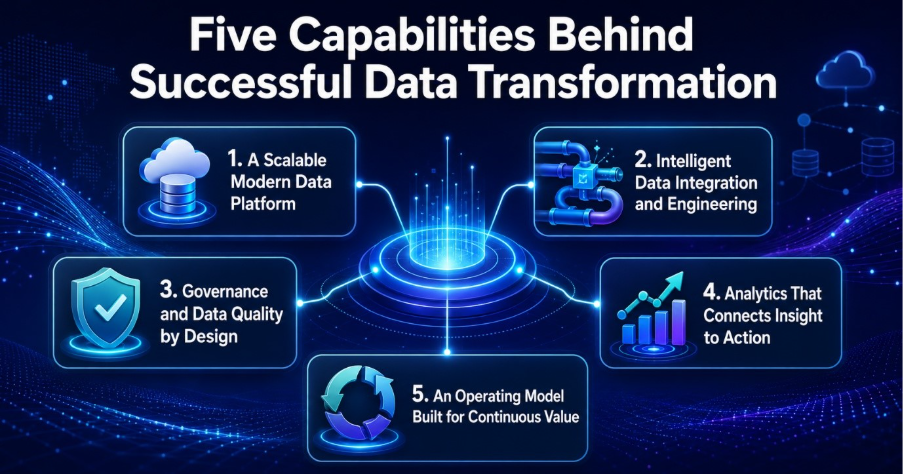
1. A Scalable Modern Data Platform
Modern cloud and hybrid data platforms allow enterprises to process larger and more diverse datasets without the limitations of traditional infrastructure.
Cloud-native warehouses and lakehouse architectures can separate storage from computing resources, enabling organizations to scale workloads based on demand. They can also support structured, semi-structured, and unstructured data for reporting, advanced analytics, and AI.
But platform selection should follow business requirements—not industry trends. Organizations must consider workload performance, security, interoperability, data residency, cost, and existing technology investments before choosing an architecture.
2. Intelligent Data Integration and Engineering
Modern analytics depends on reliable data movement.
Automated pipelines can ingest information from enterprise applications, databases, connected devices, partner ecosystems, and external sources. Batch processing may remain appropriate for some use cases, while streaming integration supports scenarios requiring immediate insight.
Data engineering also includes transformation, validation, orchestration, lineage, observability, and exception management. These capabilities reduce manual work and help ensure that analytics teams receive timely, usable information.
Reusable pipelines and metadata-driven automation can further accelerate migration while improving consistency across domains.
3. Governance and Data Quality by Design
Governance should begin at the start of transformation, not after the new platform is deployed.
A strong governance framework establishes who owns data, who can access it, how quality is measured, where information originated, and how it may be used. Catalogs, lineage, business glossaries, policy automation, and quality monitoring translate governance principles into daily operations.
This foundation becomes even more important when data is used to train or ground AI systems. Inaccurate, biased, poorly documented, or unauthorized data can undermine model performance and introduce regulatory, security, and reputational risks.
Trusted AI begins with trusted data.
4. Analytics That Connects Insight to Action
Modernization creates value only when people use the resulting information.
Self-service business intelligence can give authorized users faster access to consistent metrics. Predictive analytics can identify patterns and anticipate future conditions. Embedded analytics can deliver recommendations directly within the applications and workflows employees already use.
The objective is not simply to produce more dashboards. It is to shorten the distance between an event, an insight, a decision, and an action.
Successful organizations design analytics around specific business outcomes, such as reducing customer churn, improving inventory availability, identifying fraud, optimizing equipment maintenance, or accelerating financial reporting.
5. An Operating Model Built for Continuous Value
Data transformation is not a one-time implementation. Business requirements, regulations, source systems, analytical models, and technology platforms will continue to change.
Organizations therefore need an operating model that supports continuous improvement. Central platform teams can provide common standards and services, while domain teams take responsibility for the quality and usefulness of their data.
Treating important datasets as products, with owners, users, service expectations, documentation, and quality measures, can improve accountability and reuse.
A Practical Roadmap from Legacy Systems to Modern Analytics
A phased transformation can reduce disruption while producing measurable wins.
The journey should begin with a data maturity assessment covering architecture, applications, integration, quality, governance, skills, costs, and analytics adoption. This establishes a realistic baseline and identifies the highest-value gaps.
Next, organizations should define business outcomes and prioritize use cases. Instead of attempting to modernize everything simultaneously, they can focus on initiatives that demonstrate value and create reusable capabilities.
A typical roadmap includes:
- Assess the current data estate and transformation readiness.
- Define business outcomes, priorities, and success metrics.
- Design the target platform, integration, security, and governance architecture.
- Select high-value workloads for phased migration.
- Build automated pipelines with validation and observability.
- Establish governance, ownership, lineage, and quality controls.
- Deliver analytics and AI use cases tied to operational workflows.
- Measure adoption, performance, cost, and business impact.
- Expand proven capabilities across additional business domains.
This incremental approach allows teams to learn, adjust, and build stakeholder confidence without losing sight of the enterprise-wide strategy.
Avoiding the “Modernized Silo” Problem
One of the greatest transformation risks is recreating legacy complexity on newer technology.
Migrating fragmented datasets without common definitions preserves inconsistency. Moving inefficient pipelines to the cloud preserves technical debt. Deploying a sophisticated analytics platform without user adoption produces an expensive reporting environment with limited impact.
Organizations should avoid measuring success only through technical milestones such as terabytes migrated or systems retired. Business-oriented measures provide a clearer picture, including:
- Time required to produce critical reports
- Data quality and reconciliation rates
- Analytics adoption across business teams
- Pipeline reliability and processing performance
- Infrastructure and operational costs
- Speed of introducing new data products
- Time from insight to business action
- AI model accuracy, traceability, and scalability
Turning Enterprise Data into an AI-Ready Advantage
Modern analytics and enterprise AI share the same essential requirement: accessible, governed, context-rich data.
When information remains fragmented, AI teams spend significant time finding, cleaning, and reconciling data. When the enterprise has reusable pipelines, consistent metadata, transparent lineage, and clear access policies, teams can develop and scale intelligent solutions more confidently.
This makes data transformation more than an infrastructure program. It becomes an enabler of intelligent operations, personalized experiences, predictive decisions, and responsible AI.
Accelerate Your Data Transformation with Prolifics
Prolifics helps organizations connect data strategy with implementation and measurable business outcomes. Its capabilities span data assessment, data engineering, data management, analytics, MLOps, governance, application modernization, cloud migration, integration, and AI-powered solutions. Prolifics’ Data & AI services are designed to help enterprises transform fragmented information into trusted insights and scalable intelligence.
Whether you are modernizing a legacy warehouse, building a cloud data platform, improving governance, enabling self-service analytics, or preparing enterprise data for generative and agentic AI, Prolifics can help you move from isolated initiatives to a connected transformation roadmap.
Ready to turn your enterprise data into a foundation for analytics and AI success?
Talk to Prolifics’ Data & AI experts to assess your current environment, identify high-value opportunities, and create a practical roadmap for transformation.