How intelligent, continuous and predictive Quality Engineering turns faster delivery into trusted business outcomes
AI can now generate code, tests and releases at machine speed. Confidence still must be engineered.
Quality is becoming the control layer for digital trust
AI is changing the economics of software delivery. Coding assistants and autonomous agents can interpret requirements, assemble features and propose changes in minutes. Cloud-native applications evolve continuously, data moves across platforms, and releases increasingly combine deterministic software with probabilistic AI behaviour.
This acceleration creates a new constraint. The enterprise may be able to build more change per sprint, but it still needs credible evidence that the change is safe, useful, resilient and ready. When validation capacity cannot keep pace with development capacity, Quality Engineering becomes both the bottleneck and the safeguard.
The answer is not to automate every test. It is to shorten the path from change to a trustworthy decision. That requires Quality Engineering to move beyond a downstream testing phase and become an operating capability spanning planning, build, validation, release and production.
The confidence gap in AI-accelerated delivery
AI-generated code can compile successfully while embedding an insecure pattern, a misunderstood business rule or a subtle integration failure. It can increase the volume of plausible defects at the same time that traditional regression suites struggle with design latency, brittle automation, constrained test data and fragmented reporting.
The defining question is therefore no longer whether AI belongs in software delivery. It is whether the enterprise can independently verify what AI creates, how embedded AI behaves and what risk autonomous systems introduce before a change reaches customers.
A responsible control model separates creation from evaluation. The generator cannot be the only judge of its own output. Prompts, supplied context, generated artifacts, human edits and approvals should be traceable. Before merge, risk-based functional, API, contract, security, accessibility and mutation tests should challenge both the implementation and the original intent.
Human judgment remains essential
The winning model is collaboration, not replacement. AI can generate variants, analyse change, maintain assets and detect patterns across evidence volumes that people cannot review manually. People remain accountable for business intent, risk tolerance, ethics, domain nuance, exceptions and the final release decision.
This Human + AI model expands coverage and feedback speed without surrendering accountability. Review thresholds should reflect risk: low-impact maintenance can be highly automated, while material changes and irreversible actions require explicit human authority.
Build one continuous confidence loop
Quality should be designed into the value stream. Each lifecycle stage should produce evidence for the next decision, while production signals should improve the next cycle of planning and validation.
| Lifecycle stage | Quality action | Evidence produced |
| Plan | Translate critical journeys and business risks into measurable acceptance criteria | Risk tolerances, controls and testable outcomes |
| Build | Apply standards, code-level checks, API contracts and early automation | Traceable change and early defect signals |
| Validate | Prioritize by risk and test software, data, performance, security and AI | Coverage, findings and residual uncertainty |
| Release | Connect transparent, automated quality gates to CI/CD | A defensible release decision and governed exceptions |
| Operate | Feed reliability, experience and incident signals back into engineering | Continuous learning and recalibrated risk models |
This loop changes the role of metrics. Test counts alone cannot tell leaders whether a release is safe. Useful measures connect engineering activity to flow, effectiveness, customer experience, trust and economics.
- Flow: lead time for change, test-cycle duration, feedback latency and release frequency.
- Effectiveness: escaped defects, defect-removal efficiency, flaky-test rate and automation health.
- Experience: critical-journey success, accessibility, performance and customer impact.
- Trust: data integrity, privacy controls, compliance evidence and AI quality.
- Economics: cost of quality, maintenance effort, environment utilization, reuse and avoided loss.
Test automation and AI testing are different disciplines
Conventional test automation validates predictable interfaces, rules, APIs, data flows and end-to-end processes. AI testing evaluates variable behaviour and asks whether model outputs remain grounded, relevant, safe, robust and useful across changing contexts. Enterprises need both disciplines in one release flow.
For generative AI and retrieval-augmented generation, teams need governed evaluation datasets, model and prompt comparisons, retrieval checks, red-team scenarios, statistical measures and expert adjudication. The evidence should cover relevance, accuracy, faithfulness, context precision and recall, consistency, contradiction, hallucination risk, bias, sensitive-information exposure, latency and cost.
Responsible implementation also requires intended use, prohibited behaviour, thresholds, lineage, monitoring and escalation to be documented. Prompts, datasets, models, retrieval configurations, guardrails and results should be versioned so teams can compare changes rather than evaluate each release in isolation.
Agentic systems must be tested as workflows
An AI agent is not just a model response. It plans, retrieves data, calls tools, maintains state and acts. Quality must therefore cover the complete path from user intent to final outcome.
- Goal quality: does the agent achieve the intended business outcome across realistic scenarios?
- Process quality: are plans, tool choices, parameters, memory and handoffs correct and efficient?
- Safety and control: does it respect permissions, data boundaries, approval points and escalation rules?
- Resilience: can it recover from unavailable tools, incomplete context, partial failures and adversarial input?
- Governance: are traces, evaluations, approvals and production monitoring reproducible and audit-ready?
Autonomy should expand only as confidence and observability improve. Agents may plan and execute approved low-risk activities, but uncertainty, policy exceptions and high-impact failures should route to people. Learning should come from confirmed outcomes, not unreviewed assumptions.
Predictive Quality directs attention before defects are committed
As regression estates grow, executing everything on every change becomes slow and economically unsustainable. Predictive Quality combines commit differences, requirements, service dependencies, defect history, test health, ownership, complexity and production telemetry to identify where failure is most likely.
The goal is not an opaque risk score. It is an explainable recommendation for reviewers, test scope, data needs, performance checks and release controls. Human override, drift monitoring and outcome-based calibration keep the model accountable. When risk is assessed while requirements and code are still changing, remediation is faster and less expensive.
Solve the enterprise constraints around testing
AI-enabled testing cannot succeed on generation alone. The broader quality system must remove the operational constraints that delay evidence.
| Enterprise constraint | Modern QE response | Business value |
| Unsafe or unavailable test data | Discover sensitive fields; mask, tokenize or synthesize; provision context-preserved subsets through repeatable services | Faster testing with stronger privacy control |
| Performance and resilience risk | Model peak business events, dependencies, saturation, failure and recovery against service objectives | Protection of revenue, productivity and continuity |
| Migration and data risk | Reconcile counts, totals, keys, mappings, transformations and referential integrity at scale | Trusted business outcomes across platforms |
| Fragmented automation | Create reusable frameworks, stable pipelines, shared evidence and transparent release gates | Faster feedback and lower maintenance cost |
| Inconsistent enterprise practice | Use a federated Testing Center of Excellence to set standards and enable product teams | Comparable evidence without central delivery friction |
A federated Testing Center of Excellence makes quality scalable
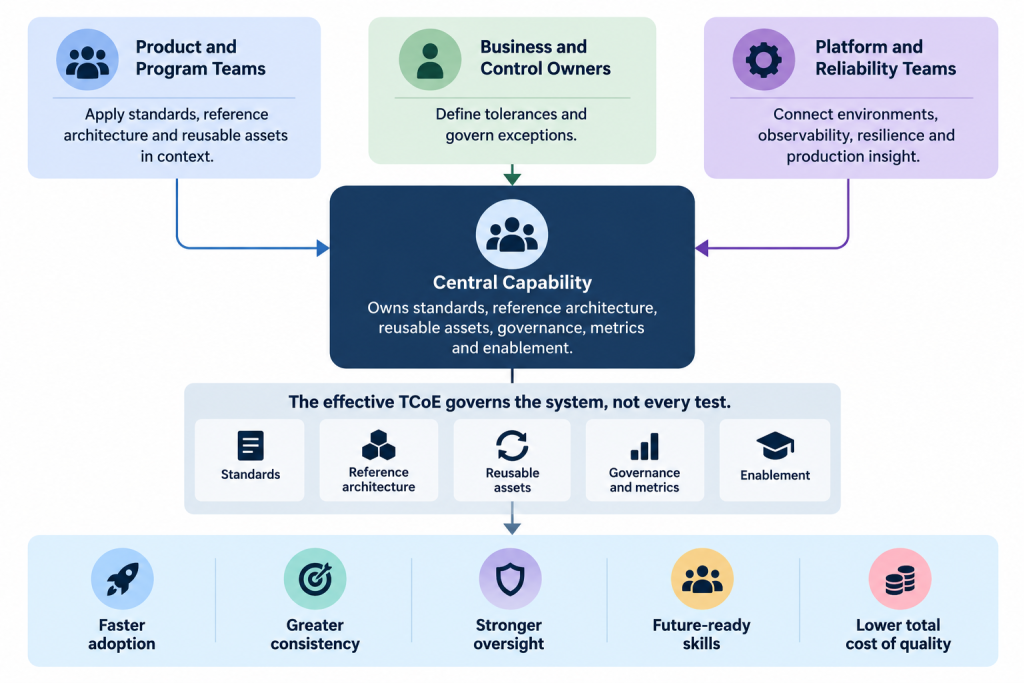
Enterprise quality cannot depend on isolated specialists or one successful program. A central capability should own standards, reference architecture, reusable assets, governance, metrics and enablement. Product and program teams should apply them in context, while business and control owners define tolerances and govern exceptions. Platform and reliability teams connect environments, observability, resilience and production insight.
The effective TCoE governs the system, not every test. Its value lies in paved roads for automation, test data, metrics and governance: faster adoption, greater consistency, stronger oversight, future-ready skills and a lower total cost of quality.
What measurable transformation looks like
The Quality Engineering CTB includes customer evidence across automation, modernization, test data and operating-model transformation. These examples show why the target is not simply more scripts; it is improved engineering flow and business confidence.
| Transformation | Intervention | Reported outcome |
| Global payments technology leader | LLM-assisted test generation with human review | Coverage increased about 30%; execution accuracy improved from 60% to 80%; automated cases per sprint rose from 55 to 72 |
| Global law firm | Centralized Tosca, Vision AI and NeoLoad automation and performance engineering | Recurring monthly regression fell from 11 days to 8-10 hours; application execution time reductions reached 85-90%; £1 million projected cost avoidance |
| Global healthcare leader | Enabled SAP subject-matter experts to configure low-code tests | 30% reduction in automation effort and 25% reduction in maintenance cost |
| Mortgage lender | Metrics-driven TCoE with shared methods, risk-based planning and reusable assets | More consistent release-readiness decisions and a scalable foundation for continuous improvement |
Reported outcomes should be interpreted in context: realized results are distinct from future projections, and benefit ranges should be validated against each client’s environment, baseline and governance model.
A focused 90-day path from bottleneck to capability
Transformation can begin with one product, migration wave, critical journey or AI use case where slow evidence visibly constrains a business decision. The aim is to prove value through a thin vertical slice while building reusable foundations.
Days 0-30: baseline
- Interview product, engineering, business, risk and reliability owners to map critical journeys and decision points.
- Measure feedback latency, coverage, flakiness, test-data fulfillment, escaped defects and AI-specific risk.
- Select one journey, define tolerances and agree accountable owners and success measures.
- Design the minimum architecture, test assets, data services and governance needed for the proof.
Days 31-60: prove
- Use a live change to connect requirements, risk-based testing, compliant data, automation and transparent evidence.
- Evaluate deterministic software and any AI behaviour with the appropriate mix of assertions, measures and human review.
- Integrate the reusable components into delivery rather than running an isolated demonstration.
Days 61-90: scale
- Measure cycle time, coverage, accuracy, stability, human overrides and decision outcomes.
- Review false positives, escapes and operational feedback, then refine controls and thresholds.
- Codify reusable patterns, ownership and exception paths, and approve the next portfolio wave.
The executive outcome should be a working proof, a quantified baseline and an investment roadmap tied to business risk.
How Prolifics connects the quality system
Prolifics approaches quality as a business capability expressed through engineering. Work begins with the outcome an organization needs to protect – revenue, service continuity, regulatory trust, transformation value or customer experience – and works backward into the controls, automation, data, environments and governance required to release confidently.
Quality Fusion. A connected Test Automation and TestOps foundation that brings requirements, planning, automation, defects, CI/CD integration, metrics and release visibility into one quality system.
Agentic Quality Engineering. A Human + AI operating model in which specialized agents support test design, self-healing automation, defect triage, data validation, release readiness and AI governance under explicit controls.
AI TestForge. A structured approach to evaluating generative AI, RAG and agentic solutions across functional quality, groundedness, ethical risk and performance, from individual scenarios to repeatable regression datasets.
TiDium. AI-enabled test-data management for data discovery, masking, context-preserved subsetting, automated provisioning, role-based access and CI/CD integration.
Effecta. High-volume data validation for migrations, transformations, APIs and enterprise platforms, connecting reconciliation evidence from source rules to target outcomes.
The differentiator is not one accelerator in isolation. It is the ability to combine strategy, independent assurance, enterprise integration, data, reusable engineering and accountable delivery around the business journeys that matter most.
Conclusion
AI will continue to increase the speed and volume of change. Whether that acceleration becomes advantage or exposure depends on the quality system surrounding it.
The enterprises best positioned to scale AI will treat quality as a continuous control layer: independent enough to challenge machine-generated change, intelligent enough to focus effort where risk is highest, integrated enough to validate software, data and agents together, and governed enough to keep people accountable for consequential decisions.
Confidence is the product. Quality Engineering is how it is built.
FAQ’s
Why is Quality Engineering important in AI-driven software development?
AI can accelerate software development, but speed alone does not guarantee reliable outcomes.
Quality engineering provides independent validation so releases remain safe, resilient, and trustworthy.
How is AI testing different from traditional test automation?
Traditional automation validates predictable applications, APIs, rules, and workflows.
AI testing evaluates variable outputs for accuracy, relevance, safety, robustness, and reliability.
What is Predictive Quality?
Predictive Quality uses change data, defect history, dependencies, and telemetry to identify potential risks.
It helps teams focus testing where failures are most likely before defects reach production.
How should enterprises test AI agents?
AI agents should be tested across goals, processes, tool usage, permissions, resilience, and governance.
High-risk decisions and uncertain outcomes should continue to involve human oversight.
How does Prolifics support modern Quality Engineering?
Prolifics combines Quality Fusion, Agentic Quality Engineering, AI TestForge, TiDium, and Effecta.
Together, these capabilities strengthen software, AI, test data, automation, and enterprise quality.