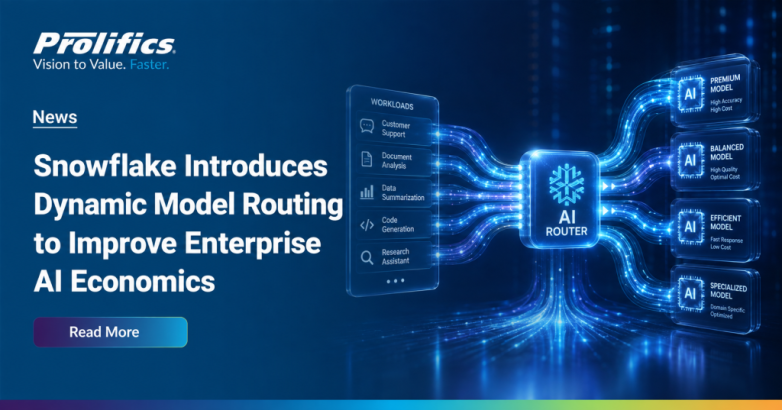
Snowflake has announced dynamic model routing within Cortex AI Gateway and its flagship AI products, advancing its efforts to help enterprises control AI costs while improving model performance, governance and scalability.
The capability automatically selects an appropriate AI model for each request based on factors such as quality, speed, cost and customer preferences. Instead of relying on a single high-cost model for every workload, organizations can direct routine or repetitive tasks to more efficient models while reserving advanced frontier models for work requiring deeper reasoning.
The announcement builds on Cortex AI Gateway, which Snowflake introduced in July 2026 as a unified foundation for governing agent connections, routing AI requests and managing AI consumption. As enterprises move more AI applications and autonomous agents into production, managing an expanding range of models can create operational complexity and unpredictable costs. Dynamic routing is designed to handle much of that complexity automatically.
Bringing Intelligent Routing Across Snowflake AI
Dynamic model routing will be integrated into Snowflake CoCo and Snowflake CoWork and made available to third-party AI agents connected through Cortex AI Gateway. Organizations can control which models and providers their users may access, helping them accommodate regional availability, internal policies and industry-specific compliance requirements.
The gateway can also adapt its routing decisions as model capabilities, availability and pricing evolve. This means businesses can take advantage of new models without repeatedly redesigning applications or rebuilding agent infrastructure.
Snowflake’s internal evaluations indicate that this multi-model approach could produce meaningful efficiency improvements. In one test, agents using dynamic routing built a dbt pipeline with up to three times greater token efficiency than an approach relying exclusively on a frontier model while maintaining comparable quality. Another internal evaluation reported 25% greater token efficiency for engineering teams completing the same number of pull requests. Results may vary by workload and configuration.
Expanding Access to Open AI Models
Snowflake also plans to add DeepSeek-V4-Flash 0731 and GLM-5.3 to Cortex AI. These models will join offerings from providers including Anthropic, Google, Meta, Mistral and OpenAI.
Expanding the model portfolio gives enterprises greater flexibility to balance cost, performance and workload requirements. At the same time, organizations can continue applying Snowflake’s access controls and governance framework to their proprietary data and AI activities.
Administrators will also gain tools to monitor token consumption, allocate costs to teams or cost centres, establish user quotas and define spending limits. These controls are increasingly important as AI agents execute more tasks across enterprise environments.
The announcement reflects a broader shift in enterprise AI priorities—from rapid experimentation to measurable business value. By combining automated model selection, broader model choice and centralized cost governance, Snowflake aims to help organizations improve what it calls “intelligence efficiency”: the ability to convert models, computing resources, enterprise data and context into meaningful outcomes.
The new capabilities could make multi-model AI architectures easier to operate, but their ultimate value will depend on real-world workload performance, governance requirements and pricing. Dynamic model routing is expected to enter private preview, while availability for the newly announced open models will also be introduced through preview programmes.
Media Contact: Chithra Sivaramakrishnan | +1(646) 362-3877 | chithra.sivaramakrishnan@prolifics.com
Frequently Asked Questions
1. What is dynamic model routing in Snowflake?
Dynamic model routing automatically directs each AI request to a suitable model based on quality, cost, speed and organizational preferences.
2. Why is dynamic routing important for enterprises?
It can reduce unnecessary AI expenditure by using efficient models for routine work and reserving more powerful models for complex tasks.
3. Which Snowflake products will support the capability?
The capability is being integrated into Cortex AI Gateway, Snowflake CoCo and Snowflake CoWork. Third-party agents can also access it through the gateway.
4. Which new open models is Snowflake adding?
Snowflake plans to add DeepSeek-V4-Flash 0731 and GLM-5.3 to its Cortex AI model portfolio, subject to availability and preview conditions.
5. How will Snowflake help businesses control AI spending?
Organizations will be able to monitor usage, attribute costs, define quotas, establish spending limits and control which models teams and agents may access.