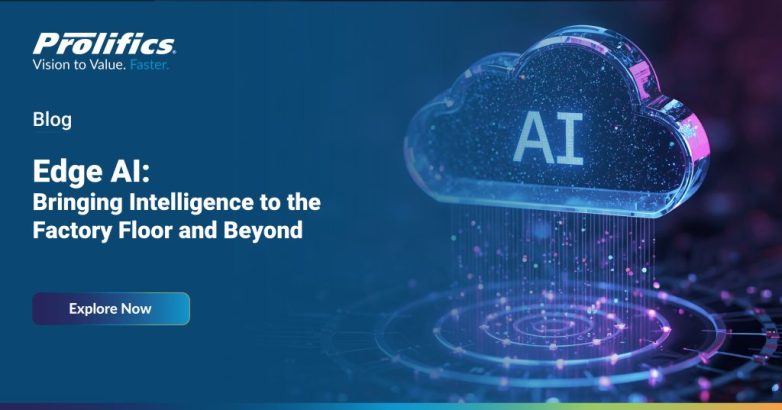
Edge AI brings artificial intelligence directly to the devices, machines, sensors, and systems where enterprise data is created. By processing data locally instead of sending every event to a centralized cloud environment, Edge AI enables faster decisions, real-time automation, lower bandwidth requirements, and greater operational resilience across manufacturing and other distributed environments.
Edge AI runs artificial intelligence models close to where data is generated, such as factory machines, cameras, sensors, medical devices, and retail systems. It reduces latency, limits unnecessary data transfer, supports real-time automation, and can keep critical workloads operating when cloud connectivity is unavailable or too slow.
What is Edge AI and how does it work?
Edge AI is the use of AI algorithms and machine learning models on devices or computing infrastructure located close to the source of data. Instead of sending every input to a remote cloud platform, the system performs inference locally, often on industrial computers, gateways, cameras, sensors, medical equipment, or other connected devices, and sends only selected data or results upstream.
The architecture combines edge computing, artificial intelligence, machine learning, Internet of Things (IoT) devices, and enterprise systems. A model may still be trained in a cloud environment or centralized data center because training can require significant computing resources. Once trained, an optimized version of the model can be deployed to an edge device for local inference.
For example, a camera monitoring a production line can analyze every image locally. When its computer vision model detects a potential defect, the system can immediately flag the product or trigger another workflow rather than uploading a continuous video stream for remote analysis.
IBM describes Edge AI as running algorithms directly on local edge devices and notes that local processing can provide responses within milliseconds. IBM also highlights AI accelerators such as GPUs and NPUs as important components for delivering high-performance inference with constrained power and computing resources.
This distributed architecture makes Edge AI particularly valuable wherever physical operations cannot wait for a cloud round trip.
Why does Edge AI matter on the factory floor?
Edge AI matters on the factory floor because manufacturing decisions often need to happen at machine speed. Equipment failures, quality defects, unsafe conditions, and process deviations can become expensive when detection depends on data first travelling to a remote platform.
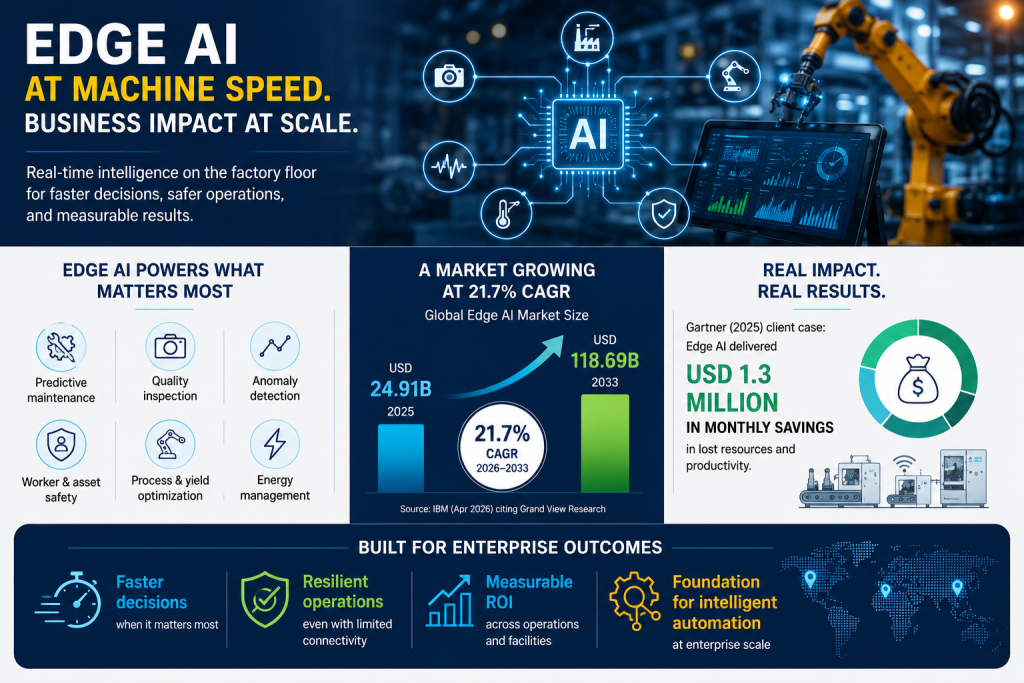
Local AI inference allows manufacturers to analyze machine telemetry, images, vibration data, temperature readings, acoustic signals, and other industrial IoT data close to its source. That capability supports several important operations:
- Predictive maintenance for critical equipment.
- Automated visual quality inspection.
- Production anomaly detection.
- Worker and equipment safety monitoring.
- Process and yield optimization.
- Energy consumption monitoring.
- Intelligent robotics and automation.
Edge AI is also becoming an increasingly significant enterprise technology category. IBM’s April 2026 Edge AI guidance cites Grand View Research estimates valuing the global Edge AI market at USD 24.91 billion in 2025, with a projection of USD 118.69 billion by 2033 and a 21.7% compound annual growth rate from 2026 through 2033.
The potential business value extends beyond technical performance. Gartner published an Edge AI business-value analysis in 2025 that included a manufacturing client case where the technology helped save nearly USD 1.3 million per month in lost resources and productivity.
For manufacturers pursuing digital transformation, the larger opportunity is therefore not simply faster analytics. Edge AI creates a foundation for enterprise automation that can respond continuously to physical operating conditions.
How can enterprises implement Edge AI step by step?
Successful Edge AI implementation should begin with a business problem rather than an infrastructure purchase. Enterprises need to determine which decisions genuinely benefit from local intelligence, then connect the edge architecture to the wider data, cloud, security, and operational technology environment.
A practical implementation process includes:
- Identify latency-sensitive business problems.
Prioritize situations where faster detection or decision-making can reduce downtime, risk, waste, or manual work. - Map the required data sources.
Identify machines, industrial IoT sensors, cameras, applications, gateways, and operational systems that generate relevant information. - Define edge and cloud responsibilities.
Decide which processing must occur locally and which workloads belong in centralized cloud or data platforms. - Select appropriate edge infrastructure.
Match industrial computers, GPUs, NPUs, gateways, and storage resources to model requirements and environmental constraints. - Integrate AI with enterprise systems.
Connect inference results with ERP, MES, asset management, analytics, workflow, and enterprise automation platforms. - Establish security and governance.
Apply device identity, encryption, access control, model validation, patch management, monitoring, and auditability. - Measure and scale proven use cases.
Track downtime reduction, defect rates, latency, throughput, accuracy, operating cost, and other business KPIs before expanding deployment.
This architecture should complement existing IT modernization, cloud migration, data modernization, and system integration initiatives rather than create another isolated technology layer.
A hybrid approach is often the most practical. Edge systems can handle immediate inference while centralized platforms support model development, governance, historical analytics, cross-location insights, and model lifecycle management.
How does Edge AI compare with cloud AI?
Edge AI and cloud AI solve different parts of the enterprise AI problem. Edge environments are optimized for immediate local decisions, while cloud environments provide the scalable computing capacity required for model training, large-scale analytics, centralized management, and computationally intensive AI workloads.
| Capability | Edge AI | Cloud AI | Hybrid Edge-Cloud |
| Processing location | Near the data source | Centralized cloud infrastructure | Distributed across both |
| Response latency | Very low | Network dependent | Optimized by workload |
| Internet dependency | Low to moderate | Typically high | Moderate |
| Raw data transmission | Reduced | Usually higher | Selective |
| Real-time automation | Strong | Use-case dependent | Strong |
| Large model training | Limited | Strong | Cloud based |
| Offline operation | Possible | Limited | Possible |
| Central governance | More complex | Easier | Centralized with distributed enforcement |
| Industrial IoT suitability | High | Moderate | High |
| Enterprise scalability | Distributed | Centralized | Distributed and coordinated |
The choice should therefore not be framed as Edge AI versus cloud AI for the entire enterprise.
Cloud platforms remain important for training, retraining, managing, and analyzing models at scale. Edge devices execute workloads requiring rapid local inference. Data that does not require immediate processing can then move to centralized platforms for deeper analysis.
IBM similarly describes Edge AI and cloud AI as complementary deployment models, with edge systems supporting local real-time decision-making while cloud environments handle workloads that require greater computing resources.
For many large enterprises, hybrid architecture provides the strongest balance between responsiveness, scalability, control, and centralized AI governance.
Which Edge AI use cases extend beyond manufacturing?
Edge AI extends well beyond the factory because many industries generate valuable data at physical locations where immediate decisions matter.
Healthcare.
Hospitals, medical devices, ambulances, and wearable technology can process patient information closer to the point of care. Local inference can support monitoring, early-warning systems, imaging workflows, and connected medical equipment while reducing the need to continuously transmit raw patient data.
One real-world example comes from Innocens BV and Antwerp University Hospital’s neonatal intensive care unit. IBM describes Innocens as an edge computing technology designed to analyze streams of neonatal patient data and identify patterns that could indicate late-onset sepsis, helping clinical teams identify warning signs earlier.
Retail.
Retailers can apply Edge AI to smart checkout, shelf monitoring, inventory visibility, loss prevention, queue analytics, and localized customer experiences. A computer vision system can detect inventory conditions locally and send only actionable events to centralized applications.
Financial services.
Banks can use edge intelligence for ATM telemetry, branch systems, local device monitoring, video analytics, and security applications. Local processing can identify unusual conditions before selected events are forwarded for centralized analysis.
Insurance.
Connected vehicles, property sensors, cameras, and IoT devices can support faster risk detection and claims-related data collection. Edge processing can filter large volumes of sensor information before relevant events enter central insurance platforms.
Public sector.
Transportation systems, utilities, public infrastructure, and smart-city environments can use Edge AI for traffic analysis, infrastructure monitoring, asset management, and emergency operations.
Across these industries, the pattern remains consistent: process information locally when speed, connectivity, privacy, or data volume makes centralized processing less practical.
What risks should enterprises address before scaling Edge AI?
Enterprises should address security, governance, model management, integration, and operational support before Edge AI moves from isolated pilots to production at scale.
The first challenge is distributed infrastructure management. A centralized AI platform may operate in several data centers, while an Edge AI environment could involve hundreds or thousands of devices distributed across factories, stores, hospitals, offices, or public locations.
Each device introduces requirements for:
- Identity and access management.
- Secure software and model deployment.
- Encryption and key management.
- Firmware and operating system updates.
- Model version control.
- Monitoring and observability.
- Hardware lifecycle management.
- Physical device security.
Enterprises must also address model drift. A model that performs accurately during initial deployment can become less reliable as equipment, environments, products, data distributions, or operating conditions change.
IT and operational technology teams therefore need a common governance framework covering data pipelines, models, infrastructure, security, and business workflows.
Forrester’s The State of Edge Computing, 2025 examines enterprise edge adoption using global infrastructure, network, wireless, edge, and IoT survey data, with specific focus on benefits, use cases, technology components, adoption plans, and deployment challenges. This reinforces why Edge AI should be treated as an enterprise architecture discipline rather than a collection of isolated intelligent devices.
Effective scaling requires standardized deployment patterns, centralized policy, strong system integration, and local operational resilience.
FAQ’s
What is Edge AI in manufacturing?
Edge AI runs AI and machine learning models close to factory equipment, sensors, cameras, and industrial systems.
It supports real-time applications such as predictive maintenance, quality inspection, robotics, safety, and production control.
What is the main advantage of Edge AI?
Edge AI processes data locally, enabling faster decisions with lower latency and reduced data transmission.
It can also keep critical applications running when cloud connectivity is limited or unavailable.
Is Edge AI better than cloud AI?
Edge AI is ideal for low-latency and connectivity-sensitive workloads, while cloud AI supports large-scale computing and model training.
Most enterprises benefit from combining both through a secure hybrid edge-to-cloud architecture.
What infrastructure is required for Edge AI?
Edge AI typically requires sensors, cameras, gateways, local servers, GPUs or NPUs, networking, storage, and AI models.
Enterprise deployments also need centralized security, monitoring, governance, integration, and model lifecycle management.
How can enterprises calculate ROI from Edge AI?
Enterprises can measure ROI through reduced downtime, lower defect rates, higher throughput, energy savings, and improved equipment utilization.
Other measures include lower inspection costs, reduced bandwidth usage, faster response times, and fewer operational incidents.
What should enterprises do next with Edge AI?
Organizations should start with measurable, latency-sensitive use cases and build a secure, repeatable edge-to-cloud architecture.
Prolifics can help connect Edge AI with enterprise data, cloud, automation, integration, and AI strategies for scalable production.