For years, working with generative AI followed a familiar pattern: write a prompt, review the response, provide corrections and repeat. The model might have been intelligent, but the human remained responsible for driving every step.
Loop engineering changes that relationship.
Instead of repeatedly telling an AI agent what to do next, developers design a system in which the agent can pursue a goal, take actions, examine the results and adjust its approach. The focus shifts from producing an impressive response to achieving a verified outcome.
This emerging discipline could become one of the most important foundations of agentic AI.
What Is Loop Engineering?
Loop engineering is the practice of designing the recurring execution cycle through which an AI agent works towards a defined objective.
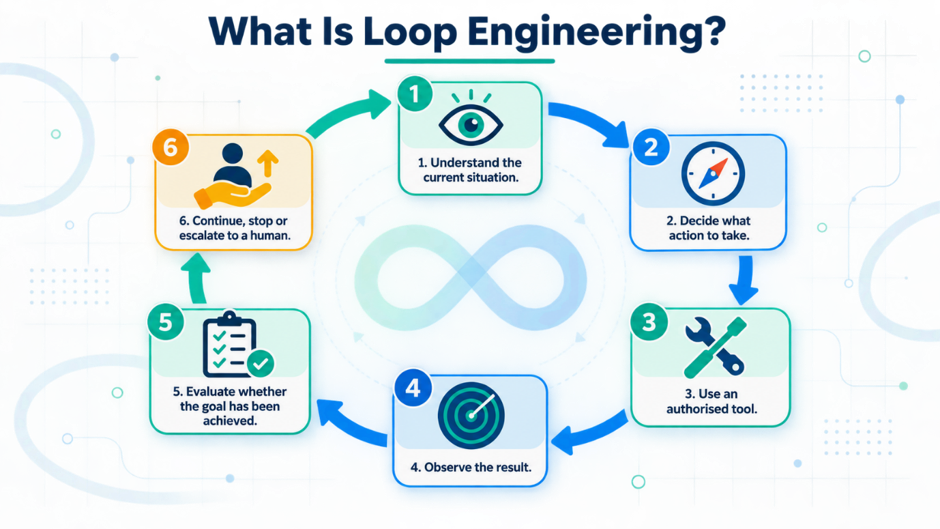
A typical loop follows a simple pattern:
- Understand the current situation.
- Decide what action to take.
- Use an authorised tool.
- Observe the result.
- Evaluate whether the goal has been achieved.
- Continue, stop or escalate to a human.
Unlike a conventional workflow, a loop does not always follow a fixed sequence. If an action fails, the agent can analyse the feedback, revise its plan and try another approach.
For example, instead of asking an AI coding assistant to “write a login function,” a developer could define the goal as: “Implement the login function and continue until all authentication tests pass.” The agent could inspect the repository, write the code, run the tests, identify failures and refine its implementation without requiring a new human prompt after every attempt.
This transition, from manually prompting the agent to engineering the system that prompts and guides it, is at the heart of loop engineering. Loop engineering is the design of a system that prompts, checks, remembers, and reruns an agent rather than performing these activities manually.
Beyond Prompt Engineering
Prompt engineering asks: “What instructions will produce the best response?”
Loop engineering asks a broader question: “What system will help the agent complete the task reliably?”
Prompts remain important, but they become one component within a larger operating structure. That structure also includes context, tools, memory, verification, permissions and stopping conditions.
The difference can be understood through the unit of work. Prompt engineering optimises an individual interaction. Loop engineering optimises an entire autonomous run, from the first trigger to the final, verified outcome.
The underlying concept has roots in earlier agent research. The ReAct framework introduced a cycle that combines reasoning with action: the agent reasons about the situation, acts through a tool, observes the result and continues. Reflection-based approaches extended this structure by allowing agents to critique their previous attempts and use those lessons in subsequent iterations.
Loop engineering turns these research patterns into practical systems that developers and enterprises can deploy.
The Essential Components of an Effective Loop
A dependable AI loop requires more than an instruction to “keep trying.” It needs a carefully designed operating model.
1. A trigger
Every loop needs an event that starts it. The trigger might be a schedule, a failed software test, a new support ticket, an incoming document or a direct human request.
Scheduled automations are useful for recurring tasks, while hooks can activate loops when specific events occur. IBM notes that hooks can also enforce security and quality requirements before or after actions, reducing the need to consume model resources on routine controls.
2. A measurable goal
The agent needs a clear definition of success. “Improve the application” is too vague. “Reduce the page-load time below two seconds without failing regression tests” gives the loop something concrete to pursue and verify.
A well-designed goal functions as both a destination and a termination condition.
3. The right tools
An agent cannot create meaningful change unless it can interact with its environment. Depending on the use case, tools may allow it to read files, execute code, search approved knowledge sources, query databases, update business systems or run tests.
However, broader tool access also creates greater operational risk. Permissions should therefore follow the principle of least privilege: give the agent only the capabilities required for its task.
4. Memory and context
Each iteration generates information, actions attempted, errors encountered and decisions made. The loop must preserve the most relevant knowledge so the agent does not continually repeat itself.
This does not mean placing every previous interaction into the model’s context window. Excessive context can increase costs and make important information harder to identify. Effective context engineering summarises older iterations, removes irrelevant outputs and maintains a concise record of progress.
5. Independent verification
A loop should not stop merely because the agent claims the job is complete. Whenever possible, completion should be verified through objective evidence such as passing tests, valid schemas, clean security scans, reconciled totals or approved business rules.
For subjective work, a separate evaluator can review the result against an explicit rubric. A maker-checker structure is generally more reliable than allowing the same agent to create and approve its own output.
6. Stopping and escalation rules
Every production loop needs limits. These might include a maximum number of iterations, a time limit, a token budget or detection of repeated failures.
If the loop cannot make progress, it should stop safely and provide a human with a concise summary of what it attempted, what failed and what decision is required.
Common Loop Engineering Patterns
Different problems require different loop designs.
The ReAct loop supports tasks requiring repeated reasoning, action and observation. A reflection loop asks the agent to critique and improve its output. A plan-execute-verify loop suits complex work in which steps must occur in order. An evaluator-optimizer loop repeatedly compares an output with defined criteria and returns actionable feedback.
Production systems also need bounded-execution and circuit-breaker patterns.
Human-in-the-loop is equally important. High-impact decisions involving production systems, regulated data, financial transactions or customer communications should pause for approval at clearly defined checkpoints.
Where Can Businesses Use Loop Engineering?
The potential extends far beyond software development. Businesses could use loops to:
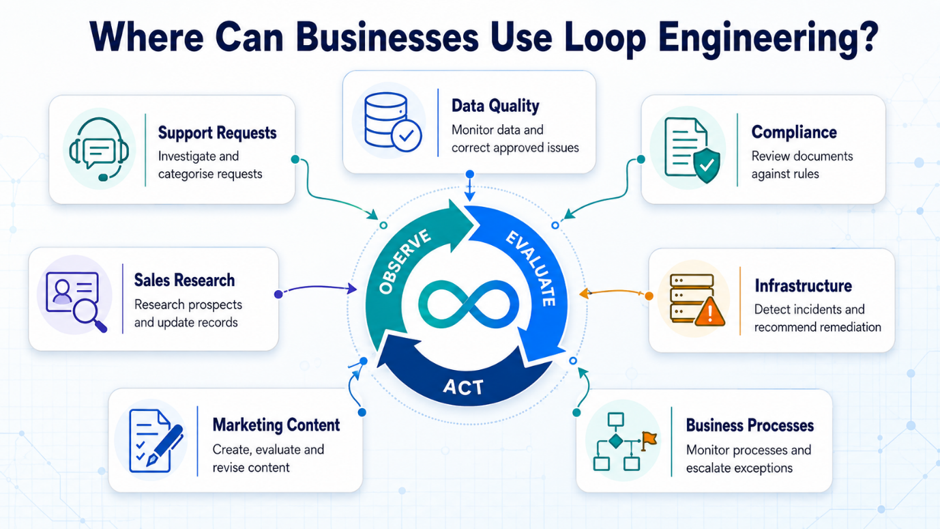
- Investigate and categorise support requests.
- Monitor data quality and correct approved issues.
- Review documents against compliance rules.
- Research prospects and update sales records.
- Detect infrastructure incidents and recommend remediation.
- Generate marketing content, evaluate it against brand standards and revise weak sections.
- Monitor business processes and escalate exceptions.
The strongest use cases share three qualities: a measurable objective, trustworthy feedback and actions that can be safely controlled.
The Risks of Poorly Designed Loops
Autonomy magnifies both productivity and mistakes. A loop with vague goals might optimise the wrong outcome. One without reliable memory may repeat failed actions. Weak verification can allow incorrect results to appear complete, while missing budget controls can produce runaway costs.
Human oversight also remains essential. IBM warns that excessive reliance on generated code can create “comprehension debt”, a growing gap between the amount of code produced and the organisation’s understanding of it.
The objective is therefore not to remove people from every process. It is to place human judgement where it adds the most value: defining intent, approving consequential actions and governing outcomes.
From Better Prompts to Better Systems
Loop engineering represents a fundamental shift in how organisations create value with AI. The competitive advantage will not come simply from having access to a powerful model. It will come from building reliable systems around that model, systems that can act, learn from feedback, verify their work and recognise when human intervention is necessary.
The future of enterprise AI is not a single perfect prompt. It is a carefully governed cycle of reasoning, action, evidence and improvement. That is the promise of loop engineering: transforming AI from a responsive assistant into a dependable participant in real work.
Frequently Asked Questions
1. What is loop engineering in AI?
Loop engineering is the practice of designing systems that enable AI agents to work through recurring cycles of reasoning, action, observation and verification. The agent continues iterating until it achieves a measurable goal, reaches a predefined limit or requires human intervention.
2. How is loop engineering different from prompt engineering?
Prompt engineering focuses on writing instructions that produce a strong individual response. Loop engineering designs the broader system that repeatedly guides the agent, supplies context and tools, evaluates its output, preserves useful information and determines when the task is complete.
3. What are the essential components of an AI agent loop?
An effective agent loop typically includes a trigger, measurable goal, relevant context, controlled tool access, persistent memory, verification mechanism, stopping conditions and escalation path. Together, these components help the agent operate autonomously without sacrificing reliability or control.
4. What are the main business applications of loop engineering?
Businesses can use loop engineering for software development, customer-support triage, data-quality monitoring, compliance reviews, document processing, sales research, content optimisation and IT incident management. The best applications have measurable outcomes, reliable feedback and clearly controlled actions.
5. What are the risks of implementing loop engineering?
Common risks include infinite execution cycles, excessive AI costs, repeated errors, context overload, unauthorised actions and incorrect outputs that appear complete. Organisations can reduce these risks through limited permissions, objective verification, iteration and budget caps, detailed activity logs and human approval for consequential decisions.