Legal AI pilot programmes create measurable value only when they become secure, governed workflows with approved data, defined users, human oversight, audit trails and clear business outcomes. Moving from pilot to practice requires workflow redesign, system integration, risk controls and operational ownership, not simply a more capable model. Success should be measured through cycle time, cost per matter, output quality, adoption and risk reduction.
A legal AI pilot should move to production only after the organisation defines a narrow workflow, assigns accountable owners, restricts data and system access, establishes human review, tests accuracy and security, integrates with existing legal systems and tracks baseline metrics. Scale only when the workflow delivers repeatable value within an approved risk threshold.
What turns a legal AI pilot into a production workflow?
A legal AI pilot becomes a production workflow when it can complete a defined legal task repeatedly, securely and within approved quality and risk thresholds. A successful demonstration is not enough. The organisation must know who can use the system, what information it can access, when an attorney must intervene and how every material action will be recorded.
Legal AI workflow governance is the operating model that controls how artificial intelligence accesses legal information, performs tasks, produces recommendations and returns work to qualified professionals. It combines policies, technical controls, human review, system ownership, monitoring and evidence collection so legal AI can operate consistently without weakening confidentiality, professional responsibility or business accountability.
Production readiness depends heavily on the data foundation. Documents, matter information, contracts, precedents, permissions and client knowledge are often spread across disconnected repositories. This fragmentation can prevent legal AI from reaching controlled production because the system cannot reliably identify trusted sources, preserve access controls or maintain a complete audit trail.
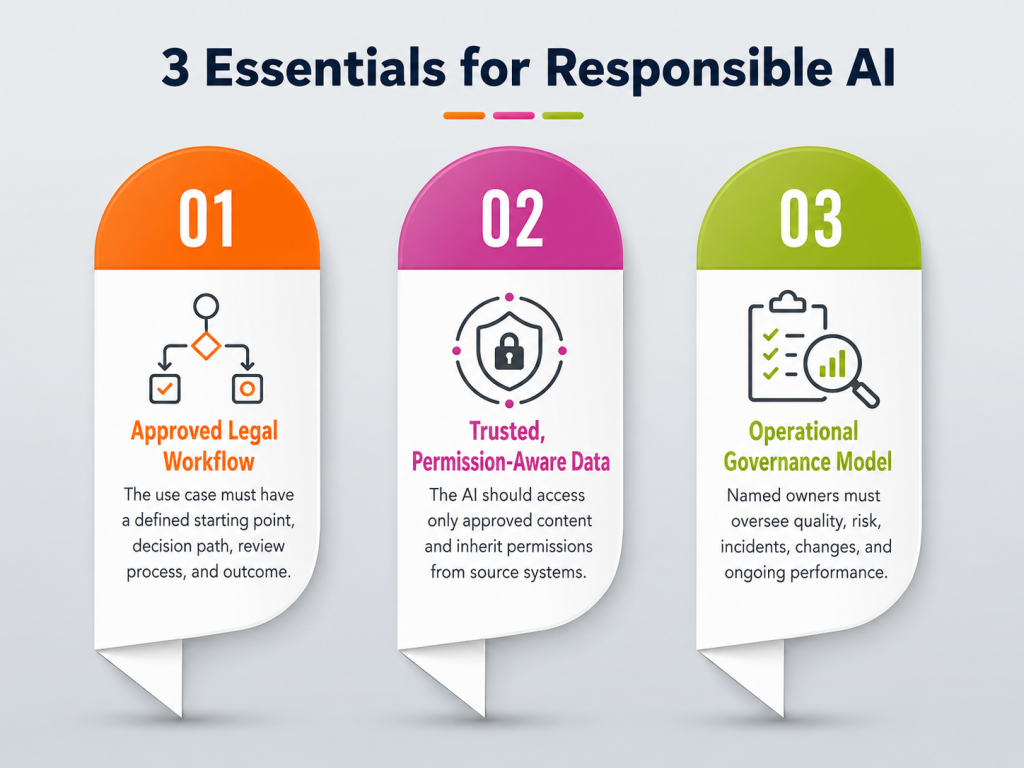
Three foundations are essential:
A responsible AI use case should follow a clearly approved legal workflow, with a defined starting point, decision process, review stages and expected outcome. It should use only trusted and authorised data, while respecting the permissions already set within source systems. Clear ownership must also be established so designated teams can oversee quality, risk, incidents, changes and ongoing performance.
The AI should work within the firm’s existing processes rather than becoming an isolated application that requires attorneys to move sensitive information manually between systems. That distinction separates experimentation from sustainable enterprise automation.
Why do legal AI pilots fail to deliver measurable value?
Legal AI pilots often fail because they are designed around technology demonstrations rather than operational outcomes. Teams test whether a model can summarise a document or answer a legal question, but they do not define how the output will enter a matter, who will verify it, which system will retain it, or which metric will establish value.
Thomson Reuters reported that the proportion of legal organisations incorporating generative AI into their work nearly doubled from 14% in 2024 to 26% in 2025. It also found that 80% of law firm respondents expected AI to fundamentally change how they conduct business. These figures show strong adoption and expectation, but adoption alone does not prove production value.
The most common causes of failure include:
- No agreed business baseline: Teams cannot prove improvement if they did not measure the original workflow.
- Unclear ownership: Innovation teams may run the pilot, but no legal, IT or operations leader owns production performance.
- Disconnected systems: Manual uploads and copy-and-paste processes create security, quality and records-management risks.
- Weak data controls: The AI may retrieve outdated, restricted or irrelevant information.
- Undefined human review: Attorneys do not know which outputs require approval or escalation.
- Insufficient change management: Users are given a tool without a redesigned workflow, training or support model.
- Unclear operating costs: Licensing, infrastructure, integration, monitoring and support costs are not included in the business case.
For legal teams, these issues are intensified by confidentiality requirements, matter-level access controls, inconsistent document metadata and the need for professional judgement. A model may perform well in a controlled test but still fail in practice if it cannot distinguish current precedent from outdated material, respect ethical walls or route uncertainty to the correct reviewer.
How do you move a legal AI pilot into production?
Move a legal AI pilot into production through a controlled sequence of workflow, data, risk and operational decisions. Each stage should produce evidence that the use case is ready for the next level of access and responsibility.
- Select one bounded legal workflow.
Start with a repetitive, document-heavy activity such as contract clause comparison, due diligence triage, matter summarisation, legal research preparation or compliance review. Avoid beginning with an open-ended assistant expected to answer every legal question. - Establish the current performance baseline.
Record cycle time, attorney hours, cost per task, rework, backlog, error rates and escalation volume before introducing AI. Without a baseline, productivity claims cannot be verified. - Classify the data and legal risk.
Identify privileged information, personal data, regulated records, client restrictions and jurisdictional requirements. Define which repositories, matters and document classes the AI may access. - Design human oversight and exception handling.
Specify which outputs require attorney approval, what confidence threshold triggers escalation and who has authority to correct or reject a recommendation. High-impact decisions should never depend on unattended model output. - Build secure system integration.
Connect the workflow through governed APIs, identity controls and approved retrieval services. Preserve matter permissions and return final outputs to the designated system of record. - Test quality, security and failure conditions.
Evaluate factual accuracy, source grounding, privilege handling, prompt injection, inappropriate disclosure, incomplete documents and conflicting instructions. Testing should include representative matters, not only ideal examples. - Operationalise ownership and measurement.
Assign business, legal, IT, security, privacy and risk owners. Establish monitoring, incident response, change control, model evaluation and regular KPI reporting before expanding usage.
This process gives legal teams a repeatable route from proof of concept to controlled production while supporting wider digital transformation and IT modernisation goals.
Which security and governance controls are essential for legal AI?
Legal AI requires controls across identity, data, models, workflows and human decision-making. Governance should be embedded in runtime operations rather than handled as a policy review after deployment.
ABA Formal Opinion 512 states that lawyers using generative AI remain subject to duties involving competence, informed consent, confidentiality and fees. NIST’s Generative AI Profile extends its AI Risk Management Framework with actions for identifying and managing risks specific to generative systems. IBM also identifies accountability, transparency and provenance as core trust factors for enterprise AI governance.
The essential controls include:
- Identity and access: Use single sign-on, multifactor authentication, role-based access and matter-level permissions.
- Data protection: Apply encryption, approved storage locations, data loss prevention, retention rules and restrictions on model training.
- Grounding and provenance: Retrieve information from approved legal sources and preserve visible citations, source dates and version history.
- Human approval: Require attorney review for legal advice, filings, contractual commitments, regulatory submissions and client-facing outputs.
- Auditability: Log prompts, sources, model versions, outputs, approvals, exceptions and system actions.
- Model and vendor controls: Conduct security assessments, review contractual protections, confirm geographic hosting, require change notification and maintain an exit plan.
- Continuous monitoring: Test accuracy, detect drift, review access, check policy compliance and maintain incident-response procedures.
These controls should be proportionate to the use case. A knowledge search tool and an autonomous contract approval agent should not share the same risk classification, approval process or monitoring threshold.
How should legal AI connect to enterprise systems?
Legal AI should connect to approved systems of record through secure, permission-aware integration rather than relying on manual uploads and copy-and-paste processes. The goal is to place AI inside the legal workflow while preserving the organisation’s existing identity, security, retention and records-management controls.
A production architecture may connect document management, contract lifecycle management, matter management, eDiscovery, knowledge management, billing and enterprise content platforms. Identity services should determine which matters and documents each user can retrieve. Data governance tools should classify sensitive information, enforce policies and record lineage. Security events should feed the organisation’s monitoring and incident-management processes.
Key integration requirements include:
- Permission inheritance: The AI should preserve the access rules of the source repository.
- Secure APIs: Approved interfaces should control how data enters and leaves the workflow.
- System-of-record updates: Final outputs, decisions and approvals should return to the designated legal platform.
- Complete audit history: The workflow should record the prompt, source material, recommendation, reviewer and final action.
- Lifecycle controls: Retention, deletion and legal hold requirements should continue to apply.
- Operational monitoring: Security, performance and quality events should feed existing enterprise monitoring tools.
Retrieval-augmented generation can ground responses in approved contracts, policies, precedents and matter documents. However, retrieval must respect the original repository’s permissions. Indexing every document into a shared AI environment can unintentionally bypass ethical walls and client-specific access restrictions.
System integration also supports measurable workflow automation. The AI can receive a contract from the authorised repository, compare clauses with approved standards, route exceptions to counsel and return the reviewed version with a complete audit history. This approach supports cloud migration and IT modernisation without creating another disconnected interface or unmanaged information store.
How should legal AI value be measured?
Legal AI value should be measured against the performance of the original workflow, not against model speed or the number of generated documents. Leaders need a balanced scorecard covering efficiency, quality, financial results, adoption and risk.
The core measurement categories are:
- Efficiency: Average cycle time, attorney hours per task, completed matters, backlog reduction and response time.
- Quality: Factual accuracy, source validity, attorney acceptance, rework and missed issue rates.
- Financial performance: Cost per matter, avoided outside counsel spend, recovered capacity and annual operating cost.
- Adoption: Active users, workflow completion and the percentage of eligible matters using the approved process.
- Risk: Unauthorised access attempts, confidentiality incidents, unsupported claims, policy violations, escalations and rejected outputs.
A faster workflow that creates more corrections or disclosure risk is not delivering measurable value. Quality and risk thresholds should therefore be treated as release criteria, not secondary reporting measures.
A practical ROI calculation is:
Legal AI ROI = (Annual quantified benefits minus annual operating costs) divided by annual operating costs × 100
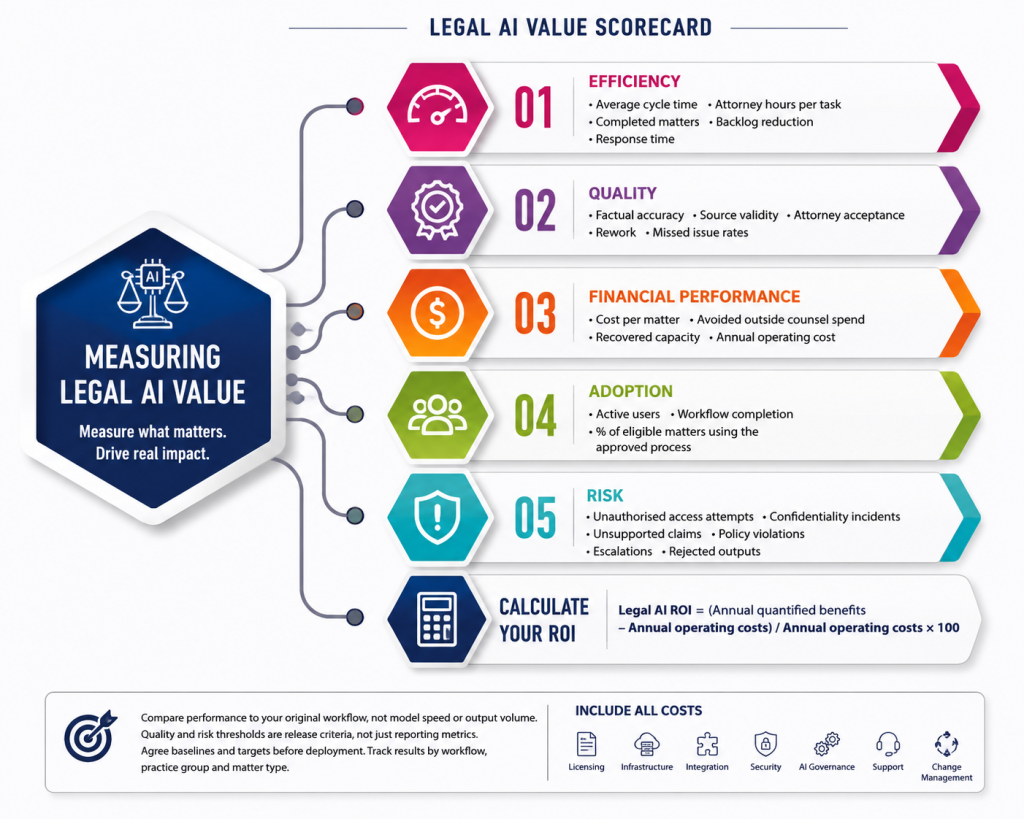
The business case should include licensing, infrastructure, system integration, security, AI governance, support and change-management costs. Baselines and target thresholds should be agreed before deployment, with results reported by workflow, practice group and matter type.
When should legal teams scale AI agents and assistants?
Legal teams should scale only after a workflow has demonstrated stable quality, secure data handling, consistent attorney adoption and measurable benefits across representative matters. Adding users or use cases before these conditions are met usually increases complexity faster than value.
Before scaling, leaders should confirm that:
- Accuracy and acceptance thresholds are consistently met.
- Access controls have been tested against real matter permissions.
- Human review and escalation processes are being followed.
- Monitoring can identify errors, drift and unusual behaviour.
- Costs remain predictable as document and query volumes increase.
- Legal, security, privacy and risk owners have approved expansion.
- Support teams can manage incidents, model changes and user questions.
This is especially important in regulated industries, where even a small expansion can introduce new data, jurisdictional and professional-responsibility risks.
Scaling should proceed by risk tier. Knowledge search and internal summarisation may expand before contract approval, regulatory interpretation or autonomous system actions. This keeps growth aligned with operational maturity rather than user demand alone.
What does a secure legal AI use case look like in financial services?
A secure financial services use case could automate the first review of third-party agreements against approved legal, security and regulatory standards. The workflow would retrieve a contract from the authorised repository, identify relevant clauses, compare them with the organisation’s playbook, flag deviations and route each exception to the appropriate attorney.
The AI would not independently approve the agreement. It would present the source clause, relevant policy, proposed classification and supporting explanation. Counsel would accept, modify or reject each result. The final decision, reviewer identity, evidence and contract version would then be returned to the contract lifecycle management system.
The workflow could measure:
- Review cycle time
- Attorney hours per agreement
- Percentage of standard clauses accepted without rework
- Exception-identification accuracy
- Time from submission to business approval
- Number of escalations and rejected recommendations
This design reduces repetitive clause searching while protecting accountability. Contract review, due diligence, legal research, knowledge search and compliance are strong candidates for secure, matter-aware AI workflows because they combine repeatable steps with clear human review points.
A public IBM legal case illustrates the value of keeping the task narrow. LegalMation used AI to generate early-stage litigation response documents in less than two minutes and reported an estimated cost reduction of approximately 80%, following an extended period of model development, testing and refinement.
FAQs
How do we move a legal AI pilot into production?
Start with one well-defined legal workflow, establish governance, and integrate it with enterprise systems.
Validate security, accuracy, and human oversight before scaling beyond a controlled rollout.
What security controls are required for legal AI?
Implement role-based access, encryption, audit logging, and approved data repositories to protect sensitive legal information.
Support these with governance, vendor assessments, human review, and continuous monitoring.
How do we measure ROI from legal AI?
Compare AI performance against a baseline using cycle time, cost, accuracy, and productivity metrics.
Include technology, governance, and operational costs to measure true business value.
Should legal AI use public cloud, private cloud, or self-hosted models?
The right deployment depends on data sensitivity, compliance requirements, and organizational risk tolerance.
Prioritize secure data control, governance, and integration over the deployment model itself.
What data should legal AI be allowed to access?
Grant AI access only to the data required for approved legal workflows.
Permissions should respect confidentiality, matter restrictions, and enterprise governance policies.
What should legal AI leaders do next?
Focus on one high-value use case with strong governance and measurable outcomes.
Prolifics helps legal organizations scale AI securely from pilot to enterprise production.