Snowflake helped Whatnot transform rapidly growing marketplace data into accessible, trusted business insights. By combining scalable data infrastructure, decentralized ownership, conversational analytics, and intelligent monitoring, Whatnot enabled employees to make faster decisions without placing every data request on a centralized technical team.
Whatnot used Snowflake to build a scalable data foundation that supports rapid business growth, real-time customer experiences, and company-wide analytics. The organization expanded access to trusted data while maintaining visibility into platform performance, governance, and cost.
What Made Whatnot’s Data Challenge Different?
Whatnot is a live shopping marketplace that connects buyers and sellers through livestreamed auctions and interactive shopping experiences.
Every auction bid, purchase, chat message, livestream, and customer interaction produces valuable information. That data supports more than historical reporting. It influences recommendations, seller performance, fraud prevention, customer engagement, and operational decisions.
As Whatnot expanded, the volume and complexity of its data grew. Snowflake reported that billions of data points now move through Whatnot’s environment every day. This created a business need for data that could remain accessible, reliable, and actionable even as usage increased.
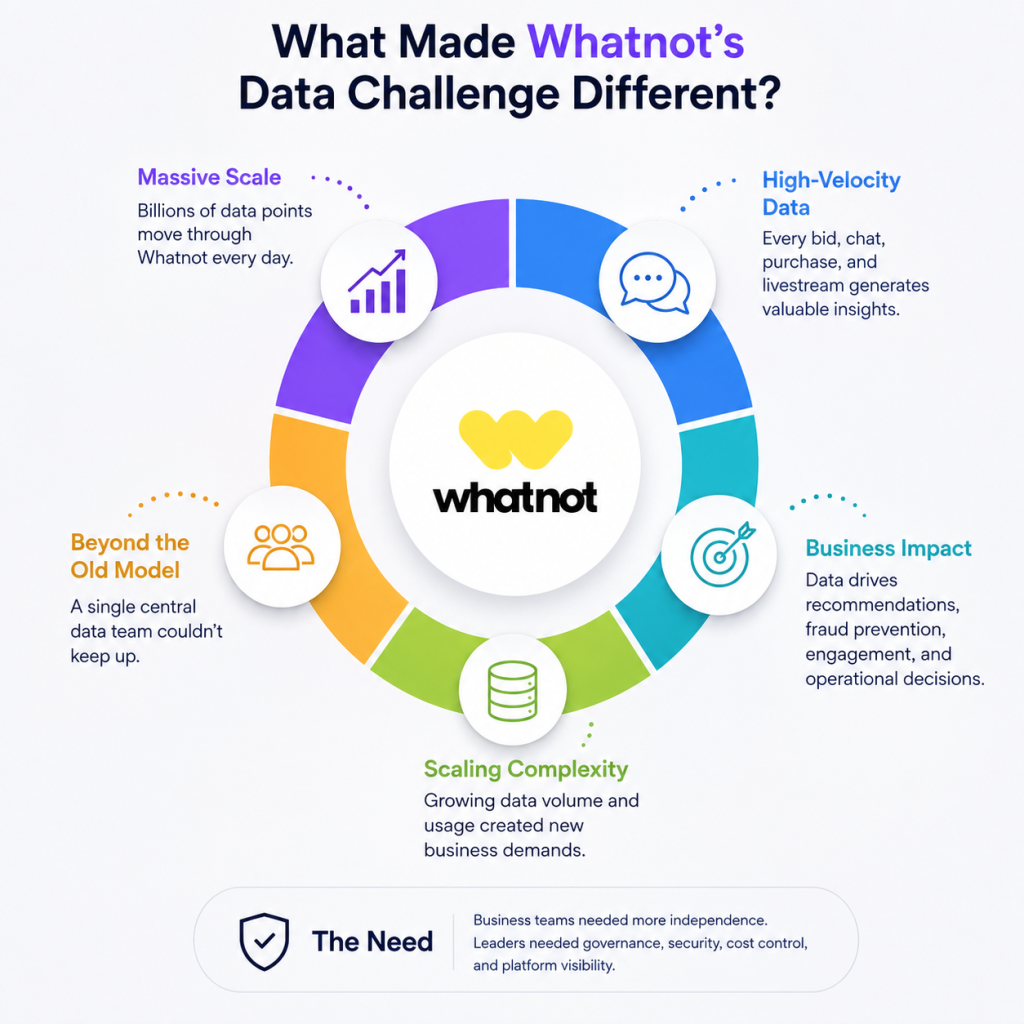
A traditional model in which one central data team handles every request would not scale effectively. Business teams needed greater independence, while technology leaders still needed governance, cost control, security, and platform visibility.
How Did Snowflake Support Whatnot’s Growth?
Whatnot initially managed data through a centralized team. As the company grew, this structure created bottlenecks and increased the time required to answer business questions.
The company responded by adopting a more modular operating model. Individual teams received the ability to manage dedicated Snowflake warehouses and data pipelines based on their specific business requirements.
This decentralized approach helped business units move faster. Teams could explore information, develop use cases, and respond to changing priorities without waiting for every request to pass through one central queue.
However, decentralization also introduced new responsibilities. More users, workloads, warehouses, and pipelines meant that Whatnot needed stronger visibility across its data environment.
The company therefore balanced team independence with shared controls for:
- Data access and security.
- Platform performance.
- Usage and cost management.
- Data ownership.
- Monitoring and incident response.
- Consistent business definitions.
The broader lesson is that scalable infrastructure alone is not enough. Organizations must combine technology with an operating model that establishes clear accountability for how data is created, governed, and used.
How Did Conversational Analytics Expand Data Access?
One of Whatnot’s biggest challenges was the growing number of business questions directed to data scientists.
Marketing, finance, product, operations, and other departments needed quick answers, but many employees did not know SQL or understand the underlying data architecture. Data specialists consequently spent significant time responding to individual requests.
Whatnot addressed this challenge by introducing conversational analytics.
Its approach evolved from an internal Slack bot into a more advanced data companion powered by Snowflake Cortex Agents. Employees could ask business questions using natural language rather than locating tables, writing queries, or waiting for an analyst.
Within 90 days of launching the agentic analytics solution, more than 80% of Whatnot’s 1,000-plus employees were actively using it. Snowflake also reported that 17 departments achieved full active utilization.
This shift made data more accessible across the organization. Teams could investigate business performance, customer behavior, seller trends, and operational questions with less technical friction.
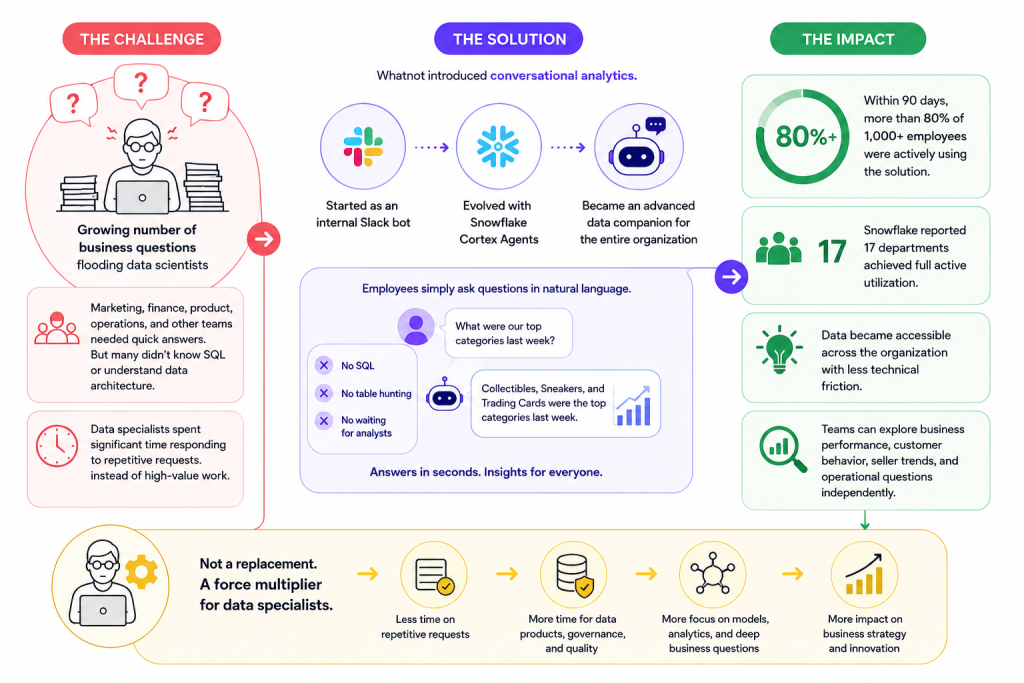
Conversational analytics did not eliminate the need for data specialists. Instead, it allowed those specialists to spend less time handling repetitive requests and more time improving data products, governance, models, and strategic analysis.
Why Is Governance Essential for AI-Powered Analytics?
Making data easier to access does not automatically make every answer reliable.
As conversational analytics expands, unclear definitions, incomplete models, inconsistent ownership, and weak access controls can become more visible. An AI assistant can retrieve information quickly, but the quality of its response still depends on the data, context, and governance behind it.
Whatnot introduced guidance designed to help its AI systems communicate findings responsibly. Its agents separate factual observations from business interpretations, avoid claiming causation based only on correlation, and use appropriately cautious language where the available evidence is not conclusive.
This is an important consideration for any enterprise implementing AI-powered analytics.
A trusted conversational analytics environment requires:
- Governed and well-understood data.
- Consistent business definitions.
- Role-based access controls.
- Clear data ownership.
- Transparent analytical reasoning.
- Responsible AI guidance.
- Continuous quality monitoring.
Snowflake has similarly emphasized that trusted enterprise AI requires connected and governed infrastructure, security designed for autonomous systems, and performance that can support high-volume AI workloads.
How Did Whatnot Improve Platform Visibility?
Expanding access to data also increased the number of workloads operating across Whatnot’s Snowflake environment.
Without sufficient visibility, decentralized environments can create unexpected costs, performance issues, delayed pipelines, and operational risk. Technology teams therefore need to understand how warehouses, queries, pipelines, and users affect the wider platform.
Whatnot worked with Snowflake to improve the speed and accessibility of platform monitoring. Snowflake Trail and its event-table capabilities helped make telemetry available more quickly, while AI-assisted workflows simplified the creation of alerts for performance anomalies and cost changes.
This represents a broader shift in data operations.
Monitoring should not be limited to confirming whether a technical job completed. Organizations need visibility into whether data remains current, whether workloads are performing efficiently, whether costs are changing unexpectedly, and which business processes could be affected by an incident.
When monitoring is connected to business context, teams can respond more effectively and prioritize issues based on their actual operational impact.
What Can Enterprises Learn from Whatnot?
Whatnot’s experience provides several useful lessons for organizations building modern data and AI environments.
Build for business decisions
Data platforms should be designed around the decisions they need to support. Collecting more information provides limited value unless employees can use it to improve customer experiences, operations, revenue, or risk management.
Balance decentralization with governance
Giving teams greater control can accelerate innovation, but independence must operate within clear security, quality, ownership, and cost-management standards.
Make trusted data easier to access
Self-service analytics reduces dependence on centralized data teams. Conversational interfaces can extend that access further by allowing employees to ask questions using familiar business language.
Establish shared business meaning
AI assistants and analytics tools require consistent definitions. Terms such as active customer, revenue, seller performance, and conversion must have a shared meaning across departments.
Treat observability as a business capability
Monitoring should connect technical events to customer, financial, and operational outcomes. This allows teams to focus on the issues that matter most to the organization.
Prepare data before scaling AI
Enterprise AI depends on trusted, governed, and accessible information. Organizations that strengthen their data foundations are better positioned to move AI initiatives from experimentation into production.
How Can Prolifics Help Organizations Modernize with Snowflake?
The Whatnot story demonstrates what becomes possible when scalable data infrastructure is combined with governance, accessibility, and intelligent operations.
Prolifics helps organizations design, migrate, modernize, and manage Snowflake environments that support analytics and enterprise AI. The focus is not simply moving data into a cloud platform. It is creating a trusted foundation that connects data investments to measurable business outcomes.
Our Snowflake capabilities can help organizations:
- Assess current data environments and modernization priorities.
- Migrate legacy data platforms and workloads.
- Build scalable data engineering pipelines.
- Establish governance and security controls.
- Enable governed self-service analytics.
- Improve data quality and platform observability.
- Prepare enterprise data for AI and machine learning.
- Optimize Snowflake performance and operating costs.
Prolifics combines Snowflake capabilities with industry knowledge, data engineering, integration, governance, and AI expertise to help organizations reduce complexity and accelerate time to insight.
Turning Data Growth into Business Value
Rapid data growth does not automatically create better decisions. Organizations need a scalable platform, trusted information, clear ownership, and accessible analytical tools.
Whatnot’s Snowflake journey shows how these capabilities can work together. Decentralized infrastructure helped teams move faster. Conversational analytics expanded access to insight. Governance established boundaries for responsible use. Intelligent monitoring improved visibility across an increasingly complex environment.
The result is a data environment designed not only to manage growth, but also to turn that growth into business value.
As enterprises prepare for AI-powered operations, the same principle will apply. The organizations that create trusted, governed, and accessible data foundations will be best positioned to transform enterprise information into confident decisions and scalable AI outcomes.
Take the Next Step
Build a trusted, scalable, and AI-ready data foundation with Prolifics and Snowflake.
Frequently Asked Questions
How did Snowflake help Whatnot manage rapid growth?
Snowflake provided a scalable data foundation that allowed Whatnot to support growing workloads, decentralize data ownership, expand analytics access, and improve visibility into platform performance and costs.
What are Snowflake Cortex Agents?
Snowflake Cortex Agents help users interact with enterprise data through conversational interfaces. They can interpret natural-language questions, identify relevant data, and support governed analytical workflows.
Why is data governance important for conversational analytics?
Conversational analytics can expand data access significantly. Governance helps ensure that users receive information based on consistent definitions, appropriate permissions, reliable data, and responsible analytical practices.
What is the main lesson from Whatnot’s data journey?
The main lesson is that technology, governance, and organizational adoption must advance together. A scalable platform creates capacity, but trusted data and accessible analytics turn that capacity into measurable business value.