A manufacturer invested in advanced analytics, yet teams still waited days for reliable insights. Its data remained fragmented; models struggled in production, and leaders questioned returns. Startups face the same pressure, only with fewer resources and less room for error.
AI and machine learning innovation helps organizations turn connected data into predictions, decisions, and automated actions. Artificial intelligence defines the broader capability, while machine learning supplies the adaptive models that learn from patterns and improve performance over time.
Why Are Enterprises Prioritizing AI and Machine Learning Now?
Enterprise interest has moved beyond experimentation, but execution still creates a wide gap between adoption and value. McKinsey reported that 88 percent of surveyed organizations used AI in at least one business function during 2025. However, only 7 percent had fully scaled AI across their organizations.
That gap shows why buying an AI platform does not create an operating capability. Companies need integrated data, valuable use cases, governance, MLOps, security, adoption, and executive ownership.
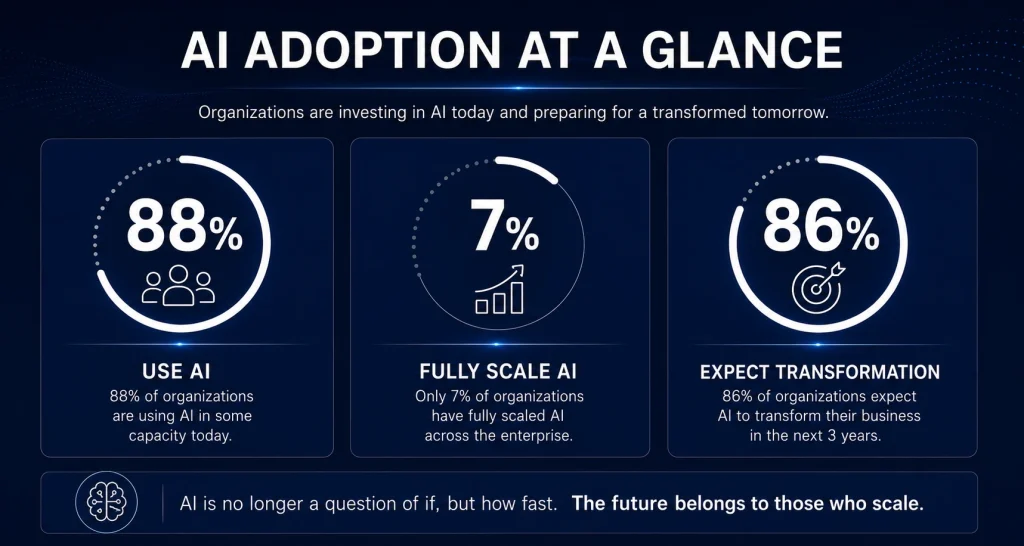
The World Economic Forum found that 86 percent of surveyed employers expect AI and information processing technologies to transform their businesses by 2030.
Prolifics helps enterprises connect trusted data, machine learning, automation, and scalable AI engineering to move high-value use cases from strategy into production securely at scale.
What Are the Core Principles of AI and Machine Learning?
Artificial intelligence enables systems to perform tasks that normally require human intelligence. Machine learning gives those systems a method for learning patterns from data. Enterprise success depends on aligning both technologies with defined outcomes, quality information, and responsible operational controls.
These four principles guide effective enterprise AI and ML programmers:
- Business outcomes should define every model, workflow, and investment decision.
- Trusted data creates reliable predictions, automation, and measurable enterprise value.
- Continuous learning keeps models accurate as enterprise operating conditions change.
- Strong governance protects privacy, security, fairness, compliance, and stakeholder confidence.
AI vs Machine Learning: What’s the Difference?
Artificial intelligence represents the broader discipline of creating systems that perform intelligent tasks. Machine learning forms a specialized branch of AI that learns relationships from data instead of following only fixed instructions.
| Business Lens | Artificial Intelligence | Machine Learning |
| Primary purpose | Simulates intelligent behaviour and supports autonomous actions. | Learn patterns and produce predictions from data. |
| Typical capabilities | Reasoning, language, vision, planning, and decision support. | Classification, forecasting, clustering, recommendations, and anomaly detection. |
| Enterprise example | A service assistant coordinates requests across business systems. | A prediction model identifies customers likely to leave. |
| Success measure | Task quality, business impact, safety, and user trust. | Accuracy, precision, recall, drift, latency, and business value. |
Companies combine models, rules, automation, integration, and human oversight into intelligent operating solutions.
How Do AI and ML Complement Each Other in Enterprise Environments?
Enterprise environments require more accurate models. AI coordinates reasoning, interactions, and actions across processes, while machine learning supplies predictions based on operational evidence. Their integration creates systems that understand context, anticipate outcomes, and support consistent execution.
The combined approach strengthens enterprise performance in several practical ways:
- Machine learning detects patterns that artificial intelligence converts into actions.
- AI workflows apply model predictions across connected enterprise business processes.
- Feedback loops improve model performance and operational decision quality continuously.
- Human oversight guides exceptions, ethics, accountability, and responsible strategic judgement.
The benefits of combining AI and machine learning become strongest when organizations connect models directly to workflows. A churn prediction creates limited value inside a dashboard. It creates measurable value when a customer platform automatically recommends the next appropriate retention action.
How Does Machine Learning Power Artificial Intelligence?
Machine learning powers artificial intelligence by transforming data into adaptive decision models. Instead of programming every possible response, teams train algorithms to recognize relationships, estimate outcomes, and improve through evaluation.
Prolifics support this process through data engineering, predictive AI, real-time analytics, machine learning, MLOps, natural language processing, governance, and enterprise integration.
These capabilities explain how machine learning powers artificial intelligence:
- Supervised learning predicts outcomes using accurately labeled historical business data.
- Unsupervised learning reveals hidden segments, relationships, and unusual behavioral patterns.
- Reinforcement learning improves actions through feedback, rewards, and repeated evaluation.
- MLOps manages deployment, monitoring, retraining, governance, and model lifecycle controls.
Machine learning enables adaptation, but data quality determines its value. Incomplete, biased, delayed, or inconsistent data produces unreliable outcomes.
How Have AI and Machine Learning Evolved?
AI first relied heavily on programmed rules and expert systems. Greater computing power, cloud platforms, connected data, improved algorithms, and modern engineering practices gradually expanded its practical business value.
Five developments shaped today’s enterprise AI landscape:
- Rule-based systems automated decisions within narrow, predictable enterprise operating conditions.
- Statistical learning introduced scalable forecasting, classification, and behavioral pattern recognition.
- Cloud computing expanded affordable storage, processing, experimentation, and model deployment.
- Deep learning improved language, vision, audio, and complex prediction capabilities.
- MLOps connected model development with secure, repeatable enterprise production operations.
Leaders now judge AI through margins, resilience, customer outcomes, productivity, and speed to market.
How Can Organizations Turn Data into Intelligent Business Decisions?
AI and ML create value when organizations connect reliable data to actionable decisions.
Enterprise Data Collection, Integration, and Preparation
Strong data foundations help models learn from complete business context:
- Integrate structured and unstructured data securely across trusted enterprise platforms.
- Standardize data definitions, formats, ownership, quality checks, and access controls.
- Prepare reusable datasets that support training, testing, and operational inference.
Identification of Trends, Risks, and Growth Opportunities
Machine learning helps teams detect signals that traditional reporting may miss:
- Detect changing customer behaviors before they affect retention or revenue.
- Identify operational anomalies that indicate emerging cost or service risks.
- Reveal underserved segments, demand patterns, and profitable growth opportunities early.
Application of Predictive Analytics for Strategic Planning
Predictive analytics helps leaders evaluate likely outcomes before committing resources:
- Forecast future demand using historical performance, seasonality, and external indicators.
- Model financial scenarios to test investment assumptions and downside exposure.
- Estimate customer, asset, and operational outcomes accurately for proactive planning.
Faster, Data-Informed, and More Accurate Decisions
Intelligent decision systems bring timely evidence directly into operational workflows:
- Deliver relevant predictions within the applications employees already use daily.
- Automate routine decisions while routing complex exceptions toward human specialists.
- Measure outcomes continuously and refine models using current performance feedback.
Where Do Enterprises Apply AI and Machine Learning?
Enterprise applications work best when they address a defined decision, process, or customer needs. The best AI and machine learning tools for business depend on data maturity, architecture, security requirements, operating scale, and expected outcomes.
Companies commonly apply AI and ML across these high-value areas:
- Personalization improves recommendations, engagement, service relevance, and long-term customer retention.
- Fraud models detect suspicious behavior and priorities of investigations more accurately.
- Predictive maintenance identifies equipment risks before failures interrupt production schedules.
- Healthcare, finance, and retail teams improve specialized daily operational decisions.
- AIOps and intelligent testing improve software reliability and delivery speed.
Tool selection should follow use-case design, not market excitement. The right architecture connects data, modelling, orchestration, observability, integration, and governance without unnecessary complexity.
How Do AI and ML Drive Automation, Efficiency, and Innovation?
Automation removes repetitive effort, reduces errors, and accelerates processes. AI extends that value by interpreting information, predicting outcomes, and supporting complex decisions.
Organizations can use AI-enabled automation to achieve several outcomes:
- Automate repetitive business processes involving documents, requests, checks, and approvals.
- Improve employee productivity through intelligent recommendations, summaries, and decision support.
- Optimize enterprise resources by forecasting workloads, capacity, demand, and constraints.
- Accelerate product innovation through rapid testing and deeper customer insight.
- Create intelligent services, pricing models, and new digital revenue opportunities.
Successful automation keeps people involved where judgement, empathy, accountability, or regulatory interpretation of matters.
How Should Businesses Implement AI and ML in Their Strategy?
Organizations often ask how to implement AI and ML in your business strategy without creating disconnected pilots. The answer starts with business value, then connects data, technology, governance, people, and operating processes around that objective.
The following sequence supports practical, scalable implementation:
- Define measurable business problems clearly before selecting platforms or algorithms.
- Assess data quality, availability, ownership, security, and technical integration requirements.
- Priorities use cases using business value, feasibility, risk, and readiness.
- Build small production-focused releases with clear technical performance success measures.
- Establish MLOps, governance, monitoring, retraining, and responsible human oversight processes.
- Scale proven capabilities through reusable architecture, skills, and operating standards.
Executive sponsorship should connect investment with accountability. Cross-functional teams should unite domain, data, engineering, security, compliance, product, and operational expertise.
What Is the Future of AI and Machine Learning Innovation in 2026?
The future of AI and machine learning innovation in 2026 will center on connected enterprise systems that combine predictive intelligence, automation, real-time data, domain knowledge, and governed human oversight.
Five priorities will shape the next stage of enterprise adoption:
- Intelligent systems will coordinate decisions across applications, teams, and workflows.
- Human and AI collaboration will strengthen judgement, speed, and consistency.
- Reusable platforms will scale trusted AI capabilities across organizational functions.
- Workforce programmed will develop data literacy, oversight, and applied skills.
- Sustainable strategies will balance innovation, cost, governance, and measurable value.
The strongest organizations will treat AI as an operating capability, modernize data foundations, reuse engineering standards, monitor outcomes, and redesign work.
How Can Prolifics Help Enterprises Scale AI and Machine Learning?
Prolifics help organizations move from fragmented data and isolated experiments toward governed, production-ready AI. Its capabilities span strategy, data engineering, predictive AI, real-time analytics, machine learning, MLOps, natural language processing, automation, integration, governance, implementation, and managed services.
This approach connects reliable foundations, valuable use cases, production models, business workflows, and continuous optimization, reducing the gap between experimentation and measurable impact.
Conclusion
Artificial intelligence and machine learning create the greatest value around real business decisions. AI provides the framework for intelligent action, while machine learning converts data into predictions that improve through experience.
Trusted data, clear outcomes, responsible governance, and scalable engineering help teams move beyond pilots, improve operations, strengthen customer experiences, and build competitive advantage through AI and machine learning integration for business innovation.