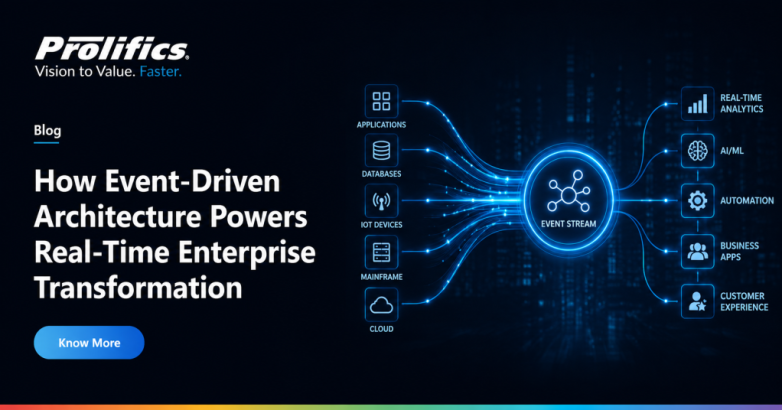
Event-driven architecture is an integration approach that enables organizations to capture, process, and act on business events in real time. By connecting applications, data, AI systems, and operational workflows through event streams, enterprises can improve decision-making, accelerate automation, and modernize legacy systems without disrupting critical operations.
Organizations adopting event-driven architecture gain real-time visibility across business processes, support AI-powered decision-making, and create scalable digital ecosystems that respond instantly to changing conditions.
Quick answer:
Event-Driven Architecture (EDA) is a software architecture pattern where systems communicate through real-time events rather than direct point-to-point integrations. It enables enterprises to process data as it is generated, support intelligent automation, improve customer experiences, modernize legacy applications, and provide AI systems with continuously updated operational data.
What Is Event-Driven Architecture?
Event-driven architecture is an architectural approach that allows systems, applications, and services to communicate through events. An event represents a significant business occurrence, such as a customer placing an order, a payment being processed, a medical record being updated, or a shipment changing status.
Unlike traditional integration models, where applications communicate directly with one another, Event-Driven Architecture introduces a decoupled approach. Systems publish events to a streaming platform, and interested applications subscribe to those events independently.
Event-driven architecture is a software design pattern that enables applications to react to business events in real time through asynchronous communication mechanisms. This approach reduces system dependencies, improves scalability, and enables organizations to process large volumes of operational data as it occurs.
Modern event streaming platforms such as Confluent, built on Apache Kafka, provide enterprise-grade capabilities including stream processing, data governance, schema management, hybrid deployment support, and AI-ready data pipelines. Combined with IBM’s integration, hybrid cloud, automation, and AI capabilities, organizations can create a foundation for real-time enterprise operations.
Why Is Event-Driven Architecture Important for Enterprise AI?
Enterprise AI depends on fresh, contextual, and continuously updated data. Event-Driven Architecture provides the real-time data foundation required to support intelligent automation and AI-driven decision-making.
Many organizations still operate with batch-based systems that process information hours after events occur. This delay creates challenges for fraud detection, predictive analytics, customer engagement, and operational monitoring.
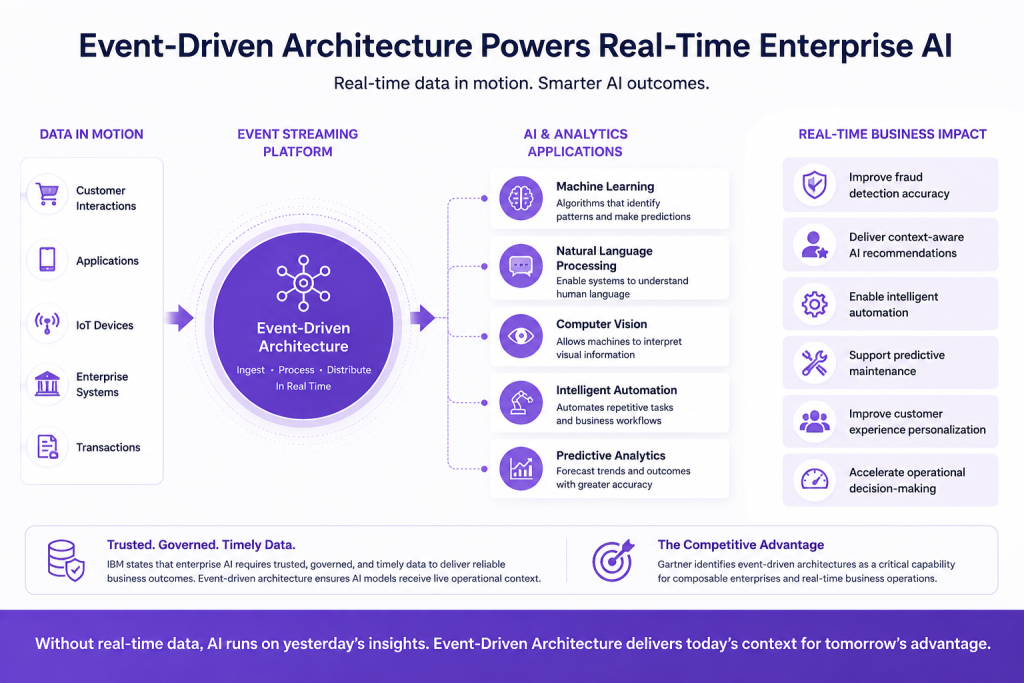
According to IBM, enterprise AI initiatives require trusted, governed, and timely data to generate reliable business outcomes. Event streaming enables organizations to continuously ingest and distribute operational data across AI models, analytics platforms, and automation systems.
As a result, AI systems can move beyond delayed insights and act on live business context. Event-Driven Architecture helps enterprises make faster decisions, improve automation, and respond to risks and opportunities as they happen. Organizations that can continuously turn data into action will be better positioned to innovate, scale AI initiatives, and compete in an increasingly digital economy.
How Does Event-Driven Architecture Support Digital Transformation?
Event-Driven Architecture supports digital transformation by connecting legacy systems, cloud platforms, AI applications, and enterprise data sources through a common real-time integration framework.
Many organizations face challenges caused by:
- Legacy applications
- Siloed data systems
- Batch processing dependencies
- Complex point-to-point integrations
- Cloud migration complexity
- Disconnected customer experiences
Traditional integration models often become difficult to scale as organizations add new applications and services.
Event-driven systems provide a more flexible approach. Applications publish events once and allow multiple consumers to access them simultaneously. This reduces integration complexity while improving agility.
IBM and Confluent enable organizations to establish a smart data platform that supports both data at rest and data in motion. This allows enterprises to connect operational systems, analytics platforms, AI models, and automation tools within a unified architecture.
For digital transformation leaders, this means faster modernization initiatives, improved operational visibility, and reduced dependence on rigid legacy integration patterns.
Which Industries Benefit Most from Event-Driven Architecture?
Industries with high transaction volumes, complex operational environments, and strict compliance requirements often realize the greatest value from Event-Driven Architecture.
Financial Services
Banks use event streaming to monitor transactions in real time, identify fraud, improve compliance monitoring, and modernize core banking systems. Real-time transaction monitoring enables organizations to detect anomalies within milliseconds rather than hours.
Healthcare
Healthcare organizations use event-driven systems to connect patient records, improve care coordination, enable real-time clinical insights, and support AI-assisted diagnostics. Real-time patient event streaming helps improve operational efficiency and patient outcomes.
Retail and E-Commerce
Retailers use event streaming for inventory management, personalized recommendations, and omnichannel customer experiences. Real-time inventory visibility helps reduce stockouts while improving customer satisfaction.
Manufacturing and Supply Chain
Manufacturers leverage IoT event streaming, predictive maintenance, and real-time logistics monitoring to improve operational efficiency and strengthen supply chain resilience.
How Can Organizations Implement Event-Driven Architecture Successfully?
Successful Event-Driven Architecture initiatives require a structured approach that balances technology, governance, scalability, and business objectives.
6-Step Event-Driven Transformation Checklist
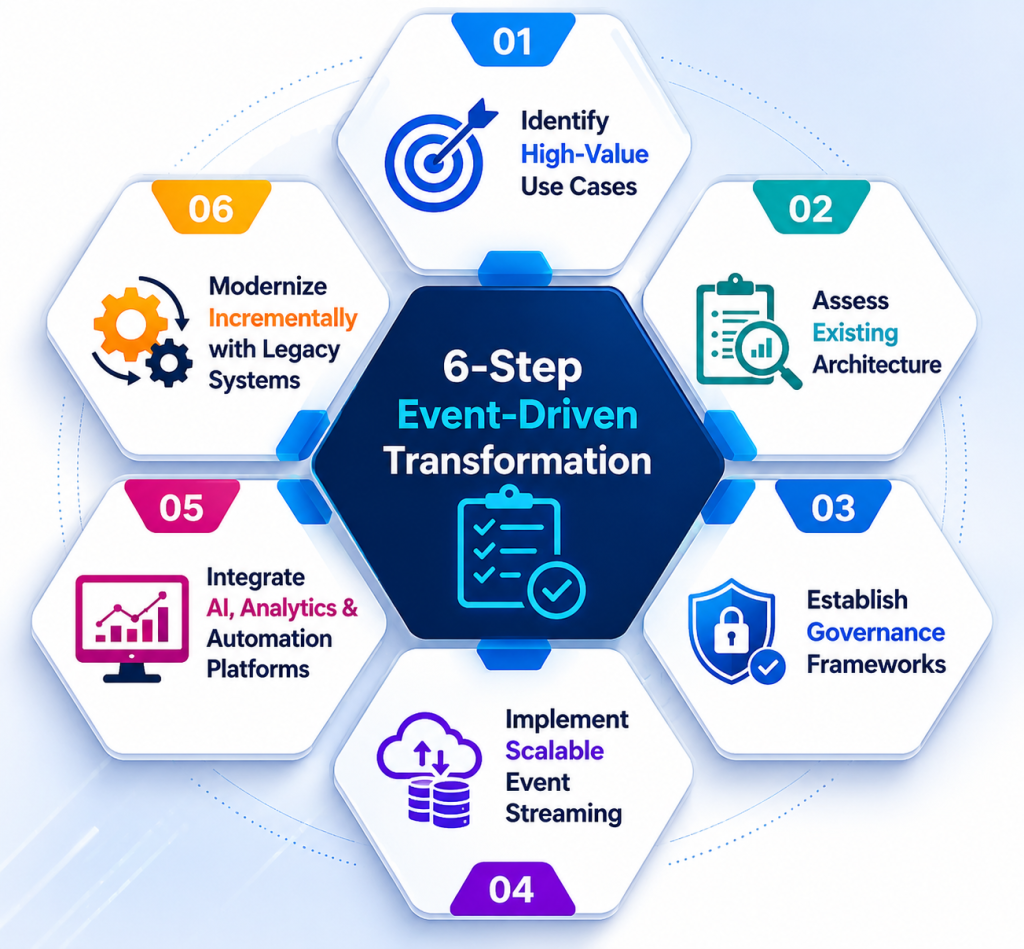
Organizations that align business and IT stakeholders early in the process often achieve faster adoption and stronger business outcomes. Shared KPIs, governance visibility, and continuous modernization planning are critical success factors.
What Is the Difference Between Traditional Integration and Event-Driven Architecture?
| Capability | Traditional Integration | Event-Driven Architecture |
| Data Processing | Batch-based | Real-time |
| System Coupling | Tight coupling | Loose coupling |
| Scalability | Limited | Highly scalable |
| AI Readiness | Delayed data availability | Continuous data streams |
| Customer Experience | Reactive | Responsive and personalized |
| Modernization Support | Complex migrations | Incremental modernization |
| Operational Visibility | Delayed insights | Live visibility |
| Automation | Limited responsiveness | Event-triggered automation |
This shift from batch processing to real-time event processing is one of the key drivers behind enterprise modernization and AI adoption strategies.
Why Do Enterprises Need a Strategic Partner for Event-Driven Transformation?
Technology alone does not guarantee transformation success.
Organizations frequently struggle with architecture modernization, governance requirements, cloud migration challenges, integration complexity, data silos, and skills shortages.
As a strategic IBM partner, Prolifics helps enterprises design, implement, modernize, and scale event-driven ecosystems using IBM and Confluent technologies. Capabilities include:
- Event-driven architecture consulting
- Enterprise integration modernization
- Hybrid cloud transformation
- AI and data integration
- Mainframe modernization
- Managed services and optimization
By combining deep expertise in system integration, cloud migration, enterprise automation, and AI readiness, Prolifics helps organizations accelerate transformation while reducing risk.
FAQ
What is Event-Driven Architecture in simple terms?
Event-Driven Architecture is a design approach where systems communicate using real-time events. Instead of applications directly calling each other, they publish and subscribe to event streams, enabling faster processing, better scalability, and real-time business responses.
How does Event-Driven Architecture improve AI performance?
Event-Driven Architecture provides AI systems with continuously updated operational data. This improves model accuracy, enables real-time decision-making, and supports intelligent automation by ensuring AI applications operate on current business information.
Is Event-Driven Architecture suitable for legacy systems?
Yes. Event-driven architecture allows organizations to modernize legacy systems incrementally. Existing applications can publish events without requiring complete replacement, reducing risk and preserving previous technology investments.
What technologies are commonly used for Event-Driven Architecture?
Apache Kafka is one of the most widely adopted event streaming technologies. Enterprise platforms such as Confluent build on Kafka and provide governance, security, hybrid deployment, and large-scale operational capabilities.