Every IT leader has faced the same challenge. A business pushes for innovation and faster releases, while aging systems, legacy code, and growing maintenance demands quietly slow everything down.
The result is a constant battle between building for the future and fixing problems from the past. At Prolifics, we help organizations use intelligent automation and AI-driven solutions to modernize operations, reduce technical debt, and improve business outcomes. In this article, we explore how AI agents are helping enterprises overcome technical debt while lowering operational costs across the organization.
Understanding Technical Debt in Modern Enterprises
Technical debt represents the accumulated cost of shortcuts, outdated architectures, inefficient coding practices, and delayed modernization efforts. While organizations often accept technical debt to accelerate delivery, unmanaged debt eventually increases maintenance costs, slows innovation, and introduces operational risks.
Modern enterprises face growing pressure to maintain legacy systems while simultaneously supporting cloud-native applications, AI initiatives, and evolving customer expectations. As systems become increasingly interconnected, technical debt impacts not only development teams but also business performance and customer experiences.
The following factors commonly contribute to technical debt accumulation:
- Legacy applications limit scalability, flexibility, and modernization initiatives today.
- Outdated codebases increase maintenance efforts and defect resolution costs.
- Manual processes create inefficiencies across development and operations teams.
- Poor documentation reduces knowledge sharing and troubleshooting effectiveness.
What Are AI Agents and Why Do They Matter?
AI agents are intelligent software systems capable of performing tasks autonomously, making decisions based on context, learning from data, and continuously improving outcomes. Unlike traditional automation tools that follow predefined rules, AI agents analyze patterns, adapt to changing environments, and execute actions with minimal human intervention.
Within enterprise technology environments, AI agents can monitor systems, identify anomalies, optimize workflows, recommend improvements, generate code, and automate repetitive activities. These capabilities make them valuable assets for organizations seeking greater efficiency and resilience.
The rise of generative AI, machine learning, and advanced language models has significantly expanded what AI agents can accomplish. Today, enterprises use AI agents to support software engineering, infrastructure management, cybersecurity, cloud operations, and customer service functions.
Key capabilities of modern AI agents include:
- Analyze complex systems and identify optimization opportunities continuously.
- Automate repetitive development and operational tasks with precision.
- Detect risks before they impact business-critical technology environments.
- Generate recommendations using contextual enterprise data and insights.
- Improve productivity through intelligent decision support and automation.
How AI Agents Help Reduce Technical Debt
Technical debt often accumulates because organizations lack the time, resources, or visibility required to continuously improve existing systems. AI agents address these challenges by proactively identifying issues, prioritizing remediation efforts, and automating improvement activities.
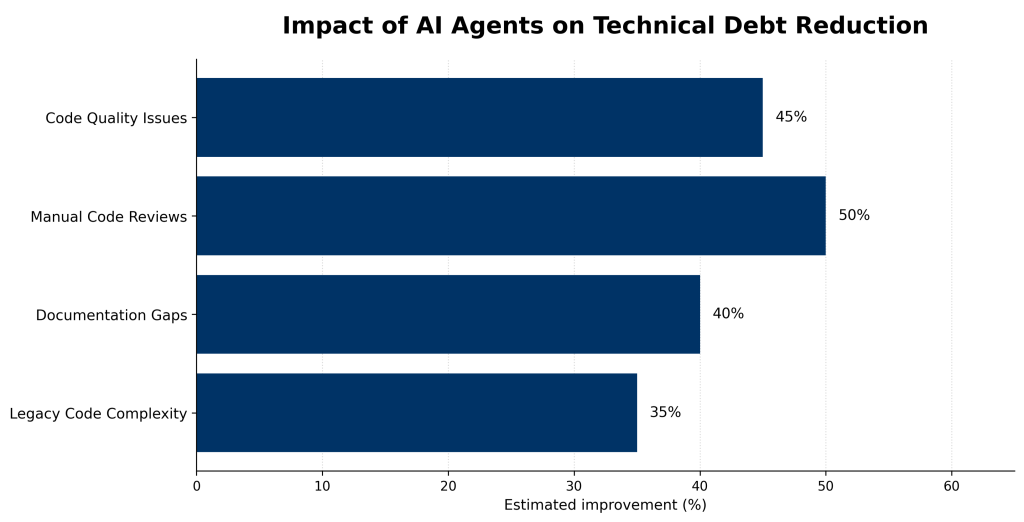
By integrating AI throughout development and operations workflows, enterprises can systematically address debt while preventing future accumulation. This approach creates a sustainable path toward modernization and operational excellence.
The following areas demonstrate how AI agents reduce technical debt:
- Identify code vulnerabilities and architectural weaknesses automatically early.
- Support intelligent code reviews across large software portfolios.
- Enable AI-powered code refactoring tools for modernization initiatives.
- Automate documentation updates and knowledge management activities effectively.
Organizations increasingly adopt managing technical debt with AI automation strategies because these technologies help teams address issues faster while improving software quality. This capability has become a critical component of AI agents in software development lifecycle initiatives.
How AI Agents Drive Operational Cost Savings
Operational expenses continue to rise as organizations manage growing application portfolios, cloud environments, security requirements, and customer expectations. Traditional approaches often require significant manual effort, creating inefficiencies that increase costs over time.
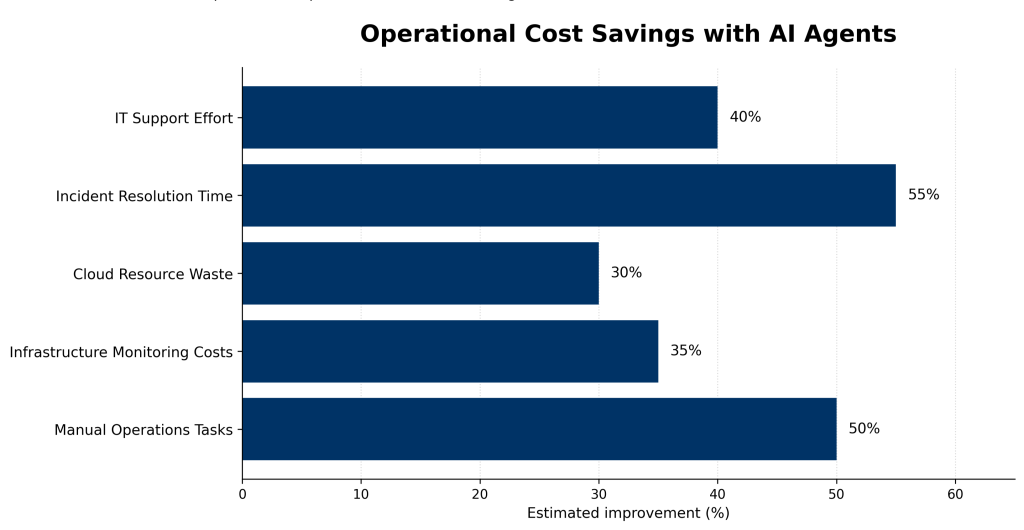
AI agents help enterprises reduce operational expenses by automating routine activities, improving resource utilization, and accelerating issue resolution. They provide continuous monitoring and intelligent decision-making capabilities that enable teams to focus on higher-value strategic initiatives.
Organizations implementing how AI agents reduce operational costs strategies often experience measurable improvements in productivity, efficiency, and technology performance. AI-driven automation minimizes repetitive work while enhancing service quality and operational resilience.
AI agents contribute to operational savings through several mechanisms:
- Automating incident detection and remediation across enterprise systems.
- Optimizing cloud resources for improved utilization and cost control.
- Reducing manual support efforts through intelligent self-service capabilities.
- Accelerating troubleshooting with predictive analytics and recommendations.
- Improving infrastructure efficiency through continuous performance monitoring.
These benefits make AI automation to reduce IT operational costs a key priority for technology leaders focused on maximizing return on investment.
Enterprise Use Cases for AI Agents
Organizations across industries are deploying AI agents to modernize operations, improve software quality, and optimize technology investments. These use cases continue to expand as AI capabilities mature and adoption accelerates.
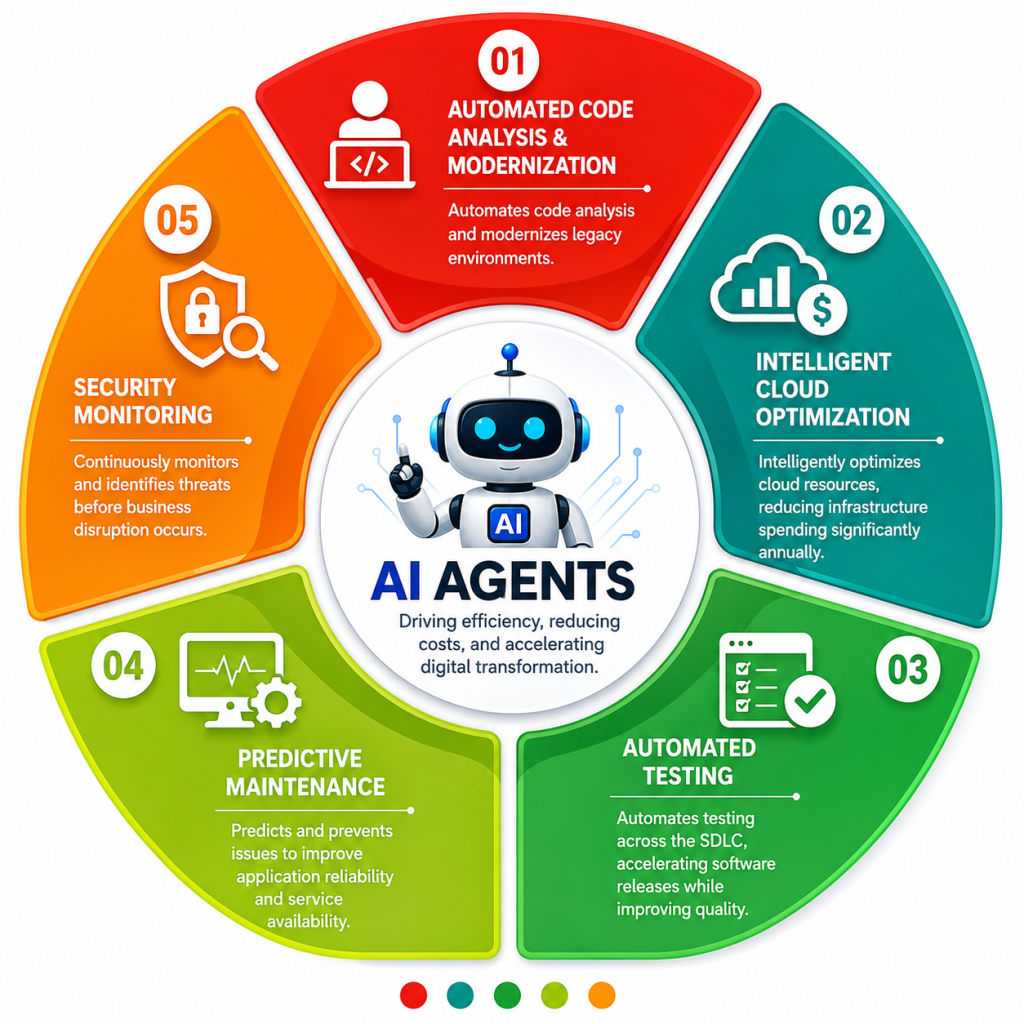
Common enterprise applications include:
- Automated code analysis and modernization across legacy environments.
- Intelligent cloud optimization reducing infrastructure spending significantly annually.
- Predictive maintenance improving application reliability and service availability.
- Security monitoring identifying threats before business disruption occurs.
- Automated testing accelerating software releases while improving quality.
Many enterprises view these capabilities as essential components of AI agents for enterprise cost optimization programs that support long-term digital transformation goals.
Key Considerations for Successful AI Agent Adoption
While AI agents deliver substantial benefits, organizations must implement them strategically to maximize value. Successful adoption requires clear governance, high-quality data, defined objectives, and alignment with broader business priorities.
Technology leaders should evaluate current processes, identify automation opportunities, and establish measurable success metrics before deploying AI-driven solutions. This structured approach helps ensure sustainable outcomes and minimizes implementation risks.
Organizations should focus on the following considerations:
- Establish governance frameworks supporting responsible AI implementation practices.
- Prioritize high-impact use cases delivering measurable business outcomes.
- Maintain strong data quality across integrated enterprise systems.
- Align AI initiatives with modernization and transformation objectives.
- Continuously monitor performance and refine automation strategies accordingly.
By addressing these areas, organizations can successfully implement the best AI tools to eliminate technical debt 2026 and beyond.
The Future of AI-Driven IT Operations
AI agents will continue transforming how organizations manage technology environments. As generative AI, machine learning, and autonomous systems evolve, enterprises will gain access to increasingly sophisticated capabilities that improve efficiency and decision-making.
Future AI agents will move beyond task automation to become strategic partners capable of orchestrating workflows, optimizing infrastructure, and proactively recommending business improvements. This evolution will further reduce technical debt while accelerating innovation.
Organizations that invest in AI-driven modernization today position themselves to remain competitive in an increasingly digital economy. The ability to automate complex processes, improve software quality, and reduce operational expenses will become a defining factor for long-term success.
As adoption grows, AI agents in software development lifecycle processes will become standard practice, enabling organizations to build more resilient, scalable, and cost-effective technology ecosystems.
Conclusion
Technical debt and rising operational costs can slow innovation and limit business growth. By leveraging AI agents for reducing tech debt and AI automation to reduce IT operational costs, organizations can modernize systems, improve efficiency, and accelerate delivery. As AI capabilities continue to evolve, businesses that embrace intelligent automation today will build more resilient, scalable, and cost-effective technology environments for the future.
Frequently Asked Questions
What are AI agents, and how do they help reduce technical debt?
AI agents are intelligent software systems that automate tasks, analyze code, identify risks, and recommend improvements. They help organizations reduce technical debt by detecting code issues early, supporting code refactoring, improving documentation, and automating repetitive development activities.
How do AI agents reduce operational costs for enterprises?
AI agents reduce operational costs by automating manual processes, optimizing cloud resources, accelerating incident resolution, and improving infrastructure monitoring. These capabilities allow IT teams to focus on strategic initiatives while lowering overall maintenance and support expenses.
Can AI agents work with legacy applications and existing enterprise systems?
Yes. Modern AI agents can integrate with existing applications, development tools, and operational platforms. Organizations often use AI agents to assess legacy environments, identify modernization opportunities, and support gradual transformation without disrupting critical business operations.
How does Prolifics help organizations implement AI agents to reduce tech debt?
Prolifics helps organizations identify high-impact automation opportunities, modernize legacy systems, and implement AI-driven solutions across the software development lifecycle. Our experts combine AI, automation, cloud, and application modernization capabilities to reduce technical debt while improving software quality and operational efficiency.
Why should organizations partner with Prolifics for AI-driven modernization?
Prolifics brings deep expertise in digital transformation, intelligent automation, application modernization, data, and AI. We work closely with clients to develop practical AI strategies that reduce operational costs, improve system performance, and deliver measurable business value while supporting long-term growth objectives.