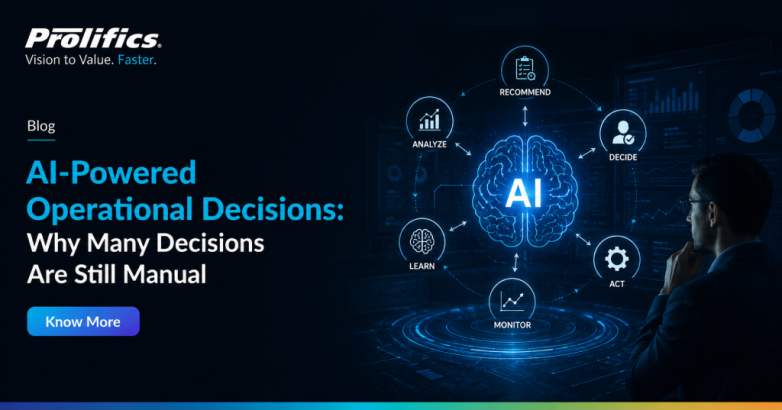
AI-powered operational decisions help organizations automate routine business decisions by combining data, analytics, business rules, and artificial intelligence. Despite significant investments in digital transformation, many enterprises still rely on spreadsheets, emails, manual reviews, and disconnected systems to make operational decisions, creating delays, inconsistencies, and missed opportunities.
Organizations that implement AI-powered operational decisions can improve speed, accuracy, and scalability while allowing employees to focus on higher-value work. By embedding intelligence directly into workflows, businesses can move from reactive decision making to proactive, data-driven operations.
What Are AI-Powered Operational Decisions?
AI-powered operational decisions use artificial intelligence, automation, and real-time data to support or automate routine business decisions. While many organizations still depend on manual processes due to legacy systems, fragmented data, and governance concerns, AI can help improve decision speed, consistency, compliance, and operational efficiency across healthcare, finance, insurance, retail, and public sector environments.
AI-powered operational decisions are business decisions made or supported by artificial intelligence within day-to-day operations. These decisions typically involve repetitive, high-volume activities such as approving transactions, prioritizing customer requests, routing service tickets, forecasting inventory, processing claims, or managing workflows.
AI-powered operational decisions are the use of artificial intelligence, machine learning, predictive analytics, and business rules to evaluate data and recommend or execute actions within operational processes. Unlike strategic decisions made by executives, operational decisions occur continuously across business functions and directly impact efficiency, customer experience, and business outcomes.
Many enterprises have invested heavily in digital transformation initiatives, cloud migration programs, enterprise automation, and system integration projects. However, the actual decision-making process often remains dependent on human intervention. Employees spend valuable time gathering information from multiple systems, validating data, and determining the next best action.
According to IBM research, organizations increasingly recognize that AI delivers the greatest value when embedded directly into business processes rather than deployed as standalone technology. This shift is driving interest in operational decision intelligence and AI-driven automation.
Why Are Operational Decisions Still Manual in Most Organizations?
Operational decisions remain manual because many organizations have modernized technology without fully modernizing how decisions are made.
Legacy applications, siloed data sources, fragmented workflows, and inconsistent business rules create significant barriers to automation. Even organizations with advanced analytics platforms often struggle to operationalize insights at scale.
Several factors contribute to manual decision making:
- Data exists across multiple systems without unified visibility.
- Business rules are undocumented or inconsistently applied.
- Compliance requirements require oversight and auditability.
- Legacy systems lack modern integration capabilities.
- Employees rely on institutional knowledge rather than standardized processes.
A healthcare provider, for example, may have patient information spread across electronic health records, scheduling systems, insurance databases, and billing applications. Staff often manually review information from multiple sources before making decisions regarding authorizations, scheduling, or patient prioritization.
Similarly, insurance organizations frequently depend on manual reviews for claims processing, fraud detection, and policy administration, despite having access to large volumes of structured and unstructured data.
Research from Gartner suggests that organizations continue to face challenges moving from descriptive analytics to automated decision execution. Many enterprises generate insights but still rely on human intervention to determine actions.
The result is slower response times, inconsistent outcomes, increased operational costs, and limited scalability.
How Does AI Improve Operational Decision Making?
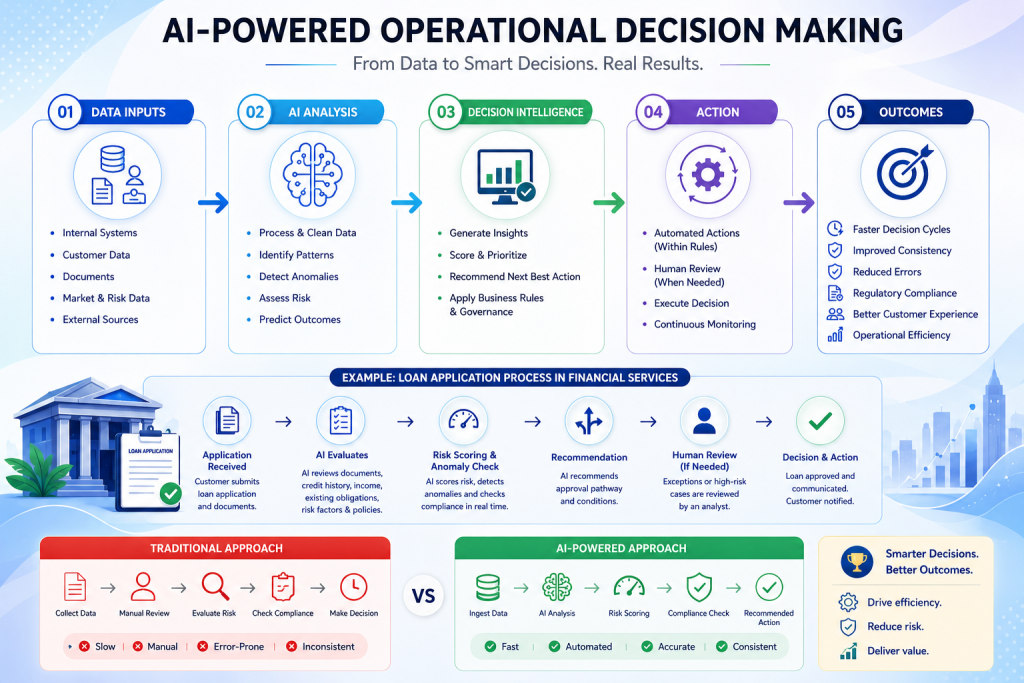
AI improves operational decision making by analyzing large volumes of data, identifying patterns, generating recommendations, and automating routine actions within predefined business rules.
Instead of requiring employees to manually gather and evaluate information, AI systems can continuously assess operational conditions and recommend the next best action in real time.
The benefits include:
- Faster decision cycles
- Improved consistency
- Reduced human error
- Enhanced regulatory compliance
- Better customer experiences
- Increased operational efficiency
For example, a financial services organization processing loan applications may traditionally require analysts to review documentation, credit history, risk factors, and compliance requirements manually. AI can evaluate these factors instantly, identify anomalies, score risk, and recommend approval pathways while maintaining governance controls.
A retail organization can use AI-driven forecasting models to analyze historical sales, inventory levels, market conditions, and seasonal demand. This enables automated inventory replenishment decisions that reduce stockouts and excess inventory.
Modern AI platforms can also combine machine learning with enterprise automation technologies, workflow orchestration, and business process management systems. This creates a connected decision-making ecosystem where insights automatically trigger actions.
According to McKinsey, organizations that successfully deploy AI across business operations can achieve significant productivity improvements while accelerating decision velocity and operational performance.
Which Operational Decisions Deliver the Fastest AI ROI?
The highest-return opportunities are operational decisions that occur frequently, follow predictable patterns, and involve significant manual effort.
Organizations often achieve measurable results by focusing on decisions that directly impact revenue, cost reduction, customer experience, or risk management.
Common high-value use cases include:
| Industry | Operational Decision | Potential Benefit |
| Healthcare | Prior authorization routing | Faster patient care |
| Insurance | Claims triage | Reduced processing time |
| Banking | Loan prequalification | Improved customer experience |
| Retail | Inventory replenishment | Lower carrying costs |
| Public Sector | Citizen service routing | Faster service delivery |
| Manufacturing | Maintenance scheduling | Reduced downtime |
Consider a nationwide healthcare distributor that uses AI to forecast product demand. By analyzing purchasing patterns and market trends, the organization can make more accurate inventory decisions, reducing inventory carrying costs while improving product availability.
Similarly, insurance providers can automate claims classification and fraud detection processes, enabling adjusters to focus on complex cases rather than routine assessments.
The most successful AI initiatives often begin with targeted operational decisions before expanding into broader enterprise automation programs.
How Can Organizations Move From Manual Decisions to AI-Assisted Decisions?
Organizations should adopt a phased approach that combines data modernization, governance, process optimization, and AI deployment.
Successful transformation requires more than implementing new technology. It requires establishing trust, transparency, and operational readiness.
6 Steps to Implement AI-Powered Operational Decisions
1. Identify High-Volume Decision Processes
Focus on repetitive, measurable operational decisions.
2. Assess Data Readiness
Evaluate data quality, accessibility, and governance.
3. Standardize Business Rules
Document how decisions are currently made.
4. Modernize Integrations
Connect systems using APIs, enterprise integration platforms, and automation technologies.
5. Deploy AI Recommendations First
Begin with human-in-the-loop decision support.
6. Expand Toward Automation
Gradually automate decisions within approved governance frameworks.
Organizations that follow this approach can reduce risk while building confidence in AI-generated recommendations.
What Is the Difference Between Manual and AI-Assisted Decision Making?
The difference between manual and AI-assisted decision making lies in speed, scalability, consistency, and the ability to act on data in real time.
| Capability | Manual Decisions | AI-Assisted Decisions |
| Speed | Hours or days | Seconds or minutes |
| Data Analysis | Limited | Large-scale, real-time |
| Consistency | Variable | Standardized |
| Scalability | Resource constrained | Highly scalable |
| Compliance Tracking | Manual audits | Automated monitoring |
| Customer Experience | Delayed responses | Faster service |
| Decision Accuracy | Human dependent | Data-driven insights |
| Operational Cost | Higher | Lower over time |
AI-assisted decision making does not eliminate human oversight. Instead, it enables employees to focus on exceptions, strategy, customer engagement, and innovation while routine decisions are handled more efficiently.
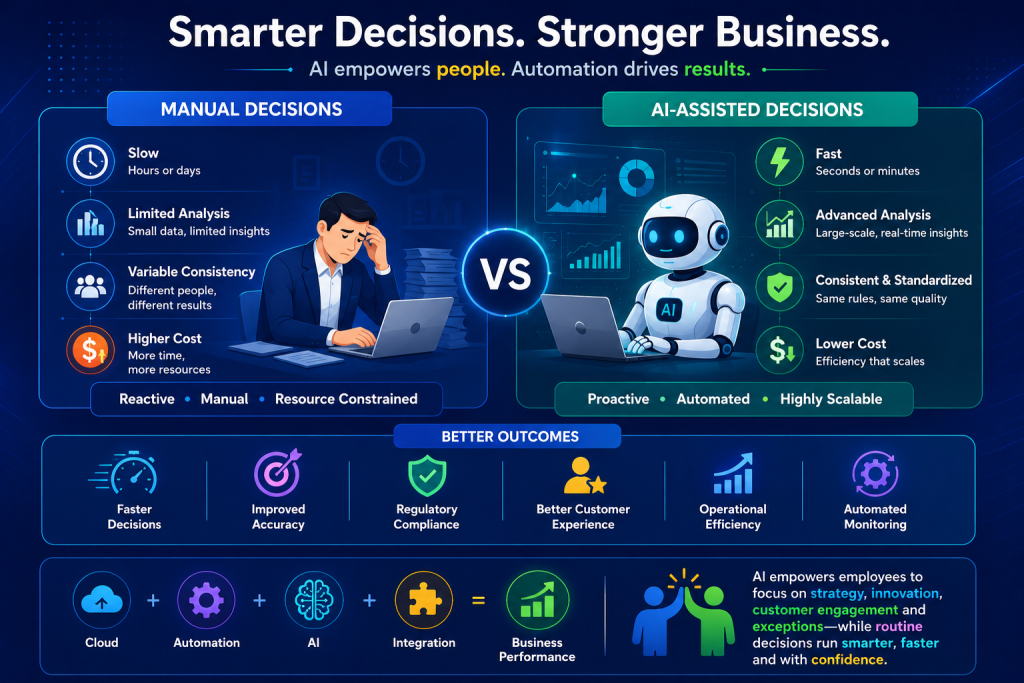
This approach aligns with broader digital transformation initiatives that seek to combine enterprise automation, cloud migration, AI, and system integration to improve business performance.
Conclusion
AI-powered operational decisions help organizations move beyond manual processes and unlock greater speed, consistency, and business value. While many enterprises have modernized applications and infrastructure, operational decision making often remains dependent on human effort, disconnected systems, and fragmented data.
By combining AI, enterprise automation, digital transformation, cloud migration, and system integration, organizations can create more intelligent operations that scale efficiently and respond faster to changing business conditions. Prolifics helps organizations design and implement AI-driven operational decision solutions that align technology investments with measurable business outcomes.
Sources: IBM Institute for Business Value, Gartner Research on Decision Intelligence, McKinsey Global Institute AI Research.
FAQ
How can AI improve operational decision making in enterprises?
AI improves operational decision making by analyzing data, identifying patterns, and generating recommendations or automated actions. This helps organizations reduce delays, improve consistency, lower operational costs, and make faster decisions across business processes.
What operational processes should organizations automate first?
Organizations should prioritize high-volume, repetitive decisions such as claims processing, inventory management, customer service routing, loan prequalification, scheduling, and workflow approvals because they often deliver the fastest return on investment.
Is AI replacing operational decision makers?
No. Most enterprise AI initiatives focus on augmenting decision makers rather than replacing them. AI handles data analysis and routine evaluations while employees retain oversight, governance, exception handling, and strategic responsibility.
What challenges prevent organizations from automating operational decisions?
Common challenges include legacy systems, fragmented data, inconsistent business rules, regulatory requirements, integration complexity, and limited trust in AI-generated recommendations. Addressing these challenges requires both technology modernization and governance.
How do organizations measure success from AI-powered operational decisions?
Organizations typically measure success through decision speed, operational efficiency, cost reduction, customer satisfaction, compliance improvements, productivity gains, and business outcomes such as revenue growth or reduced risk exposure.