Every day, across multiple grow houses, a mushroom producer worked to get one thing right; the perfect substrate mix. Some batches delivered excellent yields, while others fell short. The difference was subtle, often hidden in small variations in ingredient ratios and chemical composition. But without clear visibility, these patterns remained difficult to understand.
As production scaled, this uncertainty grew. Teams relied on experience and manual tracking, but consistency became harder to maintain. The same process could produce different outcomes, making it challenging to predict yield and optimize performance.
To bring clarity to this complexity, the organization partnered with Prolifics to introduce a more structured, data-driven approach to cultivation.
By using data-driven insights, the organization transformed substrate preparation into a more precise and performance-driven process.
Analyzed historical production data alongside substrate composition to identify previously hidden patterns.
Connected yield outcomes with chemical properties and ingredient combinations to uncover key performance drivers.
Shifted substrate preparation from a trial-and-error approach to a more controlled and predictable process.
Identified optimal ingredient ranges that consistently deliver higher yields.
Enabled yield forecasting and established practical guidelines to improve consistency across growing houses.
What once felt uncertain is now measurable and manageable. The producer can make more confident decisions, reduce variability, and maintain consistent yield performance even as operations continue to grow.
At Prolifics, we turn data into meaningful action. With over 45 years of experience in digital engineering and consulting, we help organizations across industries build smarter, more efficient, and scalable operations through data, analytics, and intelligent transformation.
Download the full case study to see how Prolifics is helping agricultural enterprises turn insight into impact.
A global pharmaceutical manufacturing organization partnered with Prolifics to modernize its root cause analysis (RCA) processes, transforming manual, fragmented investigations into a faster, more intelligent, and compliance-driven framework.
Operating in a highly regulated environment, the organization faced increasing pressure to maintain strict quality standards while accelerating investigations and improving compliance reporting. However, legacy processes made it difficult to connect insights across RCA reports, SOPs, and regulatory requirements.
Prolifics brought an engineering-first, AI-driven approach to redefine how RCA is performed. By combining generative AI with knowledge graph intelligence, we designed a scalable, data-driven solution that enables faster investigations, deeper insights, and stronger compliance alignment, setting a new benchmark for AI-powered root cause analysis pharmaceutical manufacturing standards.
Key Highlights of the Transformation
AI-powered analysis of RCA reports, SOP documentation, and regulatory data
Knowledge graph integration to uncover hidden relationships across quality events and compliance requirements
Automated identification of root causes and recommended corrective actions
Semantic intelligence layer to unify regulatory and operational data
Intelligent investigation support to improve speed, accuracy, and decision-making
Beyond technology, the engagement introduced a new way of working advancing pharmaceutical quality investigation automation by shifting RCA from a manual, reactive process to a proactive, intelligence-driven capability.
Business Impact Achieved
60 to 80 percent reduction in investigation effort through AI and knowledge graph automation
10 to 15 percent improvement in RCA accuracy by identifying hidden relationships across datasets a direct result of knowledge graph RCA compliance integration
Faster identification of compliance risks and root causes
Improved transparency and efficiency across quality investigation workflows
Today, the organization has a modern RCA framework that not only accelerates investigations but also strengthens pharmaceutical manufacturing AI compliance and quality management at scale.
Download the full case study to see how Prolifics helps pharmaceutical organizations modernize quality processes with AI and build a foundation for smarter, faster decision-making.
A leading national water utility in the Middle East partnered with Prolifics to drive digital transformation in water utilities by reimagining its workforce platform. The goal was to transform a legacy, maintenance-heavy system into a future-ready foundation for innovation. With growing pressure to deliver API-driven government services and demonstrate progress to government stakeholders, the organization needed more than a technology upgrade; it needed a clear and scalable vision.
Prolifics brought an engineering-first, strategic approach to define that vision. Through collaborative workshops and deep architectural assessment, we designed a modern, cloud-native utility architecture built for agility, scalability, and long-term growth. This approach provided a proven model for legacy system transformation for utilities looking to modernize their core operations.
Key highlights of the transformation include:
Modern, modular architecture for improved flexibility and scalability
API-driven integrations to enable seamless connectivity across systems
Cloud-ready infrastructure to support future digital services
Introduction of public sector AI solutions in the Middle East for enhanced employee productivity.
AR-enabled capabilities for improved field workforce support
Beyond technology, the engagement delivered a structured transformation roadmap and governance framework, enabling confident decision-making and sustainable innovation.
Business impact achieved:
Clear and actionable modernization strategy
Strong alignment with national digital transformation initiatives
Improved scalability for evolving workforce needs
Foundation for adopting emerging technologies like AI and AR
Today, the utility is equipped with a clear path to modernization and is ready to unlock new possibilities with emerging technologies.
Download the full case study to explore how Prolifics helps public sector organizations modernize with confidence and build platforms for the future.
A major theatre chain relied on Azure Data Factory and Azure Synapse to power business-critical analytics, from ticket sales insights to operational reporting. As their data environment grew more complex, maintaining reliable pipelines and ensuring consistent performance became increasingly challenging.
Disruptions in data workflows risked delays in reporting and decision-making, while internal teams faced mounting pressure to manage and troubleshoot the system without dedicated support.
Prolifics introduced a managed services model built to keep analytics environments stable, efficient, and continuously optimised. With proactive monitoring, routine maintenance, and ongoing performance improvements, the theatre chain gained more reliable data pipelines, faster issue resolution, and greater confidence in its reporting. This also reduced the burden on internal teams, allowing them to focus on strategic initiatives instead of day-to-day operational issues.
If your data pipelines are critical to your business, they need to run without disruption. Prolifics helps you stay ahead with managed services that keep your analytics environment performing at its best.
Schedule a conversation today and see how we can support your data and analytics operations.
Regulatory oversight and compliance reporting demand precision, transparency, and timely insights. Yet many organizations still rely on complex legacy reporting environments that slow decision-making and increase IT dependency. Power BI self-service analytics is helping organizations modernize these environments by enabling faster insights and reducing reliance on IT teams.
In this case study, discover how a global legal and compliance organization partnered with Prolifics to modernize its reporting ecosystem and unlock faster, more secure analytics.
Facing a reporting landscape of over 450 SAP BusinessObjects reports, the organization struggled with complexity, limited usability, and heavy reliance on IT teams for report modifications. Compliance analysts lacked the agility needed to quickly respond to audits, regulatory requests, and emerging risk indicators.
Prolifics implemented a modern Power BI–driven analytics platform designed to simplify reporting, enable secure self-service analytics, and deliver real-time insights for legal and compliance teams. Through report rationalization, automated migration, and interactive dashboards, the organization transformed its reporting environment into a scalable and user-friendly analytics ecosystem.
The result was a streamlined reporting framework that reduced complexity, improved accessibility, and empowered compliance professionals to explore insights independently while maintaining strict data governance.
Download the full case study to learn how Prolifics helps organizations modernize legacy reporting platforms, enhance compliance visibility, and build scalable analytics foundations with Microsoft Power BI.
Salesforce has announced a major expansion of MuleSoft Agent Fabric, introducing automated agent discovery capabilities designed to help enterprises gain visibility, control, and AI agent governance over rapidly growing AI ecosystems. As organizations accelerate AI adoption across multicloud environments, managing AI agent sprawl solutions has become a pressing challenge for enterprise AI ecosystem management.
AI agents are being deployed across departments, platforms, and cloud providers. While these agents unlock automation and intelligence at scale, they also create operational complexity. Without centralized oversight and proper multi-cloud AI orchestration, enterprises risk duplication, security gaps, compliance concerns, and underutilized AI investments.
Salesforce’s enhanced MuleSoft Agent Fabric directly addresses these challenges through continuous, automated agent discovery and cataloging of AI agents across diverse environments. This includes Salesforce Agentforce, Amazon Bedrock, Google Cloud Vertex AI, and other supported frameworks, providing much-needed agentic AI visibility.
Why This Matters for Enterprises
As AI adoption grows, businesses face three critical challenges:
Limited visibility into deployed AI agents
Inconsistent AI agent governance across multi-cloud environments.
Difficulty scaling AI securely and efficiently
The new automated agent discovery capability eliminates manual inventory tracking and replaces outdated spreadsheets with real-time agent intelligence, helping leaders understand how to manage AI agents across multi-cloud environments.
What MuleSoft Agent Fabric Now Delivers
The expanded platform introduces intelligent agent scanners that continuously monitor connected environments. These scanners detect active AI agents, extract key metadata, and register them within a centralized registry for enterprise AI agents.
Key capabilities include:
Continuous automatic discovery of AI agents
Centralized registry serving as a single source of truth
Deep metadata capture including capabilities and data access
Cross-platform visibility across multicloud ecosystems
Real-time updates without manual intervention
This ensures IT, security, and AI operations teams always know:
Which agents are running
Where they are deployed
What data they access
How they interact with enterprise systems
Enhanced Visualization and Control
Salesforce has also introduced Agent Visualizer, enabling teams to view, filter, and analyze AI agents across platforms. For example, organizations can quickly isolate agents running on Amazon Bedrock versus Google Cloud with a few clicks.
This capability supports stronger governance, improved compliance alignment, and faster decision-making.
Strategic Business Impact
The value of automated discovery goes beyond visibility. It enables enterprises to:
Eliminate redundant AI agents
Optimize AI investments
Improve security posture
Accelerate innovation
Promote reuse of intelligent workflows
Reduce operational silos
Conclusion
AI is rapidly transitioning from experimental pilots to mission-critical enterprise infrastructure. Organizations that succeed will be those that balance innovation with control, flexibility with AI agent governance, and scale with security.
With automated agent discovery, MuleSoft Agent Fabric positions Salesforce as a leader in helping enterprises manage the complexity of agentic AI across multi-cloud environments. By delivering unified visibility, operational control, and scalable governance, Salesforce is enabling businesses to innovate confidently and build a connected, intelligent enterprise.
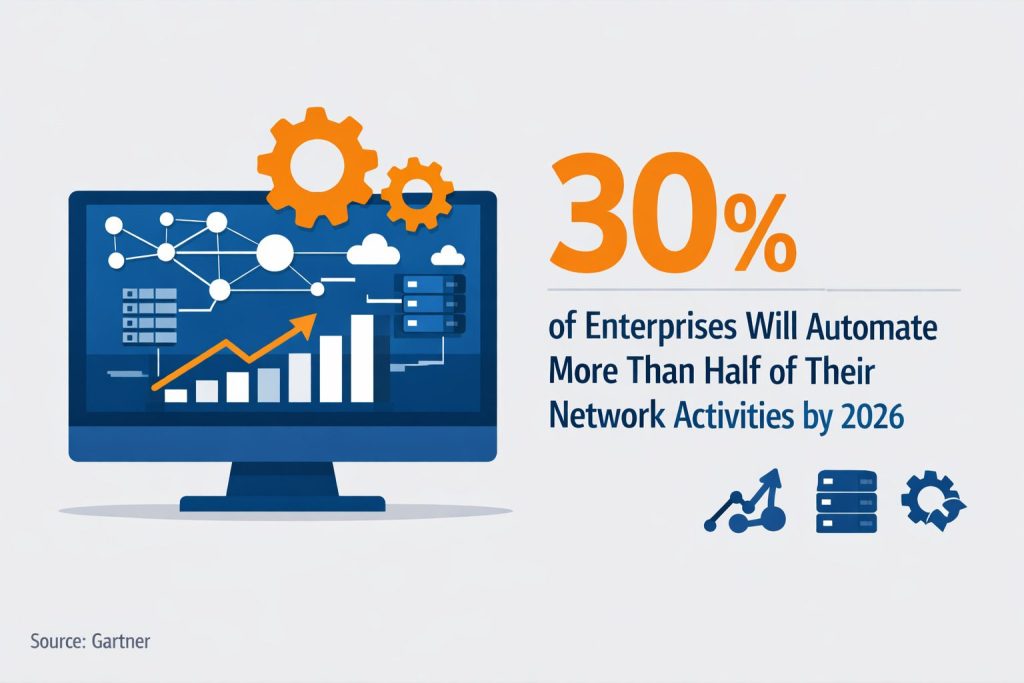
By 2026, 30 percent of enterprises are expected to automate more than half of their network activities, up from less than 10 percent in mid-2023, according to Gartner. At the same time, 90 per cent of large enterprises prioritise hyperautomation, yet fewer than 20 per cent know how to measure success of hyperautomation initiatives effectively. Infrastructure and operations leaders are rapidly embracing AI-driven analytics, augmented decision-making, and AI-driven process orchestration to bridge this gap.
Hyperautomation is an enterprise-level strategy that uses a blend of advanced technologies to automate business processes end to end. At Prolifics, we partner with enterprises to unlock the full potential of their digital transformation journeys by offering comprehensive Hyperautomation Services for Enterprise that deliver measurable value at scale.
While hyperautomation is a strategic foundation for modern digital enterprises, it is most effective when integrated into an end-to-end digital transformation framework. According to industry leaders, hyperautomation combines Cognitive RPA Solutions, artificial intelligence (AI), machine learning (ML), Process Mining and Discovery Tools, and Intelligent Document Processing (IDP) to streamline and optimize complex workflows across the enterprise.
What Is Hyperautomation?
At its core, hyperautomation is about automating everything that can be automated, while intelligently orchestrating interactions between systems, people, and AI-powered processes through AI-driven process orchestration. Traditional automation focuses on individual tasks. Hyperautomation Services for Enterprise connect multiple automation tools into one cohesive strategy that enables end-to-end process optimization and autonomous business process management.
Why Hyperautomation Matters Today
The move toward hyperautomation is no longer optional. It is essential. Gartner and other industry analysts report that most enterprises are increasing investments in Hyperautomation Services for Enterprise because it drives speed, accuracy, resilience, and a significant intelligent automation ROI.
A Strategic Response to Enterprise Complexity
In many organizations, digital systems have grown organically, resulting in siloed applications, manual handoffs, and inefficiencies that slow operations. Basic automation helps with individual tasks, but automating manual handoffs in complex enterprise workflows remains a challenge. Hyperautomation bridges those gaps by creating a unified automation layer that provides AI-driven process orchestration across systems and teams.
Fueling Growth, Not Just Cutting Costs
While cost reduction is a clear benefit, hyperautomation delivers much more than savings:
Faster time to market through streamlined workflows
Improved customer experiences via responsive, automated services
Higher data accuracy and compliance using AI-driven verification and monitoring
Better decision-making from real-time operational insights
These outcomes transform an end-to-end digital transformation framework into enterprise accelerators rather than just operational improvements, maximizing your intelligent automation ROI.
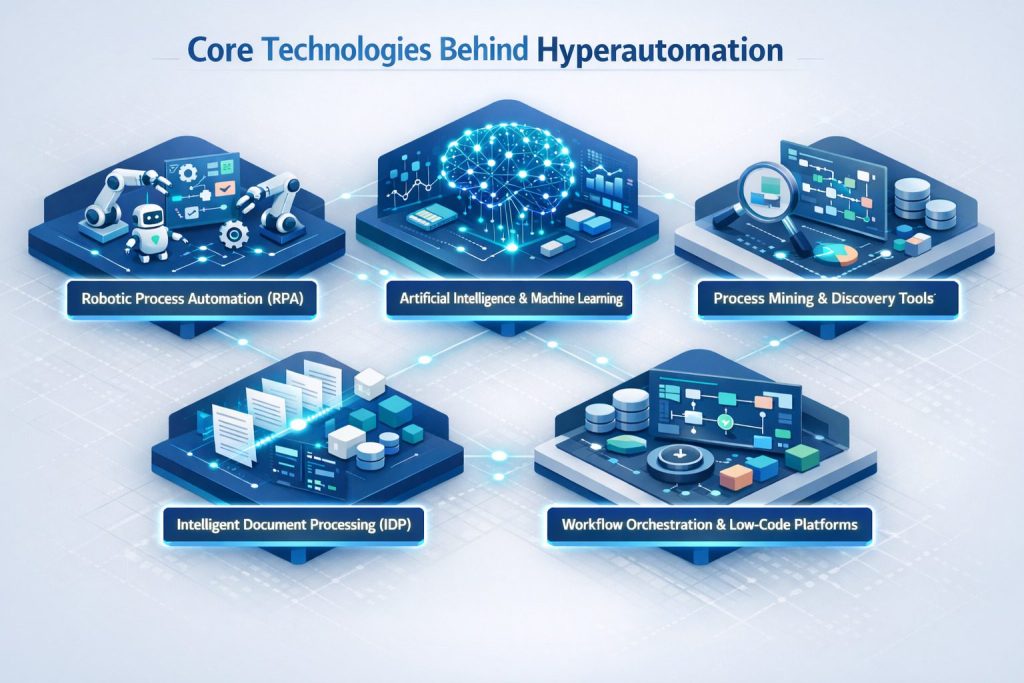
What are the core technologies behind hyperautomation?
Hyperautomation is an ecosystem of powerful technologies working together under a model of autonomous business process management.
Robotic Process Automation (RPA)
RPA bots handle repetitive, rules-based tasks with speed and precision, from data entry to system updates. When combined with AI, these bots evolve from simple task execution to intelligent process automation.
Artificial Intelligence and Machine Learning
AI and ML bring cognitive capabilities to automation by enabling systems to interpret unstructured data, make predictions, and adapt to changing conditions.
Process Mining and Discovery Tools
These tools map real workflows, uncover bottlenecks, and identify the best candidates for automation, ensuring efforts are highly targeted and data-driven.
Intelligent Document Processing (IDP)
Intelligent Document Processing (IDP) extracts and interprets information from complex documents, eliminating manual data handling while improving accuracy.
Workflow Orchestration and Low-Code Platforms
Orchestration connects people, bots, and systems into seamless workflows, essential for AI-driven process orchestration.
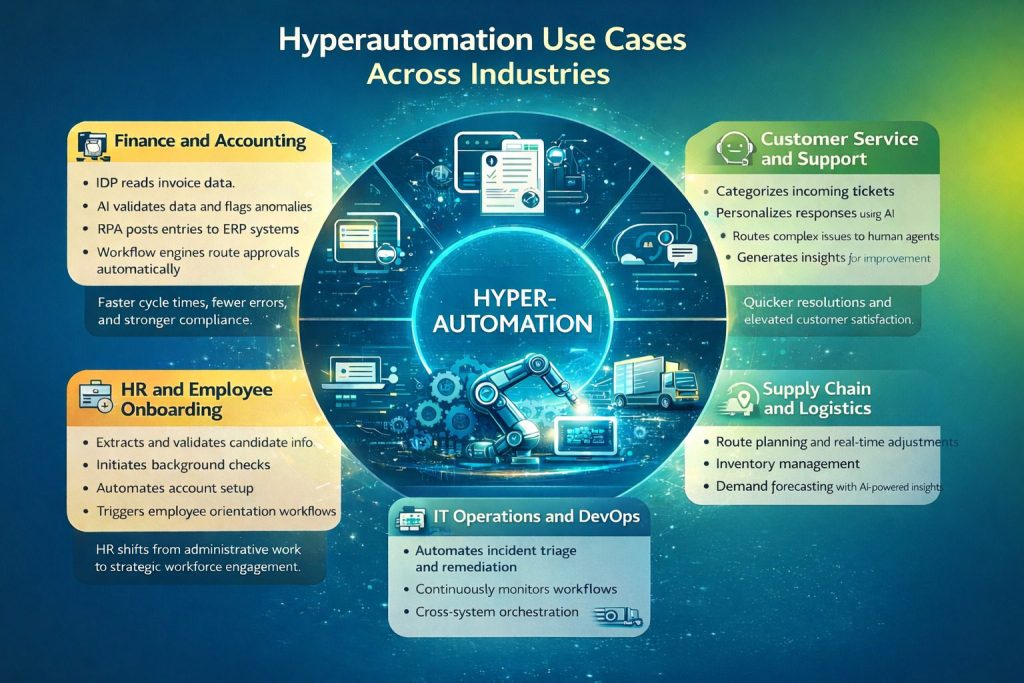
Top Hyperautomation Use Cases Across Industries
Hyperautomation has real, tangible applications across business functions. Here are key use cases where Prolifics helps clients accelerate their end-to-end digital transformation framework.
1. Finance and Accounting
Invoice processing typically involves multiple systems and manual checks. Considering hyperautomation use cases in finance and accounting 2026, the process becomes seamless:
Intelligent Document Processing (IDP) reads invoice data
AI validates data and flags anomalies
RPA posts entries to ERP systems
Workflow engines route approvals automatically
The result is faster cycle times, fewer errors, and stronger compliance governance.
2. Customer Service and Support
Customer expectations today are high. Hyperautomation transforms service by:
Automatically categorizing incoming tickets
Using AI to personalize responses
Routing complex issues to human agents
Generating insights for service improvements
This leads to quicker resolutions and elevated customer satisfaction without overwhelming support teams.
3. HR and Employee Onboarding
From document collection to system access provisioning, onboarding can be tedious. Hyperautomation:
Extracts and validates candidate information
Initiates background checks
Automates account setup across tools
Triggers employee orientation workflows
HR teams shift from administrative work to strategic workforce engagement.
4. IT Operations and DevOps
IT environments can be complex, with manual workflows slowing deployments. Hyperautomation enables:
Automated incident triage and remediation
Continuous monitoring of workflows
Cross-system orchestration for service delivery
This accelerates digital services while improving reliability and uptime.
5. Supply Chain and Logistics
Hyperautomation optimizes:
Route planning and real-time adjustments
Inventory management
Demand forecasting with AI-powered insights
This translates into improved delivery performance and reduced operational costs.
Real Benefits of Hyperautomation
Organizations that adopt Hyperautomation Services for Enterprise, especially with a partner like Prolifics, realize measurable results:
Operational Efficiency at Scale
Workflows run faster, with fewer bottlenecks and less manual rework.
Higher Accuracy and Compliance
AI-driven checks reduce errors and improve adherence to regulations.
Better Customer and Employee Experience
Automated systems respond faster and free employees for higher-value work.
Smarter Decision-Making
Real-time data insights enable proactive strategy and continuous improvement.
Agility and Resilience
Businesses can quickly adapt processes to changing market demands.
These benefits improve operations and position organizations to compete more effectively in the digital era.
Why Prolifics for Hyperautomation?
At Prolifics, we understand that the journey to hyperautomation is not just about technology. It is about strategy, execution, and business outcomes. Here is how we help.
Strategic Assessment and Roadmapping
We uncover automation opportunities that deliver the greatest impact, grounded in business objectives.
Technology Integration and Orchestration
From RPA and AI to process mining and workflow orchestration, our experts seamlessly integrate tools into existing environments.
End-to-End Implementation
Prolifics builds, deploys, and scales hyperautomation solutions while ensuring they are resilient, secure, and adaptable.
Continuous Optimization
Hyperautomation is not a one-time project. It is an evolving ecosystem. Prolifics provides ongoing support, governance, and performance tuning.
Industry-Specific Expertise
Whether financial services, healthcare, supply chain, or customer experience operations, we tailor hyperautomation to your goals.
Getting Started with Hyperautomation
Starting a hyperautomation journey does not require an all-or-nothing approach:
Assess current processes for automation potential
Identify bottlenecks and priority workflows
Build a phased roadmap aligned with business value
Deploy pilot solutions and scale iteratively
With the right framework and execution partner, even complex enterprises can experience rapid transformation.
Conclusion: The Time for Hyperautomation Is Now
Hyperautomation is not just a technological trend. It is a business imperative. It empowers organizations to run leaner, respond faster, and innovate continually. At Prolifics, we combine deep industry knowledge, technical excellence, and strategic insight to deliver hyperautomation solutions that make a difference.
Transform your business processes, unlock new operational possibilities, and achieve sustainable growth. Let Prolifics help you harness hyperautomation for measurable, game-changing results.
Start your hyperautomation journey with Prolifics today.
As digital transformation accelerates across industries, enterprises are facing a common challenge: disconnected systems that slow innovation and limit growth. In response, Prolifics is helping organizations break down these barriers with advanced MuleSoft Integration Services that unify applications, data, and processes into a seamless digital ecosystem.
By combining deep integration expertise with Anypoint Platform Consulting, Prolifics enables businesses to modernize faster, innovate smarter, and unlock measurable operational efficiency. In an era where speed, scalability, and customer experience define competitive advantage, Prolifics is positioning enterprise API management solutions not as an IT function but as a strategic growth engine.
With the Anypoint Platform at the heart of its integration strategy, Prolifics empowers organizations to unify applications, data, and customer experiences. From Legacy System Modernization MuleSoft projects to cutting-edge cloud apps, we ensure everything works with speed, reliability, and scale.
A Unified Integration Advantage for Real Business Outcomes
Modern enterprises run countless applications, including CRMs, ERPs, e-commerce platforms, and more. Without smart MuleSoft integration services, IT teams are stuck in a cycle of point-to-point connections that are brittle and costly. Prolifics changes that with:
Prolifics changes that with:
API-Led Connectivity Strategy: A structured way to accelerate digital transformation with API-led connectivity, designing reusable APIs that expose data and accelerate innovation.
Anypoint Platform Expertise: Through specialized Anypoint Platform Consulting, we consolidate integration design, deployment, and monitoring onto a single platform, reducing risk.
Automated Workflows and RPA: Beyond integration, we leverage MuleSoft RPA for automated enterprise workflows to deliver faster time to value.
Why Prolifics + MuleSoft
Prolifics brings decades of leadership and is a recognized Salesforce MuleSoft integration partner. Our team includes experts who provide comprehensive MuleSoft managed services to ensure your composable IT infrastructure remains agile. This experience translates into outcomes that matter:
Faster Time to Market: Projects that once took months can be completed in weeks, enabling businesses to launch digital services ahead of competitors.
Reduced Operational Overhead: By reusing APIs and utilizing MuleSoft Managed Services, companies lower maintenance costs and free IT to innovate.
Scalable, Secure Architecture: We provide robust enterprise API management solutions with flexible deployment options cloud, on-premises, or hybrid.
Enterprise-Wide Connectivity: Whether you need to hire certified MuleSoft architects for healthcare integration or retail solutions, our tailored approaches meet industry-specific challenges.
Importantly, a strong integration strategy does more than connect systems; it drives agentic enterprise transformation by unlocking data value. When data flows freely, organizations see smarter decisions and more personalized engagement.
Turning Vision Into Value
Prolifics partners with businesses to reimagine how they operate. Through expert MuleSoft consulting, strategic architectural design, and robust automation frameworks, Prolifics helps organizations:
Simplify complex IT landscapes
Reduce dependency on custom point-to-point coding
Standardize integration best practices
Empower teams with reusable assets
Accelerate digital transformation journeys
Ready to transform your enterprise with MuleSoft? Connect with Prolifics and start your integration journey today.
In modern software development, API testing plays an important role in ensuring applications are reliable, secure, and high-performing. As APIs form the backbone of communication between services, systems, and applications, validating their behavior before deployment is essential to delivering seamless digital experiences and strengthening API quality engineering practices.
Unlike UI testing, which focuses on the user interface, API testing targets the underlying service layer, where business logic and data exchanges occur. It ensures that endpoints behave as expected, data is transmitted accurately through API Data Contract Validation, integrations remain stable, and systems continue to perform reliably, even under heavy loads or unexpected conditions. Strong performance testing for APIs further ensures that service layers remain resilient and scalable.
Modern applications rarely operate in isolation. APIs enable:
Communication between mobile apps and back-end services
Integration with third-party partners, data sources, and service providers
Real-time updates, transactions, and business logic enforcement
Scalable microservices architectures in cloud environments supported by Microservices Integration Testing
That means APIs are responsible for critical business workflows, and failures here directly translate into customer frustration, lost revenue, and brand risk. A structured shift-left API testing approach ensures issues are caught early before they escalate into production incidents.
Yet traditional testing approaches often fall short. GUI or UX testing alone cannot uncover the kinds of defects, performance issues, or compliance gaps that lurk beneath the surface. This is why API testing shines it gets below the UI and tests the business logic, data contracts, reliability, performance, and security of the system itself. Modern API quality engineering integrates API security and compliance testing alongside functional validation to ensure complete coverage.
What Effective API Testing Looks Like in Practice
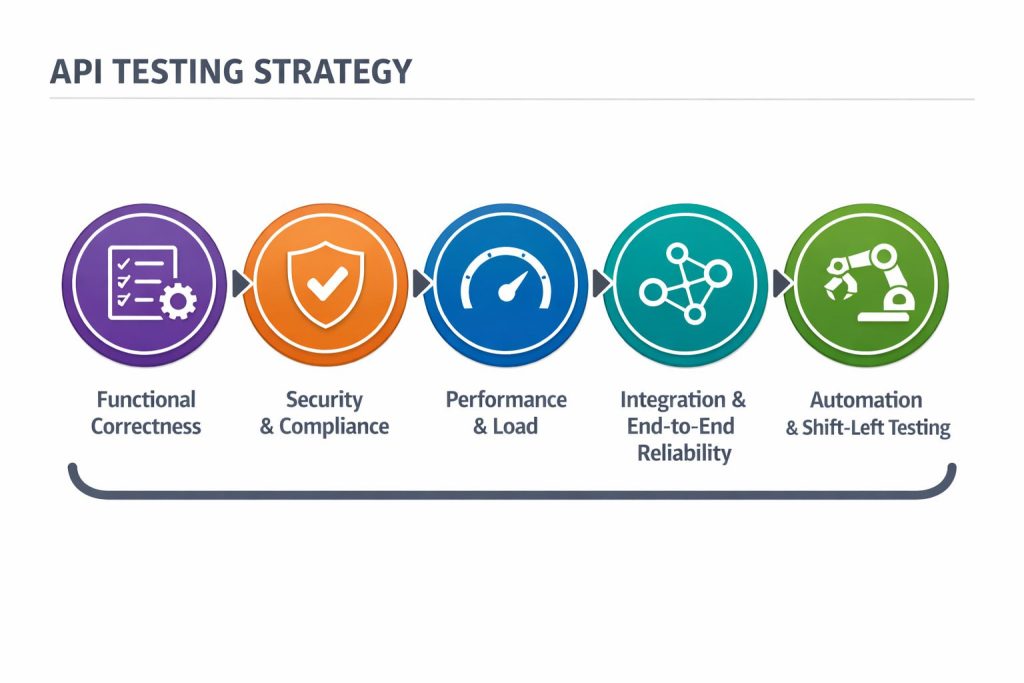
A robust API testing strategy should cover many dimensions and align with a strong shift-left testing strategy:
🔹 Functional Correctness — Does the API do what it’s supposed to? 🔹 Security & Compliance — Is access controlled? Are data protections enforced? 🔹 Performance & Load — Can it handle peak traffic volumes? 🔹 Integration & End-to-End Reliability — Do all parts of the system work together without failure? 🔹 Automation & Shift-Left Testing — Are tests integrated into CI/CD so defects are caught early?
But quality isn’t just about testing; it’s about engineering quality into the process. That means embedding tests early in development cycles through Shift-Left API Testing, leveraging AI-Driven Test Automation, and analyzing test results using predictive models to prevent failures rather than simply detecting them after the fact. This is the foundation of advanced API quality engineering.
The ROI of Quality Engineering
When API testing and quality practices are done right, organizations realize measurable business outcomes and see tangible ROI of AI-powered predictive analytics in quality engineering initiatives:
Faster Time-to-Market: Automated API tests integrated into CI/CD pipelines reduce cycle times and accelerate releases.
Lower Development Costs: Catching defects early costs far less than fixing issues in later stages or post-release.
Higher Customer Trust: Reliable, secure APIs reflect directly on user experience and customer satisfaction.
Reduced Operational Risk: Performance and security testing break down failure modes before they impact production.
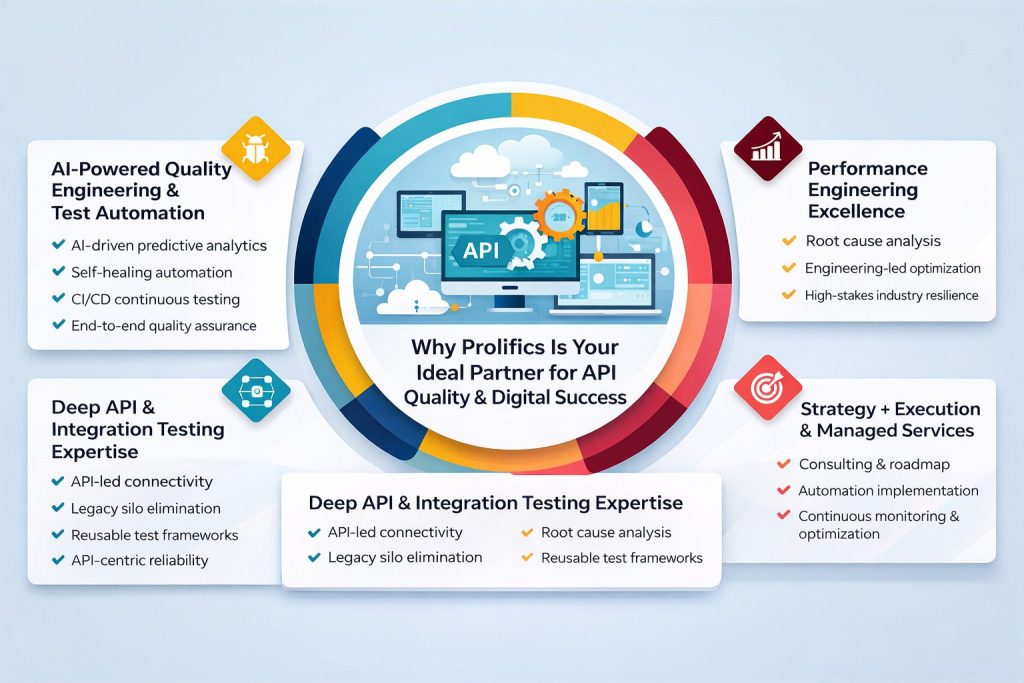
Why Prolifics Is Your Ideal Partner for API Quality & Digital Success
Here’s how Prolifics doesn’t just test but transforms how you deliver software:
1. AI-Powered Quality Engineering & Test Automation
AI-driven predictive analytics that forecast issues before they occur
Self-healing test automation that adapts as systems evolve
Continuous testing integrated into CI/CD pipelines
End-to-end assurance that improves test coverage and reduces risk
This combination accelerates delivery, lowers maintenance costs, and ensures quality is built in, not bolted on.
2. Deep API & Integration Testing Expertise
APIs don’t exist in a silo, they connect systems, partners, cloud services, and microservices. Prolifics’ Digital Integration and Platform Solutions help you:
Streamline API-led connectivity across enterprise systems
Eliminate legacy data silos for unified data access
Accelerate integration testing with reusable frameworks
Enable robust API-centric testing strategies that improve reliability
Reduce development costs and speed delivery without compromise
This breadth ensures that regardless of environment, cloud, hybrid, or on-prem, your critical interfaces hold up under pressure.
3. Performance Engineering, Not Just Performance Testing
Many providers test performance. Prolifics goes further by offering Continuous Performance Engineering, meaning they identify root causes and propose engineering solutions, not just surface-level reporting.
This is crucial in high-stakes environments like finance, healthcare, and retail, where latency or instability can directly affect revenue, compliance, or trust.
4. Strategy + Execution + Managed Services
Prolifics doesn’t just provide tools; they offer end-to-end quality strategies, including:
Managed services that continuously monitor, optimize, and innovate
This lifecycle approach ensures sustainable API quality engineering maturity across the organization.
Real Results, Real Impact
Clients partnering with Prolifics have seen:
✔Reduced software defects before release ✔ Automation that scales with CI/CD velocity ✔ Improved test coverage across API layers ✔ Reduced downtime and faster recovery from issues ✔ A quality engineering culture that empowers teams
In today’s digital-first world, mediocre quality isn’t acceptable; it’s expensive. Organizations that invest in comprehensive API quality engineering, backed by performance testing for APIs and AI-driven test automation, unlock faster innovation, happier users, and greater business resilience.
Conclusion
APIs are the backbone of modern software. But without rigorous testing, performance engineering, and AI-enabled quality practices, they’re also a risk vector. The difference between an API that supports your growth and one that hinders it can come down to the sophistication of your testing and quality strategy particularly your adoption of API Quality Engineering, Shift-Left API Testing, and Continuous Performance Engineering.
That’s where Prolifics steps in, transforming quality from a cost center into a competitive edge. From strategy and automation to performance engineering and managed services, Prolifics gives you the tools, expertise, and partnerships you need to win in today’s digital age.
Partner with Prolifics to elevate quality, accelerate digital transformation, and unlock superior business outcomes.
In today’s digital economy, enterprises are no longer defined by a single technology stack or centralized infrastructure. Instead, they operate across hybrid environments, multi-cloud platforms, SaaS ecosystems, legacy systems, and expanding partner networks. While this evolution enables agility and innovation, it also introduces complexity. Without a cohesive enterprise integration strategy, organizations risk fragmented data, operational silos, inconsistent customer experiences, and stalled transformation efforts.
A modern enterprise integration strategy serves as the foundation for a connected enterprise. It enables seamless communication between applications, systems, data, and people, transforming technology from a collection of isolated assets into a unified, intelligent ecosystem built on a scalable Connected Enterprise Framework.
Why Integration Has Become a Strategic Imperative
Digital transformation has accelerated technology adoption at an unprecedented pace. Business units independently adopt SaaS applications. Cloud migrations introduce new infrastructure layers. APIs power customer-facing applications. Meanwhile, legacy systems continue to support mission-critical operations.
This rapid expansion creates disconnected environments where systems do not naturally communicate with one another. The result?
Manual workarounds
Data inconsistencies
Limited real-time visibility
Increased operational risk
Slower innovation cycles
According to McKinsey & Company, organizations that modernize their technology foundations significantly outperform competitors in speed, agility, and operational efficiency. However, modernization without a structured enterprise integration strategy often leads to complexity rather than clarity.
Integration is no longer just an IT concern. It is a business growth enabler that directly impacts customer experience, operational resilience, and competitive advantage.
The Core Pillars of a Modern Integration Strategy
A connected enterprise is built on a deliberate and scalable integration foundation. Several key pillars define modern integration success within a strong Connected Enterprise Framework.
1. API-First Architecture
APIs act as digital connectors that allow systems to exchange data securely and efficiently. An API-first architecture ensures that integration is intentional, not reactive, and supports modernizing legacy systems through API-led connectivity.
Platforms such as MuleSoft promote API-led connectivity, where reusable APIs are designed as modular building blocks. This API-first architecture approach allows enterprises to:
Accelerate development cycles
Reduce duplication of effort
Enable faster partner onboarding
Improve system scalability
API management also introduces governance, monitoring, and security controls that prevent integration sprawl. By embedding API-first architecture principles into an enterprise integration strategy, organizations create a flexible digital foundation capable of evolving with business needs.
2. Cloud and Hybrid Connectivity
Most enterprises today operate in hybrid or multi-cloud environments. Systems span on-premises data centers and public cloud platforms. Hybrid Cloud Connectivity ensures seamless communication across these environments without compromising performance or security.
Frameworks from Google Cloud emphasize automation, observability, and resilience as key components of operational excellence in cloud environments. Similarly, platforms from Microsoft and AWS provide integration services that support API management, event-driven architecture, and secure messaging across distributed systems, forming the backbone of scalable hybrid cloud connectivity.
Cloud-native integration enables:
Rapid deployment of services
Elastic scalability
Real-time data exchange
Simplified infrastructure management
Hybrid integration ensures legacy systems remain connected while organizations modernize incrementally. For enterprises seeking to build a scalable hybrid cloud integration roadmap, aligning cloud adoption with a well-defined enterprise integration strategy is critical.
3. Data Integration and Real-Time Intelligence
A connected enterprise is fundamentally data driven. However, disconnected systems create fragmented data landscapes that limit visibility and slow decision-making. Advanced Data Integration Solutions are essential for eliminating silos and supporting Real-Time Intelligence Systems.
Research from PwC highlights that organizations with integrated data ecosystems achieve faster, more informed decision-making and stronger operational transparency.
Modern integration strategies prioritize:
Real-time data synchronization
Event streaming architectures
Master data management
Unified analytics pipelines
The benefits of event-driven architecture for connected enterprises include improved responsiveness, reduced latency, and enhanced scalability across distributed environments.
When data flows seamlessly across applications through robust data integration solutions, enterprises gain a single source of truth. This unified data layer powers real-time intelligence systems and supports AI-driven insights.
Without strong data integration solutions and scalable real-time intelligence systems, AI initiatives struggle to scale, and digital transformation efforts fail to reach their full potential.
4. Security and Governance
As connectivity expands, so does exposure to risk. APIs, cloud services, and partner integrations introduce new security considerations across the digital landscape.
A robust enterprise integration strategy embeds governance from the start, ensuring secure hybrid cloud connectivity and standardized API-first architecture practices. Governance frameworks also strengthen digital ecosystem orchestration, ensuring systems, applications, and partners operate cohesively and securely.
Key governance components include:
Identity and access management
Encryption and tokenization
API security policies
Compliance monitoring
Continuous observability
Security is not an afterthought in a connected enterprise. It is a foundational design principle within a mature connected enterprise framework.
The Business Impact of a Connected Enterprise
A well-executed enterprise integration strategy delivers tangible, measurable outcomes.
Faster Innovation Reusable APIs and modular architecture under an API-First Architecture model reduce development time and accelerate new product launches.
Improved Customer Experience Integrated systems powered by hybrid cloud connectivity and real-time intelligence systems ensure consistent, real-time data across channels, enabling personalized and seamless interactions.
Operational Efficiency Automation and advanced data integration solutions reduce manual processes, eliminate redundancy, and lower maintenance costs.
Greater Agility Enterprises can quickly adapt to new market demands, partnerships, or regulatory changes through a scalable Connected Enterprise Framework.
Enhanced Resilience Event-driven architectures, intelligent monitoring, and cloud-native integration strengthen operational resilience and business continuity.
Integration transforms disconnected systems into a cohesive ecosystem that drives operational excellence.
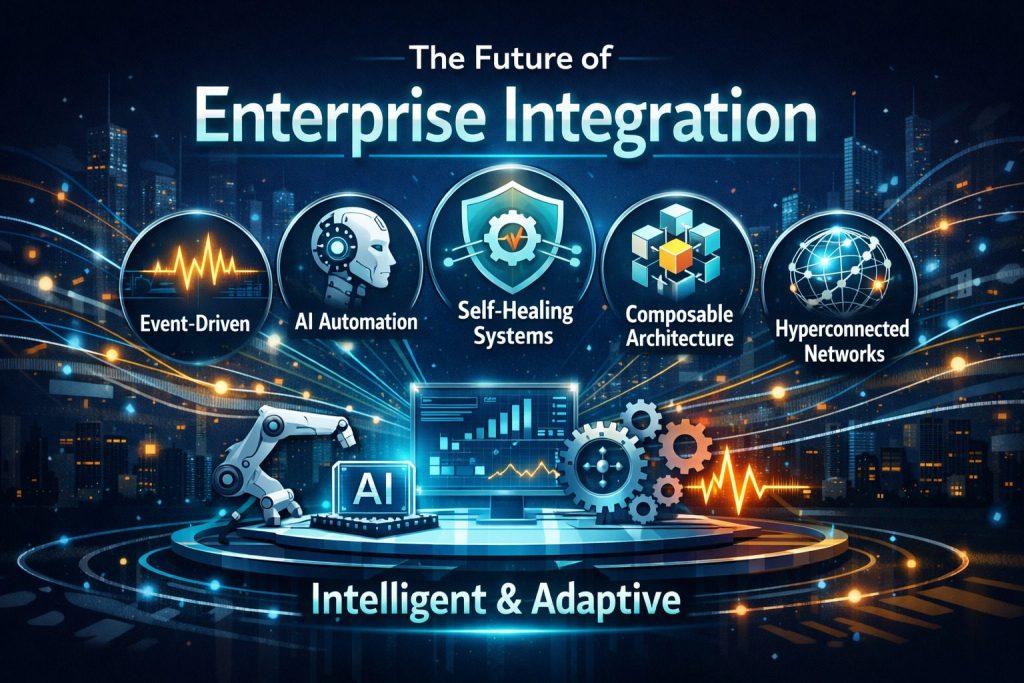
The Future of Enterprise Integration
Integration is evolving beyond simple system connectivity. Emerging trends include:
Integration is becoming an intelligent backbone that dynamically supports business processes. As AI adoption accelerates, integration layers will increasingly automate decision-making, monitor system health, and optimize workflows in real time. The enterprises that succeed will be those that view integration not as middleware but as a strategic capability.
Key Takeaways
A connected enterprise does not happen by accident. It is architected through a deliberate enterprise integration strategy that aligns technology investments with business objectives.
A connected enterprise does not happen by accident. It is architected through a deliberate integration strategy that aligns technology investments with business objectives.
At Prolifics, we help organizations design and implement modern integration strategies that unify applications, data, and cloud environments into a cohesive digital ecosystem. By combining API-first architecture, cloud-native platforms, secure governance models, and deep domain expertise, we enable enterprises to reduce complexity, accelerate innovation, and unlock measurable business value.
Integration is not simply about connecting systems; it is about connecting strategy to execution, data to insight, and technology to transformation. The foundation of a connected enterprise begins with integration. And the future belongs to organizations that build it right.