Master data management (MDM) gives enterprise AI a governed identity and relationship layer for the customers, products, suppliers, assets, locations, employees, and other business entities it must understand. By reconciling duplicate records, standardizing definitions, preserving lineage, assigning ownership, and distributing trusted data, MDM reduces ambiguity before models and agents make recommendations or take action. It is essential, but it is not sufficient by itself: successful AI also needs fit-for-purpose transactional and unstructured data, security, metadata, model governance, and continuous monitoring.
That distinction matters. An AI system can retrieve a great deal of information and still misunderstand the enterprise if “customer,” “product,” or “supplier” means something different in each source system. Microsoft describes MDM as the process of creating a deduplicated source of truth and a golden standard against which key data assets can be checked. For AI, that standard becomes shared business context.
What master data management means in an AI system
Master data describes the relatively stable entities that multiple processes and systems reuse. Examples include a customer and its accounts, a product and its hierarchy, a supplier and its risk attributes, or an asset and its location. MDM is the combination of policies, ownership, processes, data models, quality rules, matching, stewardship, and technology used to maintain authoritative versions of those entities.
The familiar “golden record” is useful, but it is not the entire outcome. AI also needs persistent identifiers, relationships, hierarchies, effective dates, consent and classification attributes, lineage to source systems, and a reliable way to receive changes. A record that was accurate last quarter but is stale at inference time can be just as damaging as a duplicate.
This is why MDM belongs within a broader data and AI foundation. The data platform stores and processes many kinds of data; MDM governs the identity and meaning of the core entities that connect those data sets.
Why AI exposes weak master data
People often compensate for fragmented enterprise data. A service agent recognizes that two spellings refer to the same customer. A planner knows which product code was retired. A procurement manager understands that two supplier names refer to one legal entity. AI systems do not inherit that institutional knowledge unless it is represented in data, rules, metadata, or tools they can use.
Weak master data can surface in AI as several practical failure modes:
Duplicate entities cause double counting, conflicting recommendations, or repeated outreach.
Inconsistent hierarchies distort rollups, segmentation, risk aggregation, and product comparisons.
Missing relationships prevent a model or agent from seeing that accounts, locations, contracts, and contacts belong together.
Unclear ownership slows correction when an AI workflow reveals an error.
Stale reference data sends a model the right entity with the wrong current status.
Uncontrolled sensitive attributes increase privacy, security, and compliance risk.
McKinsey’s explanation of master data emphasizes entities, attributes, unique identifiers, hierarchies, and relationships. Those elements are precisely what an AI system needs to connect evidence to the correct subject and interpret it in business context.
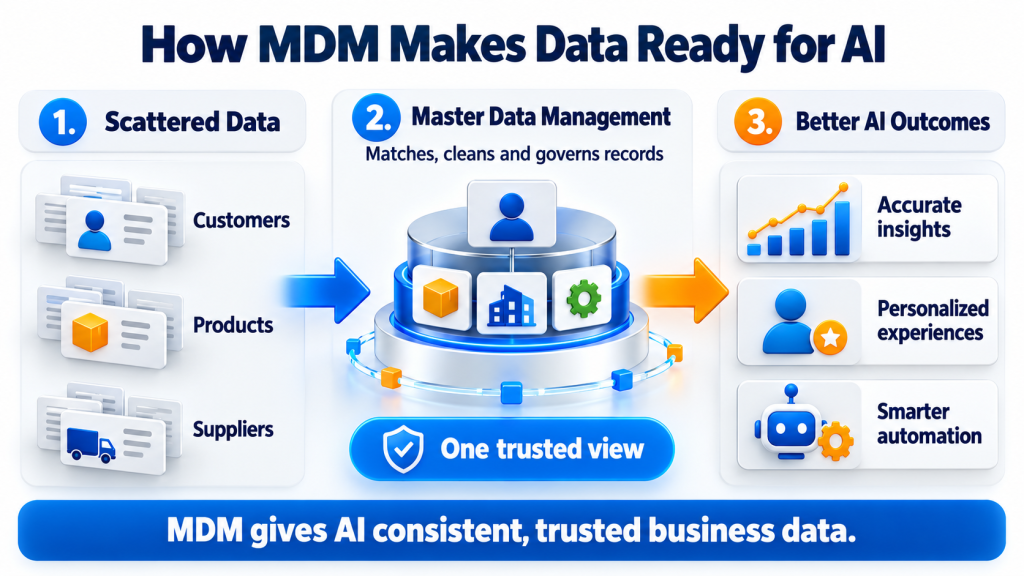
Fragmented entity records become governed master data and then reusable context for analytics models, assistants and automated workflows
How MDM supports predictive AI, generative AI and agents
Different AI patterns consume master data differently, but all benefit from consistent enterprise context.
Predictive AI uses resolved identities and consistent attributes to build features, labels, cohorts, and evaluation sets. If records for one customer or asset are split, the model learns from an incomplete history.
Generative AI uses master data to ground responses in approved names, products, policies, relationships, and status. Retrieval can find documents, while MDM helps determine which entity those documents concern.
AI agents need current, governed identifiers before they call tools or change systems. The higher the permitted autonomy, the more important it is to resolve the entity, confirm permissions, and preserve an audit trail before action.
A 2026 Gartner public research abstract frames MDM as part of the context layer for AI agents and warns that unreliable master data can amplify quality problems. The practical implication is straightforward: an agent should not independently infer which of several conflicting customer or supplier records is authoritative at the moment of action.
Six MDM capabilities that make AI context trustworthy
1. Entity resolution and persistent identity
Matching and merging processes determine when records from different sources represent the same real-world entity. Persistent identifiers let models, retrieval pipelines, feature stores, and operational systems refer to that entity consistently even when source keys change.
2. Quality rules based on the use case
Completeness and accuracy are not abstract goals. A fraud model may need legal entity and ownership relationships; a service assistant may need current contact preferences; a maintenance model may need asset serial numbers and installation dates. Define quality dimensions, thresholds, and service levels around the AI decision.
3. Shared semantics hierarchies and relationships
MDM establishes approved definitions and represents how entities relate. Product families, corporate households, supplier parents, locations, and asset assemblies supply the structure needed for consistent aggregation, retrieval, reasoning, and policy enforcement.
4. Lineage classification and access controls
A trustworthy answer needs more than the latest value. Teams should know where the value came from, how it changed, who approved it, and whether it may be used for the intended purpose. This connects MDM to data and AI governance, privacy controls, cataloging, and model governance.
5. Stewardship and exception management
Rules and machine learning can automate many matches, but ambiguous or high-risk cases still need accountable human decisions. Stewardship workflows should prioritize exceptions by business impact and feed corrections back into rules, models, and source processes.
6. Timely distribution and observability
Trusted master data must reach the applications, data products, feature pipelines, retrieval systems, and agents that need it. APIs, events, and data products can distribute changes, while monitoring checks freshness, failed propagation, unexpected volume shifts, and downstream usage.
A use case first path from MDM to AI value
The most practical starting point is not “master everything.” A public Gartner research abstract on just-enough MDM recommends a light-touch, highly automated approach for analytics and AI. Organizations can apply that principle through six steps.
Start with an AI decision and its risk. Define the user, decision, action, expected value, potential harm, and level of human oversight.
Map the entities and relationships the decision requires. Identify the customer, product, supplier, location, asset, employee, or other domains that must be resolved. Include reference data and hierarchies.
Profile the current sources. Measure duplicates, conflicts, missing identifiers, latency, lineage, access, and ownership. Separate issues that affect the use case from data debt that can wait.
Define the authoritative model and controls. Agree on identifiers, attributes, survivorship rules, quality thresholds, stewardship roles, access policies, and change processes.
Deliver governed master data into the AI workflow. Publish the mastered entities through data products, APIs, events, or pipelines. Test the entire path from source change to model or agent consumption.
Measure and expand deliberately. Monitor master-data health and AI outcomes together. Add domains, sources, and automation only when the use case and control evidence justify expansion.
Measure the data layer and the AI outcome together
An MDM program can improve technical metrics without improving an AI decision. An AI pilot can improve a model metric while relying on brittle identity logic. A shared scorecard prevents either team from declaring success in isolation.
| Measurement layer | Examples |
| Master data health | Duplicate rate, match precision and recall where labeled data exists, completeness of critical attributes, hierarchy integrity, exception backlog, freshness, and propagation success. |
| AI performance | Use-case-specific accuracy, error severity, grounding or retrieval quality, false positives and negatives, task completion, escalation rate, and model or agent latency. |
| Business outcome | Cycle time, rework, leakage, service resolution, conversion, inventory availability, risk exposure, or other approved KPI tied to the decision. |
| Governance and risk | Unauthorized access, policy exceptions, unresolved high-risk matches, audit completeness, incident rate, and time to correct affected outputs. |
This continuous view aligns with the NIST AI Risk Management Framework, which organizes risk management around Govern, Map, Measure, and Manage and treats governance as a cross-cutting function across the AI lifecycle.
What MDM does not replace
MDM is a foundational capability, not a substitute for every part of the modern data and AI stack.
| Capability | Primary role | Relationship to MDM |
| Data catalog and metadata management | Help people and systems discover, understand, classify, and trace data assets. | MDM governs the authoritative entities and values those assets reference. |
| Lake warehouse or lakehouse | Store and process analytical, transactional, and unstructured data at scale. | MDM supplies consistent identities, definitions, and hierarchies across those stores. |
| Vector database and retrieval layer | Index and retrieve semantically relevant content for generative AI. | MDM helps resolve which enterprise entity the retrieved content belongs to and which version is authoritative. |
| Feature store | Manage reusable model features consistently between training and inference. | MDM helps ensure features attach to the right entity and domain definition. |
| AI and model governance | Control model approval, evaluation, deployment, monitoring, and accountability. | MDM governs core business data; the two control systems must interoperate. |
AI can improve MDM but stewardship still matters
AI and machine learning can improve matching, anomaly detection, classification, enrichment, rule suggestions, and steward prioritization. Generative interfaces can also help business users search master data, explain lineage, or draft remediation steps. These capabilities can reduce manual effort and make MDM more responsive.
They should not remove accountability. Matching models can be confidently wrong, generated enrichment can introduce unsupported facts, and automated merges can propagate errors widely. High-impact decisions need thresholds, test sets, human review paths, reversible changes, monitoring, and clear ownership. AI should accelerate governed stewardship, not bypass it.
How Prolifics can help
Prolifics helps organizations connect AI priorities to the data foundation required to run them in production. Our Data and AI services span assessment, data engineering, data quality, master data management, metadata and lineage, analytics, MLOps, governance, and managed services. That scope matters because a mastered record creates value only when it is integrated into the platforms, controls, and workflows that consume it.
A practical first step is to select a high-value AI use case, identify the entity context it depends on, and assess the quality, integration, governance, and operating-model gaps that stand between a pilot and production. Prolifics’ AI Maturity and Readiness services provide an execution-focused way to prioritize that work and build a phased roadmap.
Frequently Asked Questions
Is master data management necessary for every AI project?
Not every AI experiment needs an enterprise MDM platform. MDM becomes increasingly important when an AI system combines multiple sources, reuses core business entities, affects regulated or high-value decisions, or takes action across operational systems. Start with the entity context and risk of the use case, then apply the level of mastering and governance it requires.
Does a data lakehouse replace MDM?
No. A lakehouse can store and process data from many sources, but co-location does not automatically reconcile duplicate entities, resolve conflicting values, assign ownership, manage hierarchies, or publish authoritative records. MDM and the lakehouse serve different purposes and should exchange governed data and metadata.
What is the difference between MDM and data governance?
Data governance establishes decision rights, policies, standards, ownership, and controls across the data estate. MDM applies those principles to critical shared entities and operationalizes matching, validation, stewardship, hierarchy management, and distribution. MDM is therefore a governed data-management discipline within the broader governance model.
Can AI automate master data management?
AI can automate and improve record matching, anomaly detection, classification, enrichment, and exception routing. It should operate within tested thresholds, lineage, approval workflows, and monitoring. Ambiguous or high-impact cases still require accountable human stewardship, and automated changes should be reversible and auditable.