Modern data stack decisions should start with workloads, governance, skills, and unit economics, not a platform label. Use a cloud data warehouse for governed SQL analytics and predictable reporting; use a lakehouse for mixed data, engineering, streaming, and AI; use both only when each has a defined role, shared governance, and a plan to prevent duplicate pipelines and uncontrolled data movement.
A warehouse is usually the fastest path for structured BI, financial reporting, and SQL-centric teams. A lakehouse fits diverse data, data science, streaming, and open-format requirements. Use both when workloads genuinely differ, and the operating model defines ownership, data movement, governance, and cost controls across the two platforms.
What is a modern data stack?
A modern data stack is a modular set of cloud or hybrid services that ingests, stores, transforms, governs, and serves enterprise data for analytics, reporting, automation, and AI. Its value comes from reliable data products and clear operating controls, not from the number of tools or whether one vendor labels the platform a warehouse or lakehouse.
The stack normally spans source integration, batch and streaming pipelines, storage, compute, transformation, metadata, data quality, security, semantic models, observability, and consumption. Those capabilities may sit in one platform or across several connected services. A good design makes ownership and service levels visible from ingestion to dashboard or model, supports system integration without proliferating copies, and gives teams a practical route to retire legacy components.
The original CIDR lakehouse paper described an architecture based on direct access to open data formats with first-class support for machine learning and data science. IBM’s current comparison adds an important qualification for enterprise buyers: warehouses, lakes, and lakehouses can serve different functions in one governed data estate. The modern choice is therefore an operating-model decision as much as a storage decision.
How do a lakehouse and data warehouse differ?
A data warehouse prioritizes modeled, structured data and high-performance SQL analytics. A lakehouse adds warehouse-style transactions, metadata, and governance to low-cost object storage so teams can work with structured, semi-structured, and unstructured data through multiple engines. The difference is narrowing, but the operating experience, workload fit, and skills required can still be materially different.
| Decision factor | Warehouse-first | Lakehouse-first | Both, with boundaries |
| Primary fit | Governed BI, financial reporting, repeatable SQL | Engineering, streaming, data science, AI, varied data | Distinct workloads with shared governance |
| Data model | Schema-on-write and curated relational models | Open files and tables with schema enforcement and evolution | Curated products move only when a consumer requires it |
| Skills | SQL, dimensional modeling, BI administration | SQL plus Spark/Python, open-table and platform engineering | Cross-platform architecture, FinOps, lineage, and ownership |
| Performance | Predictable for relational joins and high concurrency | Strong when formats, layout, caching, and compute are tuned | Fit-for-purpose, but integration overhead must be controlled |
| Cost pattern | Simple consumption model, but compute can grow with concurrency | Low-cost storage, with engineering and compute costs to manage | Potentially higher unless duplication and data movement are limited |
| Main risk | Copies for AI and nonrelational workloads | Complexity or weak SQL serving experience | Two platforms become two versions of truth |
Microsoft’s Fabric decision guide similarly maps a warehouse to enterprise data warehousing, SQL BI, OLAP, and full SQL transaction needs, while mapping a lakehouse to big data, machine learning, varied formats, and data engineering. Treat product claims as inputs, then validate them against your own workload tests and governance requirements.
When should a modern data stack use a warehouse?
Use a warehouse when the dominant need is trusted, repeatable analysis over structured data and the organization already operates effectively in SQL. Finance, risk, sales, and regulatory teams often need stable dimensions, reconciled measures, predictable access controls, and high-concurrency dashboards more than they need direct access to raw files or several compute engines.
A warehouse-first path can also accelerate IT modernization when legacy reporting is the immediate constraint. It gives analysts familiar tools, supports controlled semantic models, and reduces the change burden on business users. That faster adoption can improve efficiency sooner than a technically broader platform that demands new engineering skills before it delivers a usable report.
Choose warehouse-first when most source data is structured; service levels center on SQL and BI; multi-table transactions or relational integrity matter; and the team can forecast query, concurrency, and retention costs. Keep an escape route for data science and unstructured content through open integration patterns. A warehouse should not become the landing zone for every workload merely because procurement has already approved it.
When should a modern data stack use a lakehouse?
Use a lakehouse when the same governed data must support engineering, streaming, exploratory analytics, machine learning, and AI across varied formats. Open table formats and decoupled storage and compute can reduce unnecessary copies and let different processing engines work on a shared foundation. That flexibility is especially useful for telemetry, documents, images, clickstreams, and other data that does not fit a conventional relational model early in its lifecycle.
IBM defines a data lakehouse as a platform that combines flexible, low-cost lake storage with warehouse-style data management and analytics. The metadata layer is the dividing line: schema enforcement, transaction consistency, lineage, versioning, and access controls turn object storage into a governed analytical platform rather than a file collection.
Choose lakehouse-first when data engineering and AI are strategic workloads, data types and arrival patterns vary, open access matters, and the organization can operate the required catalog, quality, security, and performance controls. Do not assume object storage makes the total solution cheap. Query engines, idle compute, small-file problems, data egress, duplicated transformations, and scarce platform skills can erase storage savings.
When should a modern data stack use both?
Use both when the workloads are genuinely different and each platform has a named responsibility. A common pattern lands and refines diverse data in a lakehouse, then serves certified, performance-sensitive models through a warehouse. Another pattern preserves a valuable warehouse for core reporting while a lakehouse becomes the foundation for streaming, data science, and AI. Both can work, but “both” is not a license for indefinite duplication.
Define the system of record for every data product, the consumers that justify movement, freshness requirements, transformation ownership, and where quality rules are enforced. Share the catalog, lineage, identity, and policy model across platforms. Set measurable decommissioning criteria for duplicate pipelines and legacy marts. Without those boundaries, cloud migration can reproduce the same integration and governance debt in two newer tools.
Forrester’s 2026 lakehouse perspective emphasizes AI readiness, trust, openness, and operational intelligence as enterprise evaluation criteria. That reinforces the practical decision: choose an architecture that supplies governed context to BI and AI, rather than selecting a lakehouse or warehouse from a feature checklist alone.
Why does modern data stack architecture affect business value?
Architecture affects cost, delivery speed, data trust, and the amount of work required to produce each decision. A simpler fit between workloads and platform capabilities can reduce redundant storage, repeated transformations, manual reconciliations, and specialist handoffs. Separating storage and compute may improve unit economics, while a focused warehouse can lower adoption costs for SQL-centric teams. Neither benefit is automatic; it depends on measurement and operational discipline.
Cost control belongs in the design. Flexera’s 2025 State of the Cloud findings reported that 84% of more than 750 surveyed cloud professionals viewed managing cloud spend as their top cloud challenge, and 87% used cost efficiency or savings as the leading measure of cloud progress. Platform teams should therefore track cost per pipeline, query, data product, and business outcome, not only the monthly invoice.
The business case should connect architecture to measurable service levels: report latency, data-quality incidents, time to onboard a source, analyst self-service, model deployment lead time, audit evidence, and cost per workload. This is where enterprise automation, observability, and clear product ownership matter. A modern platform creates value when trusted data reaches a decision or automated process faster and with less operating friction.
How should you build a modern data stack step by step?
Build the stack as a portfolio of governed data products, beginning with measurable use cases and an explicit exit plan for legacy components. The following sequence keeps technology selection tied to value and reduces the risk of an expensive platform that never becomes the default way of working.
1. Prioritize business decisions: Select two or three outcomes, name their users, and establish current baselines for latency, cost, quality, and manual effort.
2. Inventory workloads and constraints: Classify data types, volumes, freshness, concurrency, transaction needs, residency, retention, security, and existing contracts.
3. Choose the minimum viable architecture: Map each workload to warehouse, lakehouse, or both. Reject components that do not serve a named requirement.
4. Design governance with the platform: Define ownership, catalog, lineage, quality controls, identity, encryption, and policy enforcement before migrating sensitive data.
5. Prove performance and unit economics: Benchmark representative pipelines and queries, including peak concurrency, recovery, egress, operations, and support effort.
6. Migrate in value slices: Move one end-to-end data product at a time, automate testing and reconciliation, and train producers and consumers together.
7. Measure adoption and retire duplication: Track business use, service levels, and cost per outcome; then decommission redundant marts, pipelines, licenses, and infrastructure when acceptance criteria are met.
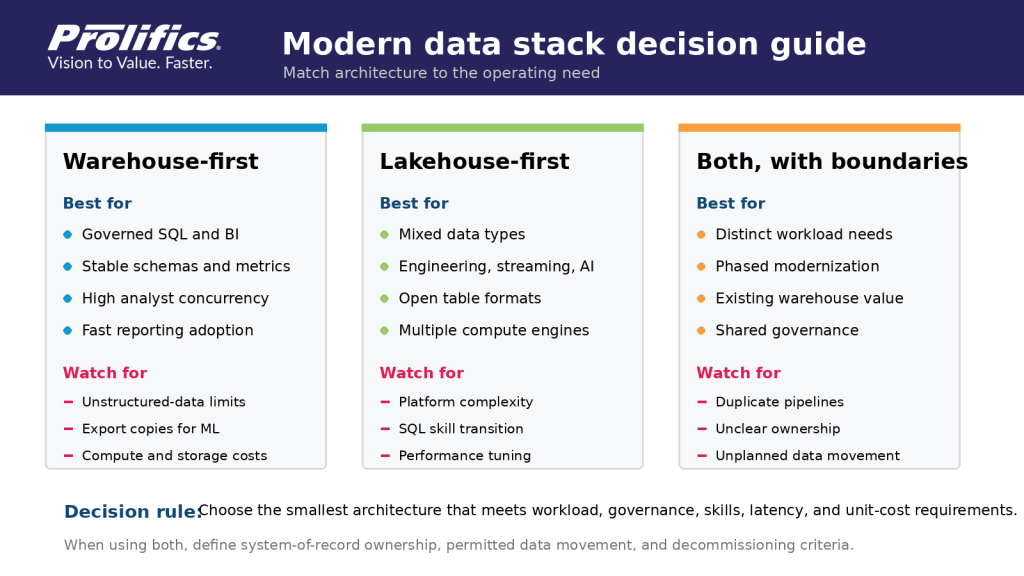
Figure 1. A workload-led decision guide for warehouse-first, lakehouse-first, or both.
What do Prolifics client examples show?
Prolifics client work shows that modernization value comes from deleting unnecessary complexity, governing critical data, and improving access, not from adopting an architecture label.
Health insurance cost and scope control. A health insurance payer serving more than 3.5 million members needed to replace costly analytics technology and consolidate its enterprise data warehouse. Prolifics reduced the estimated migration cost from $2 million to $700,000 and identified 20–40% of existing data processes that did not need to move. The resulting platform supported on-demand data for plan pricing, member segmentation, claims analysis, and regulatory reporting.
Insurance governance and productivity. Another insurer reported that employees spent 70% of their time looking for the right data. Prolifics established a centralized master-data and governance platform, automated policy handling, and trained more than 140 employees. The case connects architecture to faster issue resolution, fewer manual errors, better customer insight, and improved decision-making.
Automotive data and AI foundation. For a leading automotive manufacturer, Prolifics implemented Azure Data Lake, Azure Data Factory, Databricks, automated pipelines, a metadata-driven framework, data-quality controls, and Unity Catalog. The published outcomes include faster reporting, reduced integration complexity, improved governance, and a scalable foundation for analytics and AI.
How can Prolifics help modernize your data stack?
Prolifics Data & AI services connect strategy, architecture, data engineering, management, analytics, MLOps, governance, and managed services. Prolifics designs lake, lakehouse, and warehouse architectures across AWS, Azure, Google Cloud, and hybrid environments, with business KPIs, security, compliance, and operating ownership defined from the start.
That end-to-end view matters when architecture crosses cloud migration, system integration, data quality, semantic models, and enterprise automation. Prolifics can assess the existing estate, prioritize high-value use cases, benchmark platform options, build governed pipelines, enable self-service analytics, and operate the environment after launch. The goal is not to maximize platform footprint. It is to reduce delivery friction, control unit cost, improve trust, and create reusable data products that support reporting and AI.
Engagements can begin with a focused assessment and roadmap, then progress through co-delivery, build-operate-transfer, or managed services as the operating model matures.
For deeper context, explore Prolifics’ Databricks lakehouse guidance and enterprise data transformation framework. Both show how platform architecture, governance, adoption, and business outcomes fit into one modernization roadmap.
Frequently Asked Questions
Should my enterprise replace its data warehouse with a lakehouse?
Keep a warehouse when it reliably serves governed SQL, financial reporting, or high-concurrency BI. Add or migrate to a lakehouse when varied data, engineering, streaming, or AI requirements justify it. Replace the warehouse only after representative workloads meet performance, governance, cost, and adoption criteria and duplicate systems can be retired.
Is a lakehouse cheaper than a cloud data warehouse?
A lakehouse can lower storage costs and reduce data copies, but total cost also includes compute, engineering, catalog operations, performance tuning, egress, observability, and support. Compare cost per workload or data product under volumes and concurrency. The cheaper architecture is the one that meets service levels with the lowest unit cost.
Can a lakehouse support regulatory reporting and business intelligence?
Yes, when the lakehouse provides transactional tables, schema enforcement, quality controls, access, lineage, audit evidence, performant SQL, and governed semantic models. Regulated reporting requires reconciliation, control ownership, retention, and tested service levels. Platform capability does not replace the operating controls required by finance, insurance, or healthcare teams.
When should an enterprise use both a lakehouse and a warehouse?
Use both when separate workloads create value: for example, a lakehouse for varied data, engineering, streaming, and AI, plus a warehouse for certified relational models and high-concurrency BI. Define one system of record per data product, shared governance, permitted movement, service levels, cost allocation, and criteria for retiring duplicate pipelines.
How should we migrate to a modern data stack without disrupting reporting?
Migrate one business data product at a time. Baseline current reports, automate source-to-target reconciliation, run old and new outputs in parallel for a validation period, and obtain business-owner acceptance before cutover. Preserve lineage and rollback paths, train users, then retire legacy pipelines only after adoption and service-level criteria are met.