AI in sales helps organizations increase pipeline without increasing headcount by automating repetitive tasks, improving lead quality, prioritizing opportunities, accelerating sales cycles, and enabling sales teams to spend more time engaging buyers. Rather than replacing sales professionals, AI augments decision-making with predictive insights, workflow automation, and real-time recommendations that improve conversion rates and revenue productivity.
Quick answer:
AI in sales enables organizations to generate more qualified opportunities without expanding sales teams. By combining predictive analytics, generative AI, automation, CRM intelligence, and workflow orchestration, businesses can improve prospecting, qualification, forecasting, proposal creation, and customer engagement while reducing manual effort. The result is higher pipeline velocity, better seller productivity, and improved revenue efficiency.
What Is AI in Sales?
AI in sales is the use of artificial intelligence, machine learning, predictive analytics, generative AI, and intelligent automation to improve how organizations identify, engage, convert, and retain customers. Rather than simply automating administrative work, modern AI analyzes customer behavior, historical transactions, CRM data, buying signals, and external market information to recommend the next best action throughout the sales lifecycle.
Enterprise AI platforms now support:
- Intelligent lead scoring
- Sales forecasting
- Opportunity prioritization
- AI-assisted proposal generation
- Meeting summaries
- Customer sentiment analysis
- Pricing recommendations
- Sales coaching
- Pipeline risk detection
- Revenue forecasting
For enterprise organizations, AI becomes even more valuable when integrated with CRM platforms, ERP systems, marketing automation, customer service applications, data platforms, and enterprise workflows. This connected approach allows sellers to work with complete customer context instead of fragmented information.
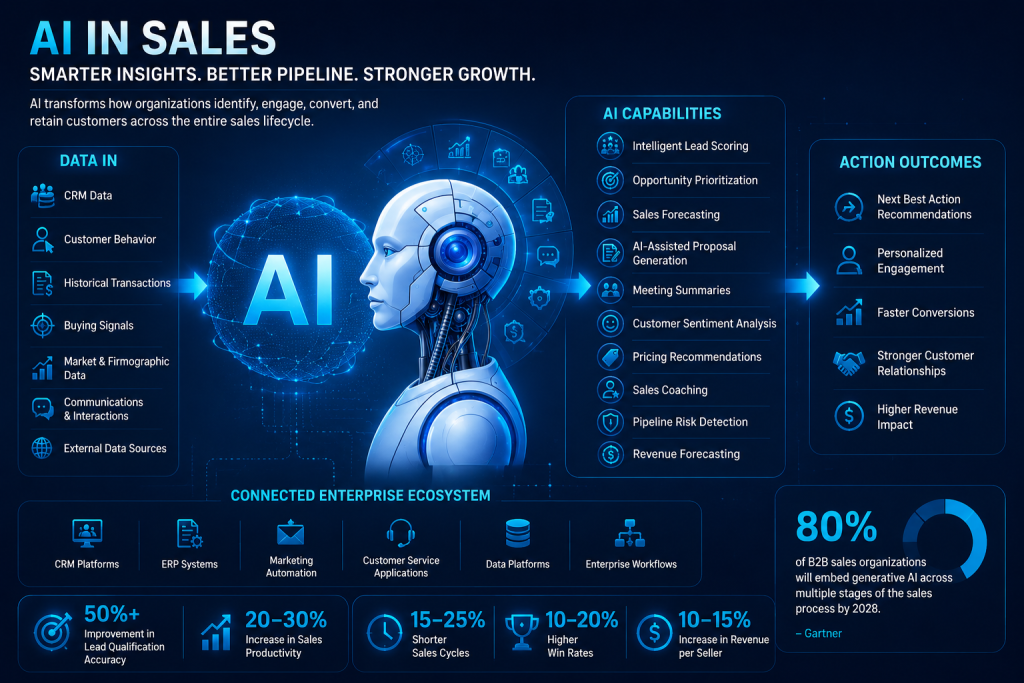
According to Gartner, by 2028, business-to-business sales organizations are expected to increasingly embed generative AI across multiple stages of the sales process, fundamentally changing seller productivity and buyer engagement.
Why Are Enterprises Using AI to Increase Pipeline Instead of Hiring More Salespeople?
Organizations are adopting AI because revenue growth increasingly depends on improving seller productivity rather than expanding teams. Hiring additional sales representatives increases costs, onboarding time, and management complexity. AI enables existing teams to achieve higher output using the same resources.
Research from McKinsey estimates that generative AI could unlock hundreds of billions of dollars in annual value across sales and marketing by improving customer interactions, content creation, and commercial operations.
Several factors are driving enterprise adoption:
- Rising customer acquisition costs
- Longer B2B buying cycles
- More stakeholders involved in purchasing decisions
- Larger volumes of customer data
- Increasing pressure to improve forecast accuracy
- Growing demand for personalized customer experiences
AI addresses these challenges by automating repetitive work while improving decision quality.
Examples include:
- Prioritizing accounts most likely to convert
- Identifying buying intent signals
- Automatically generating personalized outreach
- Summarizing customer meetings
- Drafting proposals
- Recommending cross-sell opportunities
- Predicting stalled deals before they impact revenue
Instead of replacing experienced sales professionals, AI removes low-value administrative work, allowing sellers to spend more time building relationships and closing business.
How Does AI Increase Sales Pipeline Without Increasing Headcount?
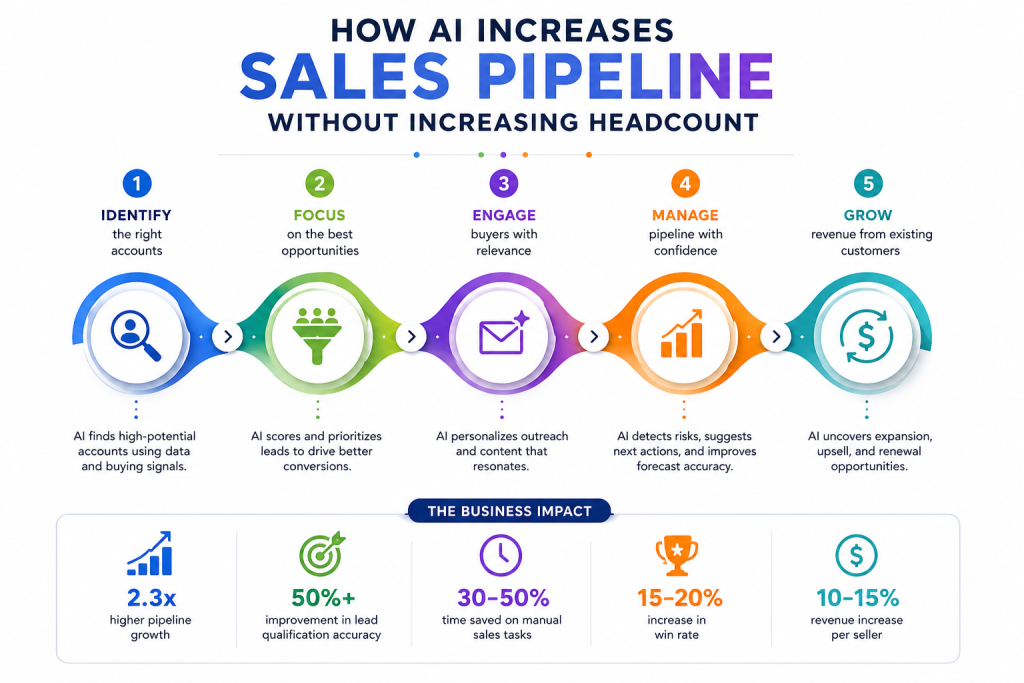
AI increases pipeline by improving efficiency across every stage of the revenue lifecycle.
Instead of relying on additional personnel, organizations improve how existing sellers spend their time.
Prospect Identification
AI continuously analyzes market signals, firmographic data, customer behavior, website activity, and historical conversions to identify high-potential prospects.
Instead of manually searching for leads, sellers receive prioritized account recommendations.
Lead Qualification
Machine learning models score incoming leads using historical win patterns, engagement data, buying intent, company attributes, and sales interactions.
This allows sales teams to focus on opportunities with the highest probability of success.
Personalized Engagement
Generative AI creates personalized emails, meeting preparation notes, account research, presentations, and proposal drafts tailored to each buyer.
This significantly reduces preparation time while improving relevance.
Opportunity Management
AI monitors pipeline health and identifies:
- Deals losing momentum
- Missing stakeholders
- Competitive risks
- Next-best actions
- Forecast changes
Sales managers gain greater visibility into pipeline quality without manually reviewing every opportunity.
Revenue Expansion
AI identifies:
- Cross-sell opportunities
- Upsell recommendations
- Renewal risks
- Customer expansion potential
Instead of only generating new opportunities, AI helps maximize existing customer value.
Which Sales Activities Deliver the Highest ROI with AI?
Not every sales activity delivers the same return on AI investment. Organizations typically see the greatest impact when repetitive work and large volumes of data slow decision-making.
| Traditional Sales Process | AI-Enabled Sales Process | Business Impact |
| Manual lead qualification | Predictive lead scoring | Higher conversion rates |
| Generic outreach | Personalized AI-generated messaging | Better engagement |
| Spreadsheet forecasting | Predictive forecasting | Improved forecast accuracy |
| Manual meeting notes | AI meeting summaries | More selling time |
| Static proposals | AI-assisted proposal generation | Faster sales cycles |
| Reactive pipeline reviews | Pipeline risk prediction | Higher win rates |
| Manual account research | AI account intelligence | Better sales preparation |
Organizations often begin with sales assistants before expanding into predictive forecasting, conversational AI, pricing optimization, and autonomous workflow orchestration.
How Can Enterprises Implement AI in Sales Successfully?
Successful AI adoption requires more than deploying a chatbot or adding generative AI to CRM software. Organisations need a structured approach to transformation that aligns people, data, technology, and governance.
1. Assess sales process maturity
Identify repetitive activities, workflow bottlenecks, data quality issues, and manual reporting tasks.
2. Build a trusted data foundation
Improve CRM data quality, customer records, product information, pricing data, and interaction history.
3. Prioritize high-value AI use cases
Focus on measurable outcomes such as:
- Lead qualification
- Proposal generation
- Sales forecasting
- Customer insights
- Pipeline management
4. Integrate enterprise systems
Connect AI with CRM, ERP, marketing automation, customer support, analytics, and collaboration platforms.
5. Establish governance
Define security, access controls, human oversight, compliance requirements, and model monitoring.
6. Measure business outcomes
Track metrics including:
- Pipeline growth
- Win rate
- Sales cycle duration
- Revenue per seller
- Forecast accuracy
- Customer acquisition cost
Organizations that treat AI as a business transformation initiative rather than a technology project achieve stronger long-term results.
How Is AI Transforming Sales Across Enterprise Industries?
Enterprise AI adoption varies by industry, but the objective remains consistent: improve revenue productivity while delivering better customer experiences.
Healthcare
Healthcare organizations use AI to identify provider engagement opportunities, personalize communications, improve account planning, and support complex sales involving multiple stakeholders.
Financial Services
Banks and insurance providers apply AI for relationship management, customer segmentation, wealth advisory recommendations, opportunity scoring, and regulatory-compliant communications.
Retail
Retail organizations use AI to improve merchandising recommendations, account management, demand forecasting, supplier engagement, and omnichannel customer experiences.
Insurance
Insurance providers leverage AI for broker relationship management, policy recommendations, customer retention, claims insights, and personalized renewal strategies.
Public Sector
Government agencies increasingly use AI-assisted knowledge management, citizen engagement, intelligent document processing, and workflow automation to improve service delivery while managing constrained resources.
What Does a Real-World Enterprise AI Sales Use Case Look Like?
A global healthcare organization managing multiple product portfolios struggled with fragmented customer information spread across CRM systems, marketing platforms, and regional databases. Sales representatives spent significant time researching accounts, preparing proposals, and manually updating customer records.
By implementing an AI-enabled customer intelligence platform integrated with CRM, marketing automation, and analytics systems, the organization created a unified view of each customer. AI prioritized high-value opportunities, generated account summaries, recommended next-best actions, and automated proposal creation.
The results included:
- Faster account research
- Improved opportunity prioritization
- Higher seller productivity
- More consistent customer engagement
- Better forecast visibility
This type of transformation reflects how enterprise organizations combine AI, integration, automation, and trusted data to improve commercial performance rather than simply adding standalone AI tools.
Which Technologies Power Modern AI Sales Platforms?
Modern enterprise sales AI combines several technologies rather than relying on a single model.
Common capabilities include:
- Generative AI
- Predictive analytics
- Machine learning
- Natural language processing
- Customer data platforms
- Intelligent automation
- Agentic AI
- Enterprise search
- Knowledge graphs
- CRM intelligence
- Data integration
- API-based system connectivity
- Cloud-native analytics
These technologies become significantly more valuable when connected across enterprise applications instead of operating independently.
Conclusion
AI in sales enables enterprises to grow their pipeline by improving how existing teams work rather than simply expanding headcount. Organizations that combine trusted data, intelligent automation, predictive analytics, and integrated enterprise systems create more productive sales operations, better customer experiences, and stronger revenue performance. The greatest value comes from treating AI as part of a broader digital transformation strategy, not as a standalone tool. At Prolifics, we help enterprises design and implement AI-powered sales solutions that integrate with existing business systems to deliver measurable commercial outcomes.
Frequently Asked Questions
How can AI increase the sales pipeline without hiring additional sales representatives?
AI increases pipeline by automating repetitive sales tasks, improving lead qualification, identifying buying signals, generating personalized outreach, and recommending next-best actions. This allows sales teams to spend more time engaging prospects and closing deals rather than handling administrative work.
What is the best enterprise AI use case for B2B sales organizations?
Lead scoring, opportunity prioritization, sales forecasting, proposal generation, account intelligence, and pipeline risk detection deliver the highest business value by improving seller productivity and increasing conversion rates.
Does AI replace enterprise sales teams?
No. AI augments sales professionals by handling repetitive tasks and providing actionable insights, allowing sellers to focus on relationship building, negotiations, and closing complex deals.
What data is required to implement AI in sales?
Organizations need high-quality CRM data, customer interaction history, marketing engagement data, product and pricing information, transaction records, and integrated enterprise systems to ensure accurate AI recommendations.
How should enterprises measure AI sales success?
Track metrics such as pipeline growth, conversion rates, forecast accuracy, sales cycle length, revenue per seller, customer acquisition cost, and overall seller productivity to measure AI’s business impact.