Enterprise AI has moved beyond experimentation. Most organizations now see AI as a way to improve productivity, customer experience, decision-making, and operational efficiency. However, many AI initiatives still fail to move from pilot to production because the architecture is not ready to support scale. The real challenge is no longer just choosing the right model or tool. It is building a secure, governed, integrated, and cost-efficient foundation that allows AI to work reliably across departments, systems, and workflows.
At Prolifics, we help enterprises turn AI from isolated experiments into scalable business capabilities. Our approach focuses on the architecture behind AI, including data readiness, system integration, governance, security, quality validation, observability, and cloud performance. By connecting AI strategy with the right enterprise architecture, Prolifics enables organizations to build trusted AI systems that deliver measurable business value and support long-term transformation.
What Is Enterprise AI Architecture?
Enterprise AI architecture is the layered technical and operational foundation that enables organizations to deploy, govern, scale, and sustain AI systems across enterprise workflows. It connects seven critical layers data readiness, system integration, AI and model selection, security and identity, governance and compliance, observability and quality, and cost and performance and determines whether AI scales beyond pilots into production-grade enterprise capability.
The CTO’s Core Challenge: Building the Right AI Foundation
The CTO now plays a central role in enterprise AI success. Business teams may identify use cases, and data science teams may build models, but the CTO must ensure that AI fits into the broader enterprise technology landscape. This responsibility includes platform decisions, architecture readiness, integration design, security standards, governance models, and operational resilience.
For CTOs, the real challenge involves building an enterprise AI architecture framework for CIOs, business leaders, and technology teams. This framework must help the organization decide which use cases deserve investment, which platforms should support AI delivery, and which governance controls should guide production deployment.
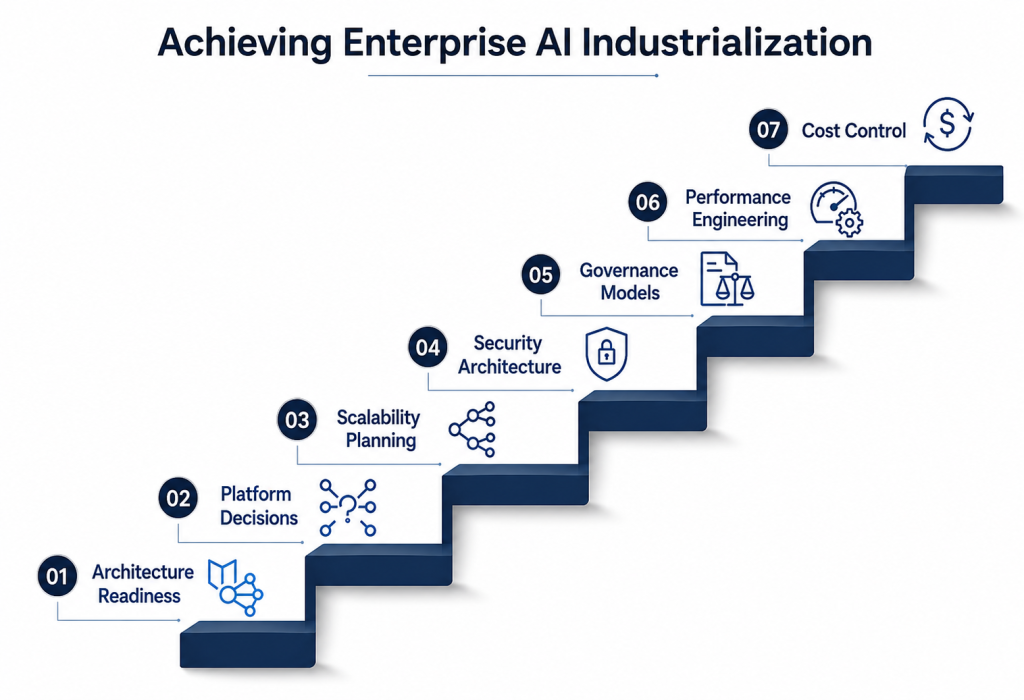
CTOs should evaluate AI readiness across several connected areas.
- Architecture readiness determines whether AI moves beyond isolated departmental experiments.
- Platform decisions shape flexibility, vendor risk, and long-term scalability choices.
- Scalability planning prevents performance issues during wider enterprise adoption phases.
- Security architecture protects data across users, prompts, and tools consistently.
- Governance models define ownership, approvals, policies, and audit responsibilities clearly.
- Performance engineering keeps AI responsive under real production workloads daily.
- Cost control aligns model usage with measurable business value outcomes.
This approach helps CTOs move from experimentation to industrialization. It also creates a practical path for how to build a scalable AI architecture for enterprise environments.
The Enterprise AI Architecture Stack
A scalable AI architecture works as a connected stack. Each layer supports the next. If one layer remains weak, the entire system becomes harder to govern, secure, monitor, and scale. This is why enterprise AI architecture best practices 2026 must focus on the full operating model, not only model selection.
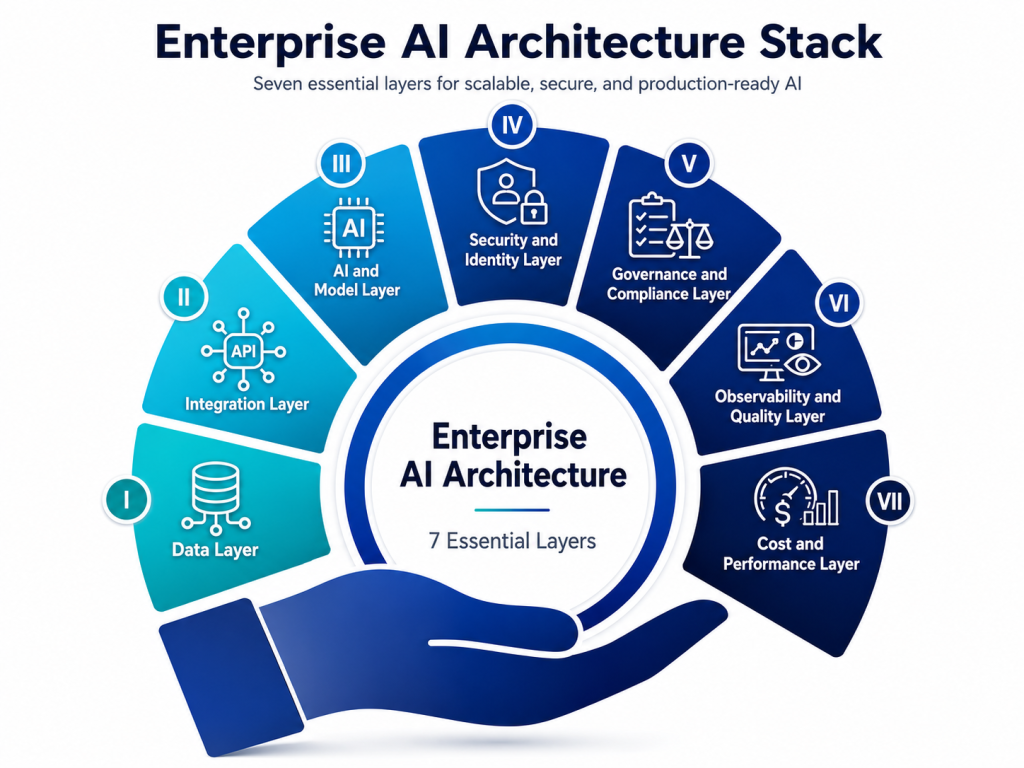
I. Data Layer
The data layer forms the foundation of enterprise AI. Models need high-quality, available, governed, and well-contextualized data to produce useful outputs. If data lives in silos, lacks ownership, or carries inconsistent definitions, AI systems will struggle to deliver reliable results.
A strong data layer includes data quality controls, metadata management, lineage, master data practices, and governance policies. It also includes access rules that define which users, systems, and models can use specific datasets. When organizations strengthen the data foundation first, AI systems gain better context and produce more dependable outcomes.
II. Integration Layer
Enterprise AI must connect with real business systems. This includes ERP, CRM, legacy platforms, cloud applications, data warehouses, workflow tools, and customer-facing systems. Without integration, AI can answer questions but cannot support meaningful business execution.
The integration layer uses APIs, event-driven architecture, middleware, connectors, and automation platforms to connect AI with enterprise workflows. This layer matters because business value often comes from action, not only insight. AI must retrieve information, update records, trigger approvals, recommend next steps, and support employees inside their existing processes.
III. AI and Model Layer
The AI and model layer includes large language models, generative AI tools, retrieval-augmented generation, custom machine learning models, AI agents, orchestration frameworks, and prompt management. This layer needs flexibility because enterprise needs will continue to evolve.
Some use cases may need a public LLM. Others may require a private model, a domain-specific model, or a retrieval-based system grounded in approved enterprise knowledge. The architecture must allow teams to choose the right model for the right use case while maintaining consistent controls around quality, security, and cost.
IV. Security and Identity Layer
Security cannot come after AI deployment. AI systems interact with sensitive data, user prompts, enterprise applications, and sometimes external tools. Organizations need strong identity and access management from the beginning.
This layer includes role-based access control, permission boundaries, authentication, encryption, data masking, and secure prompt handling. It also requires clear policies for tool access. If an AI agent can retrieve data, open tickets, update records, or trigger workflows, the organization must define exactly what it can and cannot do.
V. Governance and Compliance Layer
AI governance gives leaders control over how AI systems behave, who owns decisions, and how risks get managed. Governance also supports responsible AI, compliance readiness, and auditability.
This layer includes policy enforcement, approval workflows, model documentation, risk classification, human review, and exception handling. It also helps organizations prove that AI systems follow business rules, regulatory requirements, and ethical standards. For regulated industries, governance becomes essential before AI can support production workflows.
VI. Observability and Quality Layer
AI systems behave differently from traditional software. They can produce inconsistent outputs, hallucinate, miss context, or respond differently when prompts change. This makes observability and quality engineering critical.
This layer includes monitoring, testing, output validation, hallucination checks, bias checks, performance tracking, drift detection, and user feedback loops. It helps teams understand how AI behaves in production and whether outputs remain accurate, relevant, and safe. Continuous validation builds trust and reduces operational risk.
VII. Cost and Performance Layer
AI can create new cost pressures through cloud infrastructure, model usage, token consumption, storage, integration traffic, and monitoring tools. Without cost visibility, AI programs can become expensive before they become valuable.
The cost and performance layer includes FinOps, usage tracking, latency management, infrastructure optimization, capacity planning, and model selection controls. This layer helps leaders connect AI spending with business outcomes. It also helps technical teams improve speed, reliability, and scalability across production workloads.
Why Agentic AI Raises the Stakes
Agentic AI changes the enterprise risk profile. Traditional generative AI often responds to a question or creates content. Agentic AI can take action. It can use tools, interact with systems, trigger workflows, complete tasks, and make decisions within defined boundaries.
This shift raises the importance of architecture. If an AI agent connects with enterprise systems, it needs strict access control, clear instructions, business policy awareness, and real-time monitoring. Otherwise, a small error can move from a wrong answer to a wrong action.
Organizations need these controls before deploying agentic AI.
- Guardrails keep agents within approved actions and business policies safely.
- Human review protects high-risk decisions before automation executes them fully.
- Tool controls limit access across systems, data, and workflows securely.
- Audit logs show what agents did, when, and why clearly.
- Failure handling stops flawed actions before they create operational disruption.
- Continuous monitoring detects drift, misuse, and unexpected behavior patterns early.
This is especially important for organizations exploring how to design AI systems that scale across departments. As AI moves into finance, sales, service, operations, HR, and supply chain, the number of connected workflows increases. Architecture must manage that complexity without slowing innovation.
What CTOs Should Prioritize Before Scaling AI
CTOs do not need to solve every AI challenge at once. They need a structured roadmap that strengthens the foundation while moving high-value use cases into production. The goal should focus on scalable patterns, not isolated wins.
These priorities help CTOs prepare enterprise AI for scale.
- Modernize data foundations before expanding AI into critical enterprise operations.
- Connect core systems through APIs and integration platforms for AI workflows.
- Build governance early so teams scale with consistent controls confidently.
- Secure AI access with clear identity and permission models enterprise-wide.
- Validate AI outputs continuously across quality and risk dimensions measurable.
- Control infrastructure and model costs through FinOps discipline and visibility.
- Design reusable patterns that support cross-department AI adoption at enterprise scale.
- Move high-value use cases into production with measurable outcomes quickly.
These priorities create a practical roadmap for moving beyond experimentation. They also help leaders avoid scattered AI adoption, where each department builds its own tools, rules, and data flows. A reusable architecture helps the business scale faster while maintaining control.
The Business Impact of Getting AI Architecture Right
Strong AI architecture creates business value because it turns AI from a set of tools into an enterprise capability. When architecture connects data, systems, security, governance, and workflows, AI becomes easier to trust and easier to use.
Organizations can expect several business outcomes from stronger AI architecture.
- Faster decisions emerge when teams trust accessible enterprise data consistently.
- Better customer experiences improve engagement, service, and personalization across channels.
- Improved productivity frees employees from repetitive manual work every day.
- Smarter automation connects insights with real business execution at scale.
- Lower operational risk comes from governance and continuous validation practices.
- Reliable AI outcomes build confidence across leadership and users alike.
- Faster production movement turns pilots into repeatable enterprise capabilities successfully.
The value also compounds over time. Once the architecture supports one production use case, teams can reuse patterns for other use cases. A customer service AI assistant can share architecture patterns with sales enablement, knowledge management, compliance review, or IT support. This reuse lowers delivery effort and improves consistency.
Strong architecture also helps leaders make better investment decisions. Instead of funding disconnected experiments, they can prioritize use cases that align with business value, technical readiness, and operational feasibility. This improves the return on AI investment and reduces wasted effort.
Conclusion: Enterprise AI Success Depends on Architecture
Enterprise AI success does not come from models alone. Models matter, but they cannot create sustained value without the right architecture around them. Organizations need clean data, connected systems, secure access, strong governance, continuous validation, and cost-aware infrastructure.
This is why enterprise AI has become an architecture problem. The next stage of AI adoption will reward companies that build scalable foundations, not companies that only run more pilots. CTOs and technology leaders must now create the operating model that turns AI from experimentation into enterprise capability.
A secure, scalable, governed, and connected architecture gives AI the structure it needs to support real business outcomes. It helps organizations move faster, reduce risk, improve trust, and scale innovation across departments. In the long run, the enterprises that solve the architecture problem will capture the greatest value from AI.